
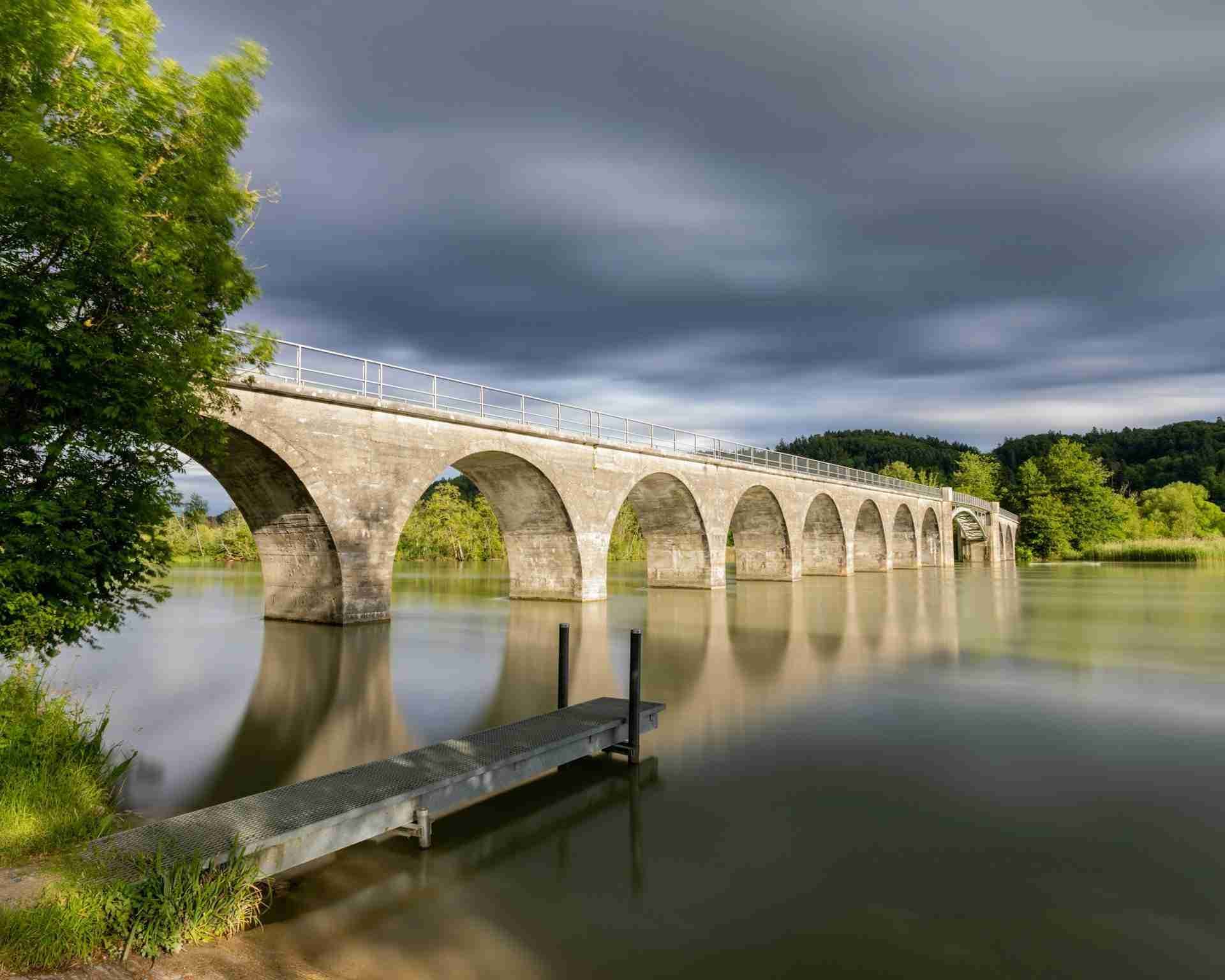
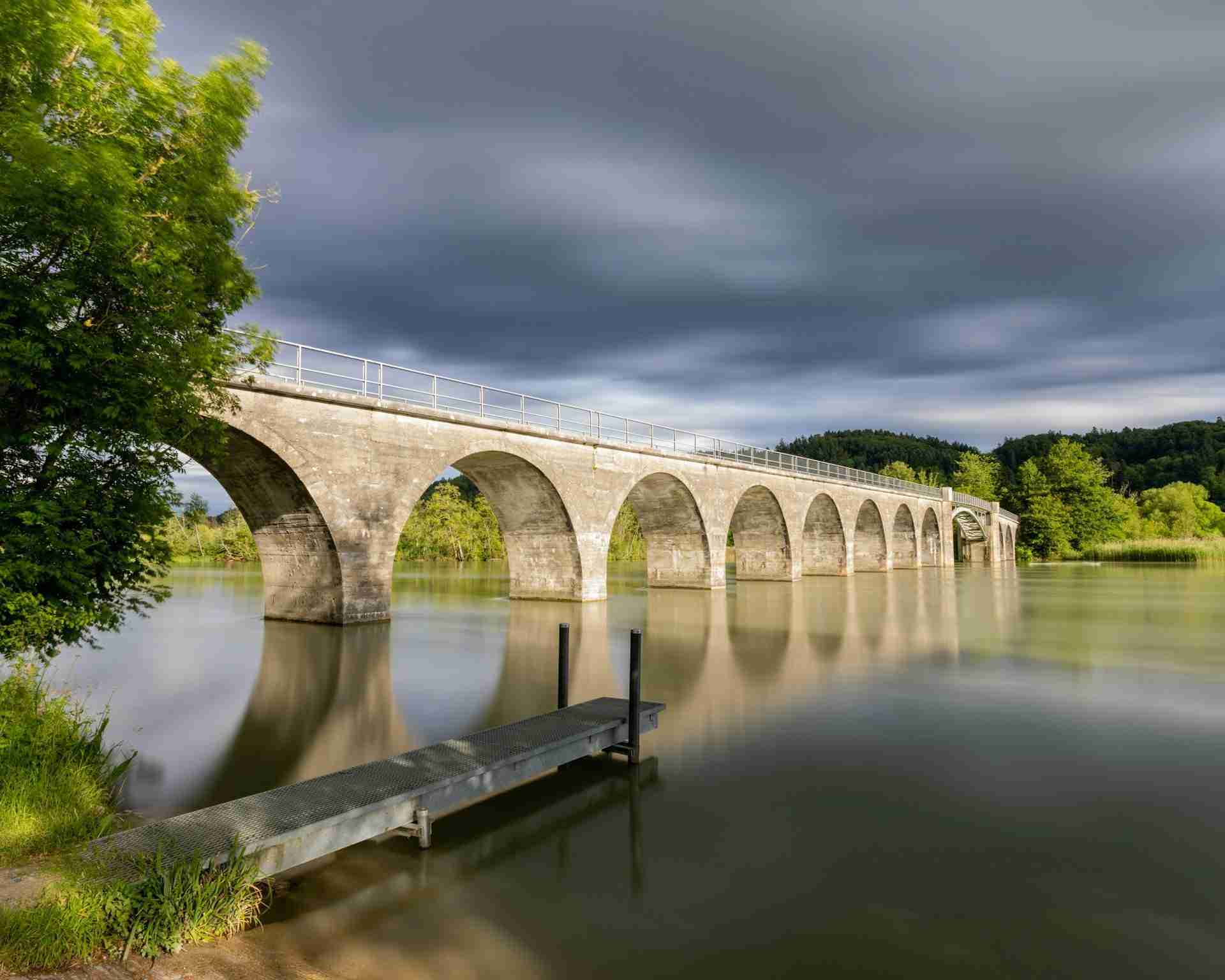
Spanning the Aare River just north of Bern, the Wohleibrücke is a graceful combination of 20th-century engineering and natural beauty. This arched concrete bridge, completed in 1920, stretches across the tranquil Aarebend near the village of Wohlen bei Bern, offering minimalist geometry, textured symmetry, and a reflective waterway that responds beautifully to light and weather. Surrounded by gently sloping farmland and wooded riverbanks, it's a lesser-known location that rewards architectural, landscape, and drone photographers alike. The interplay between form and reflection—especially in soft light—makes Wohleibrücke a quiet but compelling subject for photographers drawn to structural elegance and environmental balance.
Best Photography Opportunities
• Symmetrical Bridge Reflections at Dawn
: Early morning, especially in spring and autumn, often brings calm water and low mist that allows for perfect mirror-like reflections beneath the arches of Wohleibrücke. From the southern riverbank, looking north, you can frame the full curve of the bridge mirrored on the surface. A 24–70mm lens gives you enough flexibility to shoot both tight symmetrical studies and wider contextual frames. A tripod is essential to capture the clarity of the reflection during low-light conditions, and pre-dawn blue hour can yield especially soft gradients in the sky and water.
• Drone Perspectives Over the Aarebend
: The sweeping curve of the river near the bridge is one of the most visually distinctive features of the region, and a drone opens up the perfect angle to highlight this. From above, you can capture the geometry of the bridge as it arcs across the teal-blue river, framed by green fields and wooded banks. Shooting in the golden hour brings out warm highlights on the bridge surface and long shadows across the landscape. Be sure to check local flight restrictions and maintain altitude guidelines, as this area is near Bern's airspace.
• Long Exposure Under the Arches
: Beneath the bridge, the rhythmic repetition of the arches creates a strong visual cadence for minimalist compositions. On overcast days, the diffused light eliminates harsh contrast and emphasizes the structural lines. With an ND filter and a long exposure, the water becomes smooth and glassy, drawing the eye deeper through each arch. Use a wide-angle lens to exaggerate perspective and step back to allow space for a vanishing point effect through the structure.
• Seasonal Framing from the River Path
: A well-kept riverside path runs along both sides of the Aare, with tall grasses, wildflowers, and overhanging trees providing seasonal framing opportunities. In summer, bright greens and flowers can create colorful foreground layers. In autumn, golden foliage along the banks brings warmth and contrast to the neutral concrete tones of the bridge. Use a 35mm or 50mm lens to keep the structure prominent while integrating the foreground textures in a balanced composition.
• Fog and Low Light Studies
: During colder months, the river valley is prone to dense morning fog, creating a dreamlike atmosphere as the bridge emerges slowly from the mist. These conditions are ideal for minimalist, tonal studies, especially in black and white. Silhouetted cyclists or pedestrians crossing the bridge can provide a sense of scale and subtle narrative. Manual focus may be necessary in thick fog, and a lens hood helps reduce contrast loss from diffused light.
Best Time to Visit
Wohleibrücke is photogenic year-round, but light conditions and seasonal color make early spring, late autumn, and winter particularly special. In spring, the trees lining the river show fresh growth and soft green tones that reflect cleanly in the water. Morning fog is common, and early light tends to be crisp and neutral, perfect for architectural detail and mood.
Autumn (late October into November) brings rich color to the wooded banks of the Aare. The golden and orange foliage acts as a warm counterpoint to the grey concrete and slate-blue water. Because the river is calmest in the morning, sunrise shoots offer the best reflections and minimal ripples. Sunset is also effective, with warm backlight catching the top ridges of the bridge.
Winter introduces a moodier palette—bare trees, snow-dusted embankments, and mist clinging to the river. The bridge takes on a ghostly quality in these conditions, especially under clouded skies or just before dawn. The combination of soft, indirect light and long exposure techniques can yield incredibly atmospheric images, particularly in black and white.
Summer is ideal for overhead drone shots and contextual landscape work, with vibrant color and high sun clarity—but expect more river activity and foot traffic in peak hours. For minimalist compositions and reflections, avoid midday and plan for early morning or evening visits.
How to Get There
Wohleibrücke is located just outside the village of Wohlen bei Bern, about 15 kilometers north of central Bern. From the city, the fastest way to reach the bridge is by car via the A1 and Route 22 toward Aarberg, turning off at Wohlen and following signs to the river. Free parking is available in a small lot near the southern end of the bridge, with additional roadside space near the adjacent picnic area.
For those traveling by public transport, take a train from Bern to Hindelbank or Zollikofen, then connect via bus 101 or 160 to Wohlen. From the bus stop, it's a 10–15 minute walk down to the river path. The bridge is accessible on foot or by bicycle via paved and gravel trails, and the entire area is popular with walkers and cyclists, especially on weekends.
There is no cost to access or photograph Wohleibrücke or the riverbanks. The site is part of Switzerland's public outdoor access network, and the trails are maintained year-round. There are no facilities directly at the bridge, so plan accordingly for early shoots—Bern is the nearest hub for food, accommodation, and gear supply. The river path is generally level and easy to navigate, making it ideal for carrying tripods or rolling gear bags.
Recommended Gear and Shooting Tips
Photographing Wohleibrücke rewards a clean, intentional approach. A full-frame camera paired with a wide-angle (16–35mm) or mid-range zoom (24–70mm) covers most needs for both symmetry and detail. For architectural isolation and reflection work, a 70–200mm lens is excellent, especially when working across the water from the opposite bank or composing through trees.
A tripod is essential for long exposure and low-light scenes. Bring 6- or 10-stop ND filters to smooth the Aare's surface or extend shutter speeds under overcast skies. A polarizer can help manage reflections and deepen sky tone in clearer conditions, though it may reduce water reflections when that's a desired effect—use selectively.
Drone users will find some of the most compelling compositions here, especially when flying low over the Aarebend and capturing the curve of the river in late light. Always verify airspace rules using Swiss drone maps, and avoid flights during high pedestrian activity.
Pack light and stay mobile—while the bridge is the focal point, nearby vantage points shift subtly in mood and angle depending on river bend, light position, and season. A pair of waterproof boots is helpful if exploring the grassy banks near the water's edge, particularly after rain or frost. Cloudy or soft-light days can be just as productive as sunny ones, particularly for monochrome studies and long exposures. The strength of this location lies in balance and restraint—compositions are often at their best when simplified, aligned, and timed with precision.
Nearby Photography Locations
: A dramatic natural feature farther east along the Aare, this gorge carves through limestone cliffs with narrow walkways, rushing water, and high-contrast lighting conditions. It's ideal for dynamic, moody compositions with strong texture and motion.
• Old Town Bern and the Nydeggbrücke
: Only 20 minutes south, Bern's medieval old town and its historic bridges over the Aare offer rich architectural and urban landscape photography. Early morning is best for quiet streets, golden light on sandstone facades, and long exposures along the river below the Nydeggbrücke.
: Just upstream from Wohleibrücke, this reservoir-like expanse features tranquil bays, reed-lined shorelines, and occasional kayakers. It's excellent for minimal landscape work, bird photography, and winter fog scenes where trees and silhouettes reflect crisply in the flat water.
: East of the bridge, Bantiger offers panoramic views over Bern, the Aare Valley, and the distant Alps. Ideal for drone and telephoto landscape work, it's best at sunrise when the city lights give way to daybreak hues across the Swiss plateau.
• Twannbach Gorge and Lake Biel
: About 45 minutes northwest, the Twannbach Gorge offers a waterfall-lined woodland trail that leads down to the shores of Lake Biel. It's a strong companion to the minimalist structure of Wohleibrücke, offering organic contrast with rock, water, and motion in tight compositions.
Wohleibrücke may not shout for attention, but it speaks clearly to those who seek out structure, simplicity, and subtle harmony between man-made form and natural rhythm. It's a location where the patient, precise photographer will find more than just a bridge—it's a study in balance, reflection, and quiet architectural grace.
Comments
Loading comments…