
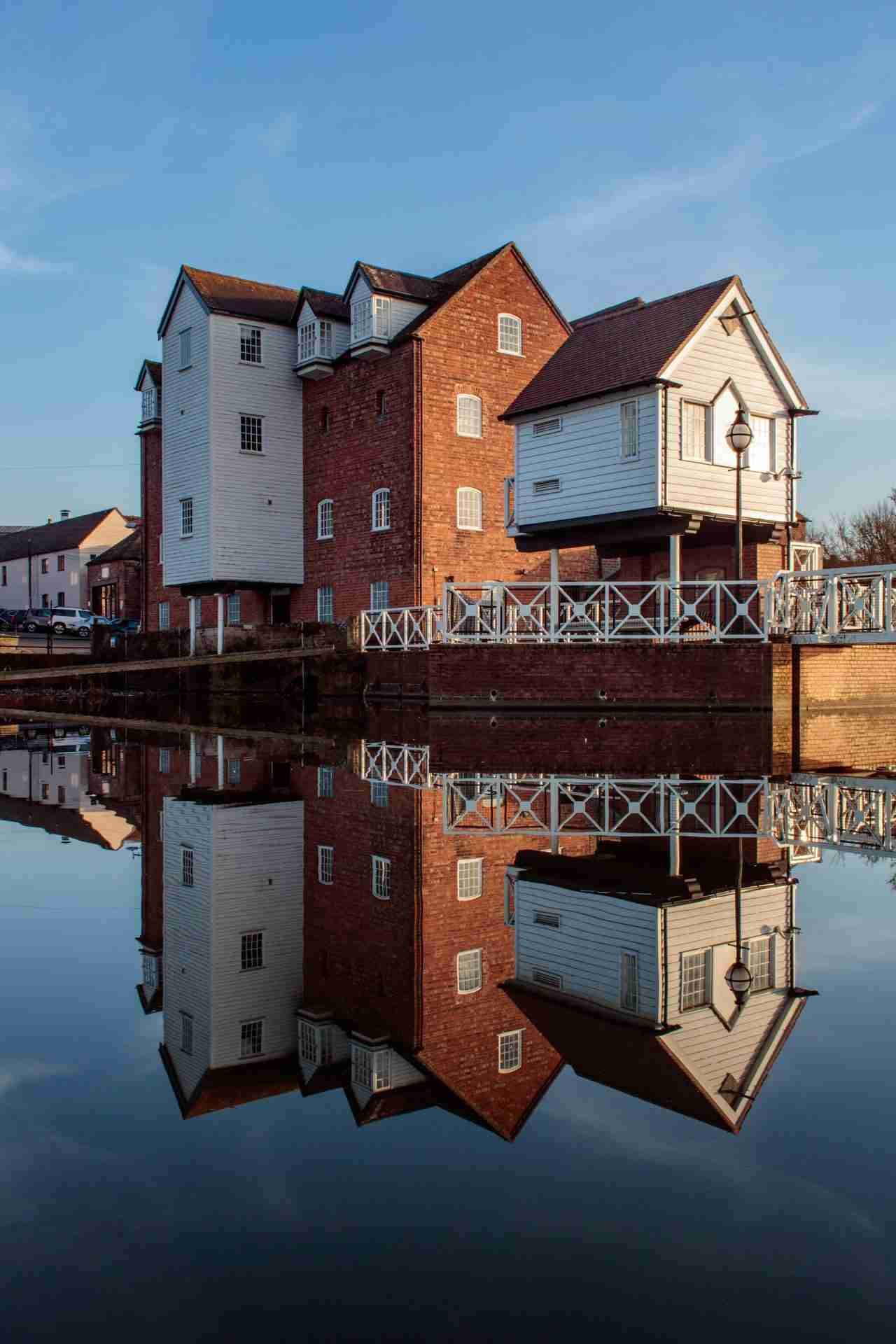
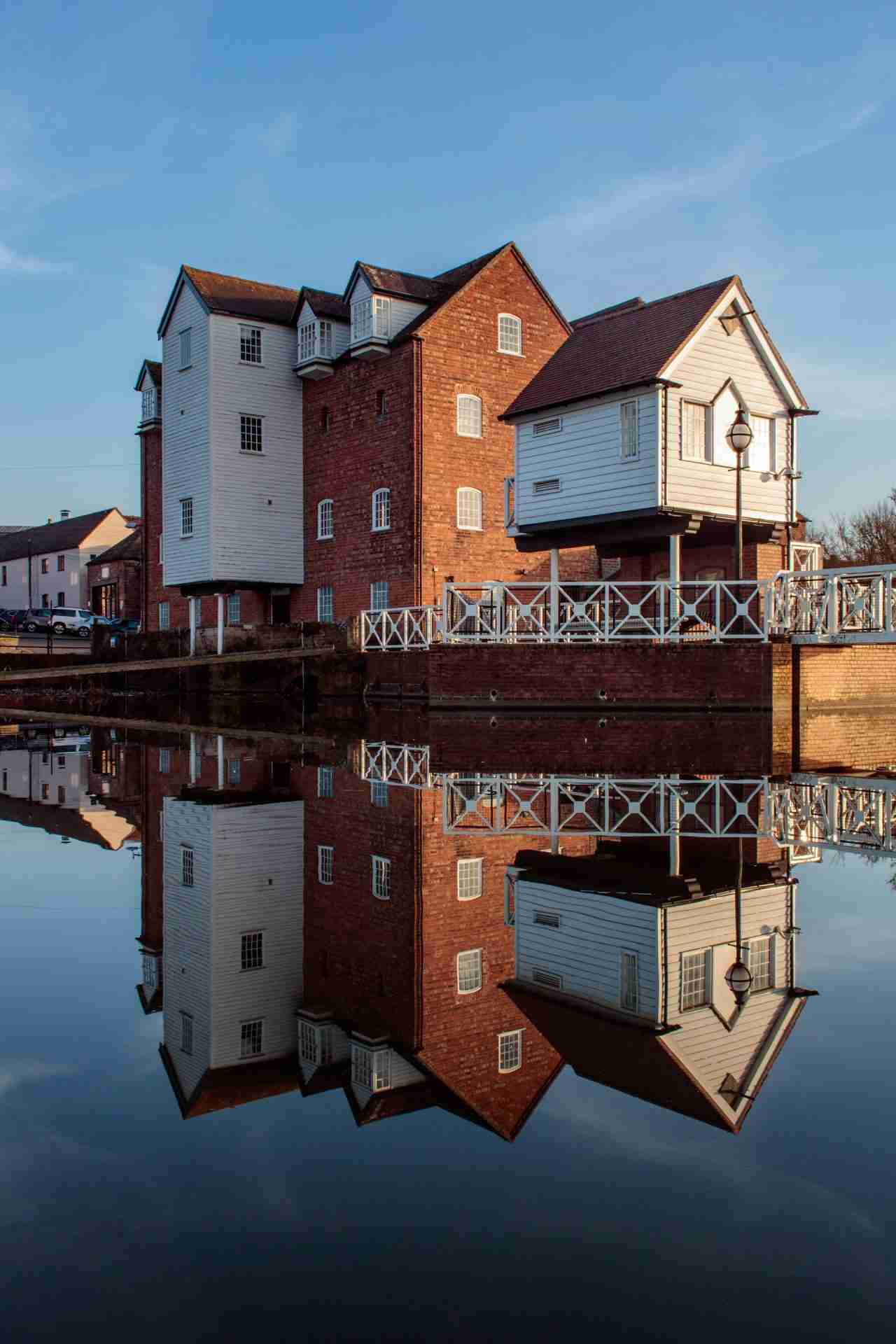
Abbey Mill, also called Fletcher's Mill, sits beside the River Avon in the historic town of Tewkesbury. The building is one of the most recognizable sights in the town thanks to its unusual structure and its position directly over the water. The red brick mill rises several stories high while two white timber framed sections extend outward on stilts above the river. This mix of materials and shapes gives the building a distinctive character that stands out immediately. The calm stretch of river beside the mill often produces mirror like reflections, creating one of the most photographed scenes in Tewkesbury. A footbridge and riverside walkway nearby provide clear views of the building from several angles, making it easy for photographers to frame both the mill and its reflection.
Best Photography Opportunities
• Reflections from the Riverside Path –
The most popular composition at Abbey Mill comes from the riverside path where the building and its reflection align almost perfectly in the water. When the river surface is calm, the mill's red brick walls and white timber structures appear mirrored below, creating a clean symmetrical image. A wide lens works well because it allows you to include the full building and the reflection together in the frame. Positioning the horizon near the center emphasizes the symmetry between the building and its reflection. Early morning often produces the smoothest water and the clearest reflections. This viewpoint captures the scene most people associate with the mill.
• Low Angles Along the Riverbank –
Moving closer to the water's edge can produce a more dramatic reflection composition. From a lower camera position the reflection occupies a larger portion of the frame, allowing the building to appear almost doubled in the image. This perspective emphasizes the shapes of the rooflines and timber sections that extend over the water. A wide lens helps exaggerate the relationship between the mill and its reflection. Calm conditions are especially important here because even small ripples can distort the symmetry.
• Mill's Structure Over the River –
Walking a short distance along the riverside path reveals a side view of the building where the timber framed section stands clearly above the water on supports. This angle highlights how the structure extends over the river rather than simply sitting beside it. A mid range zoom can help isolate the overhanging portion of the building and the supports beneath it. Including part of the riverbank in the foreground adds depth to the composition. This perspective also shows more of the architectural details within the timber framing.
• Footbridge View –
A small footbridge near the mill provides another strong vantage point. From here you can photograph the building slightly elevated above the river with the walkway railings leading toward it. These lines naturally guide the viewer's eye through the frame toward the mill. A moderate wide lens helps capture both the bridge structure and the building together. This composition works well when people walk across the bridge, adding scale to the scene.
• Warm Evening Light –
Late afternoon and early evening light often illuminates the red brick walls of the mill with warm tones. As the sun lowers, shadows begin to form along the edges of the timber sections and rooflines, adding depth to the building's shape. A mid range zoom allows you to frame the mill tightly while still including the reflection in the water. If the sky remains clear, the warm light and darker water surface can create a strong contrast that makes the building stand out.
Best Time to Visit
Early morning is often the best time to photograph Abbey Mill. The river is usually calmer, producing cleaner reflections, and the area tends to be quieter before visitors arrive. Soft morning light also helps reveal the texture of the brick and timber.
Late afternoon and evening can also produce beautiful conditions. As the sun lowers, the red brick walls take on warmer tones and reflections can still appear if the water remains calm. Windy conditions tend to break up the reflection on the river, so calmer weather generally produces the strongest images.
How to Get There
Abbey Mill is located in the town of Tewkesbury in Gloucestershire, England, a short distance from Tewkesbury Abbey. The building sits beside the River Avon near the center of town.
Visitors can reach the location easily on foot from the town center. Several parking areas are available nearby within Tewkesbury, after which it is only a short walk through the historic streets to the riverside path beside the mill. The riverbank and footbridge viewpoints are publicly accessible and there is no admission fee required to photograph the exterior of the building.
Recommended Photography Gear
A wide lens is particularly useful at Abbey Mill for capturing the full building together with its reflection in the river. A mid range zoom provides flexibility when isolating architectural details or framing the structure from different viewpoints along the riverbank.
A tripod can be helpful in low light conditions or when shooting at smaller apertures to maximize sharpness across the reflection. A polarizer can sometimes help control glare on the water, although removing it may strengthen reflections depending on the light angle.
Nearby Photography Locations
is a large Norman church with a distinctive square tower that dominates the skyline of the town. The building's Romanesque architecture and long stone walls create strong compositions from the surrounding streets and green spaces. Early morning light often illuminates the western side of the abbey.
crosses the River Severn and dates back to the medieval period. The stone arches and the small chapel built directly into the bridge make it one of the most unusual historic bridges in England. Reflections in the river can create striking compositions.
• The Severn Ham Riverside
is a wide riverside meadow located where the River Severn meets the River Avon. From here you can photograph open views of the rivers and the surrounding countryside. Misty mornings often produce atmospheric landscape scenes.
sits about thirty minutes north of Tewkesbury and features impressive medieval architecture with tall stone towers. The surrounding parkland offers several good viewpoints for photographing the building. Seasonal flowers often appear in the nearby gardens.
rises above the surrounding countryside and offers sweeping views across the Severn Valley. The hilltop tower and nearby church provide interesting foreground subjects for landscape photography. Sunrise and sunset often produce dramatic light over the rolling hills.
Comments
Loading comments…