
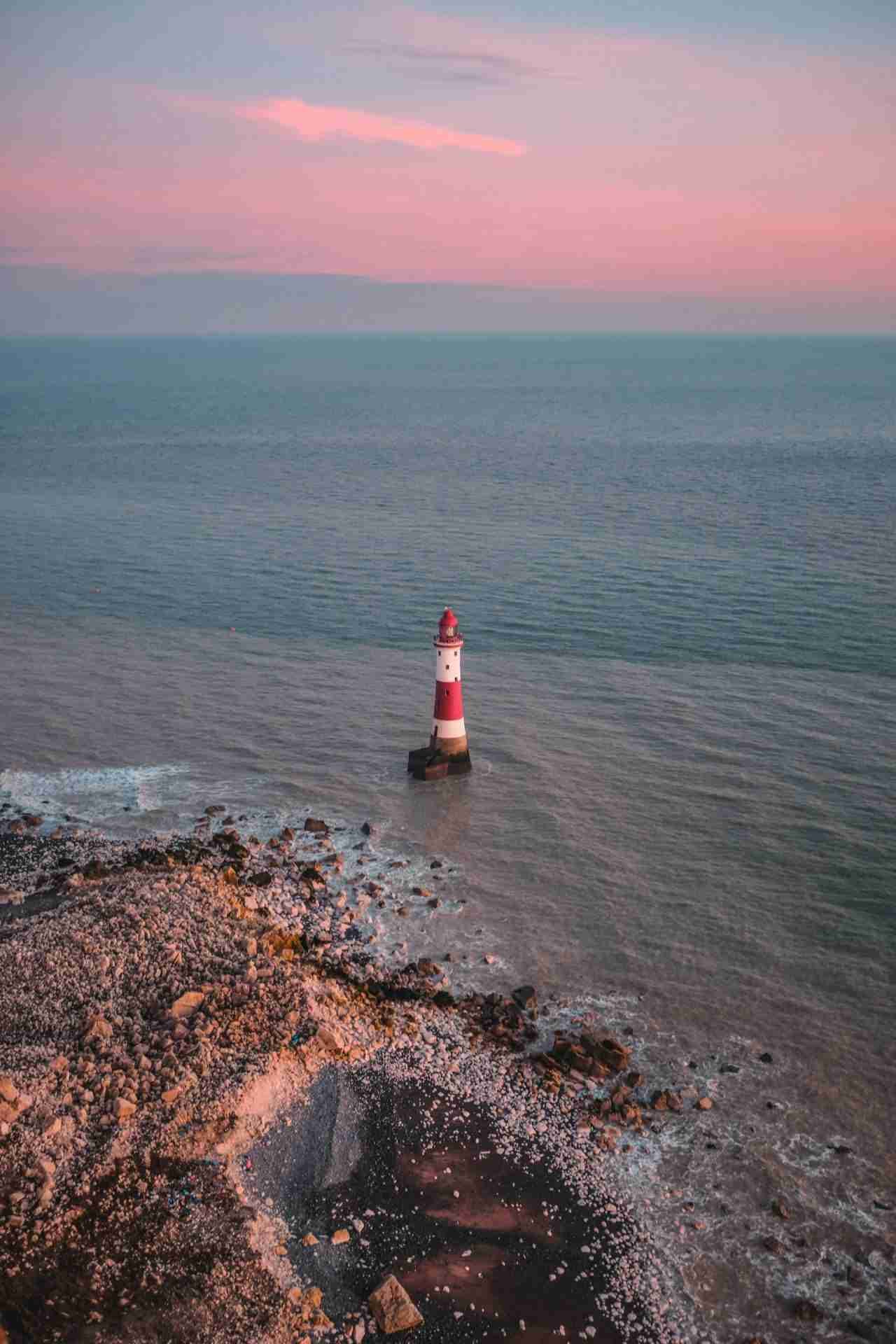
Set against the dramatic backdrop of England's highest chalk sea cliffs, the Beachy Head Lighthouse is a singular subject perched defiantly at the base of East Sussex's sheer coastline. Built in 1902 and standing 43 meters tall, this red-and-white striped sentinel emerges from the surf below the towering white cliffs of Beachy Head near Eastbourne. It's an arresting juxtaposition of natural scale and human craftsmanship—where the geometry of the lighthouse collides with the elemental force of sea and sky. For photographers, Beachy Head offers a range of vantage points: panoramic cliff-top views, compression-rich telephoto angles, and seasonal atmospherics that shift daily with the English Channel's mercurial mood.
Best Photography Opportunities
• Clifftop Vantage from Beachy Head Path
: The most iconic and immediately accessible viewpoint is from the top of the chalk cliffs themselves. A short walk from the Beachy Head car park leads to the winding coastal path where the lighthouse can be photographed looking nearly straight down. A telephoto lens (100–300mm) compresses the distance and emphasizes the isolation of the tower, floating in the blue-green sea far below. Early morning or late afternoon sun lights the cliffs and creates long shadows that deepen the vertical drama. To balance sea, cliff, and tower in one composition, step back slightly along the trail and use a wide-angle lens to incorporate foreground wildflowers or grasses into the frame.
• Panoramic Cliffline and Lighthouse Compositions
: From farther along the path toward Birling Gap, broader views open up where the lighthouse sits framed by the curving sweep of white chalk cliffs. These perspectives are excellent for showcasing scale and geography—where the human-made lighthouse appears dwarfed beneath the immense vertical drop. Use a mid-range zoom (24–70mm) to capture the full scene and include texture in the chalk surface, especially during golden hour when soft light gives warmth to an otherwise stark palette of white, blue, and green. On misty mornings or stormy days, this location produces cinematic atmosphere with the lighthouse partially obscured, adding a sense of mystery or maritime struggle.
• Minimalist Aerial Feel with Long Lens
: From elevated clifftop positions, a long telephoto (200–400mm) allows you to isolate the lighthouse entirely against the sea, eliminating all landmass and producing a minimalist composition. Shoot vertically or horizontally depending on the tide's patterns, which can leave curving waterlines or darkened rocks around the base of the tower. Low tide reveals the full structure of the lighthouse including its red base, offering a more sculptural view. This perspective is particularly effective in midday when shadows are minimal, allowing the form of the lighthouse and the tonal transitions in the water to dominate the composition.
• Long Exposures and Motion Contrast
: The sea surrounding the lighthouse is in constant motion, creating opportunities for long exposure work from the clifftop or shoreline. Use an ND filter to slow shutter speeds to 10–30 seconds, smoothing the waves into a soft texture that contrasts with the static geometry of the lighthouse. This technique is especially effective during overcast days or twilight, when lighting is even and the red-and-white tower becomes a focal point amid blurred blues and greys. Including parts of the cliff's edge or layered strata as a frame can add depth and natural texture.
• Low-Angle Shoreline Perspective (Limited Access)
: Though much more difficult to reach and requiring careful planning around tide times, it's possible to access the base of the cliffs during extreme low tide from Cow Gap or Birling Gap. This allows for close-up, low-angle views of the lighthouse from beach level, capturing its full height against the towering chalk cliffs. Bring a sturdy tripod, waterproof footwear, and check tide charts meticulously—this access is tide-dependent and can be dangerous without precise timing. From this rare vantage point, use a wide-angle lens to exaggerate the vertical scale and capture rock textures, surf spray, and direct detail of the lighthouse's base.
Best Time to Visit
The lighting and atmospheric conditions around Beachy Head vary dramatically throughout the year, offering distinct photographic moods. Spring and summer provide the longest shooting windows, with early morning and late afternoon offering golden light that skims across the cliffs and warms the otherwise cool-toned sea. Sunrise is particularly compelling when fog drifts inland, partially obscuring the lighthouse while bathing the cliffs in diffused light. This mist, often present from April through June, adds a haunting softness to an otherwise rugged scene.
Autumn introduces lower sun angles and more turbulent weather, resulting in dynamic cloud formations and storm-driven waves that make for powerful compositions—ideal for long exposures or capturing raw seascapes. In winter, the sun tracks lower and the cliffs cast longer shadows. This season also brings the cleanest, crispest skies and dramatic side light, especially in the early afternoon when the sun breaks through coastal clouds.
Midday light, while often harsh elsewhere, can work here—especially for minimalist compositions where the lighthouse's red band contrasts cleanly against the turquoise sea. The most photographically favorable times of day are sunrise for east-facing glow on the cliffs, and sunset when the western sky can illuminate cloud cover and create reflective light on the water. Tidal variation is another key element—low tide reveals more of the lighthouse's base and can add textural elements to the surrounding sea floor, while high tide accentuates its isolation.
How to Get There
Beachy Head Lighthouse is located just west of Eastbourne on the south coast of England, within the South Downs National Park. The most direct access is via the Beachy Head car park on Beachy Head Road, about a 10-minute drive from Eastbourne. From the car park, a clearly marked coastal trail runs along the clifftops, offering multiple vantage points of the lighthouse within a 10–20 minute walk. This path is mostly flat but can be muddy in winter or after rain.
For those seeking wider coastal views, continue the trail west toward Belle Tout Lighthouse and Birling Gap, which provides elevated panoramas and changing angles on the main lighthouse below. There is no direct path down to the lighthouse itself due to the vertical cliffs, and drone use is heavily restricted due to the site's protected status and unpredictable coastal winds.
Access to the shoreline near the base of the cliffs is possible at extremely low tides from Cow Gap or Birling Gap, though this route is for experienced hikers only and requires tide chart consultation. These paths are rocky and slippery, and the tide can trap unprepared visitors quickly. There is no fee to explore or photograph the area, though always respect posted warnings, fencing, and coastal safety guidelines.
Recommended Photography Gear
Bring a wide-angle zoom (16–35mm) for expansive clifftop landscapes that include foreground interest such as wildflowers, grass tufts, or chalk textures. For tighter frames or compositions that emphasize the lighthouse's isolation, a mid-to-long telephoto lens (70–200mm or 100–400mm) is essential. This range is particularly effective from the clifftops when compressing distance and simplifying the frame to sea and tower.
A tripod is necessary for long exposures, especially during blue hour or when photographing water motion around the lighthouse. Pair it with a 6- or 10-stop ND filter to blur wave movement or passing clouds. A circular polarizer is helpful for reducing sea glare on bright days and enhancing color separation in the cliffs and water.
A weather-sealed camera body and lens are advisable due to frequent coastal wind and spray, particularly in stormy conditions. Use a lens hood to cut flare when shooting into low sun angles, and pack a microfiber cloth to keep optics clean. If attempting low-tide shoreline access, waterproof footwear and a compact kit are essential. Be cautious with drone use, as permissions are strict and wind conditions change rapidly along the cliffs.
Nearby Photography Locations
• Belle Tout Lighthouse
: Just west of Beachy Head, this decommissioned lighthouse sits atop the cliffs and makes for an excellent subject in its own right. Photograph it during sunset with the South Downs rolling behind it, or use it as a compositional anchor in panoramic cliff shots.
: Further west beyond Birling Gap, these iconic white chalk cliffs form a rhythmic pattern of peaks and valleys along the coast. Best photographed at sunrise or sunset, especially from Seaford Head where the meanders of the River Cuckmere lead into the composition.
: A small cove at the base of the cliffs, this location provides beach access, rock pools, and views looking back toward Beachy Head. Low tide reveals wave-sculpted textures, while high tide offers strong wave interaction against the cliff face.
: East of Beachy Head near Eastbourne, this peaceful coastal garden leads to tide-exposed rocky platforms and chalk outcrops. Excellent for close-up shoreline photography and unique foregrounds.
• Eastbourne Pier
: For a complete contrast in subject matter, visit this Victorian-era pier with ornate ironwork and colorful details. It's particularly photogenic during blue hour, when lights reflect in the water and the structure's symmetry shines through long exposures.
Beachy Head Lighthouse isn't just a coastal landmark—it's a subject that rewards patience, planning, and an appreciation for the interplay between structure and natural scale. With its ever-changing light, shifting tides, and vast open surroundings, it offers photographers a chance to work with elements both timeless and elemental, high above the tide and deep in the rhythm of the sea.
Comments
Loading comments…