
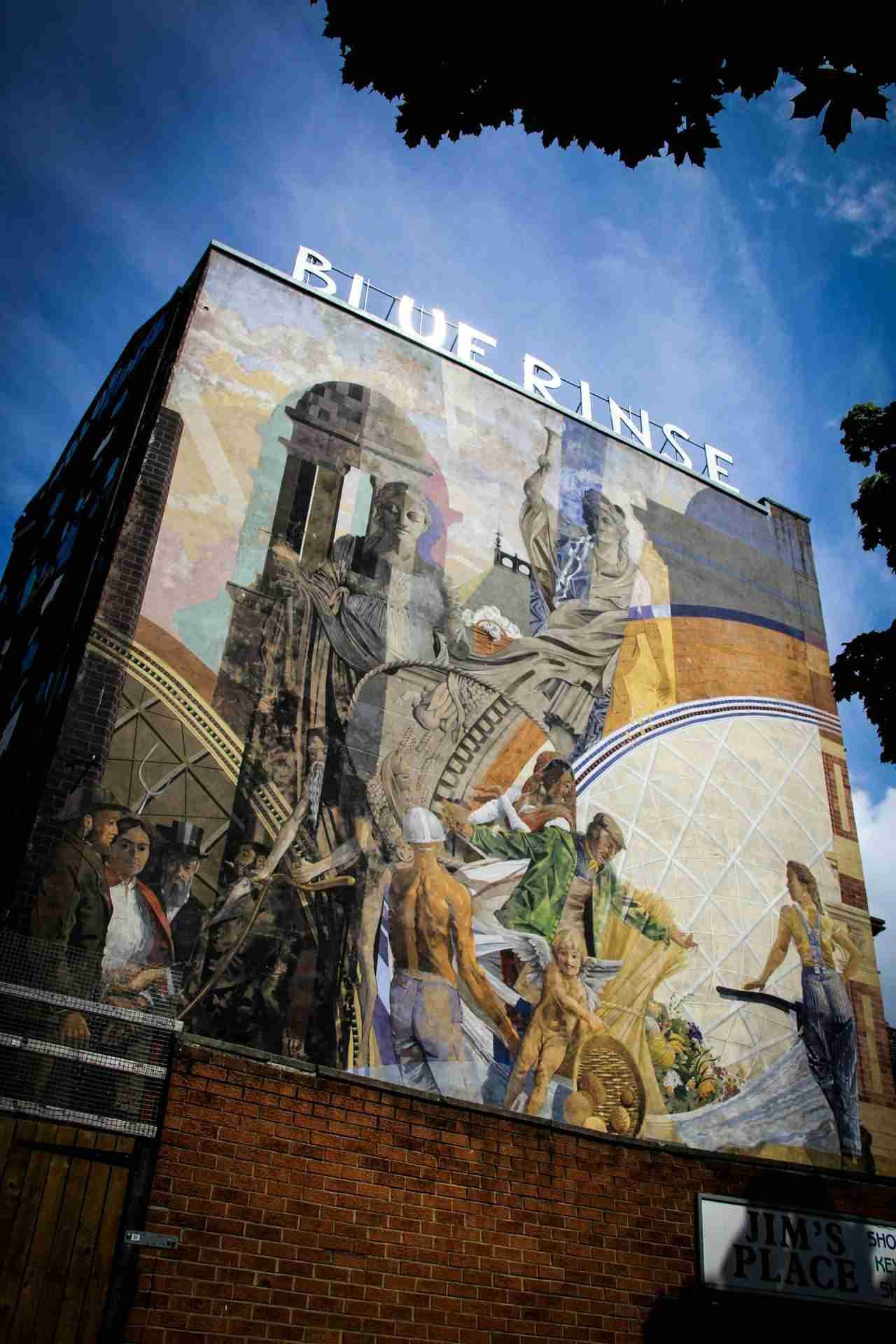
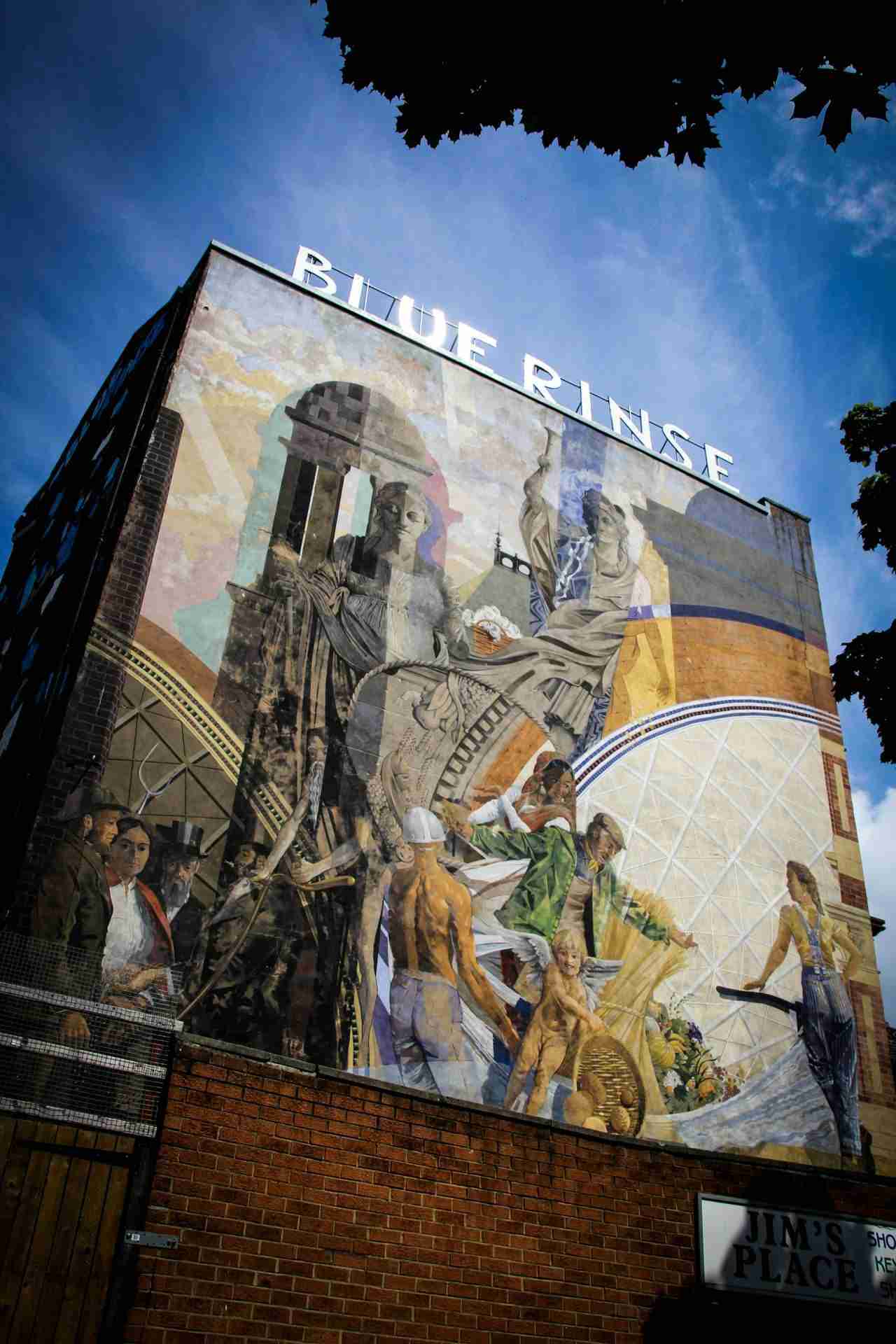
Standing tall above the corner of Call Lane in Leeds, the Blue Rinse Mural is a complex and richly detailed public artwork that rewards slow looking and careful composition. Painted on the side of the Blue Rinse vintage clothing shop, this multi-story mural is not a single scene but a tightly woven patchwork of historical figures, architectural motifs, allegorical references, and industrial imagery. It reads almost like a fresco from a civic hall, adapted to the context of an urban street corner. For photographers, the challenge and reward lie in working with the mural's verticality, its shifting interaction with natural light, and the way its dense layers of imagery sit within the grit and rhythm of Leeds' city fabric. This is not just a colorful wall but a conversation between past and present, framed by red brick and northern sky.
Best Photography Opportunities
• Frontal Composition from Across Call Lane
To capture the mural in full, step across Call Lane and use a wide-angle lens between 24 and 35mm. Framing the building squarely allows you to contain the entire composition while also including the BLUE RINSE lettering at the top. Morning light from the east brings strong shadow relief across the mural's painted architecture and human forms. If clouds are moving fast, use a short time-lapse or burst mode to capture the sky as a dynamic backdrop. This is the best angle for showing the mural as a unified whole without distortion.
• Close Crops of the Lower Register Figures
The figures in the bottom third of the mural — a mix of industrial workers, cherubs, and classical forms — can be cropped into smaller, painterly compositions. Use a medium telephoto lens to isolate interactions between characters or focus on brushwork and texture. This approach works well under overcast skies when shadows are soft and color is consistent. Look for diagonals and visual tension in the positioning of tools, limbs, and flowing cloth. Even though it's a static wall, these segments can feel cinematic when composed tightly.
• Shadow and Contrast Studies in Late Afternoon
As the day progresses, shadows from nearby structures and trees begin to fall across the mural's surface, breaking it into sections. These conditions allow for high-contrast monochrome work or dramatic detail shots that emphasize form over narrative. Use these changes to isolate individual sections — such as the stone arch or the domed grid behind the laborers — and let the light simplify the scene. This is also a good time to work handheld and move quickly as light conditions shift by the minute.
• Contextual Compositions with Pedestrian Activity
Including foot traffic at street level helps tie the mural into the life of the neighborhood and shows its relationship to the people who pass it daily. A 35mm or 50mm lens gives you a natural perspective for this approach. Photograph during a weekend afternoon when the area is most active. Look for moments when someone glances up at the mural or when their clothing color or posture echoes a form in the artwork above. These small interactions can create layered, living compositions that reflect the mural's purpose as public art.
• Night Photography with Ambient Street Lighting
While the mural is not directly lit at night, ambient lighting from nearby bars and signage creates a moody atmosphere that works for long exposures. Use a tripod and shoot at higher ISO settings to maintain shadow detail without blowing highlights. Look for reflections in nearby windows or puddles that mirror parts of the mural in abstract form. Night shooting also minimizes foot traffic and gives you more freedom to position your tripod in the street without interruption.
Best Time to Visit
The mural faces slightly east, which makes early morning the best time for clean, directional light that reveals the artwork's full detail and tonal range. The colors are vibrant during the first few hours after sunrise, especially in cooler months when the sun sits lower and the shadows stretch longer. Late afternoon brings deep contrast and partial shading that can be used creatively for detail and abstraction.
Overcast days help reduce glare on the painted surface and allow the mural's texture and layering to show through more subtly. These conditions are perfect for studying the composition up close. Rainy days can be rewarding if you are prepared to shoot with weather-sealed gear or from under nearby awnings. Reflections in the pavement and saturated colors in the brick and paint offer a moody but rich palette for street-focused images.
How to Get There
The Blue Rinse Mural is located on the side of the Blue Rinse vintage store at the junction of Call Lane and Duncan Street in Leeds city centre. It is an easy five-minute walk from Leeds Station, passing through some of the city's most vibrant retail and nightlife streets. Multiple bus routes serve the area, and the mural is highly visible from the street. No special access or permissions are needed to photograph it from public walkways.
There is no fee to view or photograph the mural, but be mindful of pedestrian flow and delivery vehicles when setting up for lower-angle shots. Weekday mornings tend to be the quietest, while evenings and weekends bring higher foot traffic that can be used to your advantage in street-style compositions. Tripods are allowed but should be used with caution on narrow sidewalks. Drones are not advisable due to the tight urban setting and nearby pedestrian areas.
Recommended Photography Gear
A wide-angle lens around 24–35mm is essential for capturing the full mural from across the street without distortion. For tighter compositions and detail studies, bring a 50mm or 85mm prime to compress the frame and work with the mural's rich texture and brushwork. A 70–200mm lens can also be useful for pulling in higher details from ground level, particularly the top third of the wall.
A lightweight tripod is useful for dawn or dusk exposures and essential for night shooting. A circular polarizer can help manage reflections on wet surfaces or nearby glass. For handheld work, consider bringing a fast prime with strong low-light performance to take advantage of fleeting light and movement. Weather protection for your gear is recommended if rain is in the forecast, and a simple crossbody camera bag helps keep your kit mobile in a busy urban environment.
Nearby Photography Locations
Just a few blocks away, the Corn Exchange offers a grand circular interior filled with shops and staircases. Its glass dome and repeating geometry make it one of the strongest interior compositions in the city for architectural photography.
This historic covered market features ornate ironwork, warm lighting, and constant motion. Ideal for documentary photography and environmental portraits in a place rich with local texture and daily life.
A ten-minute walk from the mural, this area mixes industrial waterfront with sleek modern structures. Reflections in the canal and long lines of bridges and walkways provide minimalist contrast to the mural's complexity.
• Call Lane Street Scene
The mural sits at the heart of a street known for its bars, shops, and vintage signage. Work the surrounding block for urban compositions, graphic storefronts, and layered light that changes hour by hour.
East of the mural, this elegant shopping arcade boasts stained glass, wrought iron, and richly tiled interiors. It's a completely different mood from the street outside and a rewarding indoor space for line and light studies.
The Blue Rinse Mural is more than just a wall painting. It is a story in layers, a celebration of labor, history, and the evolution of a city told through brush, texture, and scale. For photographers willing to look closely, move deliberately, and respond to light and context, it offers something new with every visit.
Comments
Loading comments…