
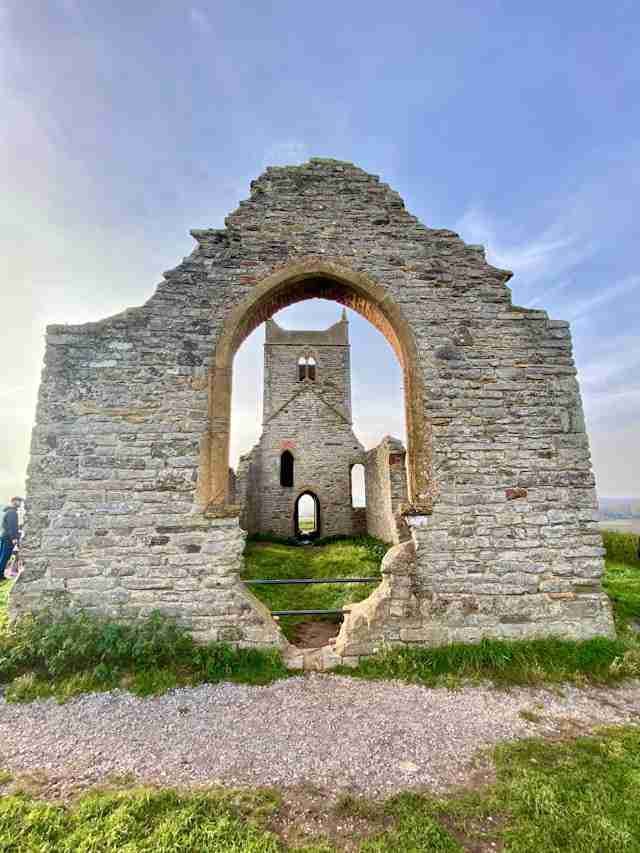
Standing on a steep hill above the Somerset Levels, Burrow Mump is a windswept site that fuses history, solitude, and expansive views into one of the region's most quietly powerful photographic subjects. The ruins of a medieval church—St. Michael's—perch dramatically at the summit, their stone arches and crumbling walls silhouetted against shifting skies. Though less famous than Glastonbury Tor, Burrow Mump offers similar archetypal elements: elevation, ruin, and a commanding presence in the landscape. Surrounded by flat floodplain fields and rivers that often mist over at dawn, the Mump is ideal for compositions that balance structure and emptiness, stillness and drama. For photographers seeking mood and scale without the crowds, this hill offers an unassuming, but rewarding canvas.
Best Photography Opportunities
• Silhouettes and sunrise from the east base
From the eastern fields below the Mump, the ruined church can be captured as a stark silhouette at sunrise, especially in autumn and winter when the sun rises directly behind the hill. The tower and remaining walls take on a graphic quality against the warming sky, and the base of the hill often sits in low fog, adding atmosphere to the composition. Use a wide-angle lens to include foreground detail—frosted grasses, fence lines, or lone trees—that guide the eye upward. A longer lens can compress the ruin against the sky, isolating it from the landscape for a minimalist feel. A tripod and graduated ND filter help balance exposure between land and sky.
• High vantage panorama from the summit
Reaching the top of the Mump reveals a sweeping, uninterrupted view of the Somerset Levels, with the River Parrett winding through the fields and the distant Quantock Hills on the horizon. The best light for panoramic work comes in the late afternoon, when golden hour warms the stone walls and the surrounding patchwork landscape. A wide-angle or mid-range zoom captures the full breadth of the scene. Use the ruin as a foreground anchor, either framing the view through its arched window or composing from behind the wall to create depth. For stitched panoramas, shoot vertically at 50mm and use a tripod to preserve alignment.
• Long exposure cloud movement behind the ruins
On windy days or during transitional weather, the Mump's exposed summit is perfect for capturing long exposure images of clouds sweeping behind the stonework. These compositions benefit from a 6- or 10-stop neutral density filter, a solid tripod, and exposures ranging from 30 seconds to several minutes. Compose to include as much sky as possible behind the tower, letting cloud movement trace diagonals or lines that accentuate the ruin's form. This technique works especially well during blue hour, when the sky transitions into soft gradients and the stone appears isolated and calm.
• Low-lying fog and inversion from the adjacent fields
On early autumn and spring mornings, mist often settles in the flat fields around the Mump while the summit remains above it. From nearby roads such as the approach from Burrowbridge, you can photograph the hill emerging from a sea of cloud. This is best shot with a telephoto lens from a moderate distance, allowing you to compress the layers of fog, grassland, and ruin into a single cohesive frame. The Mump appears as a solitary island, which lends itself to storytelling compositions about isolation and memory. Bracket exposures to manage tonal differences between the sky and fog layer.
• Architectural detail and textural close-ups
While the structure is mostly ruin, the remaining walls, windows, and arch fragments offer rich textural subjects for close-up work. The weathered stone shows centuries of wear, with lichen, moss, and erosion marks providing detail-rich surfaces. A fast prime or macro lens is ideal here for shallow depth of field and tactile focus. These compositions work best in overcast light, which softens shadows and brings out subtle tonal variations. Look for graffiti carvings, intersecting stone joints, or light passing through broken windows. These studies add a personal, intimate layer to wider landscape shots.
Best Time to Visit
Burrow Mump is open and accessible year-round, but its mood and photographic potential shift notably with season and weather.
Spring offers bright greens in the surrounding meadows and cool, misty mornings. It's a prime time for fog inversions and dew-covered textures. The hilltop often remains clear above valley mist, giving it a floating, otherworldly appearance just after sunrise.
Summer brings longer daylight hours and clear skies, but also harsher light and heat haze in the distance. Early morning or golden hour sessions are essential during this time. The grass around the hill tends to be more even and dry, creating a cleaner foreground for minimalist frames.
Autumn is perhaps the most rewarding season, with low sun angles throughout the day, lingering morning fog, and rich tones in both sky and land. The soft browns and yellows of the surrounding fields pair well with the cold greys of the ruin. Cloud patterns often add motion and depth to sky compositions, ideal for long exposure work.
Winter introduces stark light, bare trees, and dramatic weather. Snow or frost transforms the Mump into a high-contrast subject, and moody skies lend themselves to black-and-white conversions. The ruin's silhouette is strongest during this season, and wind-driven clouds create powerful compositions.
How to Get There
Burrow Mump is located near the village of Burrowbridge, Somerset, just off the A361. It's approximately a 20-minute drive from Taunton, or 30 minutes from Glastonbury. From the center of Burrowbridge, follow signs to the National Trust car park located at the base of the hill on the western side.
The hill is steep but manageable, with a short footpath leading to the summit. Allow 10 to 15 minutes for the ascent with gear. The site is open at all hours, and there is no admission fee or photography restriction for personal use. There are no facilities on-site, so plan accordingly. The surrounding roads are narrow, so early arrival is helpful for both parking and quiet light.
Public transport is limited. The nearest train station is at Bridgwater, from which a taxi or bike is needed to reach Burrowbridge. Walking from neighboring villages is possible but best suited to those familiar with rural navigation and weather conditions.
Recommended Photography Gear
Burrow Mump's exposed summit and minimal structures require a kit optimized for versatility and stability. A wide-angle zoom (16–35mm) is essential for full-scene landscapes from the summit, sky-heavy compositions, and foreground detail inclusion. A mid-range zoom (24–70mm) allows you to isolate the ruin within the landscape or work tighter from field-level perspectives.
A telephoto lens (70–200mm or more) is crucial for fog inversion work, compressing the Mump against distant fields, or isolating it from a distance when viewed from nearby ridgelines or roads. For texture and detail photography, a fast prime (35mm or 50mm) is ideal for soft light studies and fine surface focus.
Bring a sturdy tripod, especially for long exposures and blue hour shooting. Use a 6- or 10-stop ND filter to control cloud movement, and a polarizer to deepen sky contrast or reduce glare on damp stone. A microfiber cloth is necessary for clearing condensation during cold mornings. Layered clothing and windproof gloves are also essential in colder months—the summit can be significantly windier than the base.
Nearby Photography Locations
Around 30 minutes away, this legendary hilltop site offers complementary elevation shots, misty morning inversions, and narrative-rich compositions combining structure and landscape.
• Wells Cathedral and Vicar's Close
Located just north, these architectural subjects offer symmetry, historical texture, and contemplative light. A perfect contrast to the natural ruin of the Mump.
• Somerset Levels and River Parrett
The surrounding wetlands provide low, open vistas perfect for mist and water reflection photography. Great for early light and minimal compositions.
• Burrowbridge and the King Alfred Statue
At the foot of the hill, this small riverside village includes a bronze statue of King Alfred the Great and traditional cottages. A good stop for contextual shots and historical framing.
Roughly 25 minutes away, this birding and wetland reserve is excellent for wildlife photography, abstract water patterns, and golden hour reeds against sky.
Burrow Mump rewards patience and mood. It's not a place of elaborate detail, but of strong shapes, elemental contrasts, and historical resonance. For photographers who enjoy shaping atmosphere with composition, light, and time, this quiet hilltop ruin offers some of Somerset's most evocative frames.
Comments
Loading comments…