
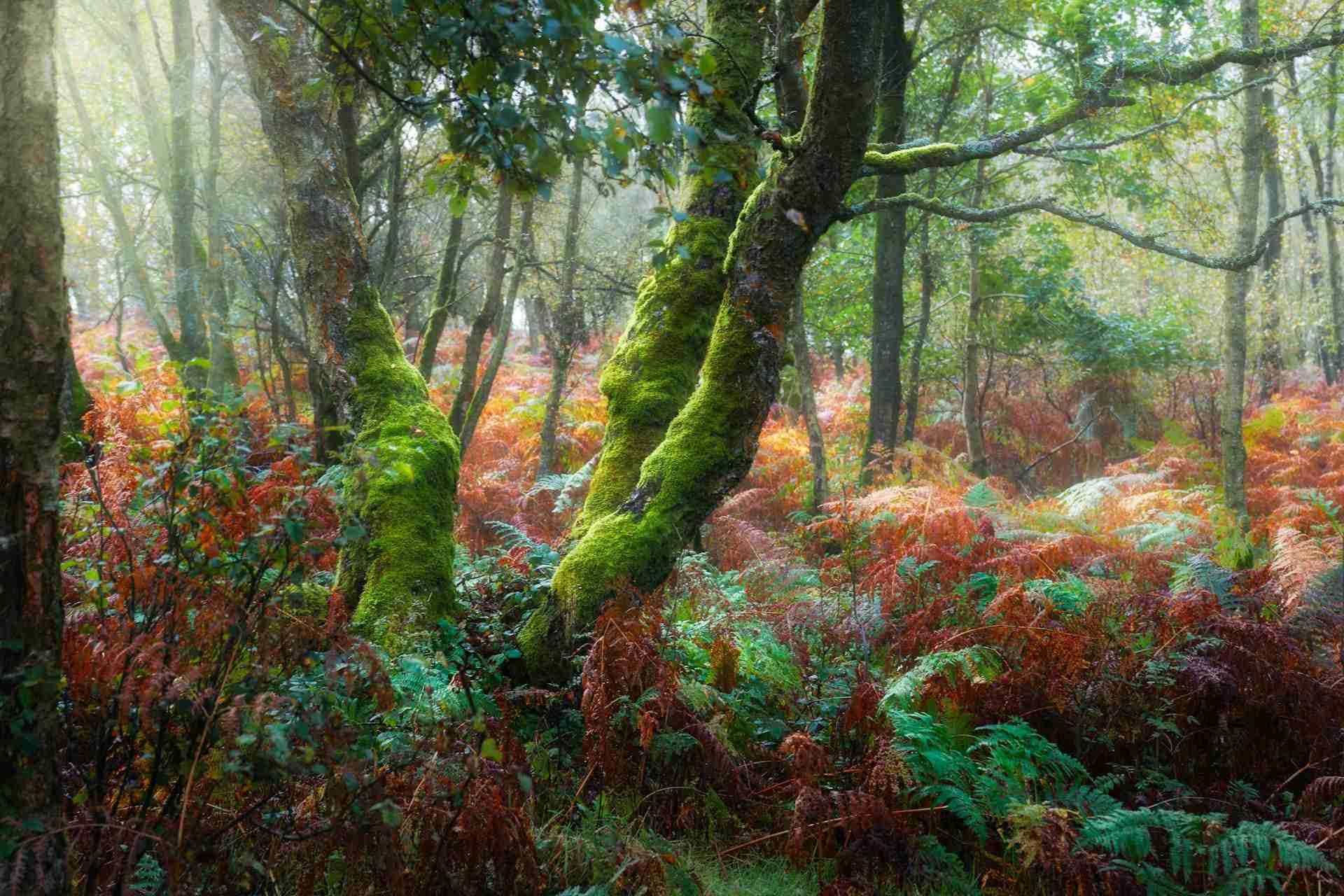
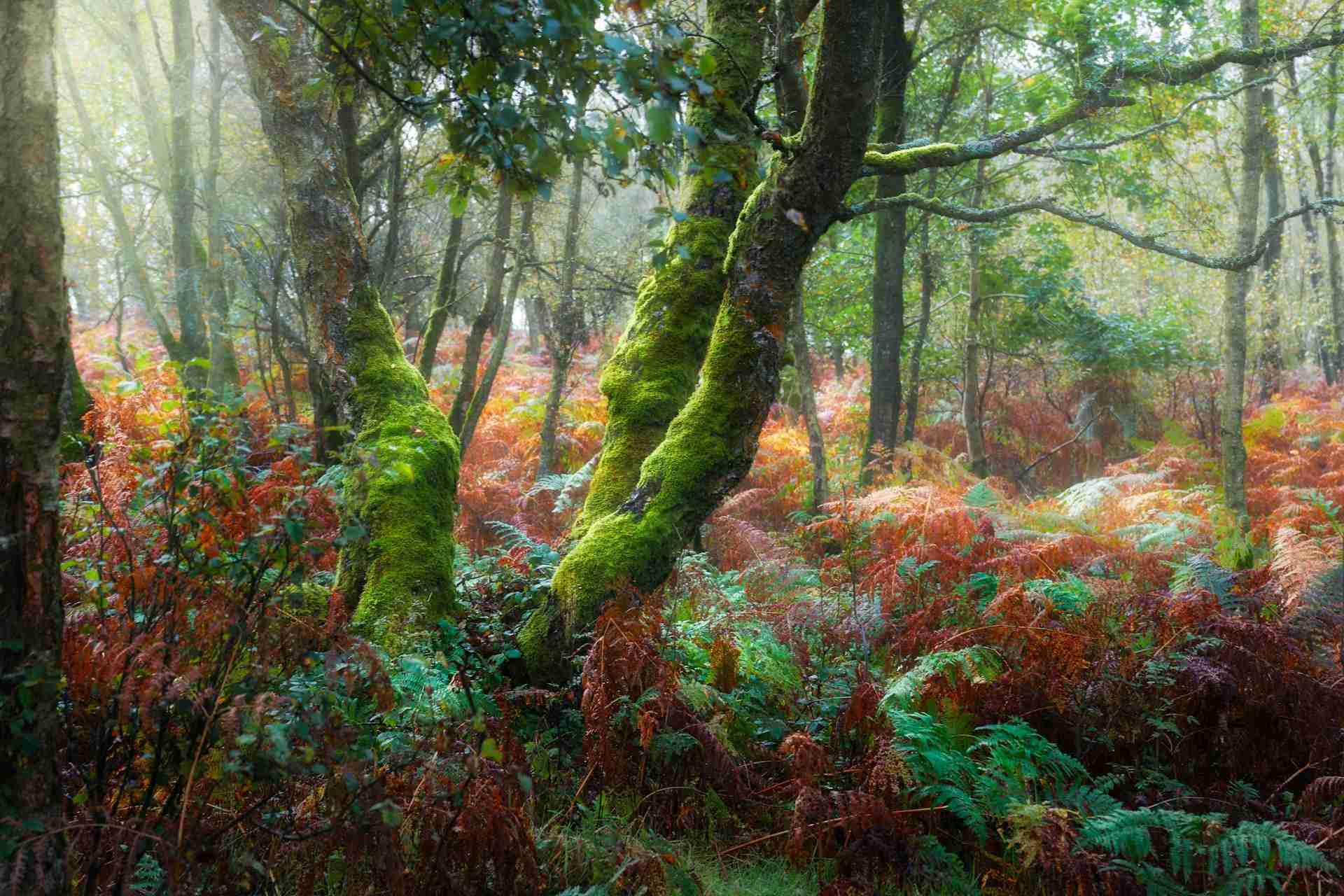
Nestled along the eastern edge of the Peak District, Froggatt Woods is a varied woodland perched just above the River Derwent and running parallel to the gritstone escarpment known as Froggatt Edge. This ancient woodland is a mosaic of moss-covered boulders, birch and oak trees, and seasonal ground cover that shifts in tone throughout the year. For photographers, it is a place of subtle beauty rather than dramatic spectacle. The location rewards patience, quiet exploration, and an eye for form and texture. The interplay of filtered light through the trees, soft mists rising from the valley, and the rough geometry of gritstone create a rich environment for landscape and woodland photography. Winding footpaths, changing elevations, and occasional clearings make the woods ideal for building compositions layer by layer.
Best Photography Opportunities
• Woodland Canopy and Backlit Trees
One of the most consistent subjects in Froggatt Woods is the tall, slender birch trees that line its upper trails. Shooting toward the light in early morning or late afternoon creates backlighting that highlights the lacy structure of branches and the glow of young leaves. A mid-range zoom allows for flexible framing, while shooting slightly upward includes sky patterns filtered through the canopy. These scenes are best captured with diffused light or during golden hour when shadows are soft and color temperature is warm. Working with a tripod allows for lower ISOs and greater depth of field to keep both foreground and canopy in focus.
• Moss-Covered Gritstone and Ground Textures
Scattered throughout the woods are large boulders and fallen slabs of gritstone, many of them blanketed in moss and ferns. These elements form compelling foreground subjects when paired with receding tree lines. Use a wide-angle lens low to the ground to exaggerate perspective and include subtle paths or root lines leading into the frame. These scenes are most effective in soft, overcast light, which eliminates glare and brings out the green and brown tones in both stone and undergrowth. Close attention to placement and spacing between boulders and trees helps create balanced, immersive compositions.
• Froggatt Edge Overlooks with Woodland Below
Ascending from the woods to the top of Froggatt Edge opens up views across the Hope Valley and back down into the tree canopy. These higher elevations are ideal for sunrise or late-day shooting when angled light moves across the ridges and picks out details in the forest below. Use a short telephoto to compress layers of trees, cliffs, and fields. On misty mornings, low fog can settle into the valley, offering dramatic contrast between sharp stone formations and soft atmospheric background. Framing from behind wind-sculpted trees or dry stone walls adds depth to these compositions.
• Seasonal Ground Detail and Color Study
In spring, carpets of bluebells and fresh ferns add color and rhythm to the woodland floor. In autumn, fallen leaves in gold and copper tones coat the trails and contrast with the green of moss and the dark bark of the trees. These intimate scenes work best with a standard or short telephoto lens and a vertical orientation to emphasize the layering of ground cover, tree trunks, and sky. A circular polarizer helps manage reflections on wet leaves and enhances saturation. Slowing down your shooting pace allows for better spotting of naturally occurring patterns and tonal relationships.
• Paths and Trails with Leading Lines
The winding footpaths of Froggatt Woods offer ready-made compositional anchors. These narrow trails meander between boulders, under arching branches, and up toward the crags. Shooting along the path with a wide lens draws the viewer into the frame and gives a natural sense of depth. Pay close attention to how light moves across the path at different times of day, creating pockets of illumination or shadow that change the mood of the shot. Including a person walking away from the camera can add scale and subtle narrative without overwhelming the natural focus of the scene.
Best Time to Visit
Froggatt Woods is at its most photogenic during spring and autumn, when ground color and overhead light are at their richest. In late April and early May, new leaves begin to catch morning sun, and bluebells often bloom in patches along the lower trails. Autumn peaks from late October through early November, when fallen leaves brighten the forest floor and sunlight filters through golden canopies.
Winter visits reveal the skeleton of the woods, with bare trees and snow or frost outlining the shape of the land. These conditions are best for monochromatic compositions or black-and-white conversions that emphasize line and contrast. Summer, while lush, can be more challenging due to dense green cover and stronger light contrast. Plan for early morning or post-rain sessions when humidity and filtered light create softness.
Fog is common in the valley, especially during cooler months and following rain. Arriving just after dawn increases your chances of mist rolling through the trees. As the woods sit just below Froggatt Edge, light changes quickly here, especially on days with shifting clouds, offering a wide variety of lighting conditions in a single session.
How to Get There
Froggatt Woods is located just east of the village of Froggatt in Derbyshire, within the Peak District National Park. The woods lie directly below Froggatt Edge and are easily accessible from multiple points along the A625. The nearest parking is available at Froggat Car Park, which provides access both to the edge above and trails leading into the woods below. Access is free, and there are no permits required for photography or tripod use. The terrain is uneven in places, with rocky steps and mud after rain, so hiking boots and weather-resistant gear are recommended.
Recommended Photography Gear
A wide-angle lens between 16 and 35 millimeters is essential for forest interiors and path-based compositions. A standard zoom such as a 24 to 70 millimeter gives you the flexibility to move between detailed textures and mid-range frames, especially in changing light. A short telephoto between 70 and 105 millimeters is helpful for compressing layers of trees or capturing atmospheric depth in misty conditions.
A sturdy tripod is invaluable for low-light woodland photography, especially when shooting early or after rain. A circular polarizer improves color and contrast, particularly when working with wet surfaces, leaves, or reflections. A remote shutter or self-timer helps reduce vibration for longer exposures.
A lens cloth and weatherproof bag are essential, as humidity and moisture can collect on gear, particularly in spring and autumn. If you are planning to explore both the woods and the edge above, a lightweight hiking pack that balances camera access with all-weather storage will serve you well. Extra batteries are recommended, as long exposure work and cold conditions can drain power quickly.
Nearby Photography Locations
Just north of Froggatt Edge, this gritstone escarpment offers sweeping views across the Derwent Valley. Large boulders and heather make excellent foreground elements, particularly during golden hour. The trail from Froggatt to Curbar makes for a rewarding linear shoot.
A short drive to the north, this mossy, tree-lined gorge offers a more enclosed and dramatic forest environment, complete with a lively stream. The twisting trees and shaded rocks create excellent long-exposure opportunities.
These quiet woods near the train station provide similar tree forms and ground cover to Froggatt, but with fewer visitors. It is a good place for practicing close composition and controlled depth of field.
South of Curbar, this elevated ridge is dotted with rock outcrops and framed by low dry stone walls. It is a strong location for capturing big skies and layered views of the valley below.
These lower elevation river walks provide wide views of the valley and reflective scenes that contrast with the close canopy of Froggatt Woods. Misty mornings often offer excellent mirrored light on the water.
Froggatt Woods is not about instant drama but rather quiet, evolving beauty. It is a location that invites photographers to slow down, notice detail, and work with the subtle rhythm of the landscape. With each visit, the woods offer new light, new color, and new paths worth exploring through the lens.
Comments
Loading comments…