
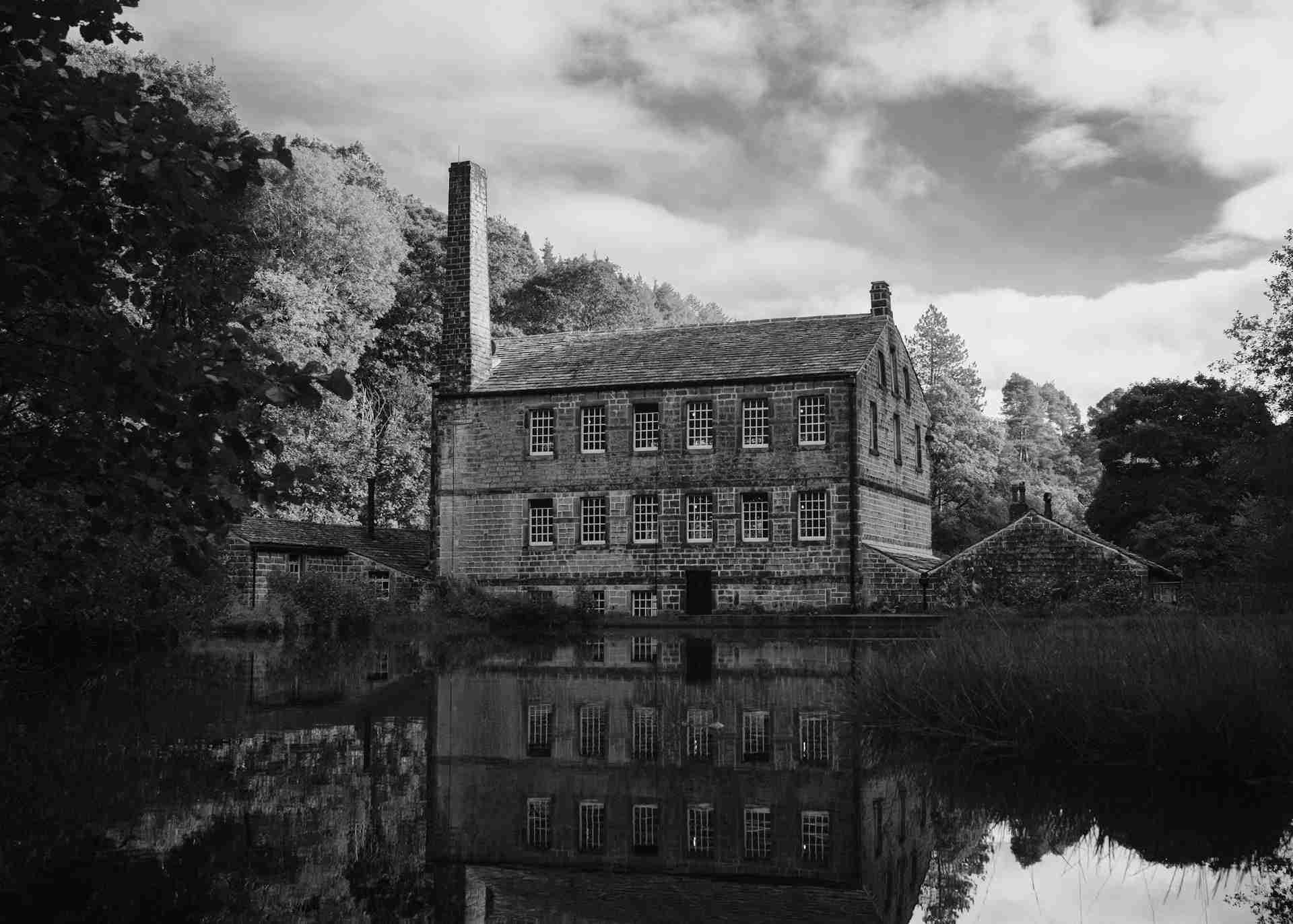
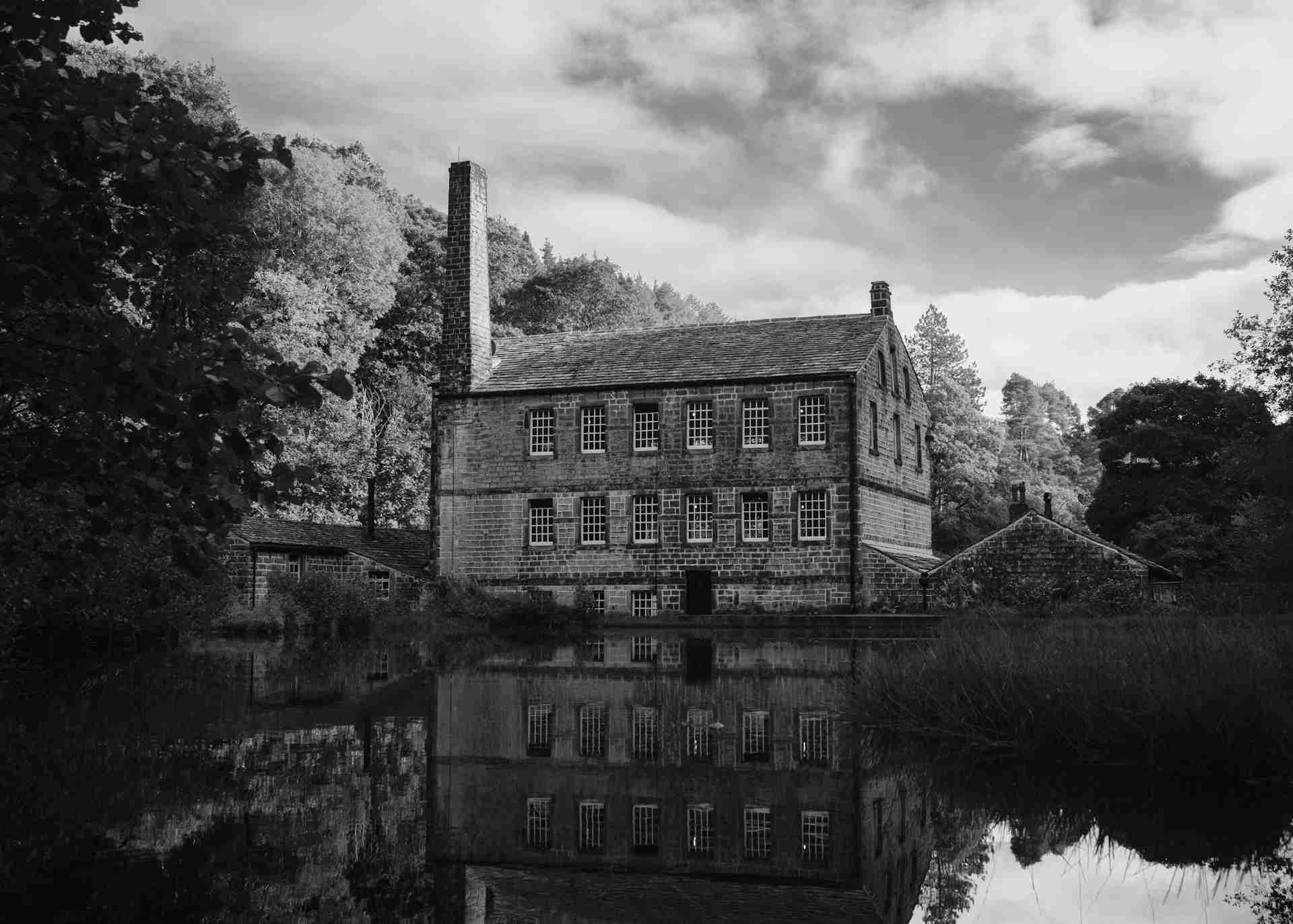
Deep in a wooded valley near Hebden Bridge, Gibson Mill stands as a stone sentinel to Britain's industrial past, mirrored in a quiet pond and framed by ancient woodland. Located within the National Trust's Hardcastle Crags estate, the 19th-century cotton mill offers a fusion of architectural interest, atmospheric reflection, and natural surroundings. Its photogenic appeal lies in the convergence of water, forest, and heritage—where symmetrical stonework is softened by moss, mirrored in still water, and dappled by shifting woodland light. For photographers seeking moody compositions, environmental storytelling, or seasonal diversity, Gibson Mill delivers a deeply textured and contemplative location nestled in the heart of Yorkshire's landscape.
Best Photography Opportunities
• Reflections in the Mill Pond
The still pond directly in front of Gibson Mill provides a natural mirror, perfectly suited for capturing symmetrical compositions. In early morning or on windless days, the reflection of the mill's windows and stone façade is nearly uninterrupted, allowing for clean, geometric compositions that feel both timeless and meditative. Position yourself at water's edge or slightly elevated along the footpath to frame both the mill and its reflection in a balanced manner. A wide-angle lens in the 16–24mm range works well here, but consider a longer focal length to compress the vertical lines for a more graphic result. Autumn and winter often add rising mist over the pond, introducing layers of atmosphere that can be accentuated with longer exposures.
• Low-Light Woodland Framing
Approaching the mill from the woodland trail provides excellent opportunities for using trees, moss-covered stone walls, and fallen logs as natural frames. The path winds through mixed broadleaf woodland, allowing you to shoot through partial clearings and create compositions that contrast the straight lines of the mill with the irregular textures of the forest. Early morning and late afternoon light filtering through the canopy adds warm highlights and soft shadows that can be used to create depth. Use an aperture between f/4 and f/8 to control depth of field depending on how much of the foreground detail you want to retain, and experiment with slight lens tilt for a dynamic perspective that evokes motion and discovery.
• Details of Stone, Iron, and Decay
While the mill building itself is in excellent condition, many of the surrounding elements—such as old gateposts, retaining walls, iron railings, and staircases—retain a patina of weathered use. These provide outstanding material for close-up and detail-oriented work. With a fast 50mm or 85mm lens, isolate features like riveted hinges, flaking paint, or creeping ivy climbing the outer stone walls. Early in the day or after a rain shower, surfaces become darker and more reflective, giving stone and metal an added dimension. Convert to black-and-white in post to focus attention on line, form, and contrast when color becomes a distraction.
• Seasonal Color and Forest Canopy
The surrounding woods at Hardcastle Crags change dramatically with the seasons, offering vibrant greens in spring, golden canopies in autumn, and frost-laced minimalism in winter. Shoot wide and high from the trails above the mill to capture the building nestled within this living landscape. Spring offers vibrant color contrast as the new growth creeps down the hillsides; autumn delivers the richest tonal variety as orange and russet leaves frame the mill like a natural vignette. Use a circular polarizer to manage glare on wet leaves and enhance saturation without over-editing.
• Stream and Waterfall Long Exposures
A short walk upstream from the mill brings you to sections of Hebden Water where small cascades and rocky pools are ideal for long-exposure work. Using a 6-stop ND filter and tripod, you can blur the water's surface to a silky flow that contrasts with the sharp rocks and tangled roots. Frame the mill in the background where possible, or focus purely on the natural elements for a change in visual tone. These water features are most active after rainfall and are especially photogenic in low, moody light when the scene takes on a painterly texture.
Best Time to Visit
Gibson Mill offers photogenic conditions year-round, with each season delivering unique light and compositional themes. Spring, from April to early June, brings vibrant new growth, fresh moss, and brighter greens that contrast with the slate-gray of the mill's stonework. Morning light filtering through the forest canopy casts dappled shadows across the trail and the pond, creating beautifully complex lighting patterns.
Summer is ideal for shooting under full foliage when the surrounding trees form a green vault around the mill. The pond tends to be at its calmest early in the morning, before foot traffic disturbs the scene. Visit midweek or early in the day to avoid crowds. Use the dense foliage to your advantage by incorporating leaf textures and sun-flecked shadows into your compositions. However, harsh midday sun can flatten textures—cloudy days or golden hour light are preferable.
Autumn is the most dramatically colorful time of year, especially from late September through October. Golden leaves reflect in the pond, and the shifting light gives each hour a distinct visual signature. Low fog and diffused light enhance the reflective quality of the water and the roughness of the mill's stone walls. Even on overcast days, the area retains a rich tonal depth.
In winter, especially after a frost or light snowfall, the site transforms into a quiet, monochrome environment. Ice often forms at the pond's edge, and the bare trees reveal more of the mill's lines and structure. Low sun and long shadows dominate much of the day, offering excellent opportunities for contrast-driven compositions.
The best times of day to visit are morning and late afternoon, when light rakes across the valley and creates dramatic interplay between illumination and shadow. Mist and moisture are common in this sheltered environment, especially after rain, and they lend softness and dimensionality to both landscape and architectural shots.
How to Get There
Gibson Mill is located within Hardcastle Crags, a National Trust site approximately 2 miles north of Hebden Bridge in West Yorkshire. From the center of Hebden Bridge, follow the A6033 north and turn onto Midgehole Road, which leads to the main visitor car park. From there, the mill is reached via a scenic 1.5-mile walk along a well-maintained woodland trail that follows Hebden Water upstream. The walk is gradual and suitable for carrying camera gear, though proper hiking shoes are recommended due to occasional mud and stone steps.
Public transport is also convenient. Hebden Bridge is served by regular trains from Leeds and Manchester, and local buses can drop visitors near the estate entrance. From the road, follow signs into Hardcastle Crags and continue on foot.
There is no entrance fee to access Gibson Mill or the surrounding grounds, though parking at the National Trust car park may require a fee. The site is open year-round during daylight hours, though opening times for the visitor center or café within the mill may vary seasonally. Tripods are welcome throughout the estate, but be mindful of footpath width and other walkers, particularly on busy weekends.
Recommended Photography Gear
Photographing Gibson Mill requires a kit suited to changing forest light, reflective water surfaces, and fine architectural details. A full-frame camera with strong dynamic range is ideal to capture the subtle shifts between shadow and sun. Pair it with a wide-angle lens (16–35mm) for full pond reflections and forest compositions, and a mid-range zoom (24–70mm) for tighter framing of the mill in context. A fast 50mm or 85mm prime is useful for texture studies and close-up detail work.
A lightweight but sturdy tripod is essential, especially for early morning long exposures or woodland shots under canopy cover. Circular polarizers help manage glare on water and foliage, while ND filters (6- and 10-stop) will allow for creative shutter control when photographing moving water or aiming to smooth pond surfaces. A lens hood is also recommended, as light through the trees can be directional and cause flaring during low sun hours.
Bring a lens cloth and rain cover for both your camera and bag—moisture is frequent, especially along the stream and in misty conditions. A compact LED panel or directional torch can help add light to shadowed details or for light painting during blue hour. For drone users, note that flying is not permitted within the National Trust property without specific permission.
Nearby Photography Locations
The wider estate includes miles of paths through dense beech and oak woodland, offering everything from misty forest scenes to streamside compositions. In autumn, the color and contrast in the leaf canopy make these trails a rewarding subject on their own.
• Hebden Water and the stepping stones
Just downstream of Gibson Mill, a series of large stepping stones cross Hebden Water, providing strong foreground geometry and opportunities for long exposures. After rain, the water here moves quickly, creating dynamic compositions.
Perched on a hill above Hebden Bridge, this ancient village features cobbled streets, stone cottages, and two adjacent churches—one in ruins. It's ideal for moody, historic compositions and black-and-white treatments, especially under soft cloud cover.
A few miles to the south, this towering hilltop obelisk offers panoramic views over the Calder Valley. It's best photographed at sunset or during dramatic weather conditions, where light and shadow roll across the ridgelines.
A short drive east, this picturesque fall is hidden in a small gorge surrounded by mossy rocks and trees. It's ideal for intimate landscape work using slow shutter speeds and natural color palettes, particularly in spring and autumn.
Gibson Mill invites a slower, more intentional approach to photography—where mood, texture, and place unfold over time. Surrounded by water, stone, and ancient trees, it rewards those who linger: waiting for light, watching the mist rise, or finding the quiet detail in a moss-lined wall. Whether you're capturing still reflections or exploring forgotten textures in the shadows, this timeless mill remains one of Yorkshire's most quietly evocative photographic locations.
Comments
Loading comments…