
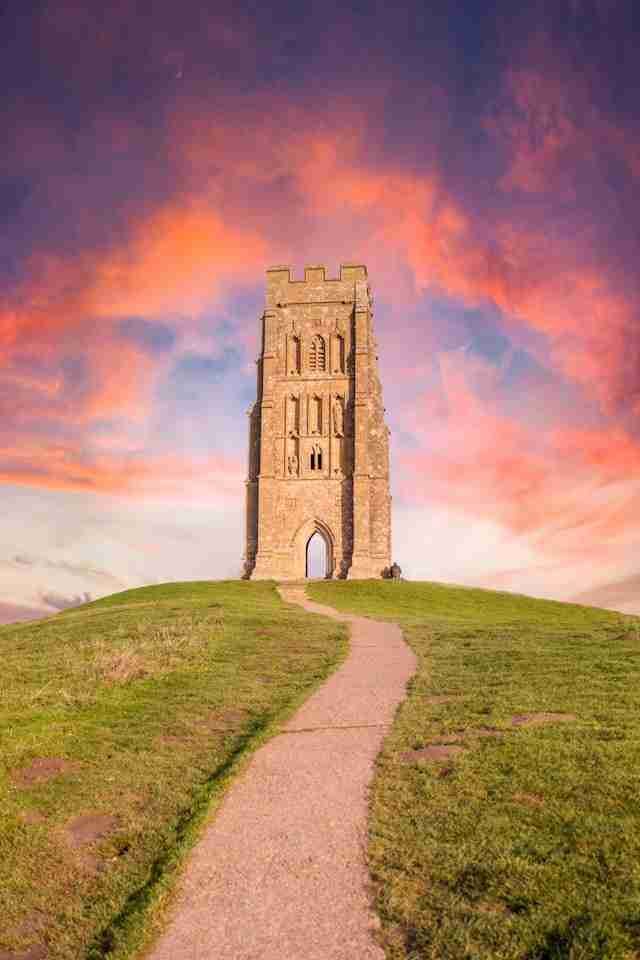
Rising steeply above the surrounding Somerset Levels, Glastonbury Tor is one of Britain's most enigmatic and photogenic landmarks. Crowned by the solitary stone tower of St. Michael's Church, the Tor commands sweeping 360-degree views across the countryside, standing as a silhouette against sky, mist, and rolling land. Steeped in myth and spiritual lore—from King Arthur to Avalon—this ancient hill is more than just a landscape feature; it's a powerful icon that blends natural drama with cultural depth. For photographers, Glastonbury Tor presents an ideal convergence of mood, isolation, and elevated light, offering both wide-scope landscapes and minimalist graphic compositions.
Best Photography Opportunities
• Silhouette and sunrise from the base footpath
The eastern footpath leading up to Glastonbury Tor is one of the most visually rewarding routes for early morning photography. As you ascend, look back and down the slope for wide, expansive views of the Somerset Levels, but it's turning your attention uphill that offers a chance at an iconic silhouette shot. From just below the summit, especially in spring and autumn, the rising sun often appears directly behind the tower of St. Michael's Church. This creates a clean, dramatic silhouette that emphasizes the tower's Gothic form against a gradient sky. Low fog and frost frequently settle in the valley below, providing a luminous base layer of atmosphere. Use a tripod, a mid-range zoom for flexibility, and bracket exposures to manage the extreme contrast between bright sky and dark foreground. On misty mornings, the silhouette becomes even more mysterious—an image that conveys both place and myth with minimal elements.
• Elevated 360-degree views from the summit
Once atop Glastonbury Tor, the hill's prominence becomes evident as the landscape falls away in every direction. This is one of the few locations in Somerset where you can shoot clean, horizon-level panoramas in a full circle. The distant Mendip Hills to the north, the moors to the south, and the patchwork farmland below offer layered compositions that work well with wide-angle lenses. During golden hour, the low sun casts long shadows from the tower across the grass, adding texture and dimensionality to the foreground. You can also use the tower itself as a framing device: positioning subjects in its arched doorway or shooting outward through it can add architectural structure to wide landscape shots. Telephoto lenses compress the layers of distant farmland, while a fast prime captures detail in the tower's stonework with soft light spilling over the hilltop.
• Low-lying fog and inversion from the north
Some of the most surreal and memorable images of Glastonbury Tor come from locations north of the hill, particularly during early mornings when ground fog fills the low-lying fields. From rural lanes near Wick Hollow or small clearings along Wellhouse Lane, you can photograph the Tor emerging from the mist like an island in a cloud sea. The effect is strongest in spring and autumn, especially following a clear, still night. A 70–200mm or longer telephoto lens allows you to isolate the Tor and compress the background into layers of tone and haze. These conditions often last only minutes before the sun burns off the fog, so pre-dawn scouting is essential. For compositions that emphasize scale and distance, include layers of hedgerow or farm structures in the foreground to show the separation between ground and peak.
• Minimalist long exposures from Wearyall Hill
Wearyall Hill offers a clean side-on view of Glastonbury Tor across a gentle dip in the landscape. This perspective is ideal for long exposure photography, particularly at twilight or under overcast skies when you want to simplify the image and emphasize mood over detail. With an ND filter, you can smooth passing clouds into streaks or soften a fog bank to create an ethereal veil around the hill. Use a long focal length to flatten the landscape and compress the tower into a sharper silhouette against the sky. In winter, when the fields are bare, the Tor's shape stands out starkly against the sky—perfect for black-and-white work that highlights geometry and atmosphere. This angle also avoids the summit crowds and lets you work uninterrupted, even at popular times.
• Close architectural and texture studies of St. Michael's Tower
The tower that crowns the Tor is the remaining fragment of a 14th-century church, stripped down to its barest structure. It offers rich opportunities for architectural photography and textural close-ups. The interior is open to the sky, allowing for compositions that contrast stone archways with clouds or sun flares. The surfaces are deeply weathered, with lichen-covered corners, tool marks in the stone, and graffiti etched over generations. A fast prime or short telephoto lens works well here, allowing you to shoot wide open in low light and isolate details with shallow depth of field. Early or late in the day, the tower's edges are rimmed with golden light, while its carved elements cast deep shadows. Consider composing through the arched openings, either looking down toward the town or up into sky, to blend structure with open space in a single frame.
Best Time to Visit
Glastonbury Tor changes dramatically with season and light, rewarding repeat visits and timing precision. Spring, from March through May, offers green slopes and frequent morning fog—especially after clear, cool nights. Early flowers and freshly plowed fields below add detail to wide compositions. Fog inversions are most common in April and early May, and early mornings after a chilly, still night offer the best chance of mist holding into sunrise.
Summer brings longer daylight hours, lusher vegetation, and more foot traffic. While midday light can be harsh, early morning and late evening offer beautiful low-angle light that grazes the tower and fields. Sunset sessions benefit from warm, pastel skies and clearer air, though haze can diffuse contrast on hot days.
Autumn is perhaps the most photogenic season, with dry atmospheric conditions creating long views, enhanced color, and consistent fog. Trees around the base of the Tor shift into yellow and orange tones, offering color contrast in mid- and long-range compositions. Early morning fog returns as temperatures drop, creating recurring opportunities for silhouette and inversion photography.
Winter introduces starkness and minimalism—bare trees, snow dustings, and steely skies. These conditions are ideal for black-and-white work or contemplative compositions with a stronger narrative tone. Shorter days bring golden hour light earlier and more predictably, while the subdued palette adds visual quietness to compositions from all angles.
How to Get There
Glastonbury Tor is located just east of the town center of Glastonbury in Somerset, UK. For visitors arriving by car, the most straightforward parking is at the Glastonbury Town Centre car parks, or at the bottom of Wellhouse Lane where a small free car park provides closer access to the main trailhead. From here, it's a 10- to 15-minute walk up a paved and well-maintained footpath to the summit.
If traveling by public transport, buses run to Glastonbury from larger towns like Wells, Taunton, or Bristol. The nearest train stations are in Castle Cary and Bridgwater, both requiring a bus or taxi transfer. Local taxis are available, though advance booking is advisable if shooting during early or late hours.
Access to the Tor is free and open year-round. The ascent is gradual but can be slippery in wet or frosty weather. Paths are narrow in places and can become crowded during weekends or peak tourist season. For sunrise and fog photography, early arrival is key. The area around the summit is exposed, so wind conditions should be factored in for gear stability and comfort.
Recommended Photography Gear
Photographing Glastonbury Tor involves a mix of elevation, changing light, and atmospheric conditions—requiring a thoughtful, lightweight kit. A wide-angle zoom (16–35mm) is critical for landscape frames from both the base and summit, especially to capture sunrise compositions and 360-degree views from the top. A mid-range zoom (24–70mm) is excellent for balanced environmental portraits of the tower or layered landscape shots across the Levels.
A telephoto lens (70–200mm or longer) is essential for fog compression, isolating the Tor from nearby hills, and working from distant vantage points like Wick Hollow or Wearyall Hill. For texture studies and architectural close-ups at the summit, a fast prime (35mm or 50mm) is ideal in low light or when wind makes tripods impractical.
A sturdy but lightweight tripod is important for long exposures at blue hour or in fog conditions, especially from distance viewpoints. Use a remote release or camera timer to reduce vibration. A circular polarizer can help cut haze and enrich sky gradients, while a 3- or 6-stop neutral density filter expands creative control during daylight long exposures. Pack a microfiber cloth—fog and wind-blown moisture are common.
Footwear with traction is essential, as paths can be steep and slippery. Dress in layers for pre-dawn and winter shoots, and consider fingerless gloves for manual camera control. A rain cover and weather-sealed backpack ensure gear remains protected during the frequent shifts in Somerset weather.
Nearby Photography Locations
Situated just below the Tor, this tranquil garden space features stone pathways, sacred springs, and richly colored foliage. Best for macro detail, soft water compositions, and contemplative documentary work in filtered light.
Offers lateral, distant views of Glastonbury Tor with open sky and uninterrupted line of sight. Ideal for silhouette compositions and minimalist long exposures, especially at sunset or during winter mists.
• Somerset Levels and Westhay Moor
The surrounding wetlands offer broad horizons, reed beds, and dramatic skies. Best for expansive landscape work, especially with telephoto lenses and long perspectives back toward the Tor.
• Wells Cathedral and Vicars' Close
A short drive away, Wells offers some of the most detailed Gothic architecture in the UK. The cathedral's west front is ideal for architectural elevation shots, while Vicars' Close provides perfect perspective lines in soft afternoon light.
Another hilltop church ruin located about 30 minutes southwest, Burrow Mump provides a complementary composition with wide views across the Somerset countryside. Excellent for comparative studies or a two-location shoot in a single day.
Glastonbury Tor is a subject that invites repetition. No two visits yield the same result—fog moves, light shifts, and wind reshapes each scene. It's a place that offers not just scale, but symbolism, giving photographers the opportunity to create images that feel timeless, personal, and charged with meaning beneath the surface.
Comments
Loading comments…