
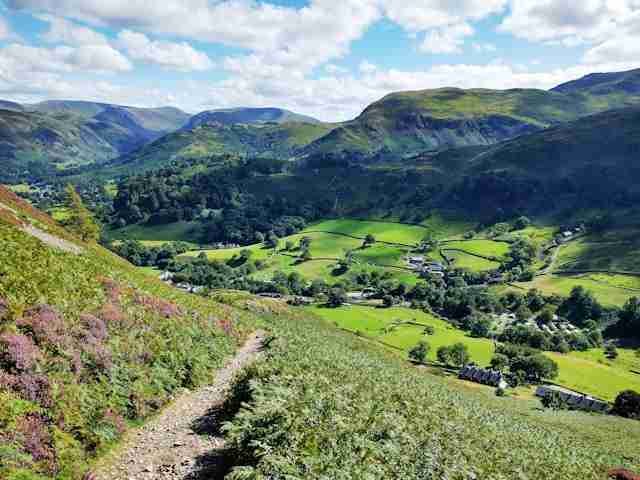
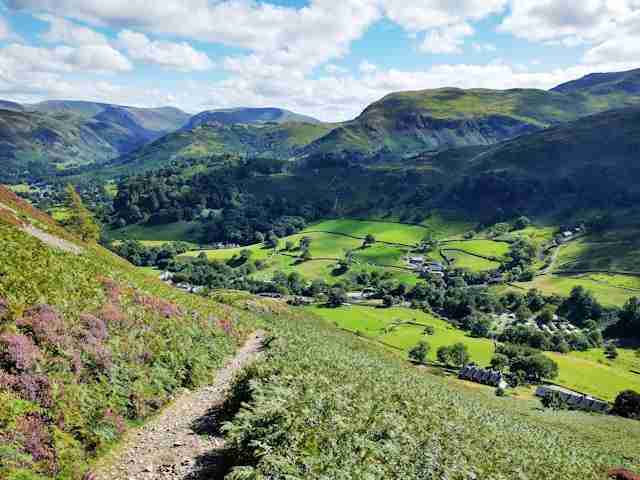
Nestled above the western shore of Ullswater in the Lake District, Glenridding Dodd offers one of the most rewarding low-elevation climbs for photographers seeking moody ridgelines, mirror-like water, and ever-changing light. Despite its modest height, this fell delivers expansive views that stretch from the pastoral village of Glenridding to the steep flanks of Helvellyn and down the sinuous length of Ullswater. The setting is intimate yet vast—perfect for those who want to capture layered landscapes, atmospheric weather shifts, and the interplay between light and topography that defines Cumbria's unique visual character. Glenridding Dodd offers scenes that unfold slowly, making it a location that rewards careful timing and a patient eye.
Best Photography Opportunities
• Ullswater from the Eastern Shoulder
One of the most striking compositions from Glenridding Dodd is the view northeast over Ullswater as it bends past the wooded shoreline of Gowbarrow Park and disappears toward Pooley Bridge. This layered vista works beautifully in both wide-angle and telephoto perspectives. During early morning, mist often lingers above the lake's surface, creating dreamy tonal separations between the hills, water, and sky. Long lenses can compress these layers for dramatic depth, while a wide lens from the summit captures the curvature of the landscape with leading lines that pull the eye down the valley. When clouds break post-rain, shafts of light often illuminate isolated parts of the lake or foreground bracken—ideal conditions for dynamic compositions with contrast and atmosphere.
• Foreground Bracken and Ridge Textures
In summer and autumn, the slopes of Glenridding Dodd are cloaked in thick bracken that turns from rich green to deep amber. These foregrounds provide beautiful texture when shot wide and low, especially during golden hour when side lighting creates luminous depth. Combining the undulating ridge with soft vegetation and distant peaks, especially when backlit, delivers a classic Lakeland feel without relying on high elevation. Autumnal color contrast between golden bracken and dark conifers across the lake adds a layer of natural harmony that's especially effective in panoramic stitches.
• Helvellyn Range in Shifting Light
Looking west and southwest from Glenridding Dodd, the Helvellyn range dominates the horizon. This rugged backdrop—often shrouded in cloud or catching last light—is a powerful compositional element, particularly during late afternoon. The varied forms of Birkhouse Moor, Catstye Cam, and Helvellyn itself rise like a jagged wall. Using a mid-telephoto lens (70–135mm) to isolate these features under changing light is highly effective. Rain squalls, breaks in cloud cover, or golden rays through mist lend themselves to high-drama landscape shots. This is a place where photographers should bracket exposures frequently, as the range shifts between shadow and illumination with striking rapidity.
• Stone Outcrops and Framing Elements
The fell's summit and shoulders feature several small stone outcrops that serve as excellent framing elements for more intimate compositions. These weathered rocks are coated in moss and lichen, and can be used to anchor the foreground of wide landscapes or serve as subjects themselves in abstract studies of texture and form. Shooting at f/8–f/11 with hyperfocal focus ensures both foreground detail and distant ridgelines remain sharp. Early morning dew or frost adds a silvery sheen that works well in low-contrast scenes, especially under overcast skies that soften dynamic range.
• Twilight and Winter Minimalism
In winter or during the shorter days of late autumn, Glenridding Dodd offers minimalistic compositions that take advantage of low sun angles and snow-dusted ridgelines. Blue hour and twilight conditions lend the lake a cold, reflective quality, especially on still evenings. The tree-covered lower slopes can create strong silhouettes, while the fell's elevation allows for clean horizon lines that work well in wide panoramic formats. A long exposure at twilight from the eastern side of the summit can turn Ullswater into a silken band flanked by darkened hills, ideal for moody, painterly landscape studies.
Best Time to Visit
Each season transforms Glenridding Dodd in ways that affect both the aesthetic and the technical approach to photography. Spring, from March to early June, offers fresh bracken, scattered wildflowers, and crisp visibility. Morning mists are common and usually lift between 7 and 9 a.m., providing a short but magical window where the landscape feels suspended in time. Sunrise arrives from the northeast, gradually illuminating the ridgelines and lake surface in golden light.
Summer, though busier in the village below, provides long days and consistent lighting conditions. Afternoon light is particularly strong for views toward Helvellyn, and golden hour near solstice can extend well past 9:30 p.m. during clear evenings. Bracken is at its peak and grasses catch backlight in luminous strands, especially just before dusk. This is also the best time for shooting handheld with lighter gear, as conditions are more predictable.
Autumn is the most color-rich season, with Ullswater's shoreline trees turning bronze, gold, and russet. From late September to early November, fog banks roll off the lake in the mornings and soft rain often adds a low-gloss finish to stone and bracken. The light is low and angled throughout the day, making even mid-morning suitable for serious shooting. Autumn winds also move clouds quickly through the fells, allowing for dramatic time-lapse or long-exposure work.
Winter sees a drastic drop in foot traffic and brings a sense of solitude. Snowfall on surrounding peaks provides tonal contrast and a high dynamic range between lake, rock, and sky. Short daylight hours (especially in December and January) mean that planning is essential—sunrise and sunset happen quickly, and light can vanish behind Helvellyn earlier than expected. Still, the reward is a minimalist, almost graphic landscape, ideal for thoughtful black-and-white or desaturated imagery.
How to Get There
Glenridding Dodd rises directly above the village of Glenridding on the western shore of Ullswater in the Lake District. From Penrith, take the A592 south along Ullswater—this scenic drive winds along the lake and takes approximately 25 minutes. Parking is available in Glenridding village, either at the pay-and-display car park near the tourist center or along the quieter Greenside Road toward the trailhead.
To access the fell, begin at the gate near Rake Cottages on Greenside Road. A clearly marked but moderately steep footpath climbs through mixed woodland before emerging onto open fellside. The ascent to the summit takes around 30–40 minutes depending on fitness and gear weight. The final approach includes uneven rock steps and loose gravel—sturdy hiking boots are recommended, particularly after rain. While the route is short, it offers varied shooting angles along the way, so allow extra time for compositions both on the way up and during descent.
Tripods are easily manageable on the summit plateau, and the open views allow for 360-degree shooting. Be cautious in high wind, as gusts coming off the lake can be sudden and forceful. There are no facilities on the fell, but Glenridding village offers cafes, restrooms, and a few local shops where you can prepare before heading out.
Recommended Photography Gear
Given the steep but brief ascent and the diverse conditions at the top, your gear choices for Glenridding Dodd should emphasize portability, stability, and adaptability. A mirrorless or DSLR body with excellent weather sealing and strong dynamic range is ideal for managing the changing skies and variable light common in the Lake District.
A wide-angle zoom (16–35mm or equivalent) will be your primary lens for capturing broad lake views and dramatic ridgelines with strong foreground elements. Use it for low-angle shots through bracken or stone-framed landscapes. A mid-range zoom (24–70mm or 24–105mm) is perfect for versatile work, including handheld scenes along the trail and layered landscapes that include both lake and fell. A 70–200mm telephoto or lightweight prime in the 85–135mm range allows you to isolate mountain textures and patterns on Helvellyn or compress the lake's bends and bays into tightly framed compositions.
A compact tripod is essential for blue hour work, long exposures, and careful compositions at the summit. Opt for a carbon fiber model with a reliable ball head to balance strength with ease of transport. Graduated neutral density filters are useful for balancing sky and ground, especially at sunrise or sunset, while a polarizing filter enhances reflections on Ullswater and helps reduce atmospheric haze in backlit mountain scenes.
Also bring microfiber cloths, lens wipes, and a rain cover—even clear days can shift quickly in this region. A remote shutter release or intervalometer is useful for bracketing, long exposures, or time-lapse. If you plan to shoot through golden hour into twilight, pack a headlamp for the descent and consider gloves during cooler months, as windchill increases sharply on exposed slopes.
Nearby Photography Locations
Just across Ullswater, Place Fell offers panoramic views back toward Glenridding Dodd and down the lake's eastern shore. The ascent is longer but the visual rewards are immense, especially in morning light when the sun rises behind Glenridding Dodd and throws long shadows across the water. Its summit provides classic Lakeland layering with dramatic depth and excellent cloud movement.
A 10-minute drive north along the A592, Aira Force is a dynamic contrast to the open fells. The waterfall cascades through a deep wooded gorge, offering dark, moody compositions and close-up water detail. Tripod work here benefits from longer exposures, and in autumn, the surrounding forest glows with saturated leaf color.
• Grisedale Valley
To the west of Glenridding Dodd lies Grisedale Valley, a glacial trough that stretches beneath the Helvellyn range. The valley offers quiet trails, reflective tarns, and dramatic converging lines that work well in overcast light. It's an ideal setting for moody, layered compositions and low-key mountain studies.
South of Glenridding, Brothers Water is a small lake flanked by steep fells and ancient woodland. It's especially appealing in calm conditions when reflections double the drama of sunrise or sunset. Reedbeds and shoreline trees provide strong foreground interest, and morning mist often settles here in photogenic bands.
Glenridding Dodd may be small in stature, but it delivers a sweeping array of photographic opportunities that reward timing, observation, and sensitivity to changing light. Its combination of accessible elevation, dramatic vistas, and layered foregrounds makes it a valuable subject for landscape photographers seeking a scene that feels vast without demanding a mountain expedition. Whether shrouded in mist, glowing at golden hour, or stripped back by winter frost, Glenridding Dodd remains a fell where the light always has another story to tell.
Comments
Loading comments…