
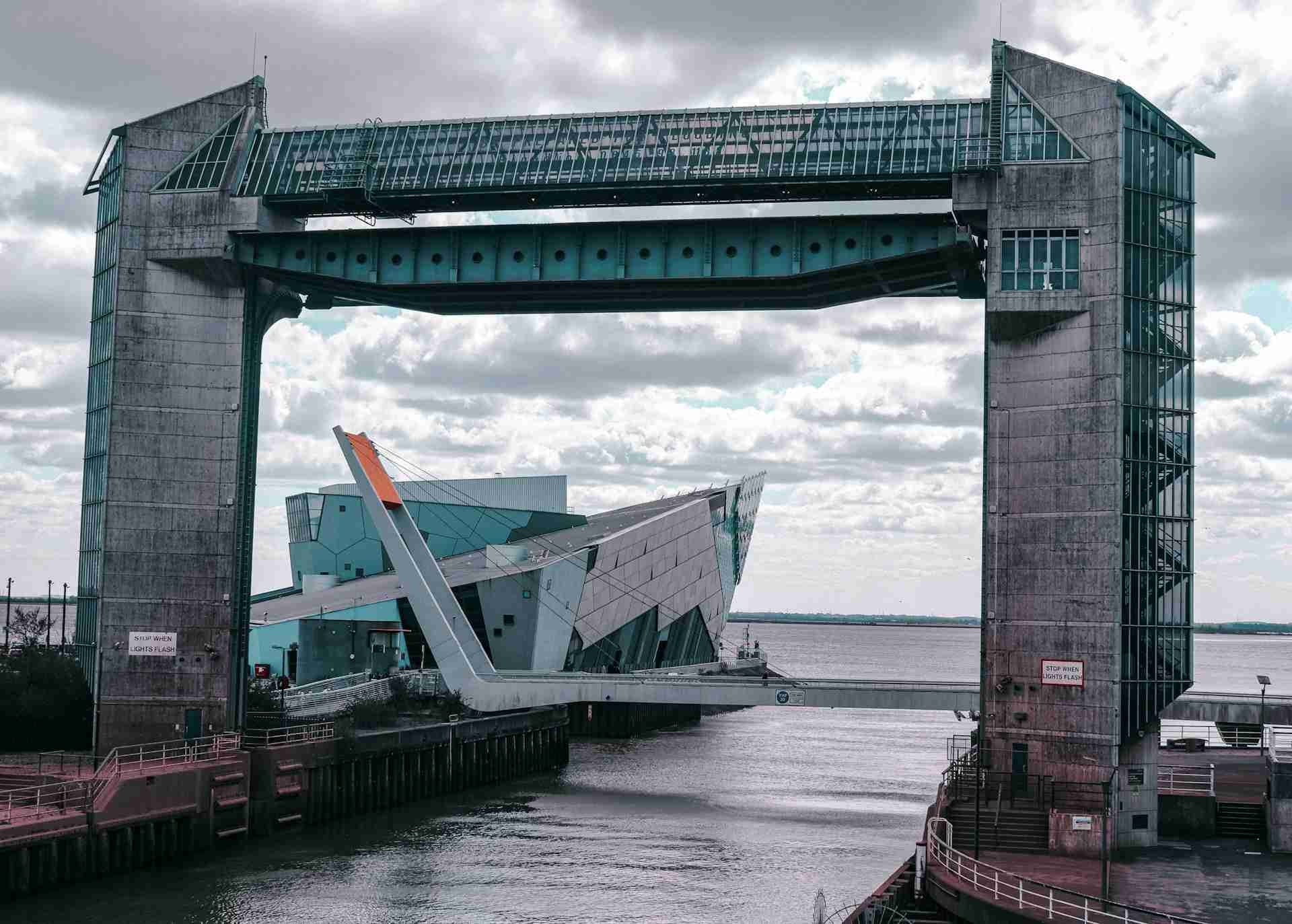
At the meeting point of river and estuary, where the River Hull flows into the Humber, the Hull Tidal Surge Barrier—commonly referred to as the Hull Tidal Gate—stands as a striking monument to both engineering and resilience. Constructed to protect the city from flooding during tidal surges, the gate is more than just functional—it's a commanding visual presence that dominates the skyline of Hull's historic Old Town waterfront. For photographers, it offers a rare blend of hard-edged industrial architecture, reflective water surfaces, and atmospheric skies shaped by the North Sea's influence. Whether you're shooting minimalist studies of form and line, or capturing dramatic long exposures as weather systems churn over the estuary, the Hull Tidal Gate is a location where infrastructure becomes art.
Best Photography Opportunities
• Symmetrical Views from Scale Lane Bridge
: The most iconic vantage point for photographing the Hull Tidal Gate is from Scale Lane Swing Bridge, which gives a direct, symmetrical view up the River Hull. From here, the structure's steel arms form a striking visual gateway over the river, particularly effective when centered within the frame. To maximize symmetry, align the horizon perfectly and let the river act as a mirror, reflecting the full height of the gate and amplifying its presence. Shooting at blue hour or during calm early mornings enhances the clarity of the reflection. Use a tripod and a narrow aperture for maximum depth of field, and consider bracketing exposures to balance the darker steelwork with the brighter sky. In winter, with mist clinging to the water, the scene becomes moody and cinematic.
• Minimalist Abstracts from the Eastern Bank
: From the quiet paths along the eastern bank, just below the gate, you'll find opportunities to create tightly framed abstracts and industrial minimalism. Get close to the structure's exposed underbelly, where metal beams intersect with support columns, hydraulic pistons, and gantry arms. These components become compositional elements in their own right, especially when framed against heavy skies. A medium to long telephoto lens (85mm–200mm) will allow you to isolate angles, curves, and mechanical detail, making use of negative space to emphasize form. Overcast or stormy weather enhances the visual weight of the metal, especially in black-and-white processing. Use a polarizing filter sparingly to manage reflections without dulling the subtle texture of the steel.
• Golden Light on the Humber Waterfront
: The best ambient light occurs when the sun is low in the sky—particularly in the evening when golden light flows across the Humber estuary and kisses the tidal gate's western flank. Set up on the marina side of the river to look southeast and capture this warm glow reflecting off the metal and glass surfaces. The lighting is soft but directional, casting long shadows that enhance the angular design. Including older brick buildings or dock cranes in your composition can help juxtapose the new with the historic. A wide-angle lens (16–35mm) lets you incorporate foreground interest like bollards, ropes, or cobbled paving stones, anchoring the modern structure in its gritty, urban context.
• Long Exposures under the Barrier
: For a more dramatic approach, shoot from directly beneath or just beside the barrier using long exposure techniques. When the tide is high and the river is moving swiftly, the structure takes on a surreal, almost sculptural quality when paired with silky water and streaking clouds. A 10-stop neutral density filter is essential to extend exposure time to 30 seconds or more, especially during daytime. These long exposures transform the gate from a static object to part of a kinetic environment. Compositionally, use the vertical lines of the structure to draw the eye upward, and experiment with low angles to exaggerate scale. Sunset or heavy cloud cover adds a sense of drama and deepens shadows in the undercroft.
• Architectural Night Shots with Urban Context
: When darkness falls, the Hull Tidal Gate becomes a beacon in the cityscape. Floodlit from below and flanked by glowing streetlamps and the ambient lights of nearby bridges, it's an ideal subject for urban night photography. The surrounding footpaths and Old Town streets add character to wide shots, while reflections from the river double the structure's luminosity. Use a tripod and shoot at ISO 100–400 to keep noise levels low, and stop down to f/8–f/11 for sharpness and starburst effects from point lights. Including human figures walking along the riverside or ghosted light trails from boats adds life to the frame and emphasizes the scale of the structure. For tighter architectural studies, switch to a fast prime and explore patterns of light and shadow cast by the barrier's ridged surfaces.
Best Time to Visit
The Hull Tidal Gate is accessible and photographically active year-round, but timing is crucial for capturing its best moods. From late autumn through early spring, you'll often find dramatic skies and low, raking sunlight—conditions that suit the angularity of the structure perfectly. These months also bring unpredictable weather, including fog, storms, and rain squalls, all of which heighten the atmosphere and allow for powerful long-exposure compositions.
Summer offers longer shooting windows and warmer golden hours, though the light can be flatter during midday. Early morning is especially productive in the warmer months, when the river is calm and the city quiet. Because the tidal gate is not raised regularly, dramatic action shots are rare unless coinciding with a test or surge event; however, tide charts are still worth checking, as low tide reveals more of the riverbanks and foreground textures, while high tide enhances reflections.
Blue hour and nighttime are particularly effective for urban and architectural photography. The structure is lit, and surrounding bridges and pathways are illuminated as well, making for vivid compositions where light and steel dominate the scene. Avoid midday unless shooting detail abstracts or scouting.
How to Get There
Hull's Tidal Gate is located at the southern terminus of the River Hull, where it meets the Humber Estuary, directly adjacent to Hull Marina and the city's Old Town. It is easily accessed on foot from the city center, with well-marked pedestrian routes leading from Whitefriargate, Scale Lane, and High Street. Public transportation links are excellent—Hull Paragon Interchange is a 15-minute walk away, offering both rail and bus access.
There is no cost to access the tidal gate or surrounding areas, and photography is permitted from all public walkways, including Scale Lane Swing Bridge and the surrounding embankments. The area is part of a larger revitalized waterfront district, so you'll also find benches, public art, and wide open views toward the Humber. Parking is available nearby at Humber Dock Street and High Street car parks, though both can be busy on weekends and during events.
While drone use is legally permitted in this area under certain conditions, it's advisable to check current CAA regulations and local restrictions due to the proximity of the port and pedestrian traffic. Tripods are safe to use and cause little obstruction due to the wide paths, but take care during high footfall periods.
Gear for Urban Drama and Waterside Geometry
For a location that combines industrial structure with changing natural light, a thoughtful selection of gear can help you unlock the full range of photographic possibilities. A wide-angle zoom (16–35mm) is essential for tight spaces and capturing the full scale of the tidal gate from below or across the river. A fast prime (like a 35mm f/1.4 or 50mm f/1.8) can be especially useful for low-light and night scenes around the Old Town, offering sharpness and shallow depth of field for detail work.
A solid tripod is a must for twilight and long exposure compositions—especially on the embankments, where water movement enhances the visual contrast with static architectural forms. ND filters (6- or 10-stop) will let you slow shutter speeds during the day for creative motion blur in sky or water. Polarizers can help manage reflections on the river and glass surfaces, but use them with care—too much polarization can flatten the scene unnaturally.
For abstracts and tighter compositions, a mid-range telephoto (70–200mm) will isolate structural elements, and a good weather-sealed body is helpful in the face of estuary winds or sea spray. If you shoot handheld at night, consider a camera with strong low-light performance and in-body stabilization to maintain flexibility. And don't forget a lens cloth—on windy days, mist and grime from the river can coat glass quickly.
Nearby Photography Locations
: Just downriver, the Humber Bridge offers one of the UK's most iconic suspension bridge views. Photograph it at dawn for silhouettes or use long lenses to compress its massive cables against the skyline. Sunset light often turns the river copper, creating a painterly effect.
: A few minutes' walk from the tidal gate, Hull Marina is filled with moored boats, dockside cafes, and reflections that make for rich twilight compositions. Use slower shutter speeds to smooth the water or catch golden reflections in the hulls of the boats.
• The Deep Aquarium
: An architectural landmark in its own right, The Deep resembles a ship's hull rising from the water. It pairs well with abstract, wide-angle compositions and works beautifully in long exposures, especially when clouds move quickly overhead.
: The surrounding area is packed with cobbled streets, Georgian buildings, and historic warehouses. Use golden hour or blue hour light to explore textures and shadows. Architectural details here contrast nicely with the modernity of the tidal gate.
• Victoria Dock Promenade
: East of the tidal gate, this quieter walkway offers uninterrupted views across the Humber and back toward the city skyline. Excellent for minimalist compositions, silhouettes, and watching the shifting light over the estuary's open waters.
The Hull Tidal Gate may be utilitarian in function, but visually it's a powerful subject—one that rewards photographers who know how to see form, light, and story in the built environment. From morning reflections to nocturnal urban drama, it invites you to slow down and study the evolving relationship between structure and sky. Whether you're a fan of industrial minimalism or looking to blend natural elements with the human-made, this riverside landmark proves that infrastructure can be just as inspiring as nature.
Comments
Loading comments…