
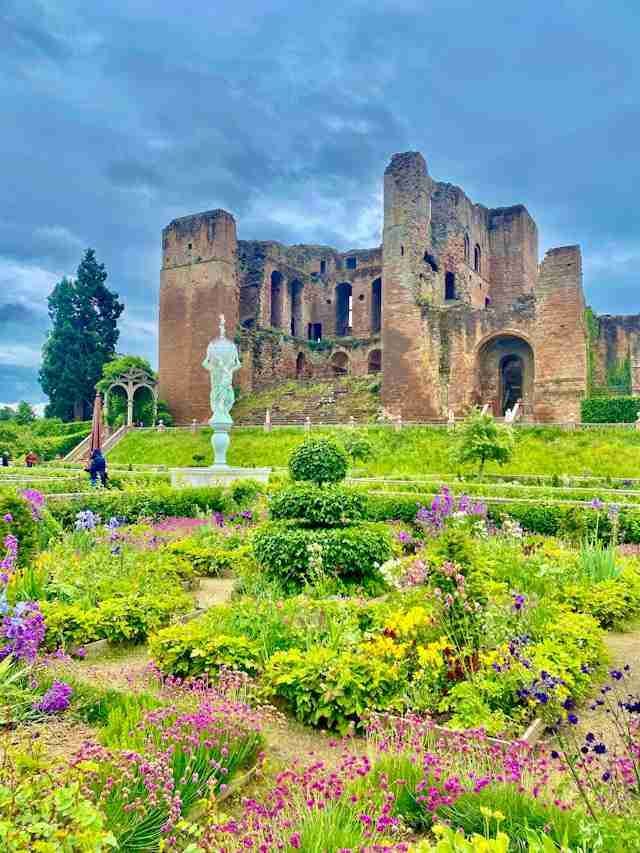
Kenilworth Castle rises from the Warwickshire countryside as a vast and weathered ruin, filled with centuries of political drama, architectural detail, and rich textures. Once one of England's most powerful medieval fortresses and later transformed into a luxurious Tudor residence, the castle today offers photographers a rare combination of monumental stonework, broken silhouettes, and restored garden symmetry. The nearby Elizabethan Garden, reimagined using period descriptions, provides an orderly counterpoint to the castle's fractured walls, with sculpted hedges, colorful flower beds, and a carved fountain at its heart. Together, the castle and gardens create a varied location full of strong compositions, layered historical elements, and changing light that shifts beautifully throughout the day and across the seasons.
Best Photography Opportunities
• The Outer Bailey and Curtain Walls
The open space of the outer bailey offers a panoramic view of the castle's defensive walls and broken towers. A wide-angle lens captures the scale of the surviving structures and allows for dynamic perspectives that include the surrounding grassy earthworks. Early morning and late afternoon light cast long shadows across the lawn, emphasizing the height and scale of the ruined curtain walls. From this position, you can also incorporate walkers or distant trees for depth and contrast. Slight elevation changes in the terrain help to vary your composition and create natural leading lines toward the castle itself.
• The Great Tower and Inner Court
At the heart of the site stands the massive Great Tower, one of the oldest surviving parts of the castle, dating back to the 12th century. Its height and fractured upper walls make it a strong vertical element within the more open, broken ruins of the inner court. A mid-range zoom lens is ideal for isolating architectural features such as arched windows, internal staircases, and the layered stone textures. Golden hour light filters through the open windows and catches on the edges of broken walls, highlighting the depth and scale of these medieval structures. Composing from just inside the entrance to the inner court provides framing that includes the tower while hinting at the space beyond.
• Views from the Leicester's Building
Climbing to the upper levels of Leicester's Building rewards you with elevated views over both the Elizabethan Garden and the castle grounds. From this perspective, you can create layered compositions that include hedges, fountains, ruined walls, and the distant countryside. Shooting in the late afternoon provides soft light that washes across the garden geometry and backlights distant hills. A polarizing filter helps manage glare on the fountain's water and enhances the saturation of garden colors. These high vantage points are also excellent for capturing people interacting with the site, creating visual stories that combine history and modern-day tourism.
• Elizabethan Garden Symmetry and Detail
The restored garden is designed around geometric planting beds, a central carved fountain, and tall wooden arbours, all enclosed within decorative hedges. It provides strong symmetrical compositions from nearly every angle, especially when viewed straight on from the central path. A standard zoom lens allows you to switch between wide garden overviews and tighter shots of blooming flowers, clipped hedges, and carved architectural elements. Morning light enters the garden from the east, casting soft shadows and highlighting early color, while the last hour before closing often provides golden backlight through the hedges and tall arbours. Macro opportunities also abound in spring and summer when the garden is in full bloom.
• Reflections and Ruins After Rain
Following a rain shower, puddles often form in the worn flagstones and depressions around the castle, providing opportunities for reflection photography. Shooting low to the ground with a wide-angle lens captures the castle mirrored in water, creating symmetry and adding depth. These conditions are most effective under overcast skies or just after a storm has passed when the light begins to return. Texture in the stone becomes more pronounced when damp, and the saturated colors of moss and lichen add contrast and vibrancy to close-up shots. A microfiber cloth and lens hood are helpful to manage spray and moisture during wet conditions.
Best Time to Visit
Kenilworth Castle can be photographed year-round, with each season offering unique qualities. Spring brings the Elizabethan Garden to life with fresh growth, colorful blooms, and soft light that enhances both the garden and castle grounds. Summer offers the most vibrant floral conditions, longer daylight hours, and stronger directional light late in the evening. Autumn provides rich tones in the surrounding trees, moody skies, and golden light that complements the red and brown stonework of the ruins. Winter, while colder and more exposed, brings misty conditions, stark tree silhouettes, and dramatic low-angle sunlight that emphasizes the structure and shadow of the ruins.
Time of day plays a significant role in shaping your images. Morning offers low, soft light ideal for shooting into the garden and along the eastern-facing walls. Midday light can be harsh, but it illuminates interior structures and cast shadows that reveal architectural shapes. Late afternoon and golden hour are perfect for wide landscape views across the outer grounds, when the castle walls glow with warmth and the sky takes on depth. Cloudy and overcast days are ideal for shooting texture, detail, and interior spaces without strong contrast.
How to Get There
Kenilworth Castle is located in the town of Kenilworth in Warwickshire, England, and is operated by English Heritage. By car, the site is easily reached via the A46 or A452, with brown tourist signs leading directly to the entrance. There is on-site parking available for visitors, including accessible spaces, and parking is free for members. The nearest train station is in Coventry, from which buses or taxis can complete the short journey to Kenilworth. Local bus services also connect the castle with surrounding towns, and it is possible to walk from Kenilworth town centre in under 20 minutes.
Entry to the castle and garden requires a ticket, though English Heritage members enter for free. Tripods are allowed on the grounds but should be used with care during busy hours or on narrow walkways. The castle grounds are large and mostly level, though some areas, such as the upper floors of Leicester's Building, require stairs. Benches, restrooms, and a café are available on site, making it a comfortable location for extended photography sessions.
Recommended Photography Gear
A wide-angle lens is essential for capturing the scale of the ruins and for working in tighter spaces such as the inner court or garden pathways. A mid-range zoom lens, like a 24 to 70 millimetre, is ideal for general use, including architectural details, garden views, and layered compositions. A telephoto lens in the 70 to 200 millimetre range is helpful for isolating distant elements such as window tracery, garden ornaments, or weathered stone texture in the upper towers.
A tripod is useful for low-light situations, especially when shooting interiors or long exposures in soft dawn or dusk light. A polarising filter enhances the saturation of stone, garden plants, and puddle reflections, especially under bright or variable skies. A macro lens is recommended for photographing flowers, carved woodwork, and surface textures in the garden. Extra batteries and a lens cloth are helpful for long visits, particularly during damp weather when condensation can be an issue.
Nearby Photography Locations
Just a short drive northeast, Warwick Castle offers a very different experience with fully intact towers, a working drawbridge, and riverside views. The castle is popular and often busy, but its reflections in the River Avon and its preserved interiors make it an excellent contrast to the ruins of Kenilworth.
Located a few miles to the southeast, this stately home features landscaped grounds, river views, and a long classical façade. It is a quieter location with soft evening light and architectural symmetry that suits a slower, detail-oriented style of photography.
This Victorian public park combines formal flowerbeds, tree-lined paths, and glasshouses, offering year-round interest for garden and lifestyle photography. It pairs well with a visit to Kenilworth for those looking to photograph garden spaces in different design styles.
This grand parish church features a tall tower that offers panoramic views of Warwick and its surrounding countryside. The interior includes stained glass, stone carving, and vaulted ceilings that make it a rewarding location for architectural and low-light photography.
A moated manor house managed by the National Trust, Baddesley Clinton features reflective water views, Tudor architecture, and peaceful woodland walks. Its small scale and well-preserved interiors make it an ideal complement to the larger ruins of Kenilworth.
Kenilworth Castle and its Elizabethan Garden provide a compelling mix of history, design, and weathered beauty. Whether you are drawn to the drama of ruined towers or the calm symmetry of restored garden beds, the site invites you to slow down, study the light, and find your own perspective among centuries of layered history.
Comments
Loading comments…