
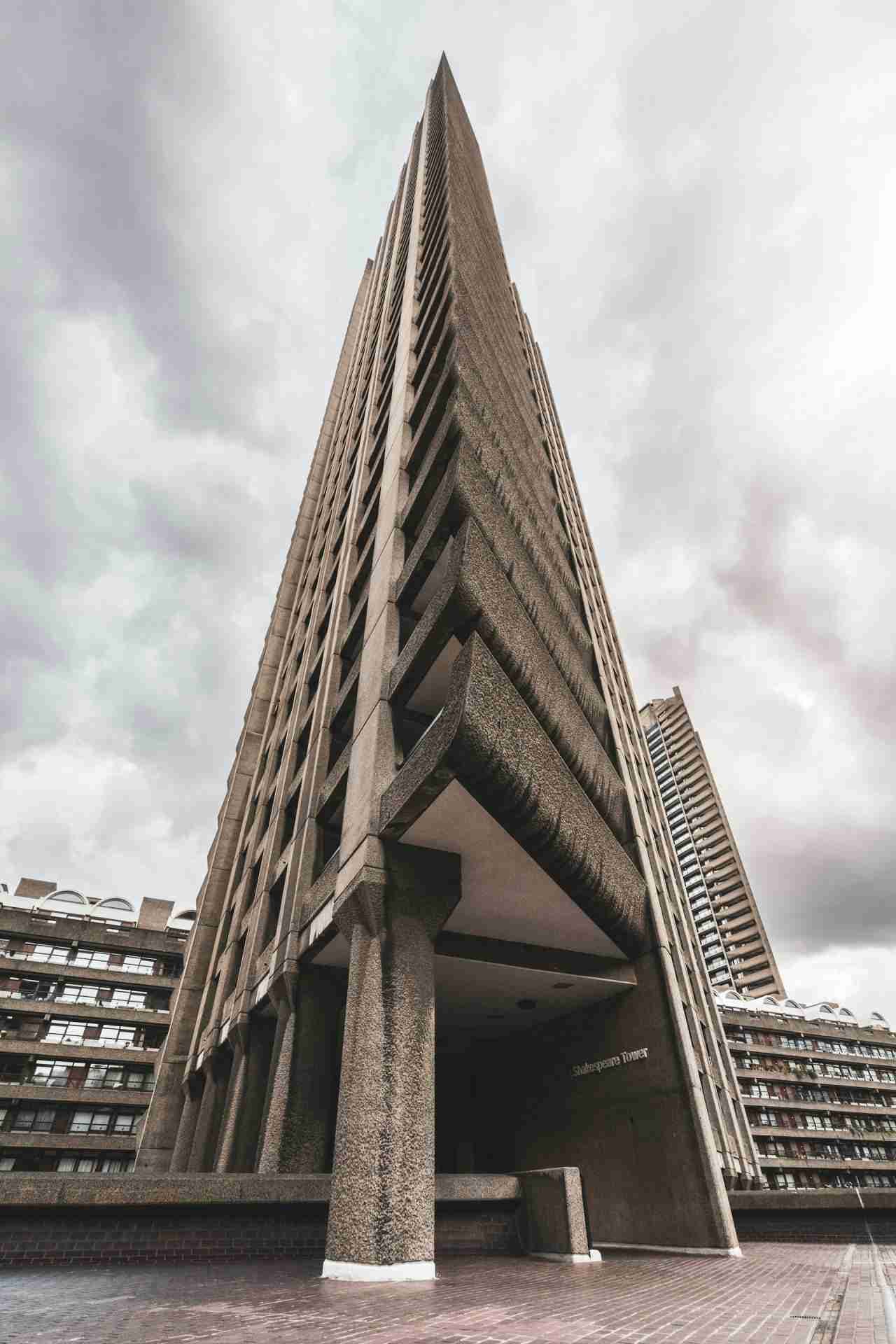
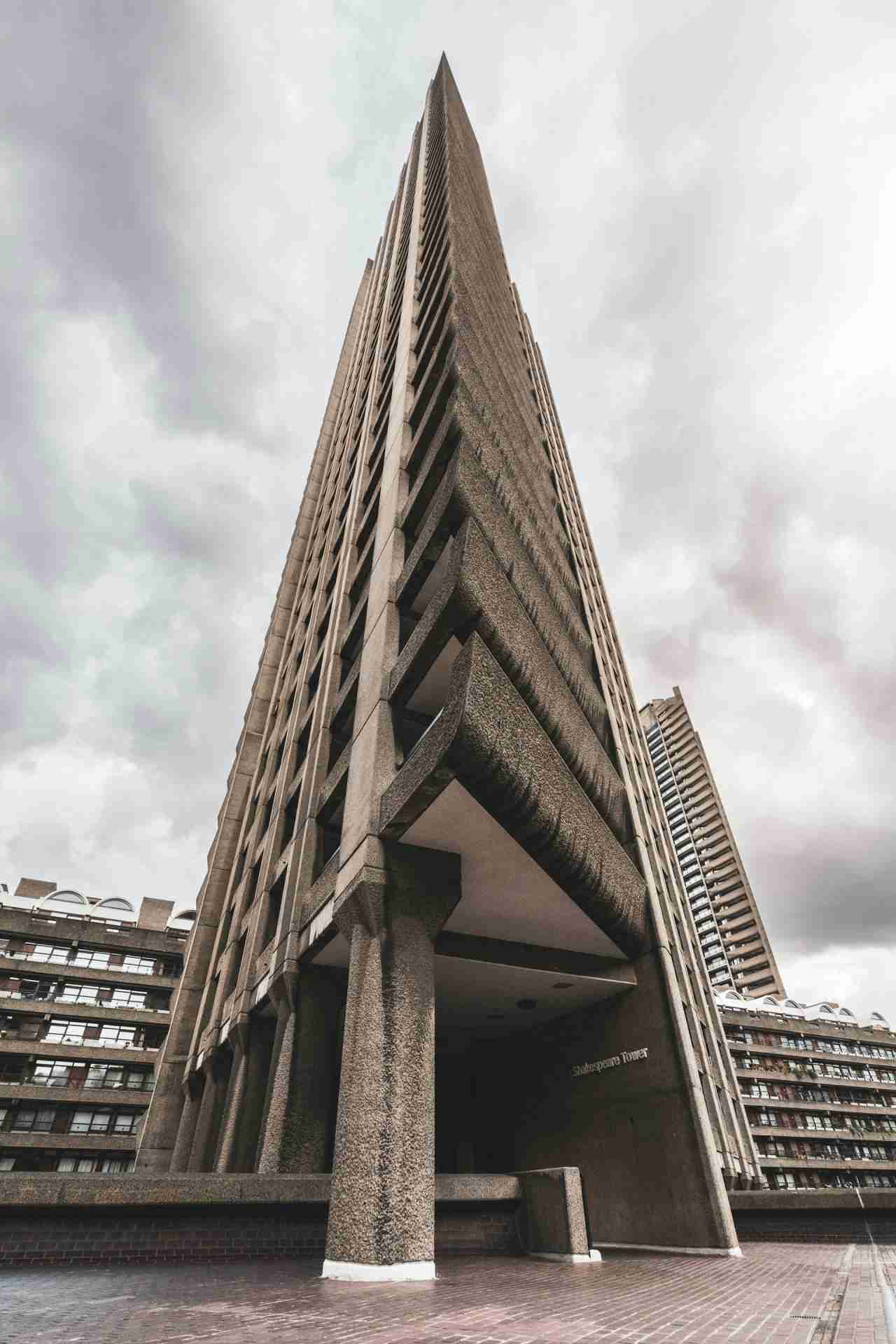
Lauderdale Tower rises sharply above the surrounding estate in the heart of London's Barbican complex, a prominent example of raw concrete design from the post war era. Built as one of three residential towers in the Barbican Estate, its unapologetically angular structure and stacked forms make it a prime subject for photographers interested in mid century architecture, urban texture, and formality of line. The building's surface, patterned with deep set windows and repetitive concrete ribs, interacts strongly with directional light, especially in low sun or shadowed overcast. It stands not just as a residential high-rise but as a sculptural presence shaped by both its era and the geometry of its design. For photographers, Lauderdale Tower provides strong opportunities for vertical composition, contrast studies, and creative urban framing.
Best Photography Opportunities
• Upward Vertical Framing from the Courtyard Base
One of the most effective ways to photograph Lauderdale Tower is from directly below in the shared courtyard space between the Barbican towers. Looking upward, the taper of the building appears exaggerated, emphasizing its vertical force. Using a wide angle lens, you can position yourself close to the base and frame the tower against the sky. The concrete ribs form lines that converge sharply in the center of the frame, and the deep window recesses cast shadows that help define its layered surface. Early morning or late afternoon works best, when the light hits from the side and creates stronger separation between planes.
• Contrasting Texture from the Elevated Walkways
The Barbican Estate is threaded with elevated pedestrian routes that pass between and around the towers. These paths offer mid-level views that are excellent for exploring contrast between built elements. From here, you can isolate portions of Lauderdale Tower against the softer curves of surrounding balconies and bridges. A mid range zoom is useful for adjusting compositions without needing to shift position often. Soft overcast light brings out the texture in the concrete, while directional sun can highlight angles and shadows, particularly in the late afternoon.
• Side Profile from Gilbert Bridge or Beech Street Underpass
Several nearby locations give side views of the tower rising above the estate. From Gilbert Bridge, you can shoot the full profile of Lauderdale Tower as it climbs in steps, with the repeating fins and window rows stacking toward the sky. This position is useful for horizontal framing that includes surrounding buildings, allowing you to show how the tower interacts with the larger Barbican layout. Beech Street, just below, allows for more dramatic low-angle shots, particularly at night when street lighting creates strong contrast against the concrete surface.
• Abstract Details and Repetitive Patterns
Lauderdale Tower is rich in repeating shapes that can be isolated for graphic compositions. Use a telephoto or mid range lens to frame sections of the façade, focusing on window patterns, balconies, or junction points between structural sections. These close compositions are especially effective in flat light, which minimizes glare and allows surface detail to come through clearly. Some of the most effective abstract shots come from photographing just a small portion of the façade, cropping tightly to emphasize rhythm and symmetry.
• Night Photography with Ambient Estate Lighting
At night, the Barbican complex is lit by a mix of ground lights and internal glow from the residential towers. This low light setting is ideal for working with moody compositions that rely on shadow and selective glow. From certain positions, you can capture light spilling from windows, casting angular shapes across the ribs of the façade. Long exposures from a tripod can help reveal more texture in the concrete while controlling highlight clipping from illuminated interiors. Night shooting is particularly effective in blue hour, when there is still some ambient sky tone to balance against the artificial lighting.
Best Time to Visit
Lauderdale Tower can be photographed year round, but different seasons and times of day offer distinct advantages. Winter and early spring provide cleaner views of the building with fewer trees or leaves in the way. Low sun during these seasons creates dramatic lighting on the tower's surface, especially on clear days during early morning or late afternoon. In summer, the light becomes harsher midday, but early morning and golden hour still offer manageable conditions.
Overcast days are particularly effective for photographers focused on detail work. Flat light reveals the fine textures in the concrete and prevents harsh contrast that can wash out shadow detail. Rain also adds a sheen to the structure, darkening the material and emphasizing its texture. Nighttime offers more creative flexibility, especially if you are interested in long exposures, window light, and the way the estate's lighting affects the mood of the space.
Because this is a residential area, early morning or later evening tend to be quieter, giving you more freedom to work without foot traffic. The tower is visible and accessible from multiple sides, allowing you to return under different conditions and continue exploring new compositions over time.
How to Get There
Lauderdale Tower is located within the Barbican Estate in central London. The nearest Underground station is Barbican, served by the Circle, Hammersmith & City, and Metropolitan lines. From the station, it is a short walk via Aldersgate Street and the pedestrian entrances into the estate. Moorgate and Farringdon stations are also within walking distance.
Once inside the Barbican, you can access the tower base via the elevated walkways or the main courtyard level. The estate is open to the public and allows pedestrian access throughout. While the tower itself is private and not accessible inside without residence or permission, all exterior areas are photographable from public paths, bridges, and walkways. Tripods are generally accepted as long as you are not obstructing passageways or shooting for commercial use without a permit. There is no entry fee.
The estate is well signposted, but the layout can be confusing on a first visit. Bringing a digital or printed map of the Barbican helps to plan compositions ahead of time and move efficiently between locations. There are also cafes and public rest areas within the estate if you plan to stay for an extended shoot.
Recommended Photography Gear
A wide angle lens is essential for vertical shots from the base and for capturing the full height of the tower in tight quarters. A focal range of 16 to 24 millimeters is ideal for this purpose. For mid distance and side profile compositions, a 24 to 70 millimeter lens gives flexibility without distortion. A longer lens, such as 70 to 200 millimeters, is useful for abstract details and for compressing layers between Lauderdale Tower and surrounding estate elements.
A sturdy tripod is helpful for night photography or when working with longer exposures in lower light, especially in shadowed areas under bridges or between buildings. A lens cloth is recommended, especially in damp or foggy conditions, as condensation can build up quickly on concrete surfaces. A polarizing filter may help reduce unwanted reflections in windows or wet surfaces but should be used selectively to avoid uneven effects on the sky.
Compact gear is best, since you will be navigating stairs, walkways, and sometimes tight corners. A small daypack allows you to carry everything securely while keeping your hands free for setup and composition. If working at night, a headlamp or small flashlight helps navigate the estate without relying on your phone.
Nearby Photography Locations
Located on the upper level of the Barbican Centre, this tropical conservatory features concrete walkways among dense plant life. The combination of brutalist lines and green canopy creates a strong contrast for both color and black and white photography.
Just across the podium, Frobisher Crescent and other estate areas provide more concrete detail, staircases, bridges, and repeating elements. These areas are less photographed and give you opportunities to work with similar material in new shapes.
A short walk north of Barbican, the Golden Lane Estate features color-accented modernist housing and open staircases with strong vertical and diagonal elements. It is quieter and less busy, ideal for architectural detail work.
Before its temporary closure, the museum's exterior was a strong example of angular design and shadow-heavy architecture. The surrounding footpaths and bridges still remain photographable and are useful for city backdrop compositions.
This historic church sits next to the Barbican lake and gives you a unique contrast between medieval stone and modern concrete. It is particularly strong in reflected compositions or when the sky breaks through in late afternoon.
Lauderdale Tower offers more than just height; it provides form, repetition, and material for photographers who enjoy visual structure and the mood of urban mass. Whether you are isolating lines, working with natural light, or building a wider story of the Barbican complex, it stands as a subject worth revisiting in different conditions and times of day.
Comments
Loading comments…