
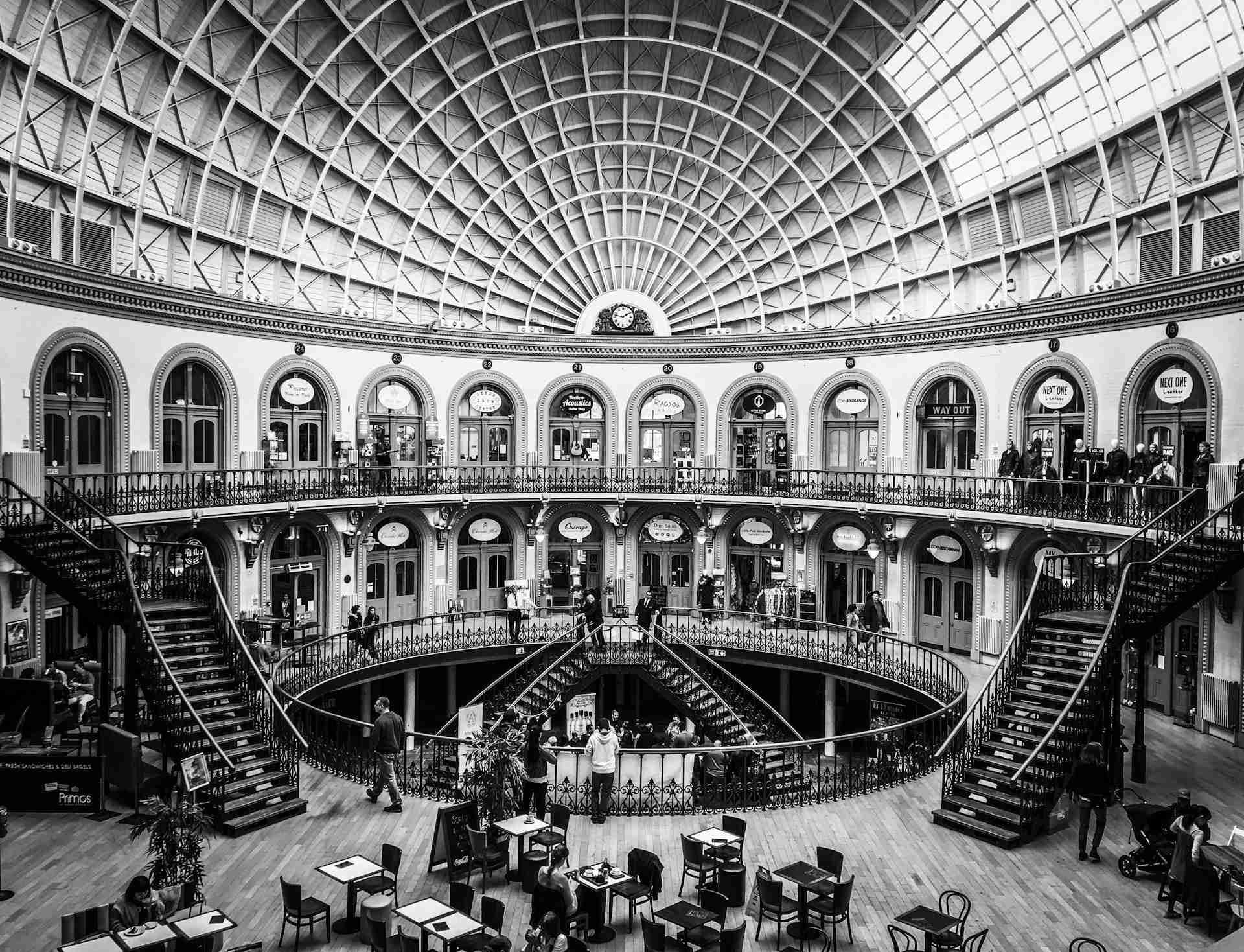
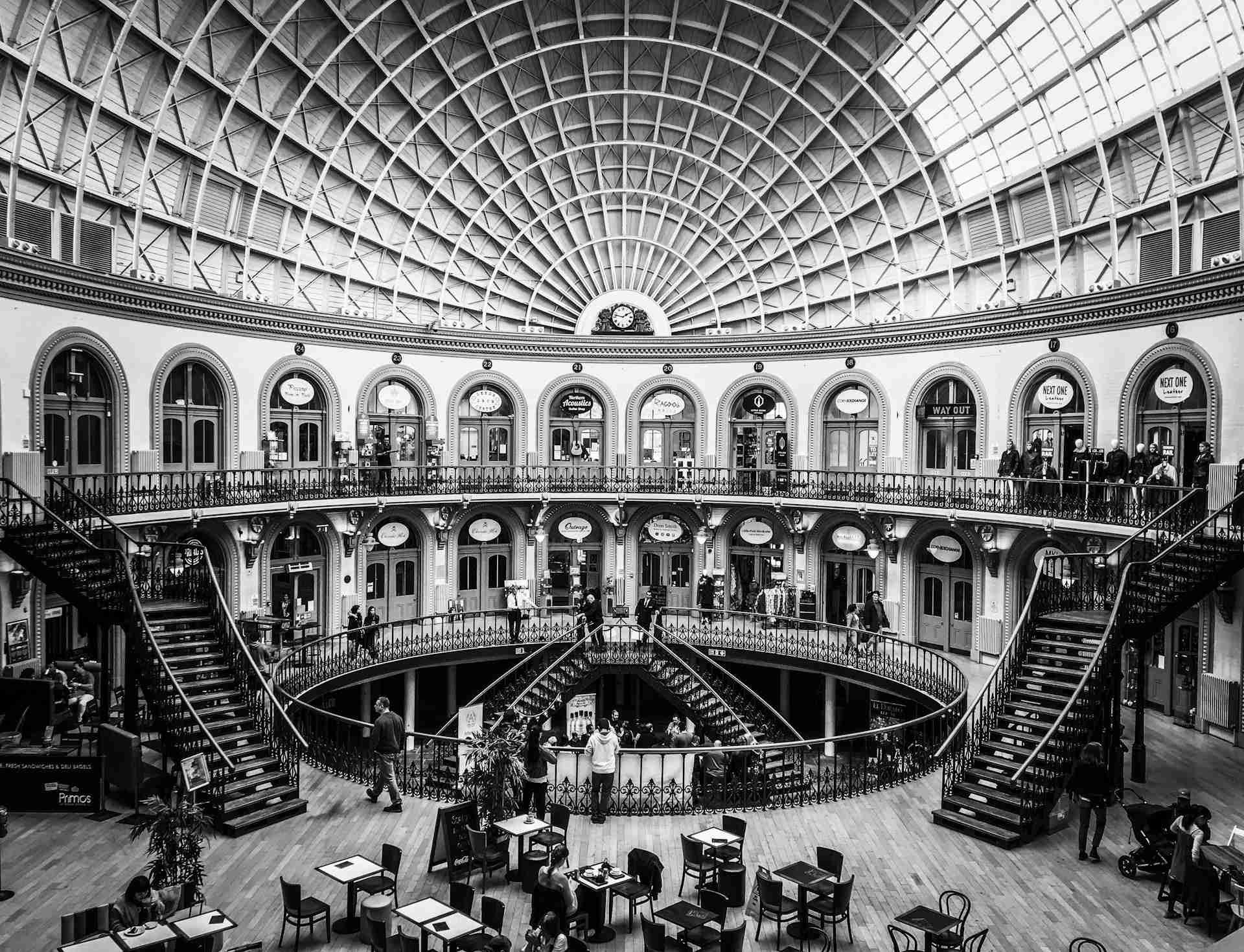
At the heart of Leeds' historic city centre stands the Corn Exchange—a Victorian masterpiece of symmetry, light, and ornamental design. Built in 1863 by Cuthbert Brodrick, this Grade I-listed building is widely considered one of the finest examples of civic architecture in the North of England. Its elliptical footprint and vast domed roof make it a dream location for photographers who appreciate architectural rhythm, natural light play, and rich interior detail. Today, the Corn Exchange functions as a vibrant independent shopping arcade, but its primary visual appeal remains the grand central atrium, where diffused light spills through the glass-paneled ceiling, revealing a kaleidoscope of textures, curves, and cast-iron artistry.
Best Photography Opportunities
• Symmetry and Scale from the Upper Balcony
: The upper gallery that encircles the main atrium provides a commanding, symmetrical perspective of the Corn Exchange's striking elliptical design. From the midpoint across from the central staircases, you can frame a balanced shot that includes the ornate balustrades, intricate cornicing, and full curve of the gallery below. A wide-angle lens (14–24mm) exaggerates the sense of space and curvature, especially if you shoot from slightly off-centre to introduce subtle tension into the symmetry. Morning light streams through the glass dome in soft, even tones—ideal for capturing detail without harsh shadows. Tripods are especially helpful here if you're shooting at a narrower aperture for maximum sharpness and depth of field.
• Dome Patterns and Architectural Details
: Look upward to the Corn Exchange's showpiece: the elliptical dome, a feat of 19th-century engineering and design. Each segment of the roof is framed by steel ribs that converge into a radial pattern, and between them, the skylight panels shift in tone depending on the time of day and weather. Use a telephoto lens (70–200mm) to isolate geometric sections or abstract details. Early or late in the day, angled sunlight can cast complex shadow networks across the upper structure. You'll also find ornate wrought-iron railings, decorative plasterwork, and Victorian signage around the perimeter—each offering opportunities for architectural close-ups that speak to the building's craftsmanship. Black-and-white or toned monochrome edits can add a sense of timelessness to these images.
• Reflections, Floor Patterns, and People in Motion
: Down on the ground floor, you'll discover rich textures beneath your feet and reflections in every polished surface. The light-colored wooden flooring often reflects natural light from the dome above, and the gently curving walls create repeated arcs and visual echoes throughout the space. These curves are ideal for layered compositions using a fast 35mm or 50mm prime lens wide open. Capture the play between static architectural lines and moving human figures—slow shutter speeds can blur passersby into soft motion streaks, creating a dynamic contrast with the stillness of the building. This area is especially effective for environmental portraiture or visual storytelling with a street photography aesthetic.
• Sweeping Staircase Compositions
: Several spiral staircases link the lower and upper galleries, and each is a photographic subject in its own right. Their cast-iron railings and worn wooden treads flow in elegant arcs that work beautifully for both wide shots and tighter compositions. Position yourself mid-staircase for layered diagonal lines that lead the eye up into the atrium or down into framed vignettes below. Side-lighting from nearby windows adds depth and texture to the stone and iron surfaces. For added compositional interest, wait for a figure to ascend or descend and place them at the golden mean within your frame. A standard zoom (24–70mm) gives the flexibility needed to move quickly and adapt to shifting angles and light.
• Exterior Curves and Street-Level Context
: From the outside, the Corn Exchange's curved sandstone façade and domed roof offer an entirely different photographic personality—grander, heavier, but no less elegant. From Call Lane and Crown Street, you can shoot the structure at an angle that exaggerates its convex form, using the surrounding Georgian and Victorian architecture as framing elements. During golden hour, the stone warms dramatically, highlighting the building's texture and carved embellishments. Use a telephoto lens from across the street to compress the façades or go wide and low for a perspective that lets the building rise into the frame with dramatic flair. Including passing cyclists, trams, or street signage grounds the structure in the modern urban fabric of Leeds and adds visual tension between the old and the new.
Best Time to Visit
The Corn Exchange is open year-round, and its interior is consistently photogenic thanks to the vast central dome that floods the space with natural light, even on overcast days. Weekday mornings offer the quietest conditions for photography, especially between 10 a.m. and noon, when foot traffic is low and the light entering through the skylights is at its softest. Midday sunlight can be quite dramatic, casting angular rays through the dome that highlight the curvature of the galleries and the intricacies of the wrought ironwork.
During the winter months, shorter days mean more diffuse light for longer periods—ideal for soft, shadowless compositions inside. The lead-up to Christmas transforms the interior with seasonal decorations and lights, adding festive visual elements for storytelling shots or atmospheric handheld scenes.
Blue hour and night photography are reserved for the exterior, where the building is occasionally illuminated for special events. Evening light across the surrounding cobbled streets also casts subtle highlights onto the sandstone walls and wrought iron signs, making for beautiful contextual urban images.
How to Get There
Located in Leeds' city centre, the Corn Exchange is easily reached by public transportation or on foot. From Leeds Station, it's a 10-minute walk northeast via Boar Lane. Numerous buses stop directly outside the building on Call Lane, and bike racks are available nearby. While there is no on-site parking, nearby public car parks such as Trinity Leeds or Brewery Wharf offer short-term options within a 5–10 minute walk.
There is no admission fee to enter the Corn Exchange or to photograph inside. Photography for personal or non-commercial use is welcomed during regular business hours, though use of tripods is at the discretion of the management—check with the front desk before setting up, especially during busy times. Most shopkeepers are accommodating if you're respectful of their space. Drones are not permitted inside or above the building due to the covered roof and proximity to busy pedestrian areas.
Gear to Capture Victorian Geometry and Light
For a subject as symmetrical and interior-focused as the Corn Exchange, lens choice and stability are key. A wide-angle lens (14–24mm or equivalent) is invaluable for capturing the full curve of the interior from above or below, especially when framing the dome or concentric arches. A fast standard zoom (24–70mm f/2.8) gives you flexibility for both wide gallery scenes and detail-rich handheld shots of staircases, ironwork, or lighting features.
Tripods are ideal for early morning low-light shooting or when using slower shutter speeds to capture motion blur or ambient interior light, but always check permissions before setting up. For detail work, a medium telephoto (85–135mm) is perfect for isolating architectural features like plaster rosettes, balustrades, or carved stonework. Circular polarizers can help control glare on polished floors and shop windows, while a lightweight LED panel may come in handy for controlled fill light in dark corners.
If you're shooting handheld, opt for a body with strong in-body image stabilization to reduce motion blur in dim conditions. A camera with excellent dynamic range will help you manage the contrast between the bright dome and the deeper shadows around the lower galleries.
Nearby Photography Locations
: Just a short walk north, this ornate shopping arcade features stained glass ceilings, mosaic floors, and Edwardian flourishes. Ideal for handheld interior photography and symmetry studies with natural light.
One of the largest indoor markets in Europe, this location offers street photography opportunities, patterns in light and form, and atmospheric portraits of everyday life.
: Located a few minutes east, this Gothic Revival church offers moody stone interiors, tall lancet windows, and excellent opportunities for photographing contrast between light and shadow.
: On the southern edge of the city centre, this rejuvenated waterfront area offers industrial textures, modern architecture, and canal-side reflections. Best photographed at sunset or early evening.
• The Calls and River Aire Footpaths
: East of the Corn Exchange, this area blends old mills, bridges, and new apartment buildings into layered cityscape compositions. Long exposures over the water are especially strong in blue hour.
The Leeds Corn Exchange is a rare space where architectural form, historic craftsmanship, and ambient light come together in perfect harmony. It's a location that invites both sweeping grandeur and quiet attention to detail—an environment where every curve, line, and texture rewards the patient, observant photographer. Whether you're capturing the dome's structural rhythm or the soft footfall of early shoppers, the Corn Exchange offers an endlessly renewing study in Victorian design and modern creative vision.
Comments
Loading comments…