
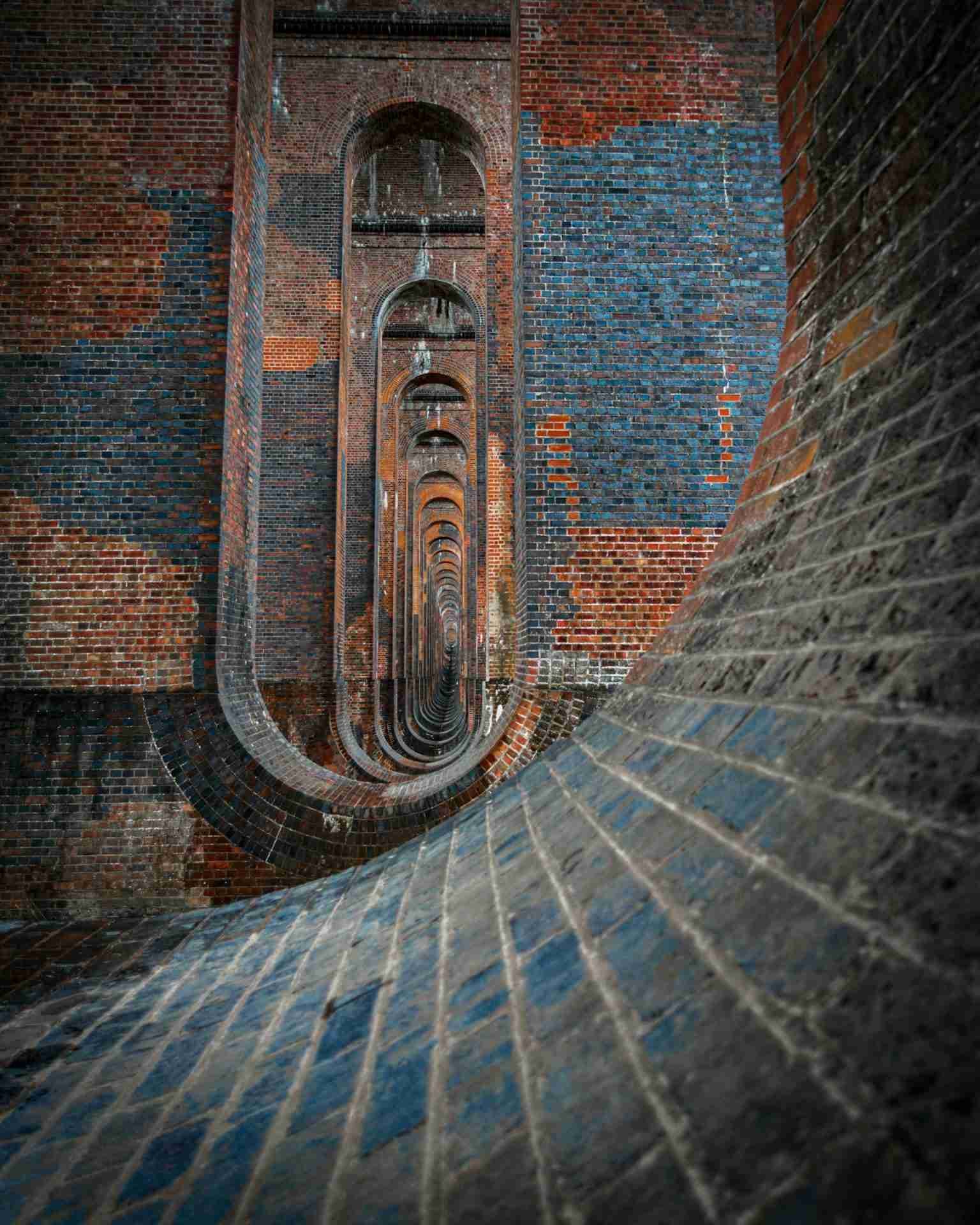
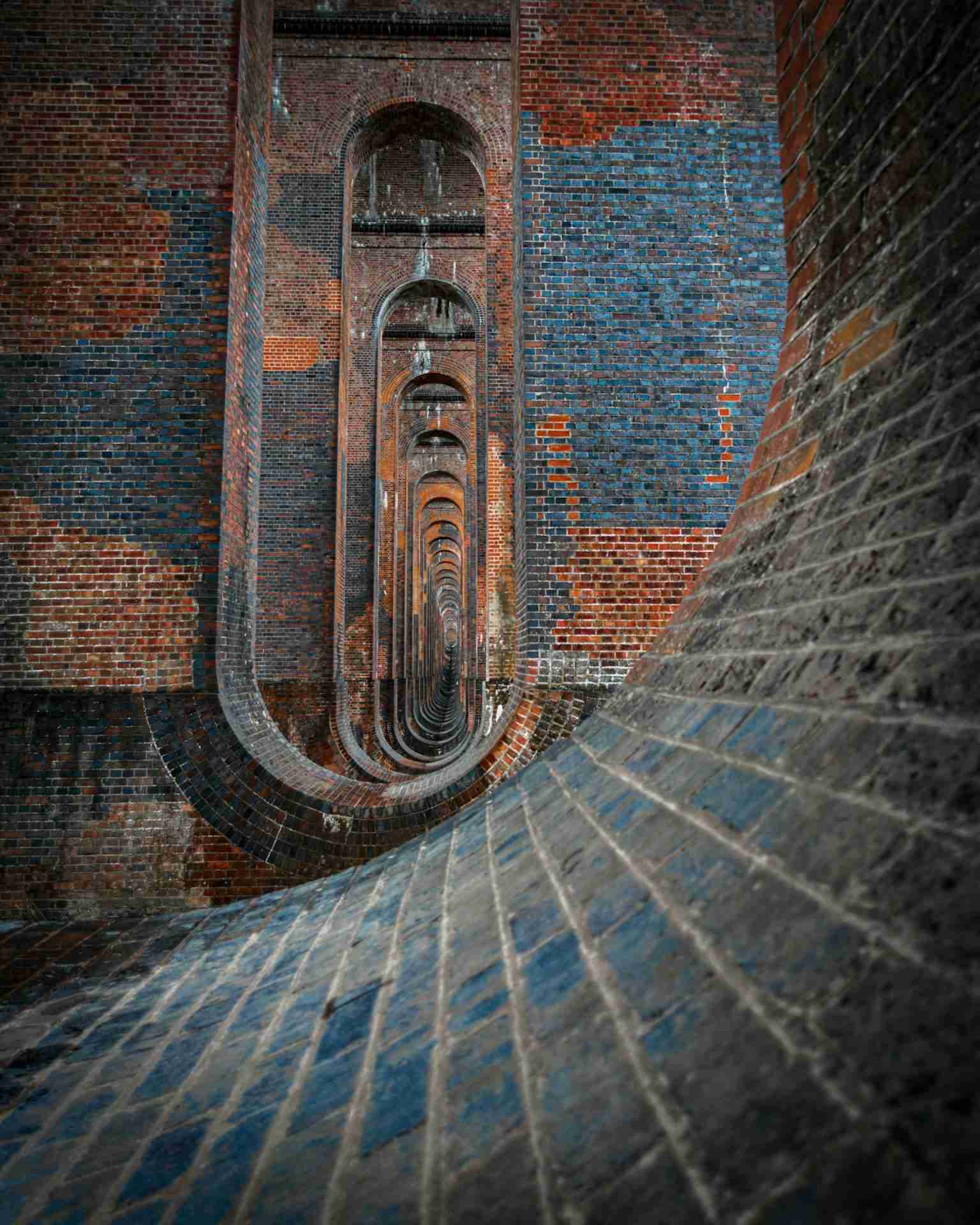
Ouse Valley Viaduct stretches across the gentle farmland near Borde Hill Lane outside Haywards Heath, its long line of red brick arches cutting cleanly through the Sussex countryside. Built in the 19th century, the structure carries an active railway line high above the River Ouse, standing on 37 evenly spaced arches that create a strong sense of rhythm and balance. The warm brick tones contrast beautifully with green fields in spring and summer, muted earth tones in autumn, and pale frost in winter. Because the viaduct sits in a shallow valley, you can view it from multiple elevations along public footpaths, which gives you flexibility in composition. It feels substantial without overpowering the landscape, and its repeating geometry makes it one of the most photogenic railway structures in southern England.
Best Photography Opportunities
• Shooting Straight Down the Center –
This is the signature composition and the most visually powerful angle at Ouse Valley Viaduct. From directly beneath the structure, you can align yourself perfectly along the center axis and photograph through the repeating oval openings as they narrow into the distance. The perspective creates a tunnel effect, with each arch framing the next in a rhythm that pulls the eye deep into the image. A wide lens works best here, but precision matters. Even slight shifts left or right will break symmetry. Get low and pay attention to the curve of the brick buttresses at the base, as they form strong leading lines that guide the viewer forward. Overcast light works especially well because it keeps exposure balanced inside the arches while preserving brick detail. This shot is about alignment, patience, and small adjustments.
• Arch Symmetry from the Fields –
One of the most recognizable compositions is taken from ground level in the fields facing the viaduct directly. From this angle, the repeating arches form a strong horizontal line across the frame. A moderate wide lens works well, but careful positioning is key to keeping the arches evenly spaced and symmetrical. Early morning light often strikes the brick from the side, enhancing texture and creating depth within each arch opening. Including a strip of grass or crops in the foreground anchors the composition and prevents it from feeling flat. Small adjustments left or right can dramatically improve alignment, so take time to refine your stance before committing to the shot.
• Elevated Perspectives –
Using higher ground along nearby public footpaths allows you to look slightly down across the viaduct. This angle reveals the full curve and length of the structure more clearly than ground level views. A mid range zoom helps compress the arches while maintaining a natural perspective. Late afternoon light is particularly effective from this direction, as it warms the brick and separates it from the green fields below. Including layers of countryside beyond the viaduct adds depth without cluttering the scene. This perspective often produces the most balanced compositions.
• Train Crossings –
Capturing a train crossing the viaduct adds scale and narrative. Timing is important, so checking train schedules in advance increases your chances of success. A slightly longer focal length helps isolate the section where the train passes while still showing enough arches for context. Shooting in continuous mode allows you to capture the moment cleanly as the train enters and exits the frame. The contrast between modern rolling stock and historic brickwork adds visual interest. Position yourself safely on public land and never attempt access to restricted railway areas.
• Sunset Silhouette –
At sunset, the viaduct can be framed as a dark shape against a colorful sky. Position yourself so the arches remain clearly defined against the horizon line. A slightly lower angle can help separate the structure from distant trees. Dramatic cloud formations enhance this composition, especially when backlit. A tripod helps manage lower light levels and maintain sharpness as exposure times lengthen. This is one of the most visually striking ways to photograph the viaduct when conditions align.
Best Time to Visit
Early morning is often the most productive time, particularly if you want soft directional light and fewer people along footpaths. Mist occasionally forms in the valley on cooler mornings, adding atmosphere and depth around the arches. Late afternoon and early evening are equally strong, especially when the brick begins to warm under angled sunlight.
Summer offers longer daylight hours and greener fields, while autumn introduces warmer tones in surrounding vegetation. Winter can provide clearer air and occasionally frost in the fields, which adds texture to foreground compositions. Overcast days should not be dismissed, as even light can work well for telephoto pattern shots. Wind can affect stability when working with longer focal lengths, so bring appropriate support.
How to Get There
Ouse Valley Viaduct is located near Borde Hill Lane outside Haywards Heath in West Sussex, England. It is accessible via public footpaths that cross surrounding farmland. Parking is limited along nearby lanes, so plan carefully and ensure you are not obstructing access routes.
The viaduct itself is an active railway structure and cannot be accessed directly. All photography should be conducted from public land and designated paths. Ground conditions can be muddy after rain, so suitable footwear is recommended. There is no fee to visit the surrounding countryside.
Recommended Photography Gear
A wide lens is useful for capturing the full length of the viaduct within the landscape. A mid range zoom provides flexibility when adjusting composition along footpaths. A telephoto lens is particularly valuable here for compressing arches and capturing trains crossing the span.
A sturdy tripod is helpful for sunset, long exposure, or low light sessions. A polarizer can deepen sky tones and manage glare on bright days. Neutral density filters are optional but useful if you want to smooth cloud movement during longer exposures. Because you will likely be walking across uneven ground, keeping your kit manageable and stable is important.
Nearby Photography Locations
offers landscaped grounds, woodland areas, and elevated views across Sussex countryside. It provides a softer, botanical contrast to the industrial structure of the viaduct. Seasonal blooms add color variety throughout the year.
• Ardingly Reservoir
features open water, woodland edges, and walking trails. It offers sunrise and sunset reflection opportunities in a more natural setting. Calm mornings are particularly strong for mirror like compositions.
provides expansive views across the South Downs. From this elevated position, you can capture rolling hills under dramatic skies. It complements the architectural focus of the viaduct with broader landscape imagery.
offers one of the most dramatic viewpoints in the region. Sweeping valley views and layered hills make it ideal for wide landscape photography. Late afternoon light enhances terrain depth.
• Lewes
provides traditional architecture, narrow streets, and views of Lewes Castle. It adds urban and historic character to a countryside focused photography trip. Early evening light works particularly well along the High Street.
Comments
Loading comments…