
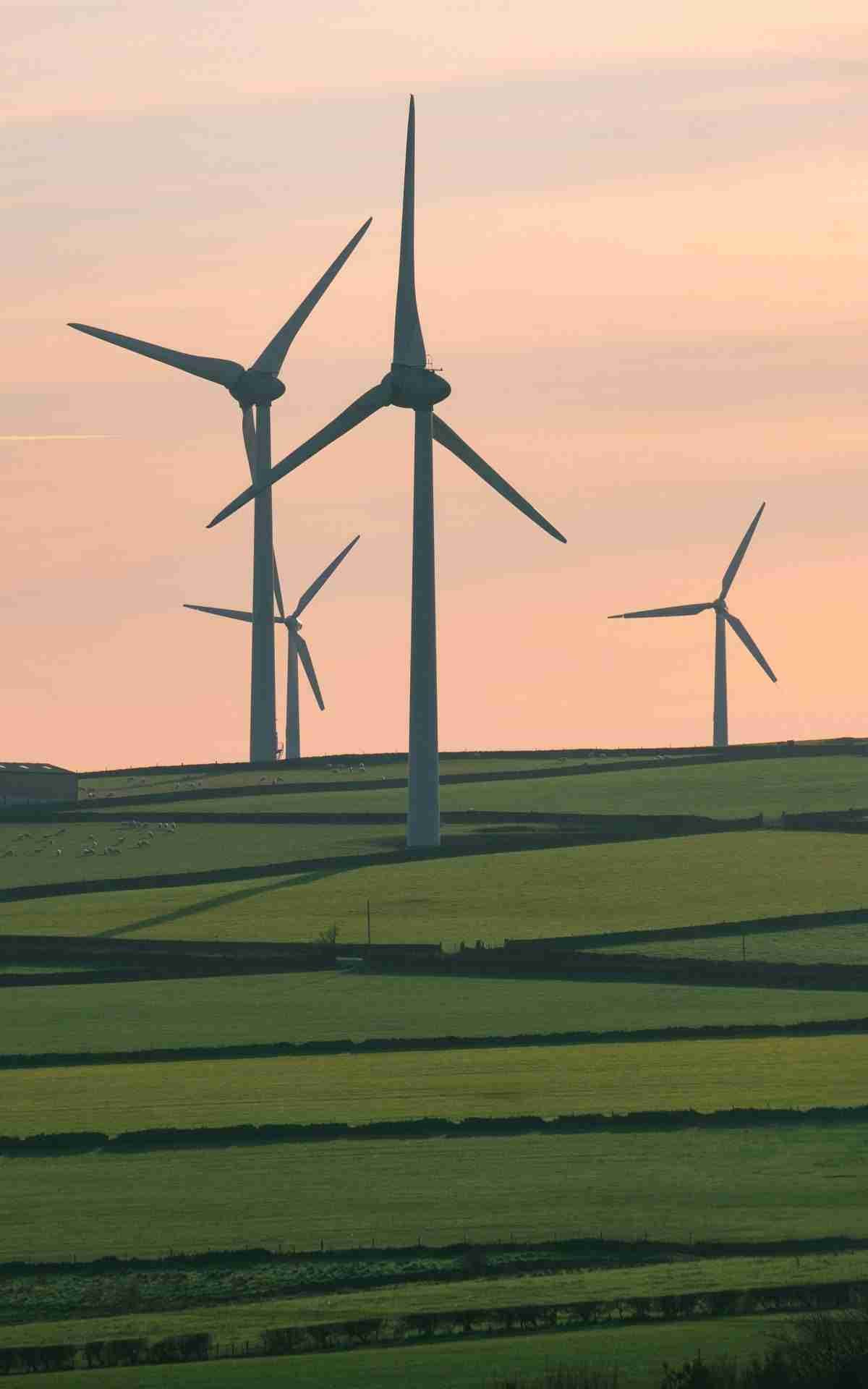
Royd Moor Wind Farm stands at the edge of High Flatts near Huddersfield, rising above the patchwork moorland and farmland that characterizes this part of South Pennines terrain. The landscape is broad, open, and often swept by wind, with turbines spaced across a plateau that catches every shift in weather and light. For photographers, Royd Moor offers a rare opportunity to work with large-scale industrial forms within a natural rural setting. The turbines are clean, minimal, and constantly moving, which opens the door to dynamic long exposures, minimalist compositions, and contrast-rich black and white work. The location pairs the rhythm of engineered motion with the wildness of upland skies, and it's this tension that defines the best photographic work here.
Best Photography Opportunities
Long Exposure Studies of Turbine Movement
The turbines at Royd Moor are spaced in a loose arc across an elevated ridge, making them ideal for long exposure photography that captures motion blur in the blades against still skies or fast-moving cloud. Shoot during transitional weather when cloud structure is pronounced and use a six- or ten-stop neutral density filter to extend exposure time between 20 seconds and 3 minutes. This creates smooth tonal gradients in the sky while rendering the turbines as both subject and mark-maker. Use a sturdy tripod and low ISO to preserve sharpness in the stationary parts of the frame, and compose from a lower elevation to exaggerate scale.
Moorland Texture and Repeating Turbine Forms
The surrounding moorland is textured with dry stone walls, grassland, heather, and scattered agricultural features. These foreground elements can be used to anchor compositions, particularly when working with mid-telephoto lenses to compress layers. Position yourself slightly off-axis from the turbine line to create diagonal flow through the frame. Early morning and late afternoon light helps to pull texture out of the land, casting long shadows across the fields and highlighting the edges of wall lines and embankments. These conditions also bring subtle color shifts that contrast nicely with the pale turbine towers.
Black and White Graphic Compositions
The simplicity of the turbines, particularly when isolated against heavy cloud or clear sky, lends itself well to black and white photography. On overcast or stormy days, convert to monochrome and work with strong contrasts between the white blades and grey or black skies. High contrast processing can enhance the graphic quality of the image, while low-key treatments allow for moodier, minimalist frames. Use a telephoto lens to abstract the turbine forms from the surrounding environment and emphasize negative space. This approach is particularly effective in winter, when the land flattens into frost tones and sky remains heavy.
Golden Hour Glow on Industrial Forms
Though turbines are mechanical by nature, the soft directional light of golden hour transforms them into something more sculptural. In low sun, the edges of the blades and towers catch warm light that contrasts against the cool moorland or deep sky. These moments are brief and best captured just after sunrise or before sunset when the light angle is low. Shooting from the eastern side of the ridge in the evening, or from the west in early morning, allows you to silhouette the turbines or backlight their edges for subtle drama. A wide-angle lens positioned near foreground features like fences or shrubs can add scale and perspective.
Storm Fronts and Turbines Under Pressure
This part of Yorkshire sees rapidly changing weather, and Royd Moor sits in a position where incoming fronts from the west can roll across the land with dramatic speed. Cloudbanks breaking over the moor behind the turbines are highly photogenic, especially when shafts of light punch through. Be ready to work handheld with a fast shutter if conditions are unstable. These fleeting moments of high contrast between sky and turbine create tension and dynamism. A graduated ND filter can help balance the exposure across the land and sky without flattening the tonal depth of either.
Best Time to Visit
The wind farm is accessible year-round, but the visual quality of the site changes significantly with the seasons and time of day. Winter
provides strong contrast, low sun angles, and often heavy skies that pair well with black and white or moody long exposures. Spring and autumn
offer more color in the landscape, with golden bracken, mossy greens, and textured foregrounds that add interest beneath the turbines. Summer
can be trickier due to brighter overhead light and flatter skies, but early morning shoots still offer usable directional light and calmer conditions.
The best shooting times are early morning and late afternoon when low light rakes across the land and highlights texture on both the turbines and surrounding fields. Wind speed tends to pick up later in the day, which increases blade rotation speed for motion studies. Overcast conditions are ideal for working in soft tones and allow for longer exposures without clipping highlights. Stormy conditions are ideal for drama, but safety and weatherproofing become essential.
How to Get There
Royd Moor Wind Farm is located just south of Penistone and north of Holmfirth, near the hamlet of High Flatts in West Yorkshire. From the A629, turn onto Royd Moor Road or Windmill Lane depending on your direction of travel. There are small laybys and gravel pull-offs near the footpaths that skirt the edge of the wind farm. The area is accessible by car, and local public transport from Huddersfield or Barnsley brings you within walking distance, although exact stops vary.
There are no official facilities or visitor centers on site, and the area is not signposted as a tourist attraction. However, public footpaths pass through and around the turbines, and there are no fees for access. Wear sturdy footwear, especially during wet or icy conditions, as the ground can be uneven or muddy. The site is exposed, so bring wind protection for both yourself and your gear. Mobile reception is generally good across the ridge, and the area is open enough to allow safe positioning without interfering with the turbines themselves.
Recommended Photography Gear
A sturdy tripod is essential for long exposure and low-light photography, especially in windy conditions. Bring a remote shutter release or use the camera's timer to avoid vibration during long exposures. A wide-angle lens, such as 16 to 35 millimeters, is helpful for capturing turbine scale within the landscape, while a 70 to 200 millimeter telephoto allows for compression and abstraction of individual turbines or weather elements.
Neutral density filters in six or ten stops will let you extend shutter speed for capturing blade motion or cloud streaks. A graduated ND filter helps balance skies in dramatic lighting. A polarizer is less essential here but can be helpful in reducing glare from wet grass or foreground water. Weather protection for your camera is strongly recommended due to frequent wind, mist, and rain. A lens cloth is a must, as turbine spray and airborne moisture can build up quickly on the front element. Gloves and layers are also important year-round due to high exposure and rapidly changing conditions.
Nearby Photography Locations
Located just a few kilometers west, Scout Dyke Reservoir offers a calm contrast to the dynamic forms of the wind farm. Its still surface works well for minimalist compositions, especially in low light or fog, and reflections of sky and moorland create opportunities for subtle, meditative images.
To the south, Langsett Moor features expansive upland walking trails, rough stone walls, and wide views across to the Peak District edge. It is especially good in late autumn and winter when snow dusts the tops and contrast between land and sky increases. The area is ideal for layered compositions and isolated tree or wall studies.
East of the wind farm, this high pass offers dramatic views across the moor and into the Peak District. The exposed road and communication mast at the summit are often surrounded by fast-moving weather, giving photographers opportunities for both wide landscape shots and tight, atmospheric detail work.
Closer to Huddersfield, this reservoir offers open water views backed by low hills and is ideal for sunrise photography. The site often holds early fog and is particularly photogenic when light breaks through to hit the embankments and surrounding reeds.
These two smaller reservoirs sit just to the west of the wind farm and offer a blend of rural farmland and open water. They are excellent for golden hour reflections, and the occasional turbine or distant moorland can be incorporated into broader scenes with longer lenses.
Royd Moor Wind Farm is not a place of natural drama in the traditional sense. Its power lies in the contrast between movement and stillness, utility and openness, weather and form. For photographers looking to work with shape, scale, and the quiet rhythm of engineered objects placed in wild space, it offers a clean, shifting canvas. The challenge is to match your timing and technique to the weather, to recognize simplicity when it aligns, and to let the turbines frame not just energy, but intention.
Comments
Loading comments…