
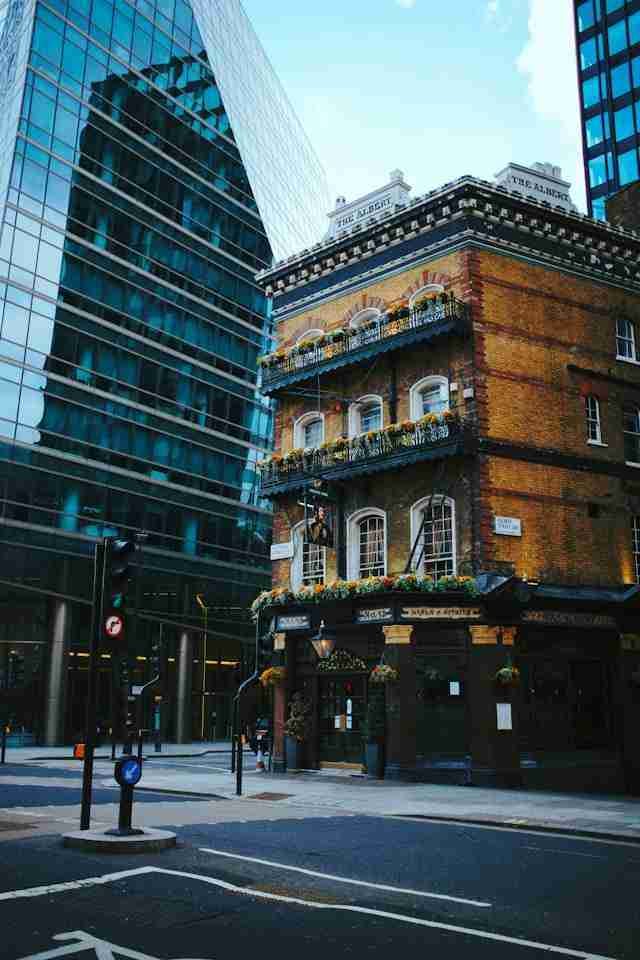
Perched defiantly on a tight corner where sleek glass towers and government offices now dominate the skyline, The Albert pub stands as a richly detailed relic of Victorian London. Built in 1862 and named after Prince Albert, the pub is a Grade II listed building and one of the capital's most photogenic public houses. With its ornate cornices, iron balconies, floral displays, and classic red brick, it provides a bold contrast to the modern architecture that surrounds it—especially from the upper floors of nearby buildings or across the curved sweep of Victoria Street. Whether you're interested in architectural juxtapositions, golden-hour glows, or atmospheric street scenes, The Albert offers urban photographers an ideal subject in the heart of Westminster.
Best Photography Opportunities
• Frontal architectural compositions from Victoria Street
Shooting directly across from The Albert allows you to capture the building head-on, showcasing its symmetrical Victorian façade framed by the angular glass towers that now surround it. This perspective emphasizes the pub's visual defiance—a small-scale, richly detailed structure holding its ground amid modern development. With a wide-angle lens, photographers can include the curve of the pavement, passing London cabs or buses, and even a bit of sky reflection in the glass structures behind. Early morning offers soft directional light and minimal foot traffic, giving you the freedom to fine-tune framing without too much foreground distraction.
• Corner views highlighting the building's curve and context
By stepping back slightly toward Christchurch Gardens or the curved section of Victoria Street near Buckingham Gate, photographers can shoot diagonally toward The Albert's corner façade. This angle reveals the building's unique wedge shape and allows you to layer the old pub against the steel-and-glass structures that loom above it. The curve of the street becomes a strong compositional line that leads the eye into the frame, and the shot gains depth with the inclusion of street-level activity. Light at golden hour often reflects off nearby buildings, casting a soft glow onto the red brick and giving the image rich tonal contrast.
• Close-up studies of period ornamentation and materials
The Albert is packed with intricate architectural details: golden signage, iron balcony railings, elaborate stone cornices, hanging flower baskets, and leaded glass windows. These elements make excellent subjects for close-up shots that celebrate craftsmanship and texture. Using a fast prime lens, photographers can isolate individual features—like a weathered window frame or an engraved pub sign—while using shallow depth of field to blur the modern background. Overcast light is ideal here, reducing glare and bringing out subtle color variations in the aged materials.
• Night photography with glowing windows and city light trails
As dusk sets in, The Albert transforms into a warmly lit beacon. The internal glow of the pub windows and illuminated exterior signage create a cozy atmosphere, perfect for night photography. Positioning your tripod across the street allows you to include motion trails from passing double-decker buses and cars, while keeping the structure crisp and well exposed. These shots often benefit from blue hour timing, where ambient sky color balances the warmth of the artificial light. Reflections on wet pavement can add a second layer of light and color, creating symmetry and mood.
• Elevated or compressed perspectives showing the contrast with modern architecture
For a more conceptual angle, elevated vantage points—such as upper-level parking structures or nearby office buildings—provide an excellent view looking down on The Albert. From above, the contrast between its historic masonry and the neighboring steel and glass is even more stark. A telephoto lens helps compress these elements, flattening space and exaggerating the architectural differences. These compositions often carry a strong narrative about preservation versus progress and are especially effective in diffused or overcast light that reduces glare from reflective surfaces.
Best Time to Visit
The Albert's positioning on a main thoroughfare means it experiences steady foot and vehicle traffic, making the best photographic opportunities those that occur during off-peak hours or at carefully chosen times of day. Early morning offers the cleanest compositions, with minimal visual clutter and soft ambient light that wraps around the building's details. Side light from the east in the morning also adds subtle contrast to the red brick and helps define the ornamental mouldings.
Golden hour in the evening offers rich color and visual warmth, particularly as sunlight reflects off the glass buildings behind the pub. At this time of day, the surrounding skyscrapers take on a golden tint that contrasts beautifully with The Albert's darker, aged exterior. Blue hour introduces a completely different mood: soft interior lighting, glowing signage, and cooler tones that highlight the pub's warmth in contrast to its modern environment. The combination of ambient street lighting and internal glow is ideal for street-level long exposures.
Weather also plays a role—overcast days reduce contrast and eliminate harsh shadows, allowing architectural details to shine without distraction. Rainy conditions add texture through reflections in puddles and glistening pavements, while fog softens the background buildings, allowing the pub to dominate more clearly in the frame. Each change in light or weather shifts the mood dramatically and adds depth to the subject.
How to Get There
The Albert is located at 52 Victoria Street, in Westminster, London. It sits at the junction of Victoria Street and Buckingham Gate, a short walk from key London landmarks including Westminster Abbey, St James's Park, and the Houses of Parliament. The pub is well served by public transport: the nearest Underground station is St. James's Park (District and Circle lines), just a two-minute walk away. Victoria Station, served by multiple Underground lines, National Rail, and buses, is roughly a seven-minute walk.
For photographers arriving by foot, the best vantage points are found directly across Victoria Street or slightly uphill along the curve near Christchurch Gardens. All viewing angles are public and accessible, and the sidewalks are wide enough to safely use a tripod during off-peak hours. Though traffic is constant, red buses and London taxis often enhance compositions by adding movement and local character. There is no restricted access to photograph the exterior, and the area is generally safe and well-lit for early morning or evening photography sessions.
Recommended Photography Gear
A wide-angle zoom (16–35mm) is highly recommended for capturing full-building shots from close quarters, especially when shooting from the narrow pavement across Victoria Street. It allows you to frame the entire façade while including street elements or dramatic sky if the light allows. For shooting tighter compositions, a mid-range zoom (24–70mm) is ideal. It offers enough reach for capturing ornamental detail while retaining contextual background—especially useful when shooting diagonally across the corner of the building.
A fast prime lens (35mm or 50mm) is excellent for handheld shooting in low light or isolating architectural features with a shallow depth of field. These lenses are also ideal for night photography, allowing you to capture clean, low-noise images of the glowing windows and signage without always requiring a tripod. For elevated or compressed views, a telephoto lens (70–200mm) is useful when working from upper floors or distant street positions, especially if you want to juxtapose The Albert against modern skyscrapers.
A tripod is helpful for night photography and long exposures, particularly during blue hour or when aiming to include light trails. In high-traffic areas, use a compact or tabletop tripod to minimize obstruction. A polarizing filter can reduce glare on windows and bring out texture in brick and signage during the day, while a neutral density filter may be useful for longer shutter speeds on busy streets. Bring a lens cloth and rain protection if working in damp or variable weather, and consider a small kit for mobility in the dense urban environment.
Nearby Photography Locations
• Westminster Abbey
Just a few minutes' walk away, the Gothic architecture and dramatic buttresses of the abbey offer grand compositions from Parliament Square and quieter corners along Dean's Yard. Best in the morning or late afternoon for directional light and shadows.
• St James's Park
London's oldest royal park provides serene lake views, tree-lined paths, and postcard-worthy frames of Buckingham Palace. It's an excellent contrast to the built environment of Victoria Street and ideal for capturing morning light and wildlife.
Home to West End productions and wrapped in ornate Edwardian architecture, this venue offers clean architectural compositions just steps from The Albert. Its glowing signage and canopy are especially photogenic at night.
• 10 Downing Street and Whitehall
A short walk east brings you to the heart of British politics, where black railings, stone façades, and ceremonial guards offer striking elements for street and detail photography. These scenes work well in monochrome and overcast conditions.
For those exploring London's historic pubs, this West London landmark is famous for its riotous floral displays and vibrant façade. It provides a strong visual counterpoint to The Albert and is best shot during daylight for full color saturation.
The Albert is more than just a functioning pub—it's a photographic monument to a London that has nearly disappeared from Victoria Street. With its rich textures, perfect positioning, and striking contrast to its surroundings, it stands out as a must-capture subject for photographers exploring the layered story of the city. Whether framed in golden light, wrapped in rain, or glowing after dark, The Albert delivers timeless character at the very center of modern London.
Comments
Loading comments…