
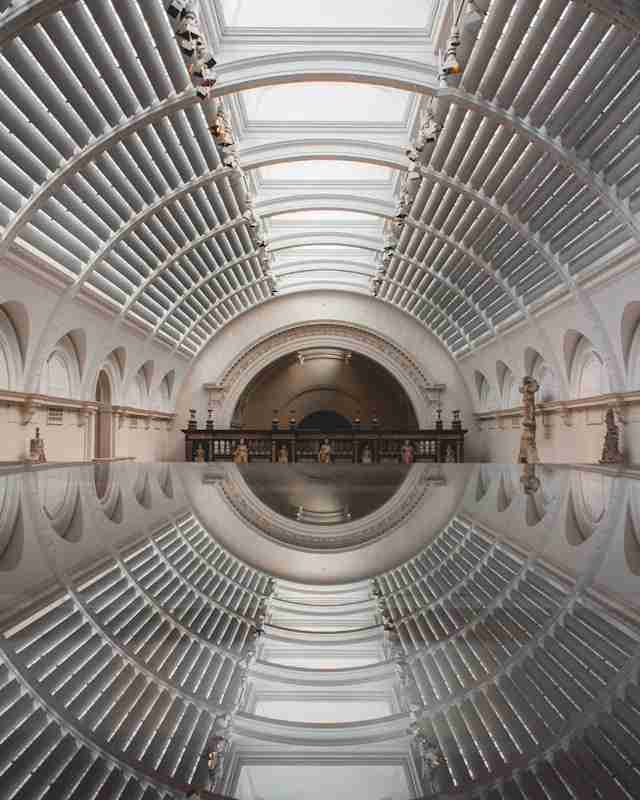
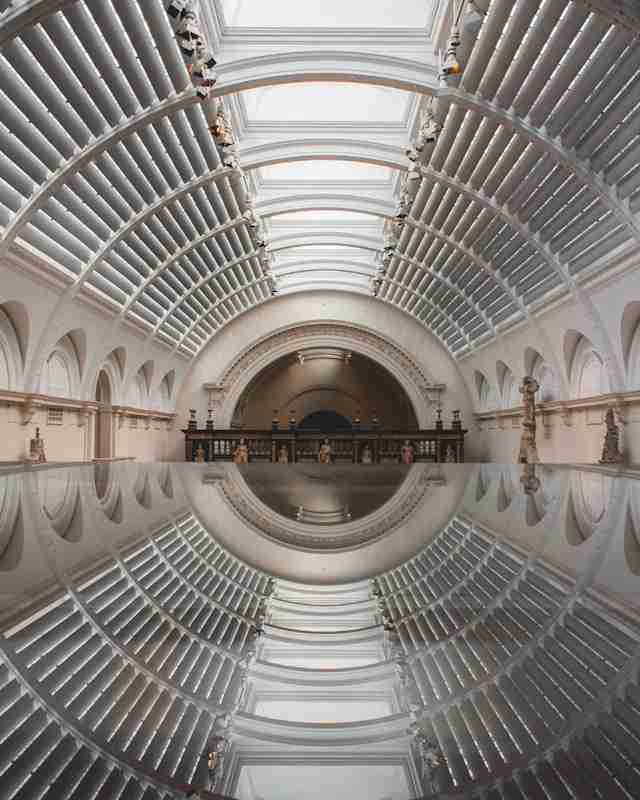
The Victoria and Albert Museum in South Kensington is one of London's most visually rich architectural spaces, offering a wealth of photographic subjects both inside and out. Built in stages since the mid-19th century, the museum blends ornate Victorian facades with sleek contemporary additions, including the courtyard and Exhibition Road entrance designed by Amanda Levete. For photographers, the V&A presents opportunities for symmetry, texture, natural light play, and human scale in grand interior volumes. Its marble halls, sweeping staircases, and detailed ceilings are perfectly suited to both wide-angle studies and intimate compositions. Whether you're drawn to classical sculpture, modern design, or architectural contrast, the V&A provides a controlled environment full of changing light, elegant geometry, and layered visual storytelling.
Best Photography Opportunities
• The John Madejski Garden and Courtyard
At the center of the museum's historic wings, this open-air courtyard is a peaceful and photogenic space with a central shallow pool, symmetrical paths, and classic brick facades. A wide-angle lens lets you incorporate reflections from the water and the layered columns and windows beyond. Early morning or late afternoon light casts soft shadows across the walls, while overcast conditions enhance the rich red brick and architectural detail. Use a tripod for controlled compositions when the space is less crowded, and look for opportunities to include visitors for scale and narrative.
• The Exhibition Road Entrance and Blavatnik Hall
This contemporary addition features clean lines, pale concrete, and dramatic shafts of natural light filtering through skylights. Shoot with a standard or wide-angle lens to capture the sweeping angles and shadow patterns that move across the floor throughout the day. The space lends itself to abstract compositions and minimalist frames where structure dominates. Black-and-white conversions work particularly well here, emphasizing tone and shape. Patience is essential to catch moments when the space empties briefly or when a single figure walks into the light.
• Cast Courts and Sculptural Detail
Inside the Cast Courts, towering plaster replicas of European sculpture and architecture offer dramatic vertical compositions and detailed close-ups. These halls are ideal for working with perspective distortion or shooting upward at large-scale forms such as Trajan's Column or the Portico de la Gloria. A tilt-shift lens can help maintain vertical lines, though careful framing with a wide lens can achieve similar results. Detail shots benefit from even interior lighting and subdued contrast. Try isolating texture, inscription, or the patina of age on older casts for more contemplative images.
• Victorian Staircases and Ceiling Patterns
The older sections of the V&A contain sweeping staircases, iron railings, and coffered ceilings that reward architectural study. Shoot from both top and bottom of stairwells to emphasize curves and leading lines, using a standard zoom or prime lens. Ceiling details are best captured with a wide-angle lens and upward tilt, ideally when natural light spills across surfaces. Low ISO settings preserve fine pattern detail in dimmer rooms. These interior frames benefit from symmetry and clean verticals, so take time to align each shot carefully.
• Gallery Interactions and Human Scale
The museum's variety of gallery spaces allows for strong visual storytelling when people are included in the frame. Look for moments of contrast between visitors and oversized sculptures, or where a figure moves through an archway or between display cases. Shoot with a longer lens to remain unobtrusive while capturing gestures and posture. These images often work best in subdued light with careful exposure, allowing the environment to remain dominant while the human presence adds life and context.
Best Time to Visit
The V&A Museum is open year-round, but certain days and hours are better suited to photography. Arrive shortly after opening to avoid crowds, especially in popular galleries and the courtyard. Midweek visits offer the quietest experience, with fewer visitors and more freedom to set up carefully composed shots.
Natural light plays an important role in many of the museum's newer spaces, so it's worth checking weather conditions in advance. Clear days provide defined shadow lines in Blavatnik Hall and highlight texture in the courtyard. Overcast days are ideal for sculpture and interior detail work, softening highlights and reducing the need for high ISO.
Photography is allowed in most areas of the museum, though tripods, flash, and lighting equipment are generally prohibited during public hours. Always check signage in specific galleries, particularly when special exhibitions are on display, as restrictions may vary.
How to Get There
The Victoria and Albert Museum is located on Cromwell Road in South Kensington, London. The nearest Underground station is South Kensington, a five-minute walk via the pedestrian tunnel connecting to the museum and nearby institutions.
There is no entrance fee to visit the main museum or most galleries. Special exhibitions may require a timed ticket, but the core architecture and public spaces are accessible for free. Museum hours typically run from morning until early evening, with occasional extended hours on Fridays.
Photography is permitted throughout most of the building, provided it's for personal or non-commercial use. Staff are generally helpful and used to visitors photographing the space, but avoid obstructing walkways or creating distractions for other guests. Mobile reception is strong throughout the building, and printed maps are available at the entrance for self-guided exploration.
Recommended Photography Gear
A wide-angle lens is essential for capturing the scale of galleries, ceilings, and courtyards. A standard zoom (24–70mm) works well for detail shots, staircases, and moments with human interaction. A fast prime lens, such as a 35mm or 50mm, is useful in low light and for shallow depth-of-field portraits or architectural close-ups.
Tripods are not allowed during public hours, so image stabilization and low-light technique are important. Set a high ISO when needed, but prioritize clean composition and straight lines over technical perfection. A circular polarizer may help with glare on glass cases, though many of the galleries use non-reflective display surfaces.
Bring extra batteries and memory cards, as shooting inside can be unexpectedly productive and time-consuming. A lens cloth is helpful for cleaning dust or smudges picked up in high-traffic areas. A small, quiet camera bag will help you move through narrow corridors without disruption.
Nearby Photography Locations
Just across Exhibition Road, this grand building features cathedral-like architecture, a soaring entrance hall, and fossil exhibits that invite dramatic interior photography. Its Romanesque stone detail and vaulted ceilings are best captured early in the day.
Also part of the South Kensington museum cluster, the Science Museum offers industrial textures, metallic structures, and a modern contrast to the V&A's classic style. Excellent for abstract or detail-focused compositions in controlled light.
A short walk west, these historic structures provide strong exterior architectural subjects, especially during golden hour when the stone glows with warm color. Use a telephoto lens to isolate statues and detail in the memorial's upper sections.
Just north of the museum, Hyde Park provides space for landscape photography, seasonal color, and candid people shots. The Serpentine Galleries offer contemporary lines and minimalist structures amid a natural setting.
• Cromwell Road Streetscape
The stretch of buildings along Cromwell Road includes richly ornamented facades, period details, and interesting light angles in the morning. It's worth walking slowly with a medium focal length to capture street-level architectural frames.
Photographing the V&A Museum means working with contrast: between history and modernity, structure and ornament, light and shadow. Whether you're exploring its newest galleries or its most historic corridors, the museum invites a visual approach that's both methodical and creative, offering strong frames around every corner.
Comments
Loading comments…