
Wells Cathedral stands as one of England's finest examples of Early English Gothic architecture, renowned for its harmonious proportions, sculptural detail, and spatial drama. Situated in the small Somerset city of Wells, the cathedral rises with a commanding but elegant presence from the city's medieval heart. It is a structure that offers photographers an extraordinary variety of subjects: towering facades carved with saints and angels, soaring vaulted interiors filled with ambient light, and contemplative cloisters that echo with symmetry and stillness. With every change of light and season, the cathedral reveals new textures, shadows, and tonal subtleties—making it one of the most rewarding sacred sites in the UK for both architectural and narrative photography.
Best Photography Opportunities
• West Front façade and late afternoon light
The west façade of Wells Cathedral is among the most intricate in Europe, with over 300 statues integrated into its arcaded elevation. Late afternoon sun from the southwest is ideal for bringing out the depth in these carvings, casting shadows that define each figure's contour and expression. Use a mid-range or telephoto lens to isolate sculptural groups, or step back with a wide-angle lens to capture the façade framed by the surrounding green and sky. Low perspectives, especially from the cathedral green, emphasize the tower's verticality and the rhythmic arrangement of arcades and niches. Overcast days provide soft, even light that reveals stone texture and surface tone without harsh contrast—ideal for black-and-white rendering.
• Scissor arches and nave interior from the central crossing
Inside the cathedral, the scissor arches—constructed in the 14th century to stabilize the central tower—are a visual and structural marvel. Their intersecting, curved lines form a symmetrical X beneath the tower, visible when standing in the central crossing of the nave. Photographing directly down the nave toward the west window captures both the arches and the sense of spatial depth created by the receding columns. A wide-angle lens is essential to include the full width of the interior, and tripod use during quiet periods (with permission) allows for long exposures that preserve shadow detail and highlight the play of ambient light filtering through stained glass.
• Chapter House staircase and side lighting
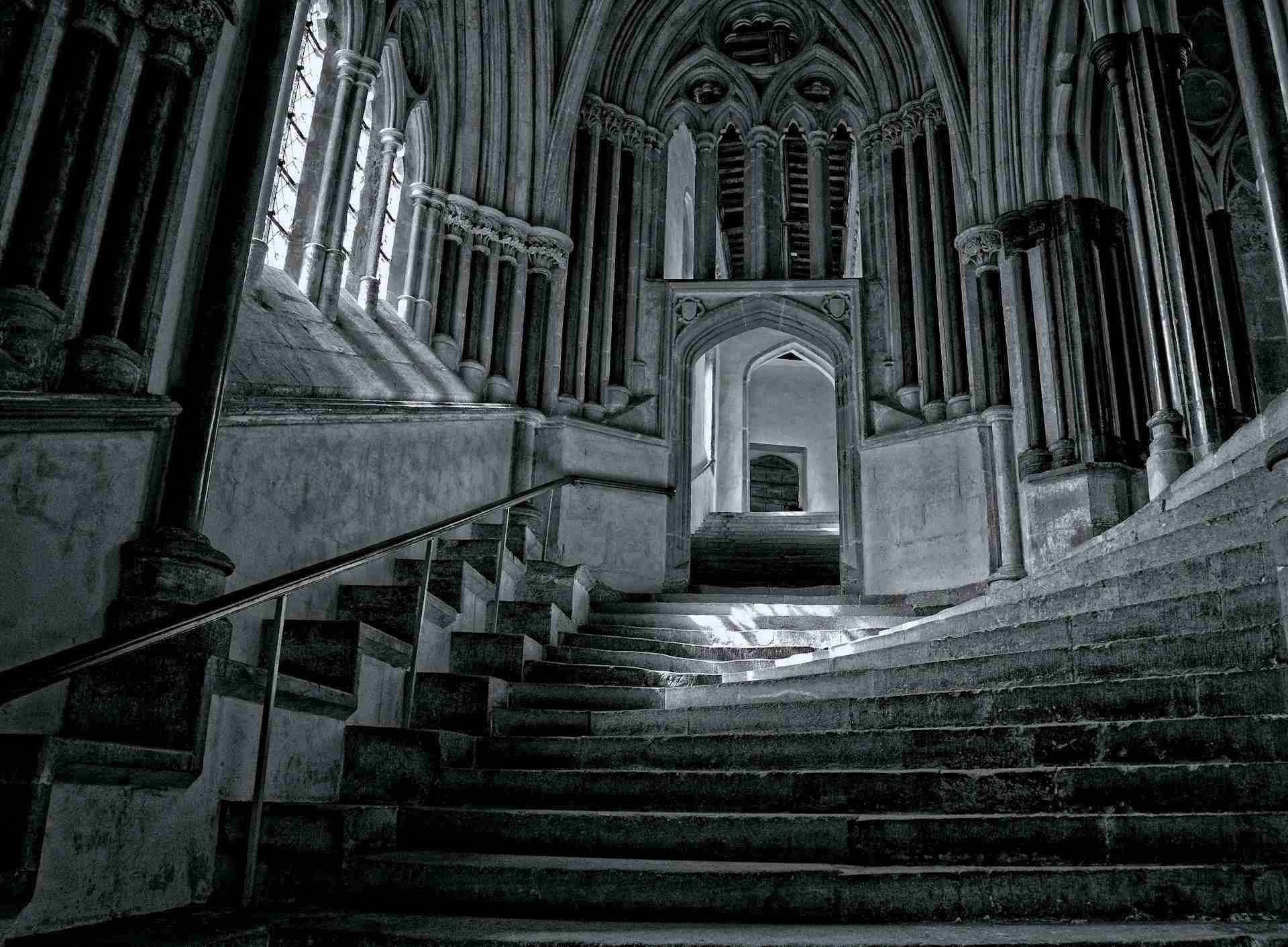
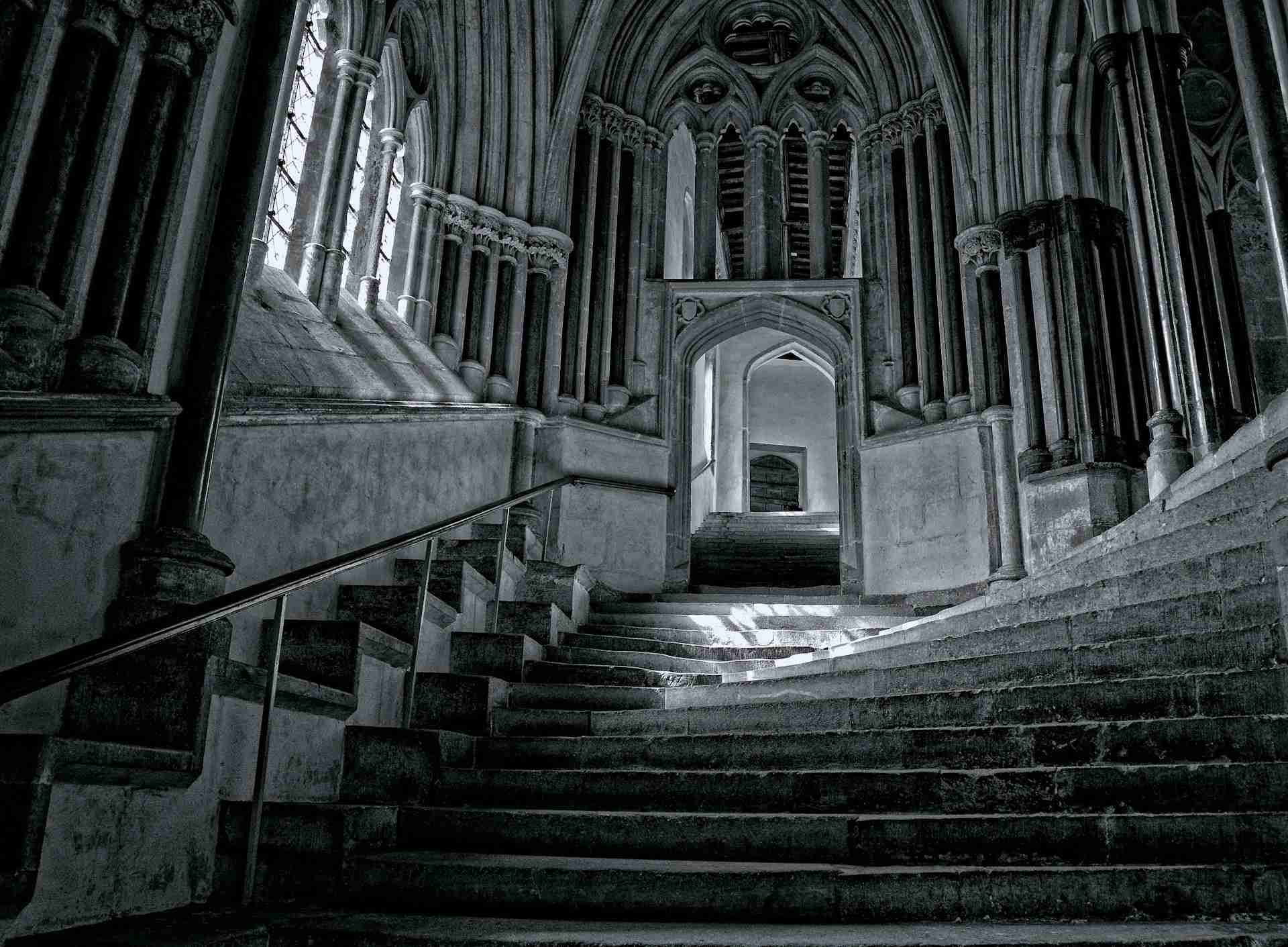
One of the most famous architectural features of Wells Cathedral is the worn, curved staircase leading to the Chapter House. The stair treads have been bowed and smoothed by centuries of use, and the organic curve paired with the play of light from the left-hand lancet windows creates a sculptural composition. Early morning or late afternoon light rakes across the steps, accentuating their shape and the subtle patina of the stone. Use a standard or short telephoto lens to focus on the curve itself, or shoot wide to include the arches and vaulted ceiling above. This location is ideal for black-and-white work, emphasizing form, age, and light.
• Cloisters and symmetry in filtered light
The cloisters, located along the southern side of the cathedral, offer some of the best opportunities for linear composition and symmetry. Their low ceilings, pointed arches, and repeating columns create visual rhythm—particularly when captured in soft overcast light or at twilight. A tripod allows for careful alignment and long exposures, while a polarizer can help reduce reflections off the floor and enhance shadow detail. For more intimate frames, focus on the texture of the stone walls or the geometric play of tracery windows framing the outer lawn. Including a single figure walking through the space can introduce scale and atmosphere.
• Reflections and seasonal foregrounds from the Bishop's Palace moat
Located just south of the cathedral, the Bishop's Palace grounds include a moat that reflects the cathedral's western towers under the right conditions. On still mornings or calm evenings, the surface becomes a mirror that captures the cathedral in soft symmetry, often with seasonal flowers or early mist adding mood. Frame from the far side of the moat with a mid-telephoto lens to compress the reflection, or shoot wide from the footpath for a more environmental portrait. Spring and autumn provide the richest colors, while winter allows for clean, stark compositions of bare trees and stone.
Best Time to Visit
Wells Cathedral can be photographed effectively year-round, but optimal conditions depend on your subject and the quality of light you want to capture.
Spring brings blooming gardens and fresh foliage to the grounds, softening the edges of the cathedral and adding color contrast to the grey stone. Morning light tends to be crisp and directional, ideal for interior light shafts and reflections on the chapter house stairwell.
Summer offers longer hours and clearer skies, with late evening light lingering across the west front and bathing the exterior sculptures in warm gold. While tourist numbers are higher, early morning and late afternoon remain relatively quiet. The cathedral interior stays cool and consistent, with ambient light filtering through vibrant stained-glass windows.
Autumn is especially photogenic, as the surrounding gardens shift to rust, ochre, and crimson. Low-angle light enhances texture and shadow across the west façade, and reflections in the Bishop's Palace moat gain tonal warmth. This is an ideal time for capturing atmospheric wide shots and tighter architectural details.
Winter introduces starkness and minimalism. On frosty mornings, mist can settle in the low garden areas, softening outlines and adding ethereal tones. The interior becomes a canvas of pale light and long shadows, with Advent and Christmas decorations introducing selective splashes of color and symbolism. Overcast days work well for texture studies and formal composition, particularly in the cloisters or chapter house.
How to Get There
Wells Cathedral is located in the heart of Wells, Somerset, a small city with well-established transit and walking access. For those arriving by car, multiple car parks serve the city center, including those on Union Street and at Waitrose, both within a five- to ten-minute walk to the cathedral. Disabled parking is available closer to the site.
For public transport, buses run regularly from Bath, Bristol, and Glastonbury. The nearest train stations are in Castle Cary and Bath Spa, requiring a short bus or taxi ride to Wells. Once in town, the cathedral is clearly signposted and easily accessed on foot.
There is no entrance fee to photograph the cathedral's main interior or exterior, though donations are encouraged. Tripod use inside the cathedral generally requires permission from staff, particularly during services or high visitor hours. Early visits and weekdays provide the best access for serious photography. The Chapter House and cloisters are open during general hours but may be closed during special events or private functions.
Recommended Photography Gear
Wells Cathedral's scale and lighting demands a versatile but intentional photographic setup. A wide-angle zoom (16–35mm) is indispensable for capturing the nave, arches, cloisters, and façade in full. Use it to emphasize verticality or architectural lines in tight interior spaces. A mid-range zoom (24–70mm) provides flexibility for sculpture studies, composition framing within arches, and transitions between indoor and outdoor shooting.
A fast prime lens (35mm or 50mm) excels in the cathedral interior, particularly for hand-held work in low light and isolating key details like carvings or candlelight. For reflection shots from the moat or close-up façade work, a telephoto lens (70–200mm) helps compress space and reduce distortion.
A lightweight tripod is essential for low-light interior shooting or long exposures in the cloisters and during blue hour. Pack a circular polarizer for managing reflections and enhancing contrast on stone. A 3-stop ND filter may be useful for subtle motion blur or smoothing water in reflection compositions.
Because the cathedral is a working place of worship, your gear should be packed discreetly and used with respect. Avoid bulky backpacks, and dress appropriately when planning to shoot indoors. Bring a microfiber cloth for lenses—interior moisture and dust are common—and a remote shutter release for precision framing on long exposures.
Nearby Photography Locations
Immediately adjacent to the cathedral, this site features historic architecture, arched bridges, and manicured gardens. The moat provides some of the best reflections of the cathedral's towers in soft or evening light.
Just north of the cathedral, this is said to be the oldest continuously inhabited residential street in Europe. Its cobbled pathway, aligned rooftops, and vanishing point composition offer one of Somerset's finest symmetrical views—especially during golden hour.
A short drive south, this legendary hilltop offers fog inversion photography, sunrise silhouettes, and panoramic countryside vistas. Ideal for combining sacred landscape and architectural minimalism.
A wooded limestone gorge just a few miles west of Wells. Great for nature macro, misty forest compositions, and autumn leaf color. Works well as a contrast to the cathedral's order with organic, wild textures.
One of Britain's most dramatic limestone landscapes, offering cliff-edge views, shadowed rock formations, and strong black-and-white potential. Photographers can transition from gothic architecture to geological grandeur within a 30-minute drive.
Wells Cathedral is a structure of both grandeur and intimacy. Whether you're photographing its sculpted façade in golden light or tracing the worn steps of its Chapter House in silence, every angle invites care, patience, and reverence. For photographers drawn to form, light, and narrative embedded in stone, it's a subject worth returning to across seasons, weather, and years.
Comments
Loading comments…