
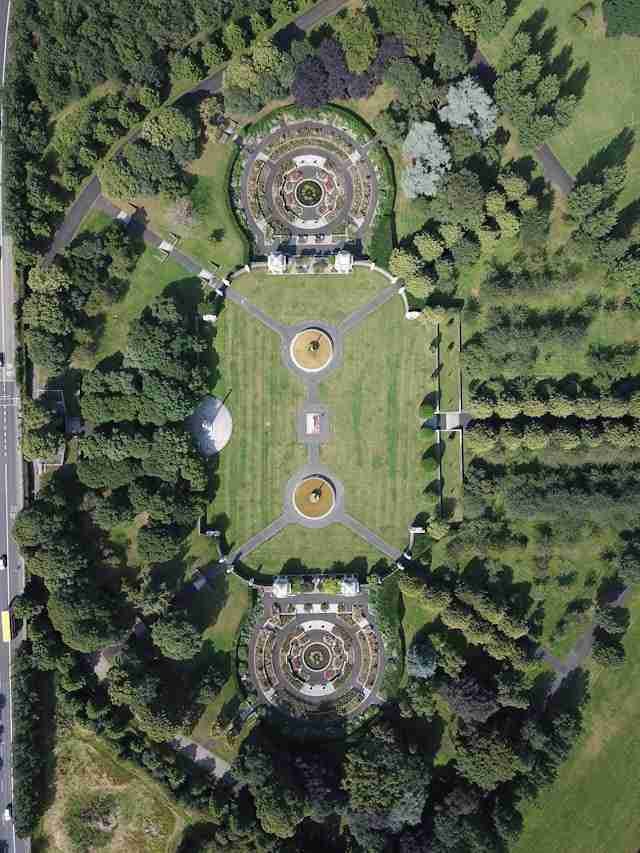
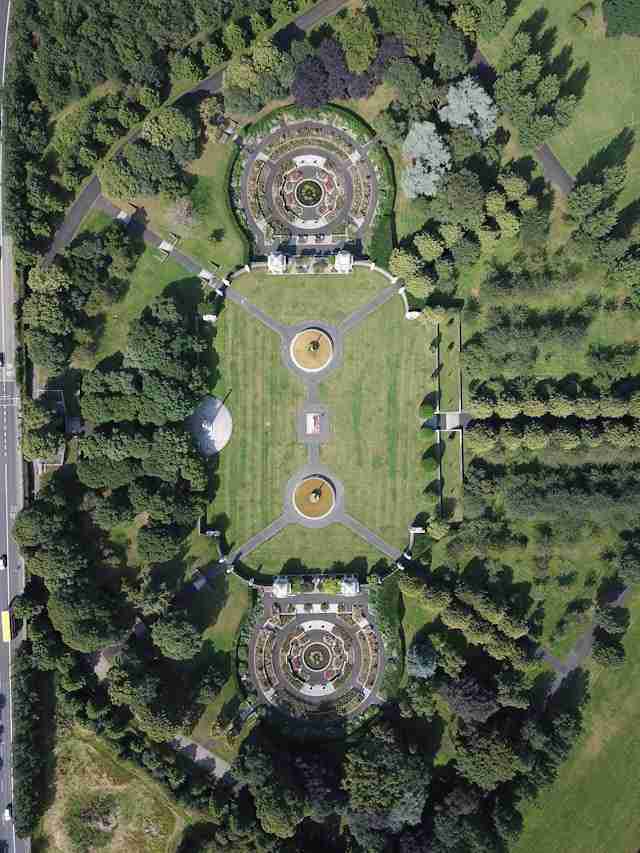
Situated on the edge of Dublin's Kilmainham district, the Irish National War Memorial Park is a quiet, reflective space dedicated to commemorating the sacrifices of Irish soldiers in World War I. Through its long waterway, stone colonnade, and mature trees, the park blends solemn memorial architecture with landscaped serenity. For photographers it offers a compelling interplay between formal design, commemorative symbolism, and changing light, making it ideal for capturing thoughtful, emotion-rich frames.
Best Photography Opportunities
• The Central Waterway and Memorial Temple
– The visual spine of the park is its long linear waterway, stretching from the formal entrance to the small domed temple at the far end. This view is all about symmetry, balance, and reflection. The water feature captures the light sky and surrounding trees in near mirror clarity during calm days, especially early in the morning or after rain. Shoot from a low angle near the edge of the path for a symmetrical vanishing point composition, and use a wide-angle lens to include both flanks of the colonnade and tree canopy. As the seasons change, the reflected color palette transforms—from fresh spring green to the deep golds and coppers of autumn. During golden hour, the low sun flares softly over the temple's roof, giving your composition a gentle glow.
• Stone Colonnade and Sculptural Details
– Running along the east and west perimeters, the stone colonnades are built with understated classical lines. The columns frame spaces of light and shadow, and they are inscribed with names of the fallen. These walls are not just architectural—they are textual, emotional, and symbolic. Use a long lens to compress the repetition of columns or to isolate names carved into the stone. Look for moments when light grazes the edges of these engravings, bringing out their form through contrast rather than direct brightness. Detail shots of wreaths laid at the base of these walls, or wider shots showing families pausing in silence, make for poignant photographic storytelling. Consider converting some of these images to black and white to emphasize the tone of remembrance.
• Mature Trees and Seasonal Canopy
– The park is flanked and divided by avenues of mature trees, ash, lime, and oak, that offer compositional structure and natural framing. In spring, new leaves form a luminous overhead canopy, perfect for shooting directly upward or capturing dappled light across the grass. Summer mid-day light filtering through thick foliage can be used to sculpt shapes on benches and paths. Autumn brings the most striking transitions; golden leaves cascade onto walkways and gather in reflective pools around the waterway. Winter, too, has photographic merit: bare branches provide minimalist contrast against the memorial's solid forms. Use a zoom lens to isolate single trunks or frame a path of trees leading into soft light. Shoot with a wide aperture to blur the background, giving your tree-lined portraits a painterly softness.
• Solitary Benches and Quiet Contemplation
– Benches are carefully placed throughout the park in deliberate positions that frame the memorials and offer rest. Photographers can use these as narrative anchors in both wide and tight compositions. An empty bench under a tree becomes a metaphor for absence, while a person seated in quiet reflection adds emotional gravity. Capture these scenes with a long lens from a distance to maintain privacy and preserve natural posture. Consider low-angle compositions that let you shoot through grass or fallen leaves, creating a natural foreground blur. During the early hours, benches facing the temple or colonnade catch side light that adds dimensionality and mood.
• Evening Glow After Rain
– After a soft rain, the entire park takes on a polished sheen. The stone colonnades darken and deepen in tone, the waterway becomes even more reflective, and puddles form on the paved paths, offering surprise mirrors for double exposures. As evening settles, ambient light from nearby lamps begins to gently illuminate the temple and walkways. This is the time to shift to long exposure work. Use a tripod to stabilize your frame and slow your shutter to smooth water reflections or catch the last trailing movements of visitors walking quietly through the space. A polarizing filter can help bring out the subtle color tones in the damp stone while reducing glare from the wet ground. The mood during this time is one of quiet reverence, perfect for a contemplative visual series.
Best Time to Visit
The Irish National War Memorial Park offers a variety of photographic moods throughout the day and across the seasons. Early morning is arguably the most rewarding time to visit. The park opens shortly after sunrise, and in the first hour of light, the waterway is often completely still, capturing perfect reflections of trees and sky. The light during these early hours is warm, low, and directional, casting long shadows across the lawn and grazing the colonnade with subtle highlights. It is also the quietest time of day, allowing photographers to work slowly and without interruption.
Midday brings brighter light and heavier foot traffic, particularly during weekends or public holidays. While the light can be more direct and contrasty, this time is useful for tight compositions, detail shots of inscriptions or wreaths, and photographing the natural textures of the tree trunks or stonework. Cloudy midday conditions are actually favorable here, they soften the shadows and create even lighting for architectural work, particularly under the colonnade.
Late afternoon and golden hour are when the park glows most vividly. The sun begins to filter through the trees on the western side, casting rhythmic shadows along the colonnades and bringing a soft luminance to the temple at the far end of the water feature. This time is ideal for both color and black-and-white work. Long, warm shadows add depth, and the horizontal quality of the light sculpts both natural and architectural forms.
As dusk approaches, blue hour takes hold and transforms the space. The fading sky contrasts with the warmly lit stone structures, while the water continues to reflect the color gradient from sky to ground. If it has recently rained, the wet surfaces double the available light, adding richness and a cinematic quality to your compositions. This is a strong time for tripod work and low ISO shooting. It is also the most emotionally evocative window of the day; a time of silence, reflection, and visual poetry.
Seasonally, the park is photogenic year-round. Spring and early summer bring fresh greens and flowering borders. Autumn, especially in mid-October, is a favorite for those drawn to color and changing light. Winter presents minimalism and mood, with frosty textures and sparse compositions. Each visit reveals a new layer of possibility, shaped by weather, time, and stillness.
How to Get There
The Irish National War Memorial Park lies alongside the Grand Canal at Kilmainham, southwest of Dublin's city centre. From Heuston Station it is a fifteen-minute walk westward. Several Dublin Bus routes, including numbers 13 and 40, stop nearby on Emmet Road. There is bike parking at the entrance gate for cyclists, and limited roadside parking is available along South Circular Road. Entrance to the park is free and open year-round, with operating hours aligned with daylight (generally from early morning until sunset).
The park's main paths are wide and flat, accommodating photographers with larger gear setups or tripods. There are no special photography restrictions, but during commemorative events or ceremonies, access to certain memorial spaces may be temporarily limited. Always maintain respectful distance from visitors engaged in private reflection or remembrance.
Essential Gear Recommendations for Photographing the Memorial Park
Given the variety of subjects in the park, from grand perspectives to intimate symbolic detail, a flexible yet focused kit will serve you best. Begin with a wide-angle lens (16 to 35 millimeter) for capturing the full breadth of the waterway and its flanking architecture. A standard zoom (24 to 70 millimeter) gives you range for mid-scale compositions and general walkaround work, especially when framing benches, trees, or visitors in context.
A medium telephoto lens (70 to 200 millimeter) is valuable for isolating architectural inscriptions, compressing rows of columns, or capturing environmental portraits without intruding. Prime lenses, such as a 35 millimeter f1.4 or a 50 millimeter f1.8, offer exceptional low-light performance for blue hour compositions or rainy, overcast scenes where mood and minimalism are key.
For low-light and reflective photography, a travel tripod is essential. Use it for long exposures near the waterway or for capturing stable compositions in changing evening light. Circular polarizers help manage glare on stone and water, especially after rainfall. If you plan to shoot long exposures during the day, pack a neutral density filter (6 or 10 stop) to allow creative blurring of water surfaces and clouds.
Weather protection is crucial. Dublin weather is variable, so carry a rain cover for your camera, microfiber cloths for lenses, and a water-resistant bag. Extra batteries are advisable, particularly if you plan to stay through dusk when temperatures drop. A remote shutter release can be useful for long exposures, and a compact reflector or white card may help when subtly controlling light on foreground elements such as inscriptions or wreaths.
Nearby Photography Locations
• Kilmainham Gaol and Grounds
– Just beside the memorial park lies the historic Kilmainham Gaol. Its rusted gates, brick arches, and dim corridors offer powerful architectural and documentary compositions. Contrast its darker tones and textures to the lighter serenity of the memorial park in your series.
– Located within the adjacent Royal Hospital Kilmainham complex, the museum's stone architecture and landscaped courtyards offer elegant lines and reflection opportunities. The interplay between contemporary art installations and historic setting gives dynamic depth to walk-through captures.
• Grand Canal Towpath
– The path just outside the park follows the canal's water toward central Dublin. Capture urban reflections, passing ducks and swans, or narrow views of canal boats moving at golden hour. The balance of greenery and urban life complements the park's mood.
– A small neoclassical pavilion across from the park entrance features fluted columns and an open vestibule. It scenes elegantly framed with the park in the background—ideal for walk-in portraiture or contemplative architectural studies.
• Phoenix Park's Victorian Alternate Gate
– A short stroll away brings you to Phoenix Park's eastern edge, where wrought iron entrances bordered by mature trees offer grand gateway compositions. Capture dappled light through leaves and gate shadows across late-afternoon pathways.
The Irish National War Memorial Park invites quiet observation, offering photographers a space where memory, light, and seasonal change shape images of both personal and historical depth. Every frame taken here has the potential to reflect more than just beauty—it can speak to history, presence, and enduring peace.
Comments
Loading comments…