
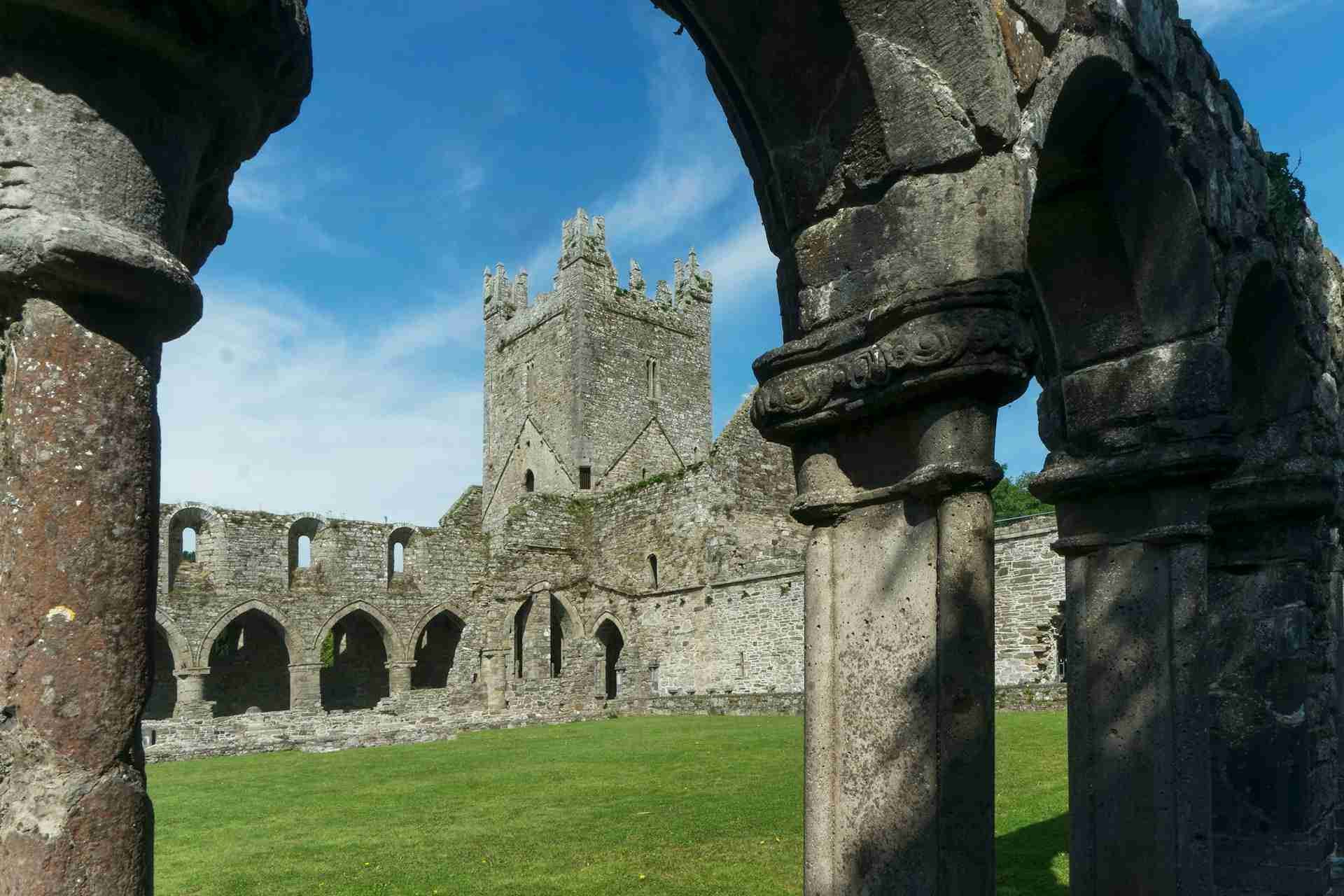
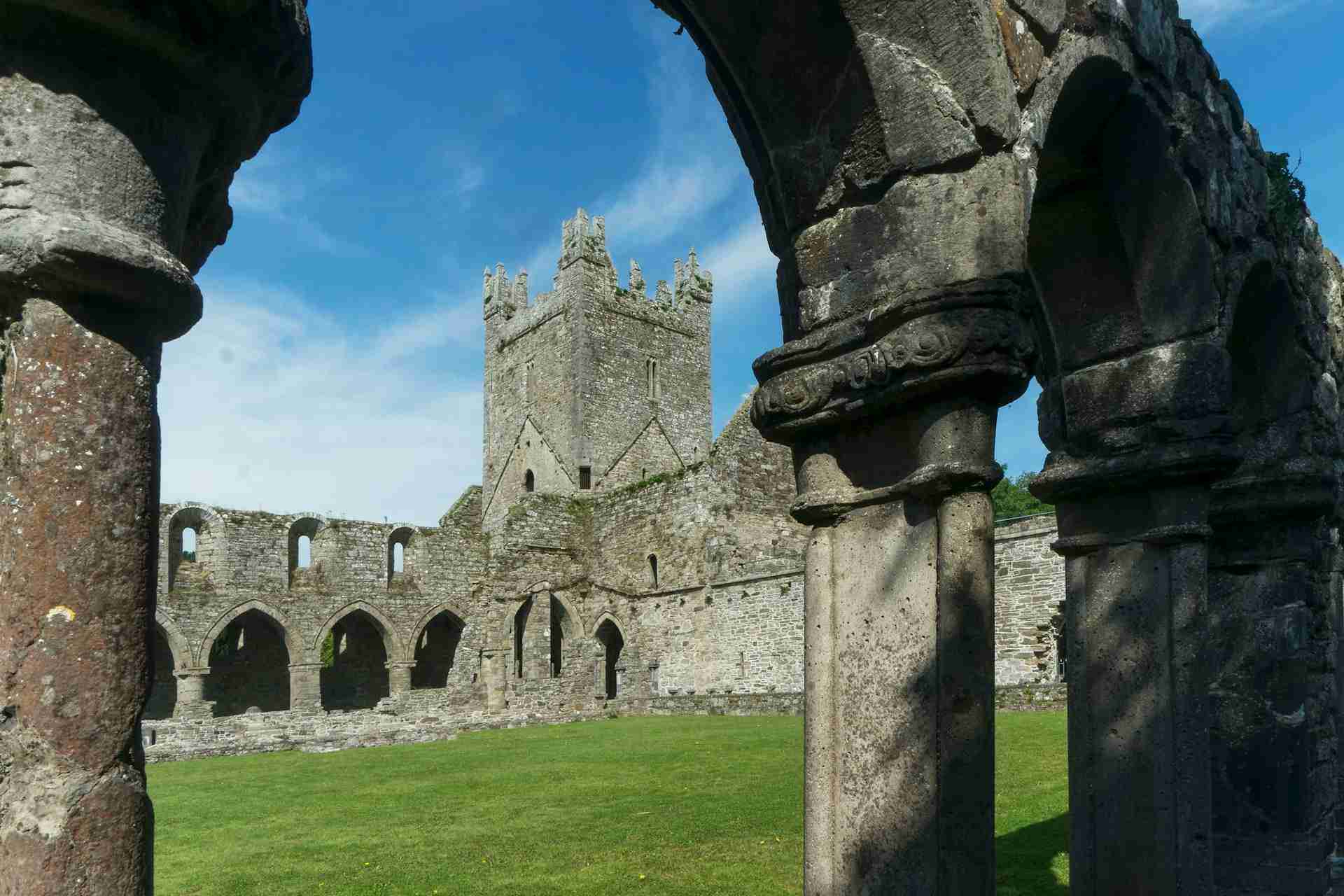
Standing just outside Thomastown in County Kilkenny, Jerpoint Abbey is one of Ireland's most impressive medieval monastic ruins. Founded in the 12th century by the Cistercians, the abbey today is a roofless stone skeleton where arches, cloisters, and carved tombs remain remarkably intact. For photographers, Jerpoint Abbey offers a mix of strong architectural geometry, intricate stone carving, and atmospheric play between light and shadow. The ruins rise from the surrounding fields, and their weathered walls are often softened by Ireland's shifting skies, which range from bright shafts of sun to moody layers of cloud. Whether you are drawn to sweeping wide shots of the abbey's structure or close studies of its detailed ornamentation, Jerpoint is a location that blends history with artistry in every frame.
Best Photography Opportunities
• Cloisters and Arched Walkways
The cloister is one of Jerpoint Abbey's most striking photographic subjects, with its series of arches and pillars enclosing a grassy courtyard. The repeating stone patterns create strong symmetry, especially when shot with a wide-angle lens at ground level. Side light during morning or late afternoon enhances the texture of the stone and casts shadows that emphasize depth. Close-ups of the carved capitals, which feature biblical scenes, mythical creatures, and floral motifs, add a level of intimate detail. On overcast days, the soft light is perfect for capturing the subtler carvings without harsh contrast.
• Tower and Nave Perspectives
The central tower rises above the ruins and serves as a visual anchor for both interior and exterior shots. Standing in the nave, you can frame the tower through the remaining arches, creating compositions that mix height and depth. Wide lenses capture the tower in context with the skeletal roofless walls, while telephoto lenses isolate its form against shifting Irish skies. Shooting upward from within the nave emphasizes the scale and draws attention to the verticality of the structure. Late afternoon light often glows warmly across the western-facing stones, highlighting their rich texture.
• Carved Tombs and Effigies
Jerpoint Abbey is renowned for its medieval tomb sculptures, including effigies of knights, bishops, and monks. These stone figures are richly detailed, with swords, armor, and robes still clearly visible despite centuries of weathering. Macro and mid-range lenses allow you to capture fine textures in the carvings, from facial expressions to decorative inscriptions. Shooting at an angle rather than head-on can bring out depth through shadow play. These subjects are best photographed in soft light, which enhances detail without flattening the forms.
• Exterior Views Across the Fields
From outside the abbey, especially on its southern side, the ruins rise starkly from the surrounding farmland. Including the green pastures in the foreground reinforces the abbey's isolation and rural character. Wide compositions balance the rugged outline of the abbey against Ireland's expansive skies, which often shift rapidly from sun to rain. Storm clouds approaching from the west add drama and contrast, while brighter skies soften the mood for more tranquil images. This location rewards repeated shooting throughout the day as the weather transforms.
• Abstract Textures and Detail Work
Beyond its sweeping architecture, Jerpoint Abbey rewards close attention to detail. Crumbling stone, lichen-covered surfaces, and broken arches provide endless opportunities for abstract compositions. Shooting at shallow depth of field with a fast lens isolates texture and color variations in the stone. Overgrown sections, where grass and ivy creep into the ruins, create natural juxtapositions of life against decay. These details often work best in overcast conditions, when even lighting allows texture to stand out without distraction.
Best Time to Visit
Jerpoint Abbey can be photographed in all seasons, though spring and summer provide the most reliable access and light. In spring, the surrounding fields are bright with fresh grass, and soft morning light casts long shadows through the cloisters. Summer offers the longest days, with early sunrises and late sunsets allowing multiple shooting sessions. Midday light can be harsh, so it is best to focus on interior cloister details or carved tombs during these hours.
Autumn adds rich golden tones to the fields and mossy surfaces, giving the ruins a warm and aged appearance. Morning mists are also more common at this time of year, adding atmosphere to wide shots of the abbey across the fields. Winter brings stark contrasts, with low sun creating strong side lighting that emphasizes stone texture. For the best balance of light and shadow, aim to visit in early morning or late afternoon, when the ruins glow with warmth against the cooler tones of the Irish countryside.
How to Get There
Jerpoint Abbey is located about 2 kilometers outside Thomastown in County Kilkenny, roughly a 20-minute drive from the city of Kilkenny and about 90 minutes from Dublin. The site is well signposted from the R448 road, and parking is available directly outside the visitor center. The abbey is managed as a heritage site, and there is an entrance fee to access the grounds and interior areas.
The site is easily walkable, with clear paths around the cloisters, nave, and surrounding grounds. Photographers should allow at least one to two hours to explore both wide views and details. Tripods are permitted and useful for low-light interiors, though be mindful of other visitors. Drones are not permitted within the heritage zone, so all photography should be planned from ground level. The visitor center provides basic amenities, including restrooms and informational displays.
Recommended Photography Gear
Jerpoint Abbey's variety of subjects makes a versatile kit the best option. A wide-angle lens in the 16 to 35 millimeter range is essential for capturing the cloisters, nave, and tower in full context. A 24 to 70 millimeter zoom is ideal for exterior perspectives and balanced compositions that include the surrounding fields. A telephoto lens in the 70 to 200 millimeter range is useful for compressing the abbey against dramatic skies or isolating sections of the ruins.
For detail work, a macro or fast prime lens allows for close studies of carvings, effigies, and textures in low light. A tripod is recommended for interior work, particularly when shooting in the cloisters or under cloud cover. A circular polarizer helps enhance the green fields and blue skies while reducing glare on wet stone surfaces. Weather protection is essential, as Irish rain showers can appear suddenly. Extra lens cloths are valuable for clearing mist and water droplets from gear.
Nearby Photography Locations
Located in the city of Kilkenny, this restored medieval castle offers both interior architectural photography and wide exterior views across the River Nore. The castle grounds provide multiple angles, while the river offers reflective compositions, especially at sunset.
Just south of Thomastown, Kells Priory is one of Ireland's largest medieval monastic sites, with extensive ruined walls, towers, and fields. Its scale makes it ideal for wide landscape shots, particularly in late afternoon light that casts long shadows across the ruins.
Situated north of Kilkenny, Dunmore Cave combines geology and history in one location. Its limestone chambers are rich in texture and shadow, rewarding photographers interested in detail and low-light compositions. Guided access ensures safety while still providing strong photographic opportunities.
East of Thomastown, Inistioge is a riverside village with stone bridges, tree-lined walks, and traditional Irish architecture. Nearby Woodstock Gardens provide landscaped grounds, woodlands, and viewpoints over the River Nore valley. Both are excellent for softer, pastoral compositions.
A bit farther afield in County Tipperary, the Rock of Cashel is one of Ireland's most dramatic heritage sites. Its hilltop cluster of medieval buildings dominates the surrounding countryside, offering panoramic views and strong silhouettes against the sky.
Jerpoint Abbey combines architectural strength, historic depth, and the shifting moods of the Irish landscape. From its cloisters and carved tombs to its commanding presence across the fields, the abbey rewards both careful study and wide contextual views. For photographers seeking to capture the essence of Ireland's medieval heritage, this site remains one of the most visually compelling and atmospheric destinations in the southeast of the country.
Comments
Loading comments…