
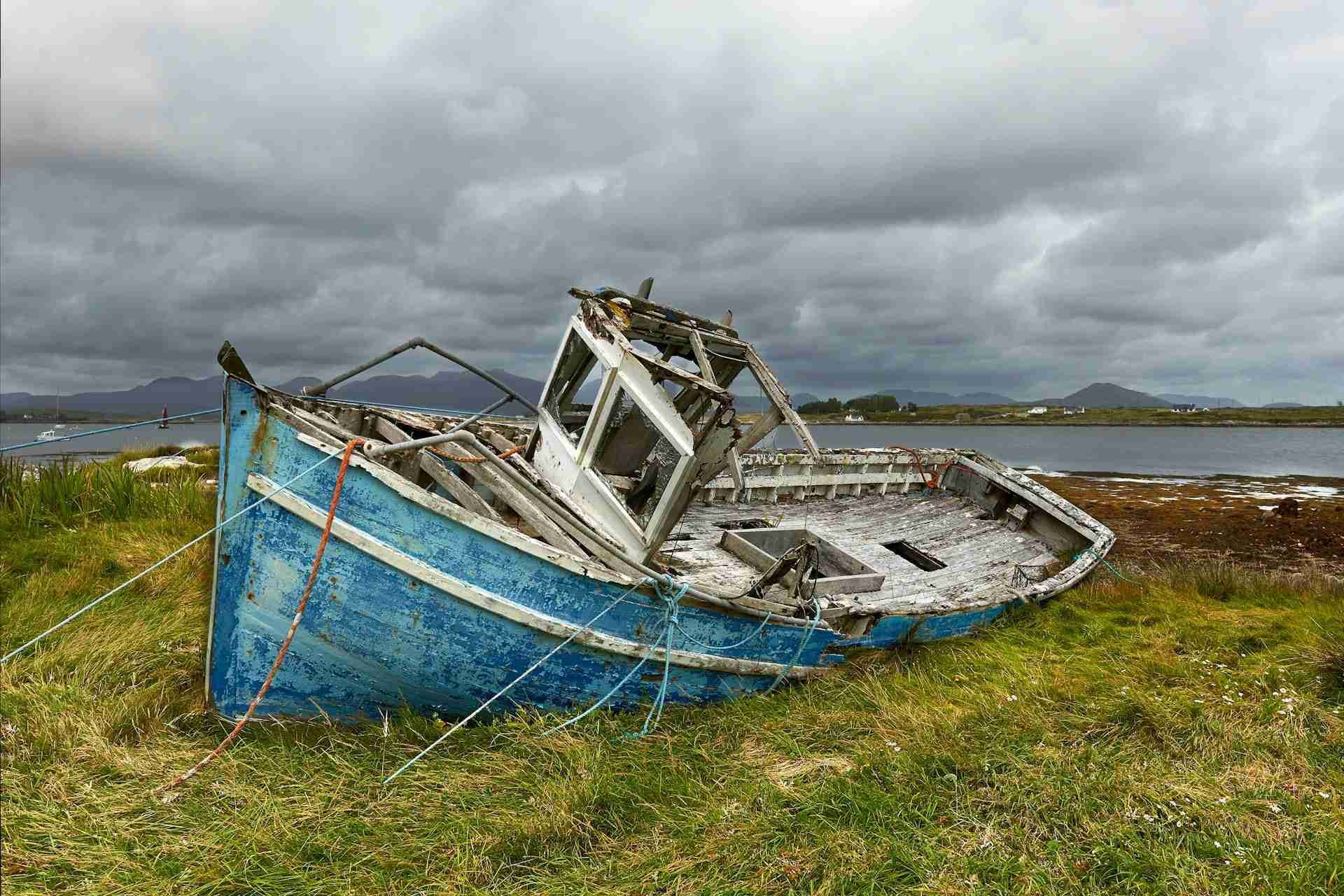
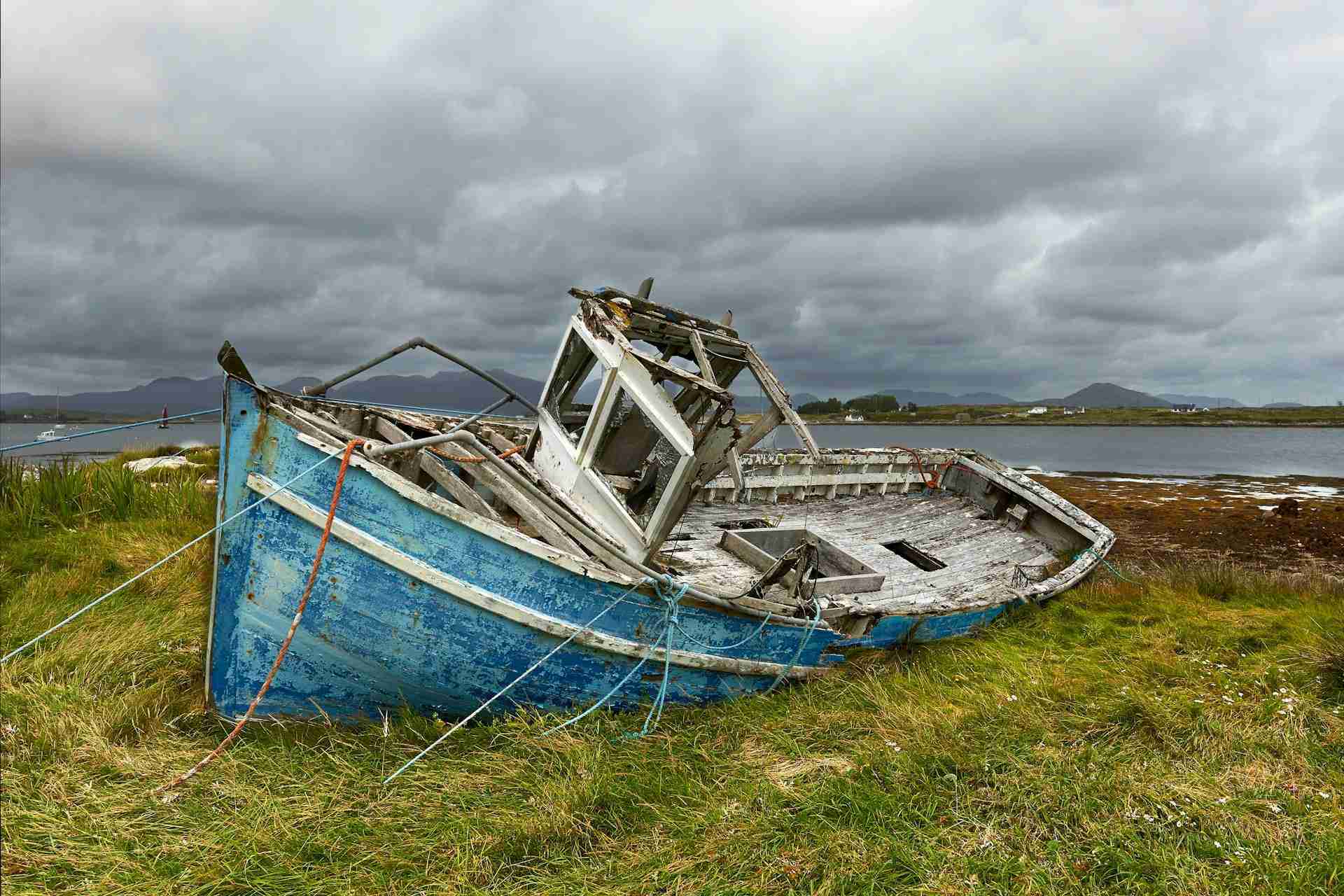
Tucked between the tidal flats and low stone walls just off Monastery Road in Roundstone, a pair of abandoned fishing boats rest permanently in the shallows, their skeletal hulls slowly giving way to rust and rot. These boats have become a quiet visual landmark on Ireland's west coast, drawing photographers who are drawn to textured decay, layered sky, and compositions shaped by tide and time. Surrounded by a sweeping, open shoreline and backed by the muted blue rise of the Twelve Bens in the distance, the scene lends itself to simple, grounded compositions that balance form, shadow, and soft movement in sky or water. It's a place where change happens slowly, but light changes everything by the minute.
Best Photography Opportunities
• Frontal Composition with the Boats Anchored in Foreground
The most straightforward and powerful composition places one or both boats in the lower third of the frame, anchoring the image against the tidal flats and distant hills. A wide-angle lens allows for inclusion of sky and reflection when tide conditions permit, while a midrange zoom keeps attention on texture and shape. The boats' slanting lines and collapsing hulls offer compelling contrast against the surrounding flatness of the landscape. These shots are strongest in early morning or golden hour light when low-angle sun brings out wood grain, rust, and subtle color in the surrounding terrain.
• Close-Up Detail of Hulls and Weathered Texture
These boats are rich with photographic detail: cracked paint, exposed ribs, rusted metal, and moss clinging to the lower timbers. Working with a 50mm or longer focal length allows for tight framing on these textures without losing depth. These shots are especially effective under overcast skies, which reduce contrast and preserve subtle variation in tone. Be mindful of your footing, as the mudflats and tidal edge can be slippery or soft. Detail frames work well as part of a visual series or in black and white, where texture becomes the subject.
• Reflections and Sky During High Tide
When the tide is in and the wind is still, the boats become partially surrounded by water, creating opportunities for soft reflections and more isolated compositions. These scenes benefit from tripod-mounted long exposures to smooth the water and emphasize form over detail. Use a neutral density filter to extend shutter speed and manage exposure during brighter conditions. Reflections are clearest in early morning before the wind rises. This is a chance to strip the scene down to shape, tone, and negative space.
• Silhouettes and Mood at Sunset
As the sun drops behind the hills, the boats darken into silhouette, especially when framed against a bright horizon or fading color in the sky. This is a moment for slower, more contemplative images built around contrast and simplicity. A small aperture can create a clean edge to the silhouette, and bracketing can help retain subtle color in the sky. These images are quiet and often benefit from minimal editing. Including birds or distant movement in the frame adds subtle life to the scene without cluttering the composition.
• Foreground Layers with Tidal Detail and Distant Hills
The shoreline around Roundstone is filled with visual texture: seaweed mats, sand ripples, and small tidal channels that work as natural leading lines into the frame. Positioning the boats deeper in the background allows you to use these elements to guide the viewer's eye. These compositions often work best in soft side light during the late afternoon. A wide-angle lens at f/11 or higher helps maintain sharpness throughout the frame. This approach creates more environmental images that place the boats within the broader context of land and water.
Best Time to Visit
The Roundstone shoreline rewards photographers throughout the year, but the months between April and October provide the best mix of light, weather stability, and accessible terrain. Spring brings cool, clear air and fast-moving clouds that often frame the boats in dynamic skies. Summer mornings offer calm conditions and clean reflections when tides are high. Autumn light tends to be warmer and lower throughout the day, casting longer shadows and bringing out more warmth in the landscape and the boats' surface textures.
Tide timing matters as much as time of day. High tide offers waterline shots with reflection and isolation. Mid to low tide reveals more foreground texture and allows for tighter positioning around the boats. Sunset is especially strong when clouds begin to break, casting a wide gradient of color across the water and sky. Overcast days are best for texture and detail work when flat light softens shadow lines. Strong winds are common, particularly in the afternoon, so early visits provide the most manageable conditions for long exposures.
How to Get There
Roundstone is located along the R341 coastal road in County Galway, on Ireland's western edge in the heart of Connemara. From Galway City, the drive takes roughly 90 minutes and winds through scenic moorlands and lakes. Upon entering Roundstone, continue along the main street and turn onto Monastery Road. The boats are located just a short walk from the roadside.
There is no fee to access the site, and it is easily reached on foot from town. Limited roadside parking is available nearby, though it's best to visit early or late in the day to avoid crowding. The terrain is open, but tidal flats can become slippery or unstable near the water's edge. Use caution when walking close to the boats, especially after rain or high tide. Drone use is permitted, but weather and wind must be factored into any aerial shoot. Tripods are easy to use throughout the area, and there is ample space for slow, deliberate composition.
Recommended Photography Gear
To make the most of the location's varied opportunities, bring a compact but flexible kit suited to long exposures, tight detail, and expansive framing. A wide-angle lens between 16 and 35 millimeters is essential for full boat compositions, sky-driven scenes, and foreground-heavy frames. A 24 to 70 millimeter zoom is ideal for midrange work, especially when capturing boats against background elements or layering tidal textures. A short telephoto helps isolate shapes and emphasize depth across flat terrain.
A solid tripod is important for long exposure work, particularly near high tide or in fading light. A 6- to 10-stop neutral density filter allows for shutter control when smoothing water or motion in the sky. A circular polarizer helps manage reflection and reduce glare on wet surfaces. Bring a lens cloth or two to clean salt spray and condensation if working close to the water. A waterproof camera bag and well-treaded boots are recommended, especially when exploring around the tidal edge or after recent rain.
Nearby Photography Locations
Located just a few kilometers from Roundstone, these twin crescent beaches are known for their white sand, turquoise shallows, and clean horizon lines. Ideal for drone photography and wide landscapes, they are best photographed at low tide when sand patterns emerge clearly. Early morning or late afternoon offers warm side light across the dunes.
Visible in the distance from Roundstone, these rugged peaks dominate the inland view and are accessible by short drives into the Connemara interior. Low morning light often picks up the sharp contrast of the ridgelines. Bring a telephoto to compress the peaks or frame them against reflective lakes in the foreground.
Further north along the coast, this unusual beach is covered not in sand but in crushed coral-like algae. Its unusual texture works well for abstract compositions, especially under side light. The surrounding coastline offers rock pools and tidal formations ideal for macro and low-angle work.
A winding coastal route offering elevated views over the Atlantic, scattered islands, and stone-fenced fields. Best at sunset, the road's pullouts offer space to shoot long landscapes with shifting weather and open skies. A wide lens is essential to capture the vastness of the scene.
• Bog Road across Derrigimlagh
This open stretch of land just south of Clifden is home to a wild bog landscape dotted with pools, low hills, and scattered ruins. It's particularly photogenic under overcast skies or morning mist. A midrange lens helps isolate pools and grasses, while a longer lens brings out subtle layering in the land.
The abandoned fishing boats along Roundstone's shoreline are a quiet kind of subject. They don't change much, and that's exactly why they work. The light, the sky, and the tide do the changing. If you're willing to wait and work slowly, there's always a frame worth building.
Comments
Loading comments…