
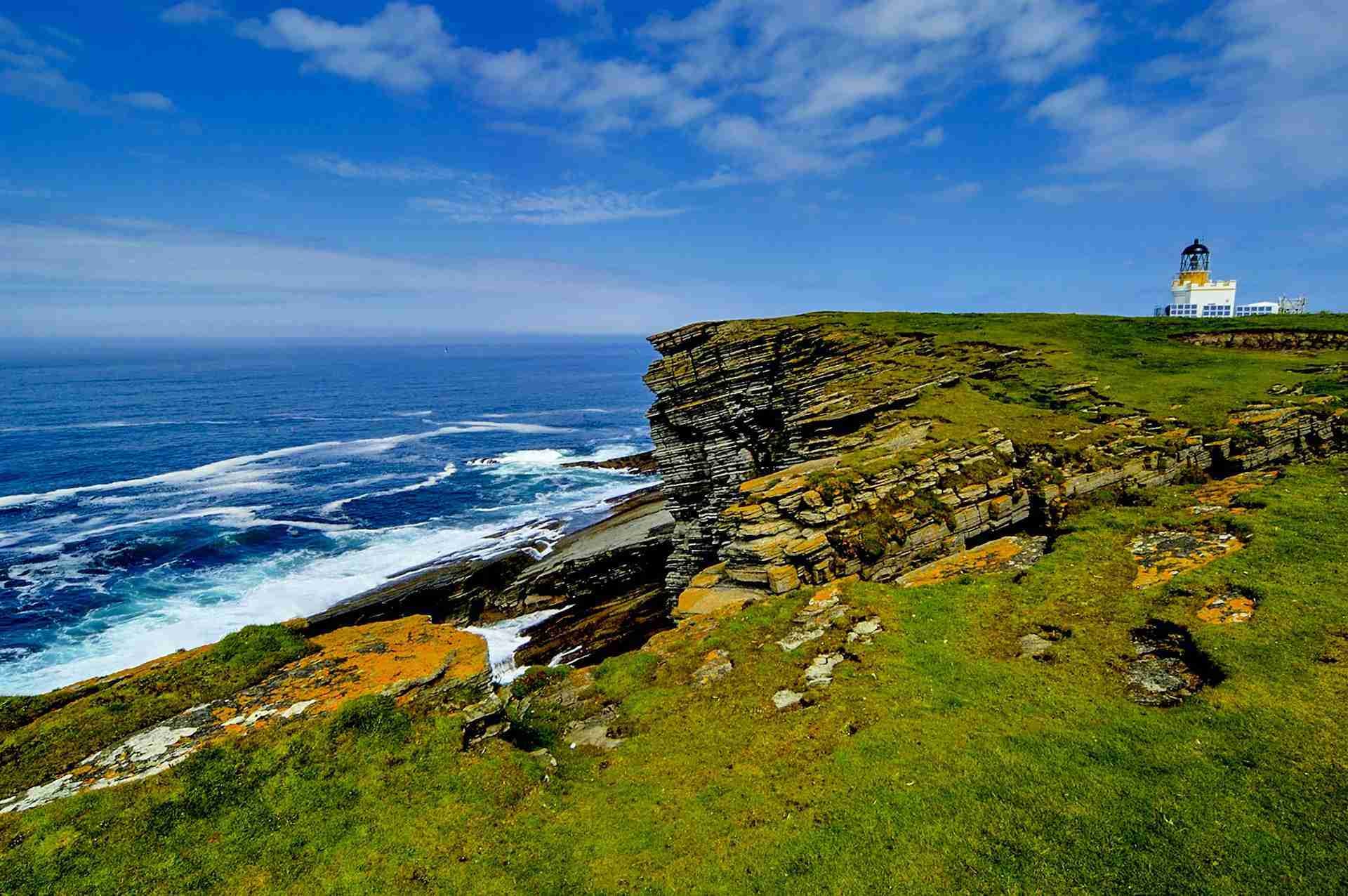
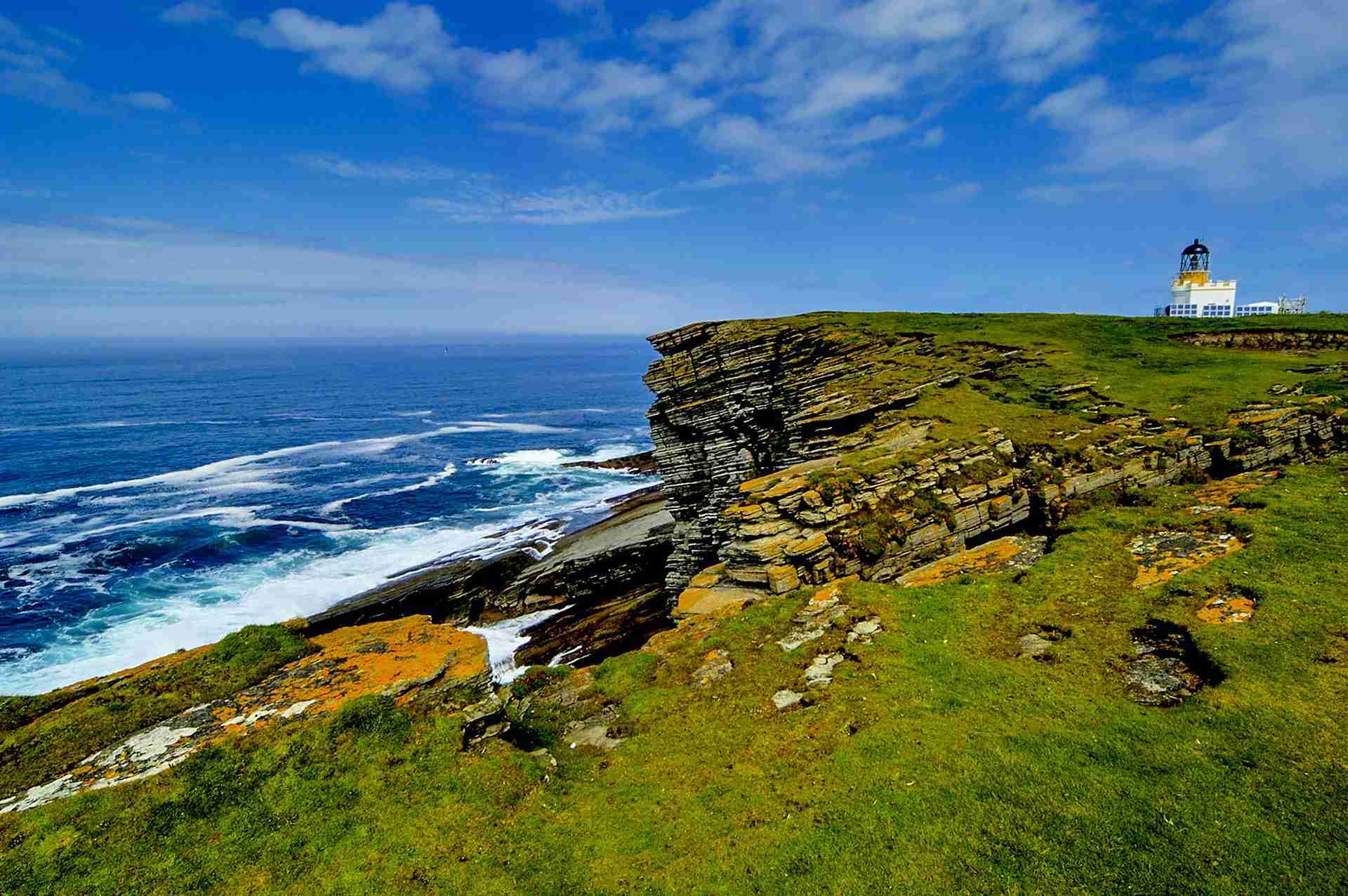
Perched on the edge of a tidal island off the northwest coast of Mainland Orkney, the Brough of Birsay Lighthouse stands alone against the expanse of the Atlantic. Designed by David A. Stevenson and built in 1925, this white cylindrical tower topped with a black lantern is positioned at the highest point of the island, offering commanding views of windswept cliffs, rolling waves, and seabird-covered crags. Reached only during low tide via a stone causeway, the lighthouse combines stark architectural minimalism with one of the most elemental landscapes in Scotland. For photographers, the Brough of Birsay Lighthouse offers solitude, drama, and a chance to compose images that juxtapose manmade structure with the raw force of sea and sky.
Best Photography Opportunities
• Cliffside compositions with lighthouse and ocean expanse
One of the most compelling views of the lighthouse comes from the cliffs south of the summit, where the structure can be framed against the endless sweep of the North Atlantic. These compositions benefit from using a wide-angle lens to include the rugged cliff edge, foreground textures such as grass or lichen-covered stone, and the water's movement below. Early morning or late afternoon light enhances the contrast between the white of the lighthouse and the deeper tones of sea and rock. In stormy weather or under dramatic skies, this viewpoint creates strong atmospheric imagery that emphasizes the isolation of the location.
• Minimalist top-down shots from the causeway path
As you ascend the footpath from the tidal causeway to the top of the island, the lighthouse begins to appear in partial frames, often peeking over rolling ground or framed by natural dips in the terrain. These minimalist shots, composed with negative space or clean skylines, highlight the tower's geometry and allow for strong contrast between built form and Orkney's open horizon. Use a longer focal length to compress foreground elements and create balance between the structure and the surrounding topography.
• Close-up detail studies of the lighthouse and its setting
While the lighthouse itself is compact, its textured surfaces, weathered railing, and clean architectural lines make it an excellent subject for detailed compositions. Photographing the door, the base curve, or the shadow of the lantern on the tower's white body allows for abstract or high-contrast images. These compositions work well in black and white, emphasizing form and shadow. When shooting close to the structure, include elements such as windswept grass, fence lines, or dry stone walls to contextualize the scale and add depth to the frame.
• Wide environmental views with layered landscape
The elevation of the lighthouse's location offers sweeping 360-degree views of the surrounding coastline. Composing with the lighthouse as a small element within the broader frame of sea, cliffs, and distant Orkney landscape adds scale and drama. These wide compositions are especially effective at sunset, when golden light illuminates the land from the west and long shadows carve definition into the grassy contours. In winter, snow or frost creates clean, graphic layering of texture and tone. Shooting from below the summit using a wide lens enables dynamic foregrounds, such as broken rock or low vegetation, leading toward the lighthouse above.
• Tidal reflections and pathway scenes across the causeway
During low tide, the stone causeway that links the Brough of Birsay to the mainland is exposed, revealing pools, seaweed, and layered rock textures. This crossing offers photographic opportunities before and after visiting the lighthouse. Use a tripod and low perspective to capture tidal reflections of the cliffs or the lighthouse at a distance. When wet, the stone surfaces gleam under soft light, adding abstract pattern and motion to your foreground. This approach is especially effective under overcast skies, which allow for longer exposures and subdued contrast.
Best Time to Visit
Photographers should plan visits around the tidal schedule, as access to the island is only possible during low tide. Tide tables are posted locally, and it's essential to time your crossing and return appropriately, as the water rises quickly and cuts off access within hours.
The best light occurs during early morning and golden hour in the late afternoon, when shadows stretch across the terrain and low-angle light warms the cliffs and lighthouse. In summer, these hours extend into late evening, while in winter, they occur mid-afternoon but are more directional and often paired with fast-moving clouds—ideal for dramatic compositions. Spring and autumn offer excellent balance between accessibility, changing weather, and wildlife presence, particularly nesting seabirds on the cliffs.
Blue hour and twilight can also be rewarding for long exposures of the surrounding sea and sky, though photographers should return to the mainland well before the tide rises. Conditions can shift rapidly, especially in the colder months, so pack for wind, rain, and fluctuating light.
How to Get There
The Brough of Birsay Lighthouse is located on the tidal island of Brough of Birsay, off the northwest coast of Mainland Orkney. From Kirkwall, take the A986 north toward Dounby, then follow signs west to Birsay. A car park is located near the mainland end of the tidal causeway, with interpretive signage and clear markers for safe crossing times.
From the car park, the stone causeway can be walked during low tide, with the crossing taking about 10–15 minutes on foot. Once on the island, follow the obvious footpath that climbs steadily to the summit, where the lighthouse sits. The terrain is uneven and exposed, so sturdy footwear and windproof clothing are recommended. There are no facilities on the island itself, and mobile signal can be inconsistent. Plan ahead, bring water, and monitor the time to avoid getting stranded by the tide.
Recommended Photography Gear
A wide-angle lens (16–35mm) is essential for capturing the full drama of the island's cliffs, sea, and lighthouse compositions. This lens is particularly effective for landscape work from elevated viewpoints and for including foreground interest in environmental frames. A mid-range zoom (24–70mm) offers versatility when shooting tighter compositions of the lighthouse or layered land-sea scenes.
A telephoto lens (70–200mm) is useful for compressing cliff faces, isolating seabirds or distant headlands, and creating abstract compositions with the lighthouse as a background anchor. A tripod is essential for long exposures, low-light work, and precise composition in strong winds. Bring a 6- or 10-stop ND filter for smoothing water movement or cloud trails, and a polarizer to enhance sky contrast or reduce glare on wet stone surfaces.
Because of the wind exposure, use a tripod with a low center of gravity or weight it down with a backpack to stabilize during longer exposures. Lens cloths and a rain cover are recommended year-round, as the weather in Orkney can change rapidly.
Nearby Photography Locations
Just inland from the tidal causeway, this 16th-century ruin offers atmospheric stone arches, gables, and textural contrasts against open sky. Ideal for close composition and storytelling frames.
A short drive south along the coast, this clifftop reserve is known for its seabird colonies and panoramic ocean views. The nearby Kitchener Memorial provides strong vertical elements for framing.
A sweeping bay with soft dunes, low-tide textures, and excellent sunset light. Works well as a complement to the more rugged terrain of the Brough of Birsay.
The famous Neolithic village is located nearby and offers low, grass-covered stone dwellings facing the sea. Ideal for wide environmental shots and ancient texture studies.
South along the west coast, this dramatic headland features towering sea stacks, wave-carved cliffs, and layered sedimentary rock formations. Excellent for dramatic coastal photography in shifting light.
Photographing the Brough of Birsay Lighthouse is a study in contrast and restraint. The lighthouse itself is modest, yet set against Orkney's vast horizon and endless sea, it becomes a visual anchor in a landscape of movement and change. For those willing to watch the tide and walk the path, it offers a quietly powerful subject that reveals new angles with every shift in light and weather.
Comments
Loading comments…