
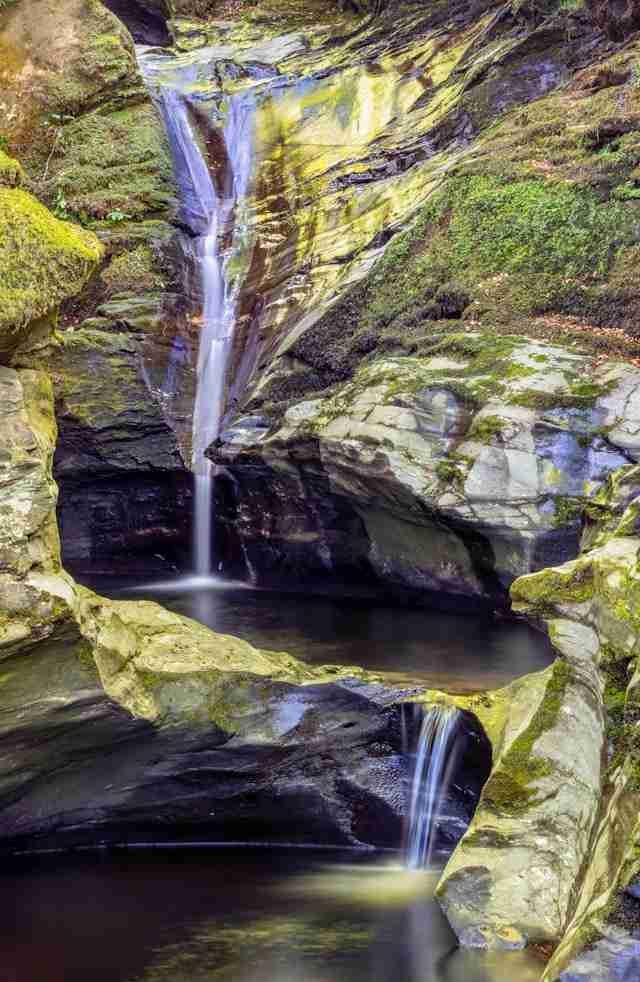
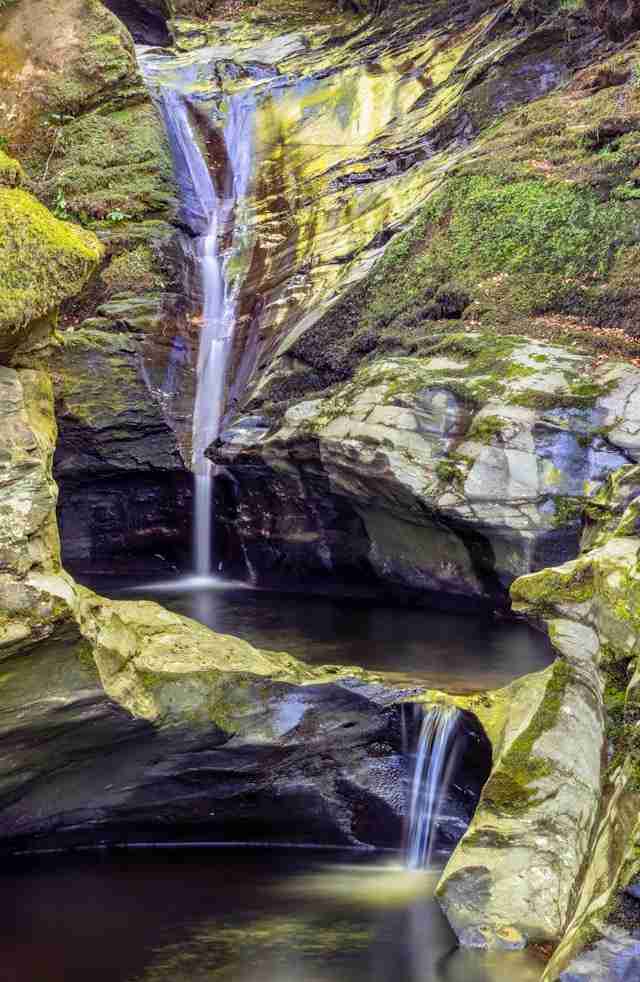
Hidden in a narrow wooded gorge above the small village of Acharn, the Falls of Acharn deliver both vertical drama and quiet forest atmosphere. This location rewards those willing to walk slowly, as the light filtering through the trees shifts constantly, shaping textures in moss, water, and stone. The main cascade drops through a steep-sided ravine, framed by thick vegetation and glimpsed from a historical stone viewing platform known as the Hermit's Cave. Though the waterfall itself is relatively compact, the layered setting and surrounding forest create a rich environment for photographers who enjoy working with contrast, depth, and controlled movement.
Best Photography Opportunities
Framing the Waterfall from the Hermit's Cave
The Hermit's Cave is a stone-built grotto tunnel that opens directly onto a small platform facing the falls. This viewpoint offers the most iconic frame of the site, with the surrounding rock and greenery naturally drawing the eye inward toward the falling water. A wide-angle lens works well here to include the cave's interior as a dark frame around the brighter view beyond. Use a tripod and slow shutter speed to blur the motion of the water while maintaining sharpness in the surrounding rock and vegetation. Timing your visit when dappled sunlight hits the pool beneath the falls adds another layer of visual interest.
Exploring the Upper Trail for Angled Compositions
Above the main falls, the trail continues along the gorge and offers glimpses of the stream as it curves and descends through the woodland. This section is excellent for diagonal compositions where water cuts through a dense field of trees, moss, and fallen branches. Use a standard zoom to isolate small sections of the scene and frame the water as a white line among green textures. These compositions benefit from soft overcast light that avoids harsh highlights and maintains detail across the entire image.
Moss and Detail Studies Beneath the Canopy
The environment around the Falls of Acharn is rich with detail. Mosses, lichen-covered stones, tree trunks, and forest floor textures all offer close-up opportunities for photographers working with a macro or short telephoto lens. This is particularly effective after rainfall, when surfaces glisten and greens intensify. Look for repeating patterns in root systems or fallen leaves, and use a wide aperture to create shallow depth of field and isolate subjects. These images work best under flat, soft light when contrast is naturally low and colors are most saturated.
Slow Shutter Studies Along the Stream
Moving downstream from the falls, the water continues its course through a more open area of woodland. Here, the stream forms small pools, ripples, and minor cascades over rocks and debris. This is a good space to work with long exposures using an ND filter to smooth out water movement. Shooting from a low angle along the bank brings foreground textures into play and allows the viewer to follow the motion of the stream into the frame. Positioning fallen leaves or branches in the foreground adds compositional anchors.
Autumn Color and Mist in the Gorge
The Falls of Acharn become especially photogenic in autumn, when the dense canopy turns to gold and orange. On cool mornings, mist often settles in the gorge, softening contrast and allowing the colors to glow more evenly. This is an ideal time for wider shots that include foliage, water, and rock in balanced compositions. Use a polarizing filter to manage reflections on wet surfaces and deepen the saturation of leaf color. These scenes benefit from slower, careful exposure settings to preserve highlight detail in the water and maintain richness in the shadows under the trees.
Best Time to Visit
The Falls of Acharn are accessible and photogenic in every season, though conditions vary considerably depending on recent weather. Spring and autumn are the most rewarding times to photograph. In spring, the forest greens are fresh and water flow is steady from seasonal rainfall. Autumn brings the best color and frequent mist, creating soft light that enhances detail and depth throughout the gorge.
Early morning offers the best chance for calm conditions, low contrast, and possible mist, especially in late September through October. Overcast days are ideal for photographing both the falls and the forest, as direct sunlight can create harsh contrast and blown highlights in the water. After rain, the flow of the waterfall increases, and the surrounding surfaces darken, enhancing mood and contrast. Winter is less reliable, but can offer minimalist opportunities when the surrounding foliage has fallen and the structure of the landscape is more visible.
How to Get There
The Falls of Acharn are located just above the village of Acharn, on the southern shore of Loch Tay in Perthshire, Scotland. From Aberfeldy, take the B846 toward Kenmore, then follow local signage to Acharn. The falls are accessed via a circular walking path that begins in the village. Park in the small lay-by or along the roadside at the trailhead near the burn. There are no official parking fees, and the path is freely accessible year-round.
The trail leads uphill through the village and quickly enters woodland. After passing through the Hermit's Cave, the path climbs above the gorge and loops back through farmland to the road. The entire loop takes roughly 45 minutes to one hour at a relaxed pace. Footwear with good grip is recommended, especially after rainfall, as parts of the path can be muddy and uneven. The route includes some steep and narrow sections, but no climbing is required. Tripods are manageable throughout, though space near the viewing platform is limited.
Recommended Photography Gear
A wide-angle lens in the 16 to 35 millimeter range is useful for capturing the falls from the Hermit's Cave or placing the water within the larger forest scene. A standard zoom lens is ideal for working along the stream and isolating details in the canopy. A short telephoto or macro lens is valuable for texture work on moss, bark, and close foreground elements.
A sturdy tripod is essential for long exposures and shooting in low light under the forest canopy. An ND filter allows for extended shutter speeds to smooth water motion, especially in brighter conditions. A polarizer helps reduce glare from wet surfaces and can enrich colors on overcast days. Weather protection is important, both for gear and clothing, as the gorge can be damp and conditions change quickly. A cloth or lens wipe is useful for clearing spray near the waterfall.
Nearby Photography Locations
Just a few minutes' drive from Acharn, Loch Tay offers long views across still water framed by distant hills. Visit in early morning for reflections and low fog, or return at sunset when the light drops behind the surrounding peaks and casts a warm glow over the shoreline.
A short drive north, this wooded gorge walk features a series of smaller waterfalls and mossy cliffs. The trail winds through dense forest with multiple vantage points for photographing the water from above and below. Autumn is especially colorful here, and the terrain is easy to navigate with a camera pack.
Kenmore Bridge and River Tay
At the eastern end of Loch Tay, the village of Kenmore offers a stone bridge, calm riverbank scenes, and wide views toward the hills. The area is well suited for long exposures and twilight work, particularly in winter when the surrounding area is quiet and the river runs high.
For highland landscapes, Ben Lawers is one of the most accessible peaks in the region. The lower slopes offer wildflowers, moorland textures, and dramatic skies. Use a wide lens for big skies or a telephoto to compress the sweeping forms of the highlands into tight, graphic frames.
Another worthwhile waterfall within reach of Aberfeldy, this steep cascade runs through a narrow cleft in the rock and is surrounded by dense foliage. The site is best visited after heavy rain, when the flow is high and mist rises into the canopy above.
The Falls of Acharn offer more than a single cascade. This is a place where light shifts quickly and details emerge slowly, where the interplay between forest, water, and time gives photographers the chance to work with rhythm and restraint. For those who value texture, shadow, and shape over spectacle, the gorge above Acharn is worth returning to across seasons, weather, and light.
Comments
Loading comments…