
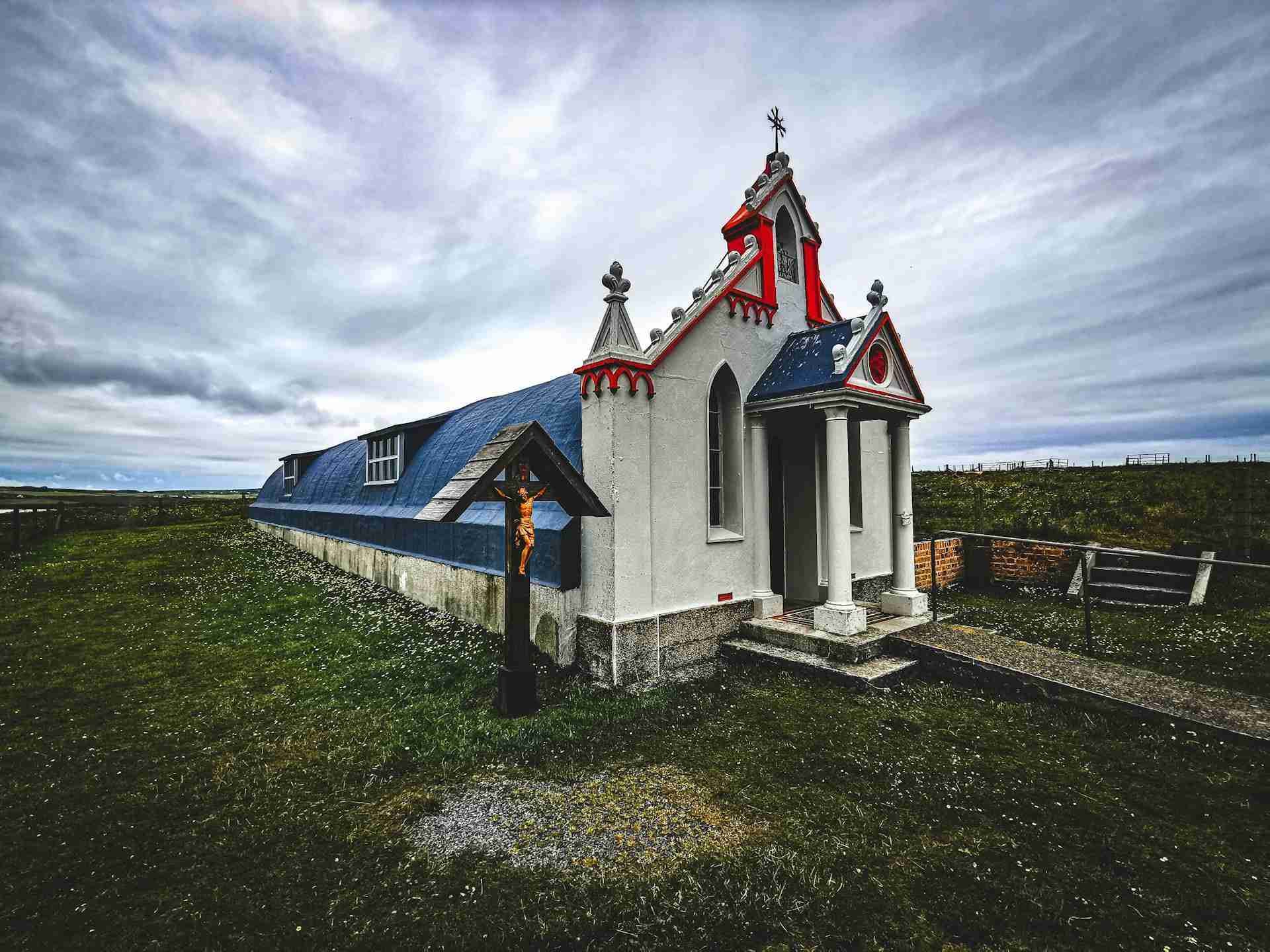
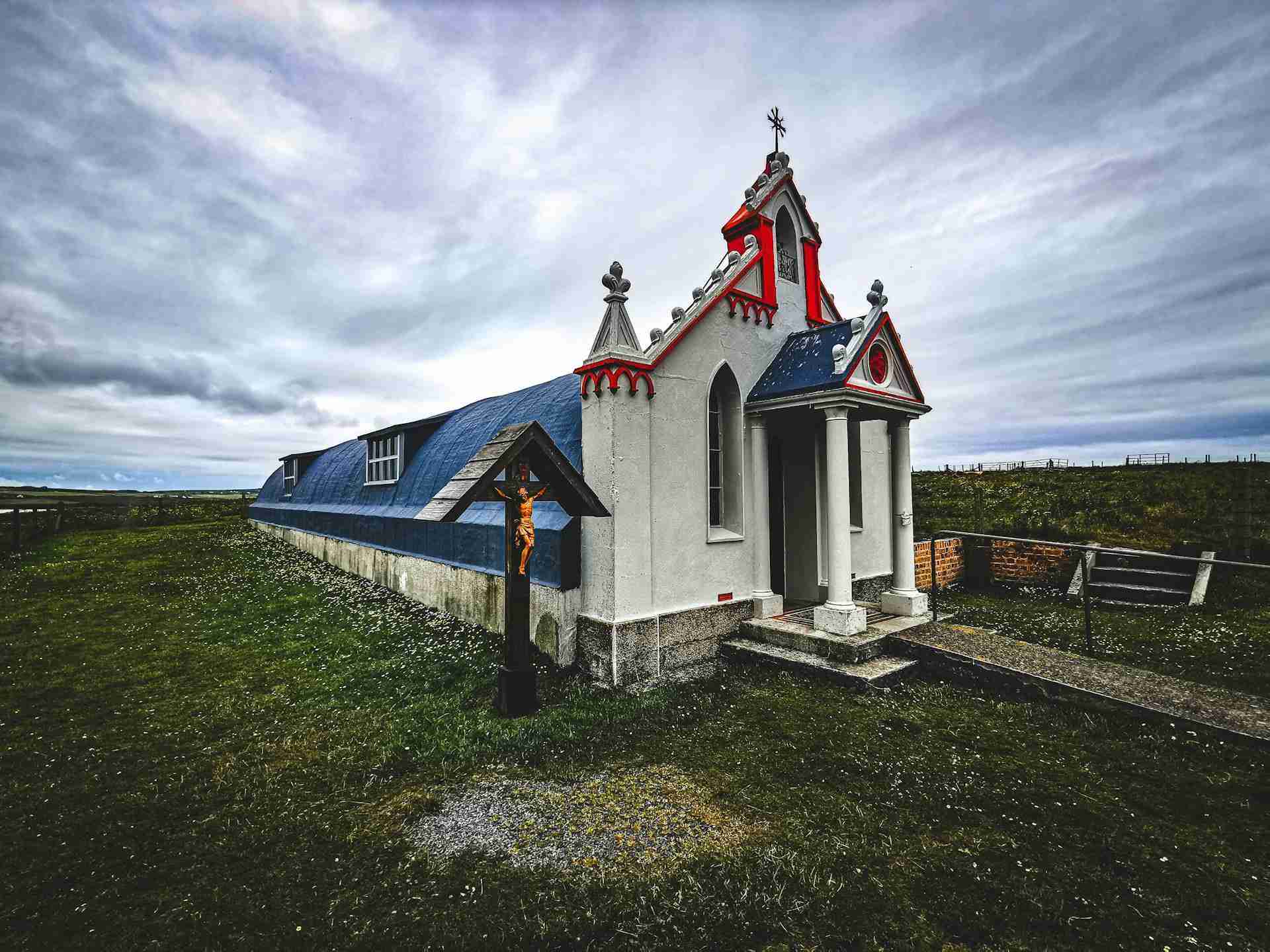
On the windswept island of Lamb Holm in Orkney, the Italian Chapel stands as one of Scotland's most unexpected and photogenic expressions of faith, resilience, and artistry. Built during World War II by Italian prisoners of war held in Orkney, the chapel transforms two humble Nissen huts into a beautifully adorned sanctuary filled with trompe-l'œil frescoes, intricate ceiling motifs, and a hand-crafted altar. The exterior is modest and unassuming, with a white façade, arched windows, and a small bell tower set against the backdrop of Orkney's wild coastline. The interior, however, reveals an extraordinary artistic feat: every surface painted with precision to evoke marble, vaulted ceilings, and sacred iconography. For photographers, the Italian Chapel offers a rare opportunity to capture both intimate hand-crafted detail and dramatic environmental contrasts in a setting where emotion and design are inseparable.
Best Photography Opportunities
• Frontal approach and wide environmental compositions from the road
The approach to the chapel from the adjacent road provides a direct, symmetrical view of the building's detailed white façade with its curved gable, red window frames, and modest bell tower. Set against the open sky and flanked by low stone walls and windswept grass, this perspective is especially powerful when photographed in early morning or late afternoon light. Wide-angle compositions that include the surrounding landscape help emphasize the scale and isolation of the structure. On overcast days, the diffused light softens the contrast between the building and the sky, allowing for subtle tonal images, while sunrise adds warmth to the front-facing details.
• Interior symmetry and painted architectural illusions
Inside the chapel, photographers are met with a complete visual transformation. The corrugated metal walls and ceiling have been meticulously painted to resemble stone arches, marble columns, and a barrel-vaulted ceiling. Positioning your camera in the center aisle and shooting toward the altar allows for a full composition that showcases the symmetry of the space and the illusion of grandeur. The altar itself, flanked by columns and centered beneath a fresco of Christ, provides a focal point rich in detail. Long exposures are essential to preserve the depth of color and intricate brushwork, and a tripod is critical for working at low ISO in this low-light environment.
• Close-up studies of devotional details and texture
Every surface of the chapel offers something to examine up close. Painted candle holders, carved woodwork, iron lamp brackets, and hand-painted borders around the windows all provide material for detail shots that reveal the depth of craftsmanship. Using a fast prime lens, photographers can isolate specific elements while keeping the soft ambient light intact. Angled shots across the painted brickwork or around the arch of the chancel highlight the interplay of color, shadow, and surface texture. These compositions work well in sequences to show the variety of techniques used by the POW artists who built the chapel by hand.
• Side and rear environmental views with surrounding landscape
Though the front is the most ornate, the side and rear of the chapel are visually important for context. From a southern viewpoint, you can frame the chapel lengthwise, showing how the decorative façade contrasts with the utilitarian corrugated structure behind it. Including the surrounding grassland and low stone walls helps root the chapel in its Orkney landscape. These environmental views are particularly effective under shifting skies or misty light, which add atmosphere and accentuate the chapel's delicate presence in a rugged setting.
• Seasonal variation and weather-driven mood compositions
The Orkney Islands are known for rapidly changing weather and dynamic skies, and the Italian Chapel lends itself well to mood-based photography. In spring and summer, the area around the chapel comes alive with green grass and occasional wildflowers, adding color and softness to wider compositions. Autumn brings cool tones and low sun angles that enhance shadow play across the building's textures. In winter, snow or frost can transform the site into a minimalist study in white and grey, while stormy skies introduce a dramatic mood that pairs well with monochrome or high-contrast treatments. Capturing the chapel under these varying conditions creates a well-rounded visual narrative of place and atmosphere.
Best Time to Visit
The Italian Chapel is photographically rewarding throughout the year, but certain times of day and season offer distinct advantages. Early morning provides the most peaceful light and minimal visitor interference. The eastern sun casts a soft glow across the front façade and enriches the warm tones of the painted details. Late afternoon brings directional side light that enhances the texture of both the landscape and the building's exterior, while also producing excellent shadow definition.
Interior photography is best in the morning, when the soft ambient light from the east-facing windows subtly fills the space and illuminates the painted surfaces with minimal glare. Late morning into early afternoon is also suitable, though care must be taken to avoid peak visitor hours if long exposures or tripod use are planned.
Seasonally, spring and summer provide the longest shooting windows, with improved ambient light and a vibrant color palette around the chapel. Autumn light is lower and more directional, perfect for detail-rich compositions. Winter offers solitude and strong contrasts but requires weather preparedness and stable shooting conditions due to wind and rain. Regardless of season, the chapel is a location where light, silence, and artistic depth come together to offer something unique each time you visit.
How to Get There
The Italian Chapel is located on Lamb Holm, a small island connected to Mainland Orkney by the first of the Churchill Barriers causeways. From Kirkwall, the main town in Orkney, take the A961 south toward St. Margaret's Hope. The drive takes approximately 15 minutes. After crossing the first barrier, the chapel is clearly signposted and sits just to the left of the road.
There is a designated parking area adjacent to the site, with a short paved path leading to the entrance. The chapel grounds are open and flat, with minimal obstacles, making them accessible to visitors with tripods or heavier camera kits. Interior access may vary seasonally, with slightly reduced hours during the winter months. For those visiting during peak tourism periods, early morning offers the best chance for uninterrupted shooting. As with many rural locations in Orkney, weather can change quickly, so it's advisable to bring protective gear for both yourself and your equipment.
Recommended Photography Gear
A wide-angle zoom (16–35mm) is the lens of choice for capturing the full interior of the chapel from the central aisle and for shooting exterior scenes that include both the building and the surrounding landscape. This lens is especially helpful when working in tight quarters indoors or composing from lower vantage points outside.
A mid-range zoom (24–70mm) allows for greater flexibility in framing architectural elements and environmental views from a moderate distance. For detail work, a fast prime (35mm or 50mm) provides excellent sharpness and low-light performance, which is ideal for handheld shooting inside the chapel where tripods may be restricted during busier times.
A tripod is essential for long exposure work inside the chapel, particularly when aiming to preserve the full detail and color of the hand-painted interior. ND filters are useful if shooting long exposures of skies or softening clouds in environmental scenes outside, while a polarizer can help manage glare on painted surfaces or enhance sky contrast in wide-angle outdoor compositions.
In cold or windy seasons, a weather-sealed bag and microfiber cloths are essential for protecting lenses and sensors from moisture and sudden temperature shifts. Because the site is small and requires deliberate compositions, packing light is advisable unless planning an extended session or return visit.
Nearby Photography Locations
Just beyond the chapel, these concrete causeways link several of the southern Orkney islands. They offer strong linear compositions over water and work especially well in stormy conditions or at golden hour with reflections on the sea.
A Romanesque masterpiece built in the 12th century, this cathedral is rich with sandstone texture, ribbed vaults, and stained glass. Ideal for high-contrast interior shots and architectural detail studies.
A short drive from Lamb Holm, this historically significant stretch of water offers moody seascapes, sweeping views of anchored ships, and long exposure opportunities with cloud and wave motion.
An evocative coastal hike east of the chapel site, this area features sea cliffs, an ancient chapel ruin, and panoramic ocean views—perfect for landscape work and elemental compositions.
Located on South Ronaldsay, these historic coastal defenses offer a grittier visual counterpoint to the chapel. Ideal for layered compositions of military architecture and windswept coastal terrain.
The Italian Chapel is a singular photographic experience—a testament to the transformative power of art and devotion, forged in the most unlikely of places. It is a space where craftsmanship becomes architecture, and where the human story behind the structure is just as compelling as the beauty within. For any photographer drawn to detail, story, and solitude, the chapel offers something rare: a subject of deep history rendered in paint, light, and silence.
Comments
Loading comments…