
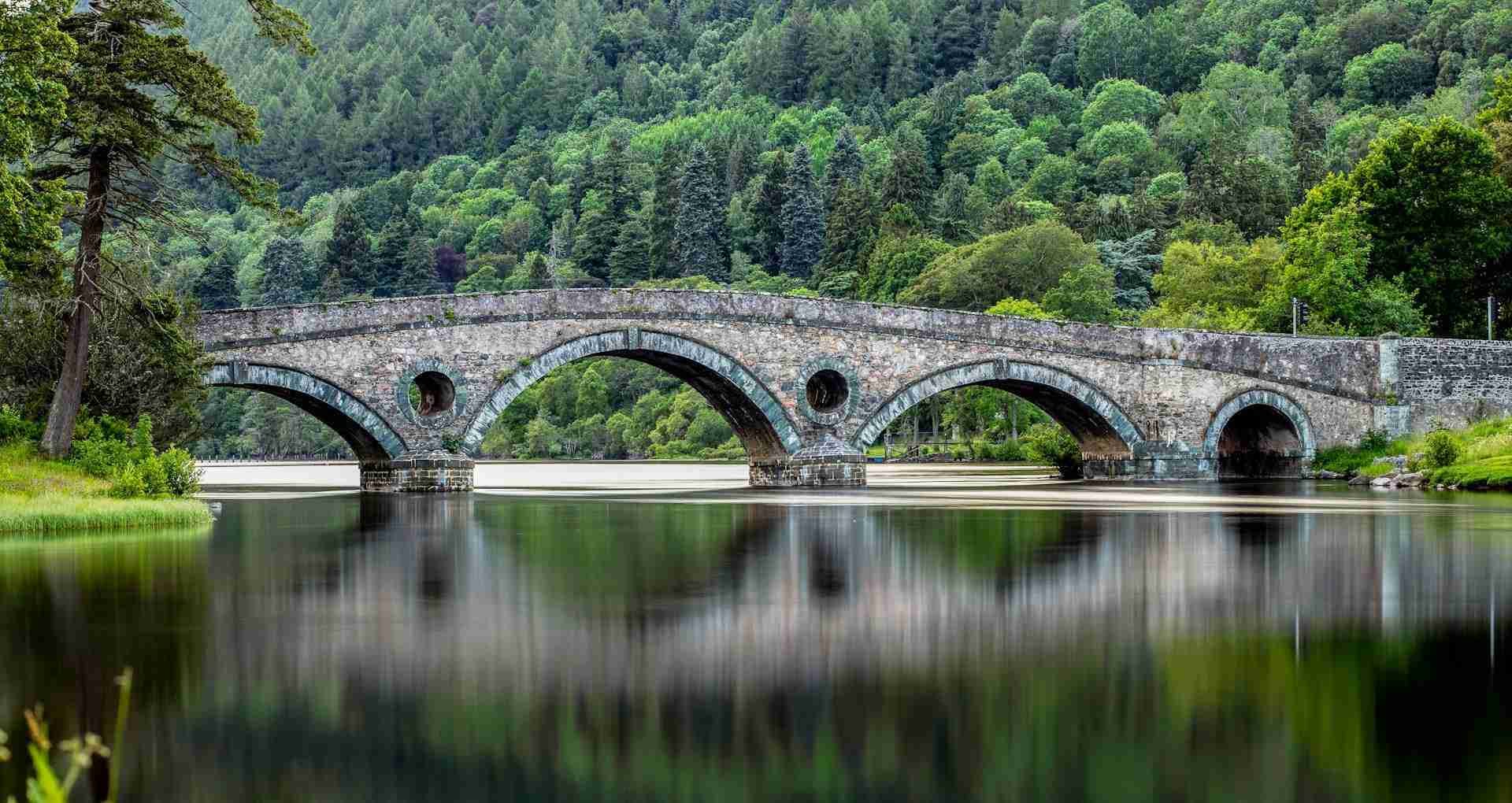
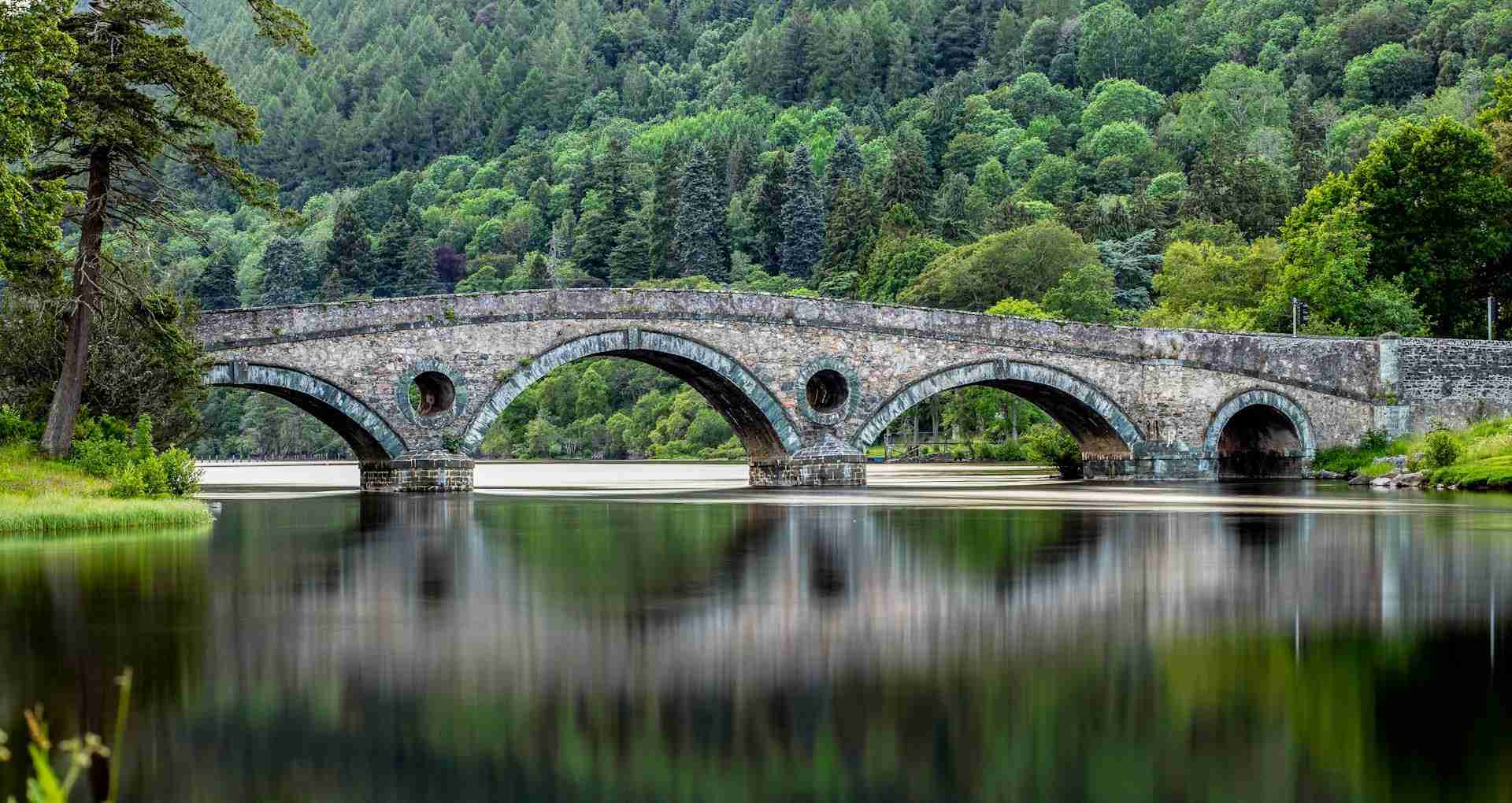
Kenmore Bridge is more than a crossing—it's a timeless focal point set at the eastern tip of Loch Tay in the village of Kenmore, where the River Tay begins its journey through the Scottish Highlands. Built in the 1770s and framed by rolling hills, woodlands, and water, this elegant stone bridge is a dream location for photographers seeking moody reflections, seasonal atmosphere, and a classic Highland backdrop. Its five graceful arches, weathered masonry, and the rhythmic flow of water beneath offer endless compositional variety, whether you're capturing dawn mist or golden-hour light spilling over the loch. Kenmore Bridge isn't just scenic—it's structurally poetic, a balance of history and landscape that invites thoughtful, deliberate photography.
Best Photography Opportunities
• Reflections at Sunrise or Sunset
The view from the east bank of the River Tay looking west toward Kenmore Bridge is perhaps its most iconic perspective. In the stillness of early morning or evening, the arches of the bridge are mirrored with striking clarity in the river's surface, forming near-perfect symmetrical compositions. During the golden hour, warm side lighting grazes the stonework and sets the surrounding trees and hills aglow, creating a soft contrast against the cool, reflective water. Use a wide-angle lens between 16–24mm to frame the full span of the bridge with ample negative space, or a 35–50mm focal length to compress the arches into a tighter frame. In colder months, mist or low fog often clings to the surface of the river, introducing an ethereal atmosphere that can be enhanced with longer exposures. Keep an eye on the sky—patchy clouds at dusk or dawn can double the drama through their mirrored forms.
• Long Exposure from the Southern Shoreline
South of the bridge, along the loch-facing path, lies one of the best positions for long exposure work. The water here flows gently, particularly where the River Tay empties from Loch Tay, allowing for soft movement even at relatively short exposure times. With a 6- or 10-stop ND filter, you can stretch your shutter speed to smooth ripples and blur passing clouds, giving the entire scene a painterly stillness. This technique works well under overcast skies, where the even light brings out the bridge's texture and helps avoid excessive highlights. Pay attention to leading lines created by reeds, dock remnants, or riverbank contours—these help direct the eye toward the bridge in an otherwise minimal composition. Use a tripod with a leveling base to keep your horizon clean, especially when shooting low across the water.
• Framing with Seasonal Foliage
The vegetation around Kenmore changes dramatically with the seasons, offering a rotating palette of natural frames. In spring, fresh green branches arch over the riverbanks, providing soft edges and vibrant foreground interest. During summer, tall grasses and blooming wildflowers can be used for low-angle compositions that feel immersive and intimate. Come autumn, the surrounding trees erupt in golden and crimson hues, offering warm color contrast against the bridge's cool stone. Positioning yourself behind overhanging branches or kneeling into the reeds helps create natural vignettes that emphasize depth and pull the viewer into the scene. Use an aperture between f/4 and f/5.6 to keep the bridge sharp while letting the foreground blur into soft shapes. On misty mornings, this technique is especially effective for moody, layered storytelling that evokes the changing moods of the Highlands.
• Bridge Detail and Textural Studies
The craftsmanship of the 18th-century stonework becomes increasingly rewarding the closer you get. The surfaces of Kenmore Bridge are richly worn, textured by centuries of weather, lichen, moss, and occasional ivy growth. Explore this with a mid-telephoto lens or fast prime between 50mm and 85mm to isolate architectural features like the curve of an arch, the keystone at its apex, or the interplay of shadow in the stone grooves. Light striking at a low angle—such as early morning or golden hour—casts deep, directional shadows that highlight cracks, surface grain, and other age-defining details. Look also for moments of contrast, such as modern signage or fishing line caught on a parapet, that add a touch of narrative or juxtaposition. Abstract compositions work well here: frame only a portion of the bridge, its reflection, or a textured section, and experiment with black-and-white processing to emphasize shape and form.
• Lochside Context and Wider Landscapes
For broader compositions that include Kenmore Bridge as part of a wider Highland scene, move west along the shore of Loch Tay just beyond the village center. From this perspective, the bridge acts as an anchoring element beneath the expansive open water and surrounding foothills. At wider focal lengths, you can include drifting boats, birds skimming the surface, or the moody skies that frequently roll in from the west. In the right conditions, the loch acts as a luminous plane, capturing the drama of cloud movement and shifting light. When shooting during the golden hour or just after a rain shower, the landscape's subtle color shifts—wet stone, saturated grass, glowing mist—offer exceptional tonal range. This is also a prime area for capturing human elements such as fishermen, canoeists, or walkers, lending scale and life to the natural scene.
Best Time to Visit
Kenmore Bridge is photogenic in every season, but each time of year brings its own distinct opportunities and challenges. For mirror-like reflections and dramatic skies, spring and autumn offer the best balance of atmospheric conditions and changing light. In April and May, fresh greenery begins to wrap the scene in vibrant color while snow may still dust the surrounding peaks—an excellent contrast that adds depth and seasonal narrative. Autumn, particularly from late September through October, is ideal for rich tones and low sun angles that sculpt the bridge's texture.
Summer provides the longest days and clearest skies, which are excellent for wide compositions and sunrise or sunset shots along the loch. However, midday light can be harsh, and tourist activity around the bridge may require patience or timing to avoid interruptions. Early morning remains the most rewarding window for soft light and empty paths.
Winter transforms the location into a study in minimalism. Snow on the hills and occasional ice on the river can create a palette of whites, greys, and muted blues, with the dark stone of the bridge standing in stark contrast. Light tends to be low and directional all day long, offering flexibility in when you shoot. Keep in mind that frost and mist are common at dawn and can elevate even the simplest composition into something atmospheric and ethereal.
Regardless of season, wind is a key variable. For reflection shots, plan your visit for early morning or late evening when the water is most likely to be calm. Keep a flexible schedule to adapt to changes in light, weather, and cloud movement—conditions in the Highlands can shift dramatically in just minutes.
How to Get There
Kenmore Bridge is located in the village of Kenmore at the eastern end of Loch Tay, within the council area of Perth and Kinross. From Aberfeldy, it's an easy 10-minute drive along the B846. If you're coming from farther afield, take the A9 north from Perth, then exit west toward Aberfeldy and follow signs to Kenmore. The roads are scenic but narrow in places, so allow time for slower driving and possible pull-offs for spontaneous landscape stops.
Public transport options are limited but possible. Regular bus services run between Aberfeldy and Kenmore, particularly in the summer season. Once in the village, the bridge is visible from nearly every point and can be accessed on foot in under five minutes from any car park or accommodation.
There is no cost to access the bridge or surrounding paths, and the area is open at all hours. However, for uninterrupted shooting and ideal conditions, early morning and late afternoon remain the best times to visit. Parking is available near the Kenmore Hotel or in the village center, with walking paths leading directly to the riverbanks and lochside trails. Tripods are generally fine to use, but be considerate of walkers and visitors along the narrower sections of the footpaths.
Recommended Photography Gear
Kenmore Bridge is a location where portability and versatility are key. A full-frame DSLR or mirrorless camera will allow you to capture both expansive vistas and intricate textural details with clarity and dynamic range. Pair it with a wide-angle lens (16–35mm) for reflection and landscape shots, and a mid-range zoom (24–70mm) to compress foreground and background elements when working along the shoreline. For tighter details and bridge textures, a fast 50mm or 85mm prime provides excellent isolation and control over depth of field.
A sturdy tripod is highly recommended for long exposures across the river, especially in low light or when using ND filters. Consider bringing both a 6-stop and 10-stop neutral density filter to work with water motion and cloud streaks under varying conditions. A circular polarizer will help cut glare on the river's surface and deepen sky contrast during midday sessions.
Weather protection is also important. The Highlands are known for sudden rain showers and mist—pack a rain cover for your camera, a microfiber cloth for your lens, and quick-dry layers for yourself. A small lens hood or flag will help manage flare when shooting toward the sun during golden hour.
For those interested in aerial perspectives, drone photography can be very effective at Kenmore Bridge. From above, the structure's symmetry and its relation to the surrounding landscape become clearer. Be aware of local drone guidelines and avoid flying too close to the village or hotel grounds.
Nearby Photography Locations
Just beyond the bridge heading west, the shores of Loch Tay offer open views, driftwood-strewn beaches, and long perspectives toward Ben Lawers. The nearby (and partly off-limits) Taymouth Castle grounds feature gothic ruins, tree-lined avenues, and moody woodland backdrops that complement the bridge's formality with a more natural, overgrown aesthetic.
A short drive south along the loch brings you to this dramatic waterfall, hidden in a wooded gorge. After a short forest hike, you'll find a two-tier cascade that's ideal for long exposure photography, especially when framed through the Victorian viewing platform known as the Hermit's Cave.
Towering above Loch Tay, Ben Lawers offers expansive panoramic views and rugged Highland terrain. The lower slopes are dotted with wildflowers in summer and golden grasses in autumn, providing color-rich foregrounds to wide-angle mountain shots.
• Aberfeldy's Wade's Bridge and Riverwalk
Just ten minutes east of Kenmore, the town of Aberfeldy offers another historic stone bridge—Wade's Bridge—along with wooded walking trails along the River Tay. This area is ideal for capturing flowing water under canopies of seasonal foliage.
North of the bridge lies the village of Fortingall, home to what is believed to be Europe's oldest living tree. The surrounding Glen Lyon valley is one of Scotland's most picturesque drives, offering rolling hills, stone walls, ancient forests, and pristine river scenes ideal for moody, layered landscape compositions.
Kenmore Bridge combines the romance of Highland scenery with the quiet dignity of historical architecture. Whether you're photographing the play of light on stone, the symmetry of reflections, or the subtle textures of mist and moss, the bridge rewards careful observation and an unhurried approach. Set against the expansive drama of Loch Tay and ringed by some of Scotland's richest natural beauty, it invites both solitude and creativity—an ideal stop for photographers seeking calm, character, and timeless composition.
Comments
Loading comments…