
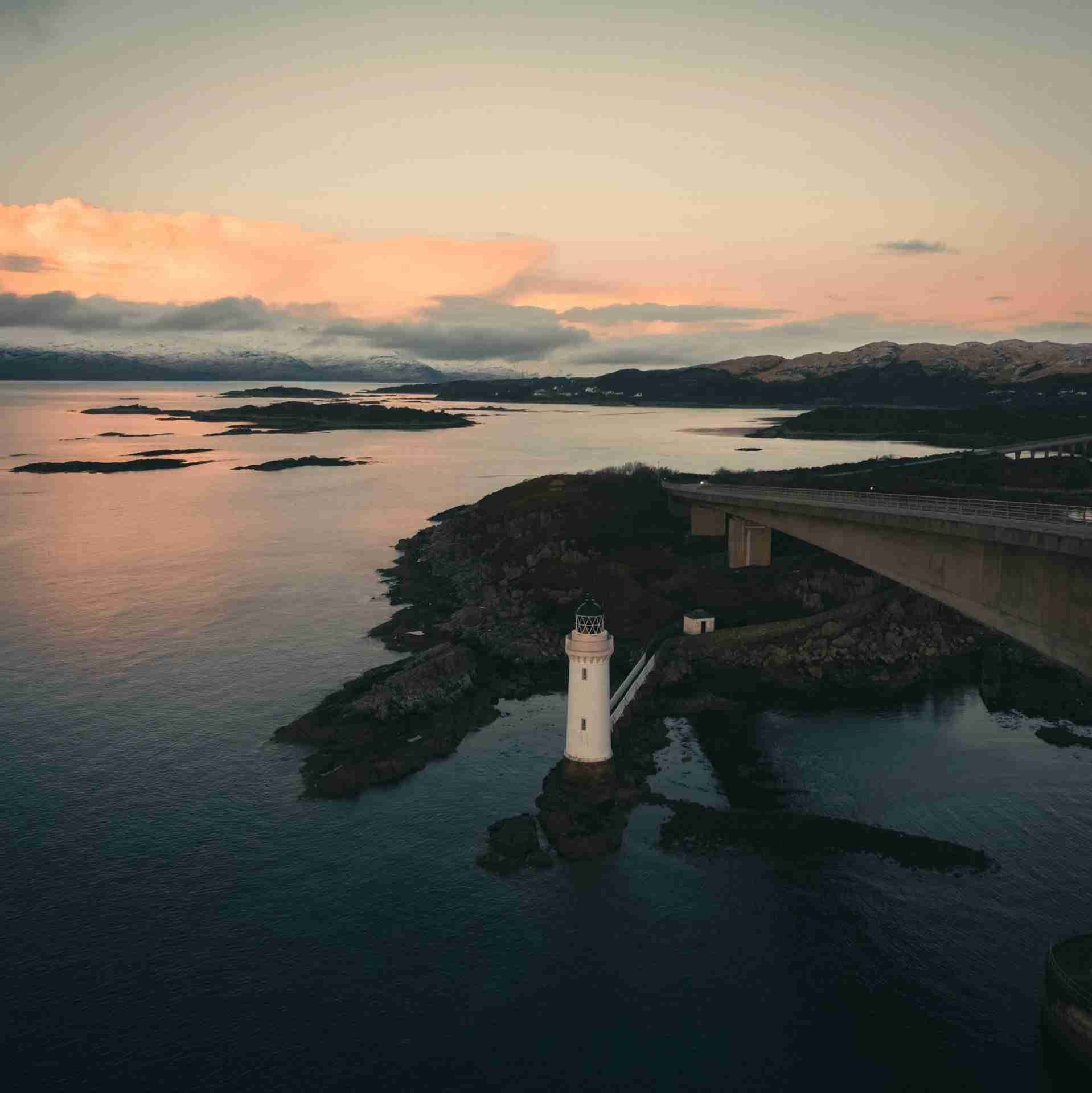
Standing sentinel between the Isle of Skye and the Scottish mainland, the Kyleakin Lighthouse on Eilean Bàn is a quiet yet compelling subject for photographers drawn to remote maritime scenes. Constructed in 1857 by David and Thomas Stevenson, the lighthouse once marked the entrance to the narrow strait between Kyle of Lochalsh and Kyleakin village. Though decommissioned in the 1990s following the construction of the Skye Bridge, the tower remains an evocative monument to the region's nautical past.
What makes Kyleakin Lighthouse so appealing to photographers is not just the structure itself, but its moody setting: perched on a small, windswept island surrounded by tidal waters, crumbling buildings, and seaweed-covered rocks. It's a place of atmosphere and solitude, where weather moves quickly and light dances unpredictably across the Sound of Sleat. Whether viewed from the Skye Bridge, shot from the shoreline with a telephoto lens, or captured by drone, this lighthouse offers stark, poetic imagery for those willing to work with the elements.
Best Photography Opportunities
• Bridge-Level Perspective with Contextual Framing
One of the most rewarding vantage points is from the Skye Bridge walkway, offering an elevated and unobstructed look directly down onto Eilean Bàn. From here, the lighthouse sits slightly offset within its rugged surroundings, allowing photographers to include the ruins of the keeper's quarters and the rocky shoreline in one balanced composition. The bridge itself also provides a strong linear element—use it in-frame to contrast the older structure with contemporary infrastructure. Cloud-filled skies and afternoon sidelight produce excellent modeling on the tower, revealing its rounded form and textured surface.
• Shoreline Views from Kyle of Lochalsh
From the water's edge in the village, you can achieve a naturalistic composition using the sea, vegetation, or foreground debris to build visual layers leading toward the lighthouse. A telephoto lens allows you to isolate the tower against the bridge's underside or compress the elements into a dense, almost graphic composition. At low tide, the exposed seaweed and stone offer textural interest in the foreground, while calm waters during early morning create beautiful mirror-like reflections—perfect for minimalist or long-exposure work.
• Drone Photography for Full Island Perspective
From above, the lighthouse reveals its full context—its circular base, the layout of Eilean Bàn, and the flow of the surrounding water. High-angle shots capture the visual contrast between the manmade structure and the natural patterns of rock, tide lines, and green growth. Orbiting shots can give motion to your compositions, and carefully planned golden hour flights can showcase warm rim light on the tower's edges while shadows define the island's topography. The angle of the Skye Bridge from above adds dynamic tension between modern geometry and the classical lighthouse form.
• Atmospheric and Stormy Conditions
This location shines in dramatic weather. Rain squalls, heavy mist, or dark rolling clouds over Skye provide a moody backdrop that suits the lighthouse's stoic personality. Fast shutter speeds capture wind-lashed waves and the expressive turbulence of Scottish weather. Consider underexposing slightly to preserve highlight detail in the sky and let the lighthouse emerge subtly from shadowed surroundings. In the right light, even a downpour can enhance the mood, turning a simple seascape into something cinematic.
• Sunset and Golden Hour at Water Level
As the sun drops to the west, the warm light illuminates the lighthouse's whitewashed walls with a golden blush. From the Kyleakin shore or near the waterline, compositions using reflective pools or silhouette techniques can be especially powerful. Shoot toward the light for strong contrast, lens flare, or starburst effects as the sun tucks behind the bridge arch. With the bridge lit from the west and the lighthouse glowing in direct light, you can capture a full environmental portrait in just a few frames.
Best Time to Visit
The best photographic conditions at Kyleakin Lighthouse come in spring and autumn, when the sun remains low for longer periods and the weather offers a wide variety of moods—from golden skies to fast-moving storm fronts. During these shoulder seasons, the light changes quickly, and each shift reveals a new version of the lighthouse—sometimes brilliant in sunshine, other times ghostly in haze.
Morning visits tend to offer more stillness, clearer reflections on the water, and fewer tourists crossing the bridge. This is when mist often clings to the water's surface or drapes gently around the island, enhancing depth and softness in your shots. Evening visits, particularly in late spring, benefit from extended twilight and that unmistakable Highland glow that lingers after sunset. Use this light to shoot layered compositions with both structure and water catching soft color gradients.
Summer brings long days and generally more stable conditions, but mid-day light is harsh and contrasty, which can wash out the subtle textures of stone and sea. Winter delivers stark, graphic compositions with low sun angles all day long—but conditions can be unpredictable and visibility limited.
Tide cycles also influence your shoot. At low tide, more of the shoreline is revealed, exposing rocks and seaweed for added texture and leading lines. High tide simplifies the foreground, allowing the lighthouse to float within a wider field of water, making for cleaner minimalist shots.
How to Get There
Kyleakin Lighthouse is located on Eilean Bàn, a small island directly beneath the Skye Bridge, which connects the mainland town of Kyle of Lochalsh to the village of Kyleakin on the Isle of Skye. From either side, a short walk brings you to the bridge's pedestrian path, where multiple viewing angles are available.
While the island is managed by the Eilean Bàn Trust as a nature reserve and is not open for unsupervised visits, the lighthouse is fully visible from the bridge, the shoreline, and public harbors nearby. Parking is available in both Kyleakin and Kyle of Lochalsh. If approaching on foot, be mindful of changing weather, strong winds on the bridge, and limited shelter while shooting.
For drone pilots, be aware that high winds and bird activity can make flying challenging. Always check local guidelines and avoid disturbing nesting wildlife during sensitive months.
Recommended Gear and Shooting Tips
A 70–200mm lens is your most versatile option here, allowing you to work from the bridge or shoreline and still isolate architectural and environmental details. A 24–70mm zoom provides flexibility for framing wider bridge scenes or working in tighter, more controlled setups along the coast. A true wide-angle lens (16–35mm) can be useful if you want to include dramatic skies, bridge spans, or extensive foreground elements in your compositions.
A sturdy tripod is essential, especially for early morning or twilight long exposures. This is especially true in breezy conditions—weighted tripod legs will help keep your frame stable during gusts. A circular polarizer will help manage glare on the water, deepen sky tones, and enhance color separation in wet stone and vegetation. For slow-shutter work, bring a 6- or 10-stop neutral density filter to smooth water and add mood during cloudy days or high tide.
If you're flying a drone, take advantage of the varied elevation around the site—shoot low and close for intimacy, and climb high for context. GPS stability is a must, and be prepared to land quickly if gusts increase. Scout from the bridge first to determine the best light angle and framing options before launching.
Always bring a rain cover for your camera and an extra microfiber cloth to manage sea spray or sudden mist. Weather changes fast, so flexibility—and patience—are often rewarded with some of the most dramatic light you'll encounter on the west coast of Scotland.
Nearby Photography Locations
From both Kyle and Kyleakin, the bridge offers sweeping views across the Inner Sound, especially at sunrise or twilight. The bridge's arc itself makes for strong graphic compositions when silhouetted or reflected in still water.
Just beyond the village lies the partial remains of Castle Moil, perched on a promontory and offering great views back toward Eilean Bàn and the lighthouse. Excellent for atmospheric shots during blue hour or stormy weather.
• Plockton Village and Loch Carron
A short drive northeast, this picturesque harbor village offers calm waters, boat reflections, and mountain backdrops. A contrast in mood and light compared to the lighthouse—great for rounding out a coastal shoot.
Further north on Skye, these iconic rock formations provide some of Scotland's most recognizable landscape photography. Ideal for golden hour, dramatic wide angles, or moody mist work.
• Elgol and the Cuillin Mountains
A rugged, dramatic shoreline with dark rock and distant mountain silhouettes. Great for black-and-white work or long exposures of waves and sky, especially at sunset.
Though no longer active, Kyleakin Lighthouse still holds the quiet weight of a sentinel. Surrounded by weather, water, and the wind-shaped stones of Eilean Bàn, it remains a solitary presence beneath the curve of the modern bridge—making it a must-shoot for photographers who chase coastal light, history, and atmosphere.
Comments
Loading comments…