
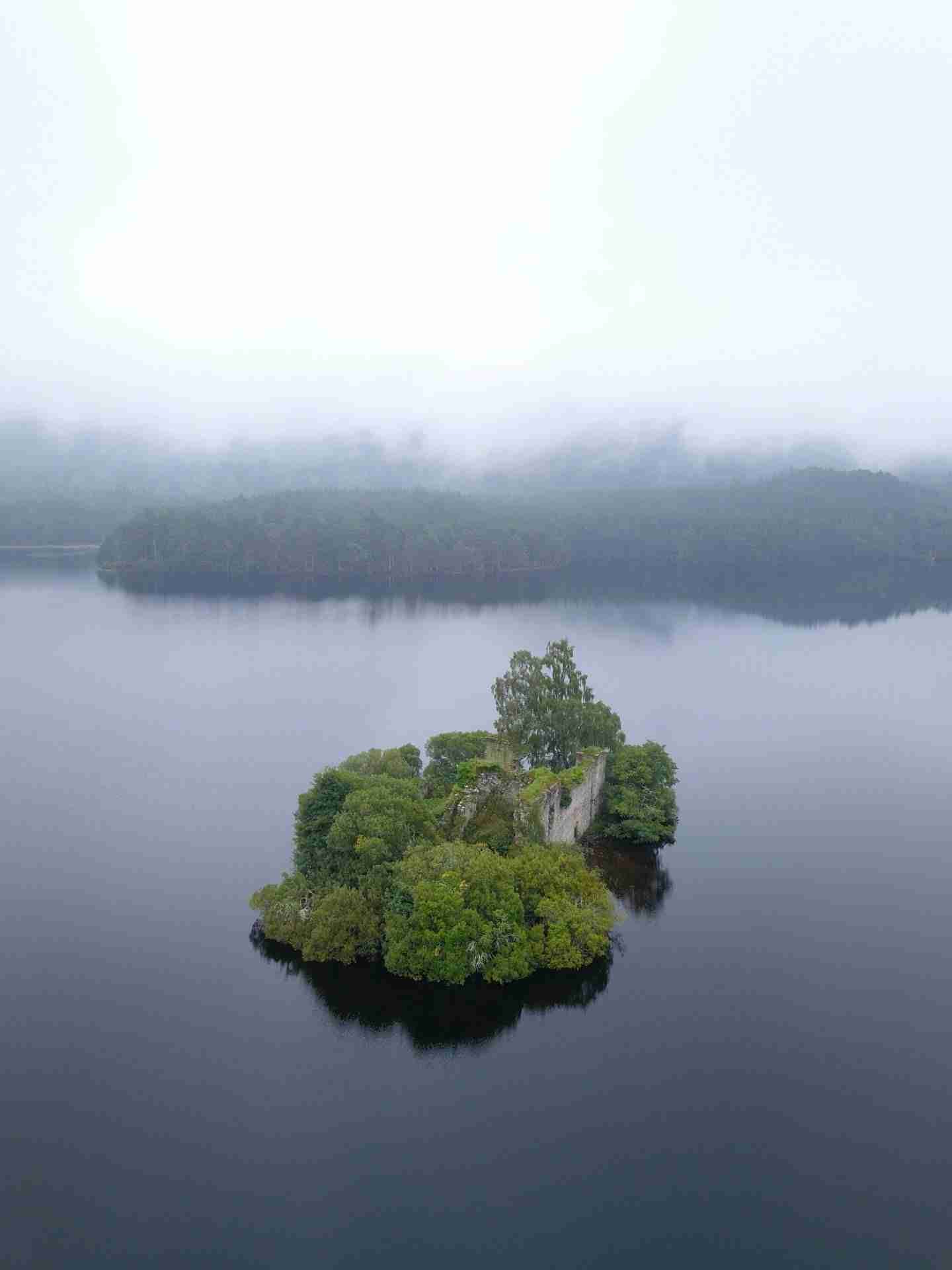
Tucked deep within the ancient Rothiemurchus Forest near Aviemore, Loch an Eilein is one of Scotland's most evocative photographic locations—an atmospheric loch cradled by Scots pines and guarded by the haunting ruins of a 13th-century island castle. Mist frequently curls across the water in the early morning, softening the outlines of the ruined keep that seems to hover just above the loch's still surface. The forest, water, and ruin create a uniquely moody and intimate setting, perfect for photographers who seek compositions rich in subtle texture, reflection, and solitude. This is a location where the best images come not from scale, but from sensitivity to tone, mood, and shifting Highland light.
Best Photography Opportunities
• Castle Reflections in Morning Mist
: The ruined castle on the small island near the southern end of the loch is best photographed at dawn, when cold air and warm water often generate low-lying mist. The castle's silhouette appears dreamlike, particularly when partially veiled in fog and reflected in the loch's surface. Use a mid-telephoto lens (around 70–100mm) to compress the scene and isolate the castle against its mirrored reflection. For moodier results, shoot just before sunrise during the blue hour, when the light is soft and even across the water.
• Loch Edge and Pine Framing
: The Scots pines that ring Loch an Eilein offer natural frames and foreground anchors for wide compositions. From the eastern shoreline path, you can position trunks or low-hanging branches to lead the eye toward the loch and castle. In early autumn, golden needles add subtle warmth to the forest palette, while in winter the sparse foliage reveals more of the water and ruins. A wide-angle lens (16–24mm) works well here, especially if you position your tripod low to incorporate roots, fallen branches, or moss-covered rocks at the water's edge.
• Frosted Forest Textures
: During colder months, the forest takes on a quiet stillness, with frost clinging to the undergrowth and fine ice forming along the loch's edge. Close-up opportunities abound: frozen leaves, lichen-covered bark, and hoarfrost on pine needles provide excellent material for abstract and macro photography. A short telephoto or macro lens will let you isolate these textures in soft, directional light. Return later in the morning as the sun breaks through the trees and casts long shadows across the forest floor.
• Long Exposure Moodscapes
: On windless days, the loch turns glassy, making it ideal for long exposure photography. Using a 6- or 10-stop neutral density filter, you can stretch exposure times to smooth the water and blur low-hanging mist into atmospheric gradients. Positioning the castle off-center and incorporating a slight ripple or reflection line creates quiet, balanced compositions that emphasize stillness and solitude. This technique is especially powerful when processed in monochrome to focus on tonal contrast and composition.
• Light and Shadow Along the Circular Trail
: The path that encircles Loch an Eilein provides constantly changing perspectives, with backlit trees, small clearings, and shifting water reflections. As light filters through the pines, it creates moments of high contrast and drama—particularly in late afternoon when golden shafts fall across the trail. Use a fast lens (f/2.8 or faster) to capture these fleeting lighting moments and consider underexposing slightly to preserve highlights and enhance contrast.
Best Time to Visit
Loch an Eilein is a year-round destination, but each season reveals a different layer of photographic opportunity. Spring (April to June) brings vibrant greens and wildflowers along the forest edge, with crisp light and clean skies ideal for clear reflections. Morning mist is common during this time, especially after cooler nights.
Summer (July and August) offers long days and full foliage, creating dappled lighting throughout the forest. However, the site can become busy with walkers and families during peak hours. For photography, early morning or late evening remains best—particularly for capturing warm side light or tranquil blue hour scenes without foot traffic.
Autumn is arguably the most visually rich season at Loch an Eilein. The foliage transitions to warm ochres and russets, and the low sun casts golden tones across the water and woodland. Late September through early November is ideal for color, reflection, and atmosphere. Be prepared for damp trails and soft ground underfoot.
Winter transforms the loch into a subdued, almost monochromatic scene. Snow dusting the pine branches and ice along the shorelines introduces minimalism and texture that works beautifully in black and white. Though access is rarely restricted, road conditions and icy paths can complicate early visits—check local forecasts and arrive prepared for cold conditions.
Regardless of season, early mornings offer the best chance for clean compositions and shifting mist. Because the loch is surrounded by trees, strong directional light is best captured when the sun is low—either side of the day creates unique mood and tonal variation across the scene.
How to Get There
Loch an Eilein is located just south of Aviemore in the Cairngorms National Park, within the private Rothiemurchus Estate. From Aviemore, take the B970 toward Inverdruie, then follow signs for Loch an Eilein. A well-maintained access road leads directly to the main car park, which sits just a short walk from the loch itself.
There is a small fee for parking, managed by Rothiemurchus Estate, which helps support conservation and maintenance of the site. The fee applies daily and year-round, and while it may vary, it is typically payable via machine or mobile app. There are no separate entrance fees for walkers or photographers. The car park includes toilets and a small visitor kiosk (seasonal), and trail maps are available near the entrance.
The entire loch circuit is about 5km on a well-maintained path, accessible for most fitness levels and suitable for carrying lightweight gear or a tripod. For castle shots, the best viewpoints are reached within 10–15 minutes' walk along the eastern shoreline path. Dogs are welcome, but keep them under close control to avoid disturbing wildlife or other visitors.
Recommended Gear and Shooting Tips
Because Loch an Eilein rewards subtlety and texture over grandeur, bring gear that allows you to work both wide and close. A wide-angle lens (16–35mm) will be useful for loch compositions and tree-framed perspectives, while a mid-range zoom (24–70mm) or short telephoto (85–135mm) is ideal for isolating the castle, woodland layers, and light patterns across the water.
A lightweight but stable tripod is essential for low-light forest work and long exposures across the loch. Bring ND filters (6-stop and 10-stop) for smoothing water and drawing out mood, and consider a circular polarizer to manage surface reflections when working close to the water's edge. A macro lens or extension tube setup is a strong addition for those looking to capture frost patterns, lichen, and bark textures in the forest.
Footwear should be waterproof—while the trail is well-defined, the ground can be wet, especially after rain or in early morning conditions. In colder months, bring gloves that allow for tactile camera operation. Spare batteries are a good idea in winter, as temperatures can dip sharply near the loch, especially before sunrise.
Arrive at least an hour before your planned shoot to walk the shoreline and scout compositions. Weather at this altitude can change quickly, so a small waterproof cover for your bag and camera is highly recommended. Don't rush—Loch an Eilein reveals itself slowly, and its most powerful images often rely on careful observation rather than dramatic weather or color.
Nearby Photography Locations
: The surrounding pinewoods are part of one of the largest remnants of ancient Caledonian forest in Scotland. Rich in texture, light, and natural patterns, this area rewards quiet exploration with opportunities for intimate landscape, macro, and wildlife photography, particularly in the soft morning or golden hour light filtering through the canopy.
: Just east of Loch an Eilein, Loch Morlich offers wide vistas with the Cairngorm massif rising behind the water. Early morning is best for reflections and clarity, while late afternoon light rakes across the mountains, enhancing shape and contrast. The sandy shoreline provides minimalist compositions and open skies ideal for astrophotography on clear nights.
: This high moorland trail near Glenmore leads to a small, vivid green loch surrounded by pine and heather. The distinctive coloration of the water, combined with open skies and dense woodland, makes for a vibrant and unexpected set of compositions. The route is walkable year-round and particularly striking in spring and autumn.
: Located just outside Aviemore, Craigellachie offers panoramic views over the Spey Valley, mixed birch woodlands, and excellent opportunities to photograph red squirrels and birdlife. The summit trail is steep in parts but rewards sunrise hikers with warm, sweeping views across the Cairngorm foothills.
: About 30 minutes north, Loch Garten lies within the RSPB's Caledonian forest reserve and is home to ospreys, crested tits, and capercaillie. The loch itself is quiet and atmospheric, with dark reflective water and wooded margins that mirror the tones and structure of Loch an Eilein, making it a perfect complementary location for a full day's shooting.
Whether you visit under morning mist, golden light, or the soft hush of snow, Loch an Eilein encourages a slower, more contemplative kind of photography. It's not about grandeur or scale, but the poetry of still water, aged stone, and forest light. It's a place where you don't just take photographs—you listen, wait, and let the scene speak quietly through your lens.
Comments
Loading comments…