
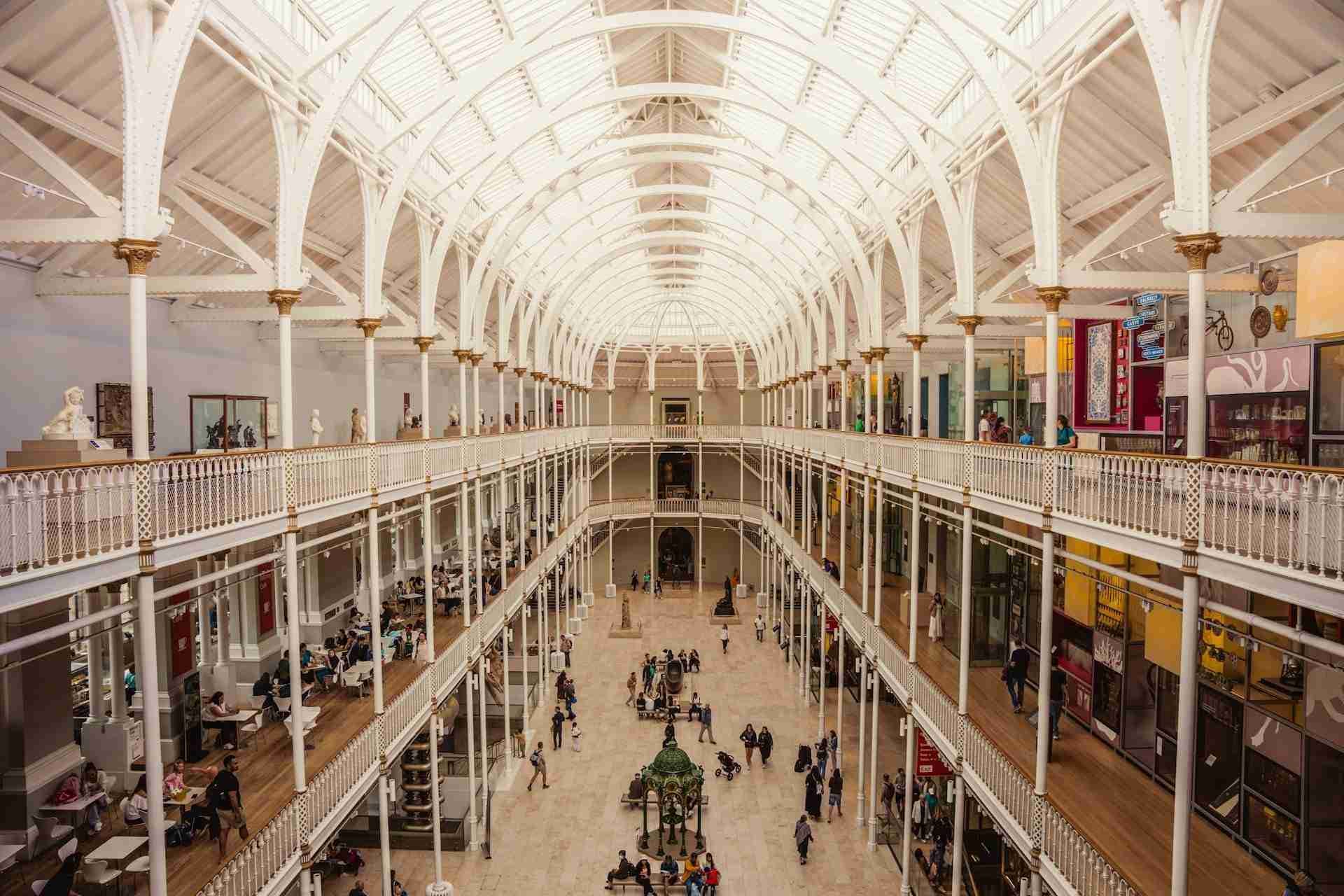
In the heart of Edinburgh's Old Town stands the National Museum of Scotland, a stunning fusion of Victorian grandeur and modern design that makes it one of the country's most photogenic cultural landmarks. Opened in stages starting in 1866, the museum blends its historic cast-iron Grand Gallery with sleek, contemporary expansions that together house centuries of Scottish history, science, and world cultures. For photographers, the building itself is as captivating as the treasures it holds. Whether capturing the soaring light-filled atrium, exploring intricate architectural details, or composing moody street scenes along Chambers Street, the National Museum offers a rich palette of opportunity at every turn.
Best Photography Opportunities
• Grand Gallery interior perspectives
: The museum's most iconic feature is its light-drenched Grand Gallery, a breathtaking space of soaring columns, intricate ironwork, and a towering glass ceiling. Use a wide-angle lens to capture the sweeping symmetry from the ground floor, or move to upper levels to shoot downward through the delicate lattice of railings and arches. Early morning and late afternoon provide beautiful slanting light that highlights the white-painted ironwork, while a tripod (where permitted) can help with low-light long exposures that preserve the detail and grandeur of the hall.
• Architectural contrasts in the modern extension
: The museum's modern wing, completed in 1998, contrasts sharply with the ornate Victorian design, offering clean lines, pale stone walls, and striking geometric shapes. Focus on juxtaposing old and new by composing frames that blend portions of both structures, emphasizing differences in material, line, and texture. Reflections in polished stone and glass surfaces offer abstract opportunities for more artistic interpretations of the museum space.
• Street-level exterior compositions
: From Chambers Street and George IV Bridge, the museum's rugged sandstone façade and bold modern entrance present striking contrasts against Edinburgh's often moody skies. Use a mid-range zoom to frame vertical compositions that emphasize the height and mass of the historic structures, or shoot wider to include passing crowds for a sense of urban energy. Dramatic lighting after rain or under heavy clouds often brings out the texture in the stone, while golden hour casts a warm glow across the façade.
• Detail work in historic exhibits
: Within the galleries, the museum's collections themselves offer rich photographic subjects, from medieval armor to intricate Celtic carvings and towering natural history specimens. When permitted, use a fast lens and high ISO to capture detailed images of artifacts, focusing on textures like aged metal, delicate textiles, or fossilized bone. Close framing can emphasize craftsmanship and the stories hidden in historical objects, while wider shots can place exhibits within the museum's beautiful architectural surroundings.
• People and scale in public spaces
: The Grand Gallery and central atrium naturally fill with visitors, creating excellent opportunities to incorporate human scale into your compositions. Include visitors admiring exhibits or children silhouetted against towering sculptures to emphasize the museum's grand proportions. Candid shots are often best captured with a mid-range zoom to remain unobtrusive while maintaining strong composition and depth.
Best Time to Visit
The National Museum of Scotland can be visited and photographed year-round, with different times of day offering distinct advantages depending on the shot you want to capture. Early mornings, particularly soon after opening, offer the best opportunity to photograph the Grand Gallery and other popular areas without large crowds. During these hours, the natural light filtering through the massive glass ceiling is soft and directional, creating beautifully balanced images.
Midday, though busier, floods the gallery with bright overhead light, ideal for high-key compositions or abstract studies of ironwork and glass. Overcast days also work well, providing diffuse light that softens shadows and highlights interior textures. In winter, shorter days mean less intense light but excellent opportunities for moody shots both inside and outside the museum.
Night photography is also possible from the exterior, where the museum's stone and glass take on a golden hue under the city's streetlights. Long exposures smooth out passing crowds and traffic, allowing the grandeur of the building to dominate the frame.
How to Get There
The National Museum of Scotland is located on Chambers Street, in Edinburgh's Old Town, within easy walking distance of the Royal Mile, Greyfriars Kirk, and other major landmarks. From Edinburgh Waverley Station, the museum is about a 10-minute walk southwest through the historic streets.
Public transit options abound, with buses running along George IV Bridge and South Bridge. Several parking garages are available nearby, but walking is the most efficient way to reach the museum, particularly during busy tourist seasons.
Entry to the museum is free, though special exhibitions may require a ticket. Photography is allowed throughout most of the museum for personal, non-commercial use, but tripods, monopods, and flash are generally prohibited without prior permission. Always check signage or ask staff if you're unsure about shooting in specific areas.
Recommended Gear and Shooting Tips
A wide-angle lens (16–35mm) is essential for capturing the scale and grandeur of the Grand Gallery and tight interior spaces with towering exhibits. A mid-range zoom (24–70mm) is excellent for detail work, artifact documentation, and street scenes outside the museum. For outdoor compositions, a telephoto lens (70–200mm) can help compress architectural elements and pick out ornate details against Edinburgh's textured sky.
Bring a fast prime lens (such as a 35mm f/1.8 or 50mm f/1.4) for low-light interior shooting, where natural light often creates moody and dramatic atmospheres. Be prepared to boost ISO settings and embrace grain for a more documentary feel.
Because tripods are generally not permitted, stabilize your shots by bracing against walls or railings. Set a slightly faster shutter speed than normal to counteract hand movement, particularly when shooting upward toward the glass ceilings. Plan to scout your compositions early and return if needed—changing light dramatically alters the mood of both the Grand Gallery and exterior facades.
Nearby Photography Locations
: Just across the street, this historic cemetery is filled with moss-covered gravestones, Gothic monuments, and atmospheric views of Old Town architecture. It's a particularly rewarding location for moody black-and-white work and low-angle compositions through the gravestones.
: Stretching from Edinburgh Castle to Holyrood Palace, the Royal Mile offers endless historic street scenes, layered stone architecture, and vibrant human activity. Early mornings are best for quiet shots of empty closes and historic shopfronts.
: A short walk uphill leads to the broad plaza outside the castle, providing sweeping views across the city's skyline. Sunset and blue hour are prime times for dramatic compositions featuring the castle walls and the distant hills of Fife.
: South of the museum, The Meadows offers open green space with lines of mature trees, perfect for relaxed, wide-angle landscape compositions or capturing seasonal changes like autumn color or spring blooms.
: A winding, colorful street filled with vibrant storefronts and classic Edinburgh stonework. Ideal for dynamic street photography, architectural abstracts, and storytelling compositions that highlight the city's quirky charm.
The National Museum of Scotland is not just a repository of history—it is an artwork itself, combining soaring architectural ambition with intimate moments of discovery. For photographers, it offers endless possibilities for exploration, from grand sweeping scenes to delicate details that celebrate the beauty of craftsmanship, science, and the spirit of a nation.
Comments
Loading comments…