
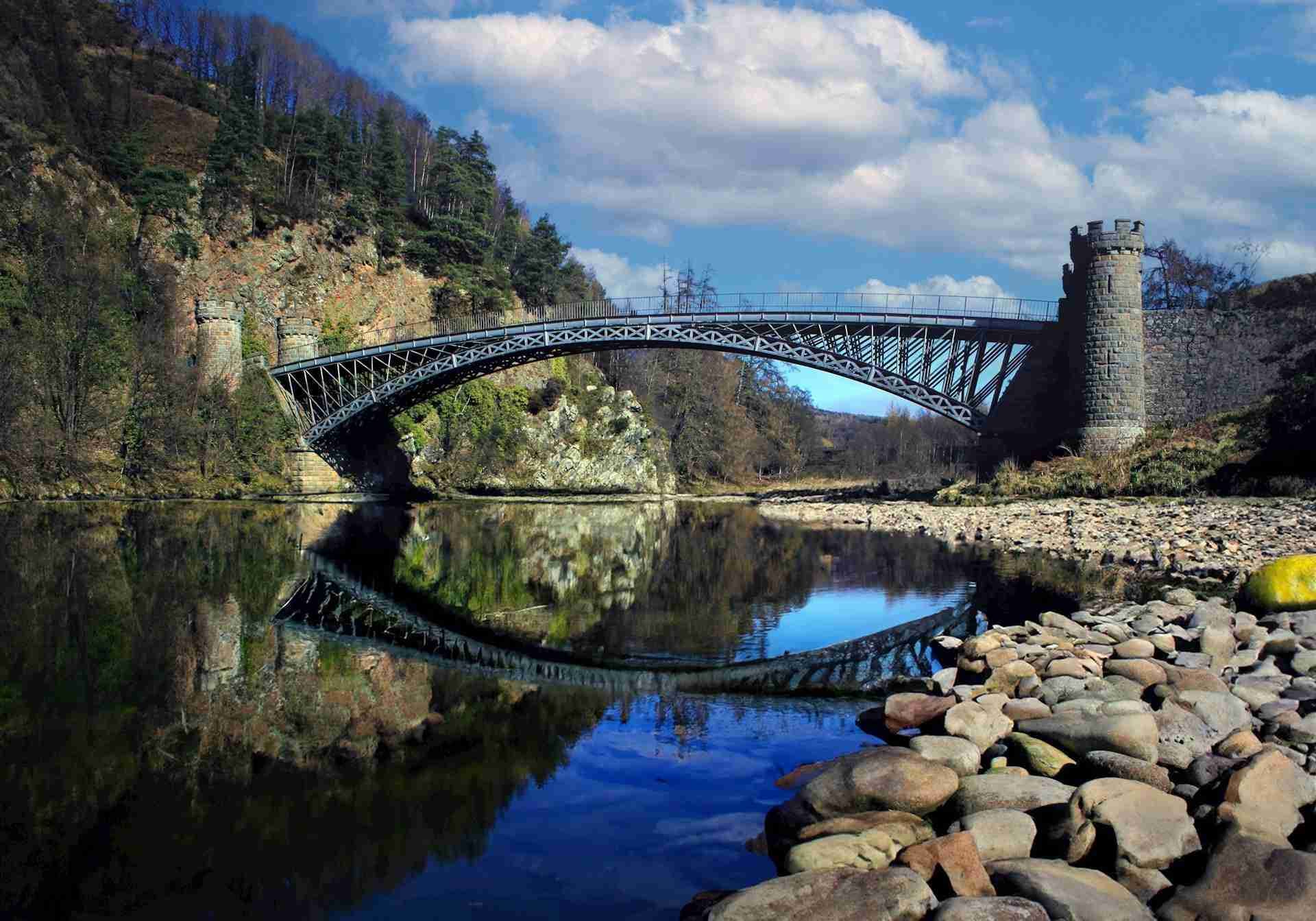
Spanning the River Spey in the village of Craigellachie, the Old Craigellachie Bridge is a masterpiece of early 19th-century engineering. Completed in 1814 by renowned civil engineer Thomas Telford, it was the first cast-iron bridge of its kind in Scotland. Its elegant single-span arch stretches 150 feet across the river, supported by massive stone abutments that anchor it into the rugged Highland landscape. Today, the bridge is closed to vehicles but remains open to pedestrians, offering photographers a chance to explore its geometry, craftsmanship, and integration with the surrounding countryside. With its mix of industrial innovation and Highland scenery, the Old Craigellachie Bridge is a compelling subject that balances architectural history with natural beauty.
Best Photography Opportunities
• Wide River Perspectives of the Bridge Span
From either bank of the River Spey, the full cast-iron arch of the bridge can be appreciated in its entirety. A wide-angle lens emphasizes the graceful curve of the span as it stretches between the two stone towers, while including riverbank foregrounds adds scale and depth to the composition. Shooting in early morning often rewards photographers with mist rising from the river, which softens the surrounding woodland and makes the bridge appear as a silhouette. Long exposures of the water create a smooth reflective surface, contrasting the flowing Spey with the solidity of the ironwork. Evening light is equally rewarding, when the warm tones of sunset glow across both iron and stone.
• Architectural Detail Studies of Ironwork and Masonry
Up close, the Old Craigellachie Bridge reveals its fine cast-iron latticework, with repeating geometric patterns that speak to both craftsmanship and innovation. Telephoto lenses are particularly useful for isolating these repeating forms, highlighting the interplay of light and shadow across the iron ribs. The stone towers at either end also provide texture and architectural detail, from weathered blocks to subtle decorative touches. Shooting on overcast days provides the best conditions for these detail studies, as even light preserves texture without glare. By focusing on these elements, photographers can build a set of images that balance broad architectural form with intricate design.
• Views from the Bridge Deck
Standing on the pedestrian walkway provides a different perspective, where the bridge becomes both a subject and a viewpoint. Looking downstream reveals the Spey winding through woodland, while upstream views are framed by rugged Highland scenery. Wide lenses exaggerate the narrowing perspective of the deck, drawing the eye toward the opposite tower and emphasizing the bridge's sense of length. Including walkers or cyclists in the composition adds human scale and reinforces the bridge's continuing role in the community. These images show not only the structure itself but also the experience of crossing it.
• Seasonal Transformations and Woodland Context
The Spey Valley changes dramatically with the seasons, and each season gives the bridge a new photographic character. In spring, fresh green leaves soften the stone and iron, while summer fills the surrounding woodland with lush color and dappled light. Autumn brings vibrant tones of orange and gold that make the cast-iron span stand out in sharp contrast against the foliage. Winter reveals the pure form of the bridge, with bare trees and occasional snow isolating it as a stark silhouette over the river. Returning at different times of year provides completely different palettes and moods, ensuring that the bridge never feels repetitive.
• Atmospheric Weather and Reflections in the Spey
The River Spey is an important compositional tool when photographing the bridge, and calm conditions can turn it into a perfect mirror. These symmetrical compositions are particularly striking in twilight, when both the bridge and the sky are reflected on the surface. After rainfall, the water becomes more turbulent, creating dynamic foregrounds of rushing motion beneath the iron span. Mist and fog add mood and depth, partially obscuring the bridge and revealing it gradually. Stormy skies emphasize the strength of the structure, with the dark iron contrasting against dramatic clouds for moody and powerful images.
Best Time to Visit
The Old Craigellachie Bridge offers compelling photography in every season, each one bringing its own character to the site. Spring provides gentle greens and softer light, with longer days that allow plenty of time to experiment with compositions. Summer offers the most reliable access and long evenings when golden light lingers across the Spey, though midday light can be harsh and is best avoided. Autumn is particularly photogenic, as the surrounding woodland erupts in warm colors that frame the bridge in fiery tones. Winter emphasizes stark lines and often adds snow, highlighting the geometry of the span against a minimal landscape.
Within each season, the time of day is just as important. Early mornings frequently bring mist above the river, which adds atmosphere and a sense of mystery to wide perspectives. Afternoons provide side light that enhances the textures of ironwork and stone towers, while golden hour warms the entire structure with soft color. Twilight is one of the most rewarding times to shoot, as long exposures create luminous water and glowing skies that complement the strong silhouette of the bridge. Overcast days, common in the Highlands, provide soft and even light that is excellent for detail studies. Planning visits around light and weather conditions ensures that the bridge can be photographed in many different moods.
How to Get There
The Old Craigellachie Bridge is located in the village of Craigellachie, near Aberlour in Moray, Scotland. By car, it is easily reached from the A941 or A95, with signposted routes into the village leading directly to the bridge. Parking is available nearby, with a short walk required to reach the bridge and its riverbank viewpoints. For those without a car, regional buses connect Craigellachie with Elgin and Aberlour, both of which are accessible by train from larger Scottish cities.
The bridge is free to access and open to pedestrians year-round. Walking paths along the river provide multiple perspectives, while crossing the bridge itself gives additional opportunities for shooting both structure and landscape. The village of Craigellachie offers small accommodations, restaurants, and its well-known whisky distillery, making it a convenient base for longer stays. Waterproof footwear is highly recommended, as riverbank access often requires navigating muddy or uneven ground.
Recommended Photography Gear
Photographing the Old Craigellachie Bridge requires a kit that can handle both sweeping landscapes and intricate detail work. A wide-angle lens in the 16 to 35 millimeter range is ideal for capturing the full span from the riverbanks. A mid-range zoom such as a 24 to 70 millimeter lens provides flexibility for architectural studies and balanced perspectives. A telephoto lens in the 70 to 200 millimeter range is valuable for isolating repeating iron patterns, compressing perspectives, and capturing the bridge framed by distant woodland. A macro lens is also useful for focusing on close details of stone, rivets, and surface textures.
A sturdy tripod is essential for long exposures, particularly for smoothing water or shooting in low light at dawn and dusk. A circular polarizer reduces glare on the river and enhances foliage tones, while neutral density filters allow for creative long exposures of both water and sky. In Scotland's variable weather, waterproof covers for gear are essential, along with microfiber cloths to manage rain and mist on lenses. Spare batteries are necessary for cold weather sessions, as well as lightweight gear options for those planning to hike trails around the village for elevated perspectives.
Nearby Photography Locations
A short walk from the bridge, the distillery is one of the most famous in Speyside and offers photography of traditional whisky production buildings. Steam rising from the distillery on cool mornings adds atmosphere and complements industrial subjects.
• Aberlour
The nearby town of Aberlour offers charming village architecture and riverside compositions along the Spey. The Aberlour Distillery and surrounding woodland create opportunities for combining cultural and natural photography.
Located a short drive away, Ballindalloch Castle is a classic Scottish estate complete with turrets, gardens, and landscaped grounds. Its elegance and decorative stonework provide a strong architectural counterpoint to the industrial character of the bridge.
To the north, Elgin Cathedral is a striking medieval ruin with impressive towers and intricate carvings. Its gothic forms contrast well with the industrial engineering of the Old Craigellachie Bridge, making it a rewarding complement to a photography outing.
This long-distance walking trail follows the River Spey and passes near Craigellachie. It offers woodland, river, and wildlife compositions along with elevated views of the surrounding Highlands.
The Old Craigellachie Bridge is more than a historic crossing; it is a subject that blends industrial innovation with Highland landscape. Its graceful iron arch, robust stone towers, and riverside setting ensure that every visit produces new perspectives. With thoughtful use of light, season, and composition, photographers can create images that celebrate both the engineering brilliance of Thomas Telford and the enduring beauty of the Spey Valley.
Comments
Loading comments…