
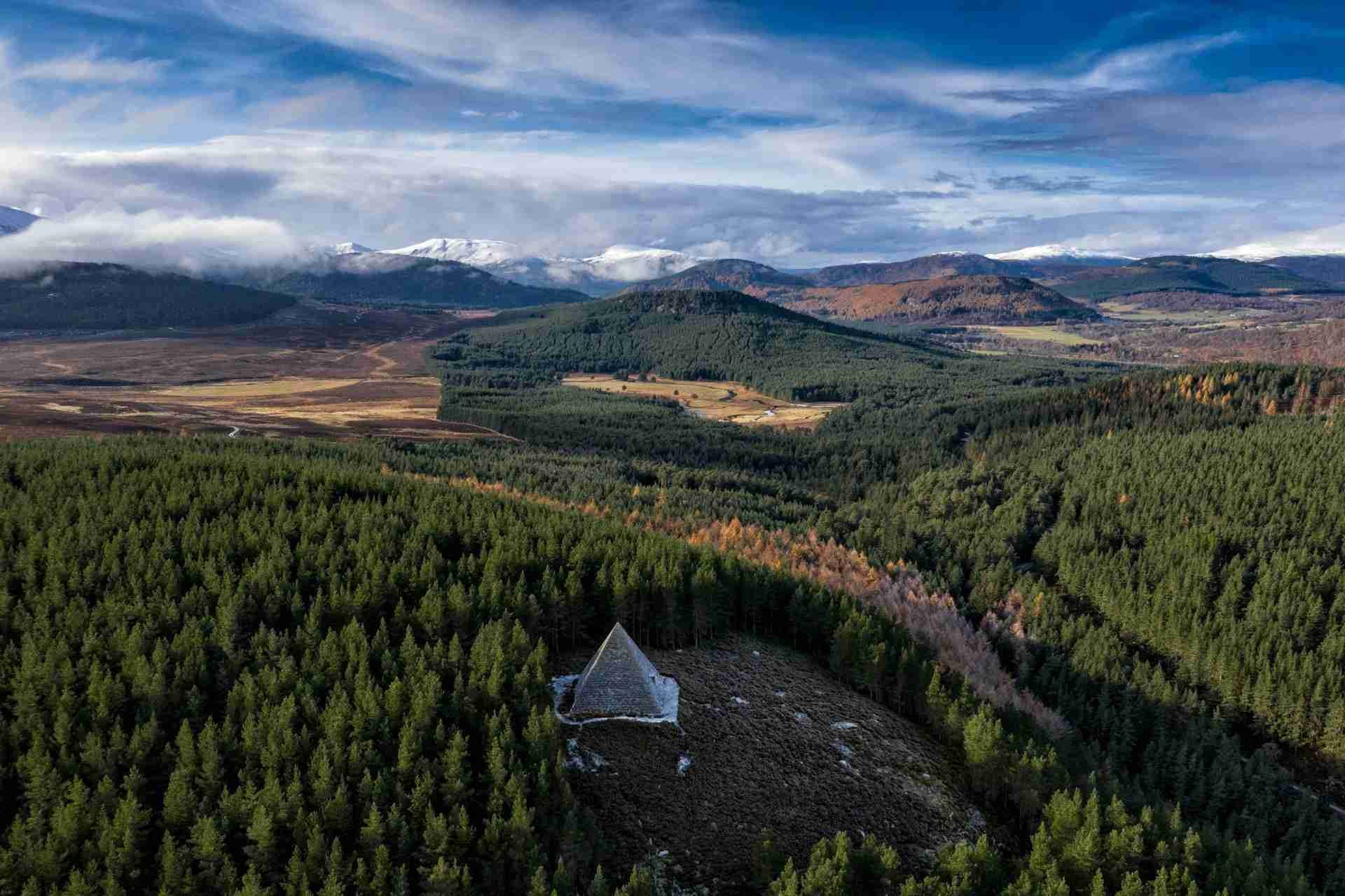
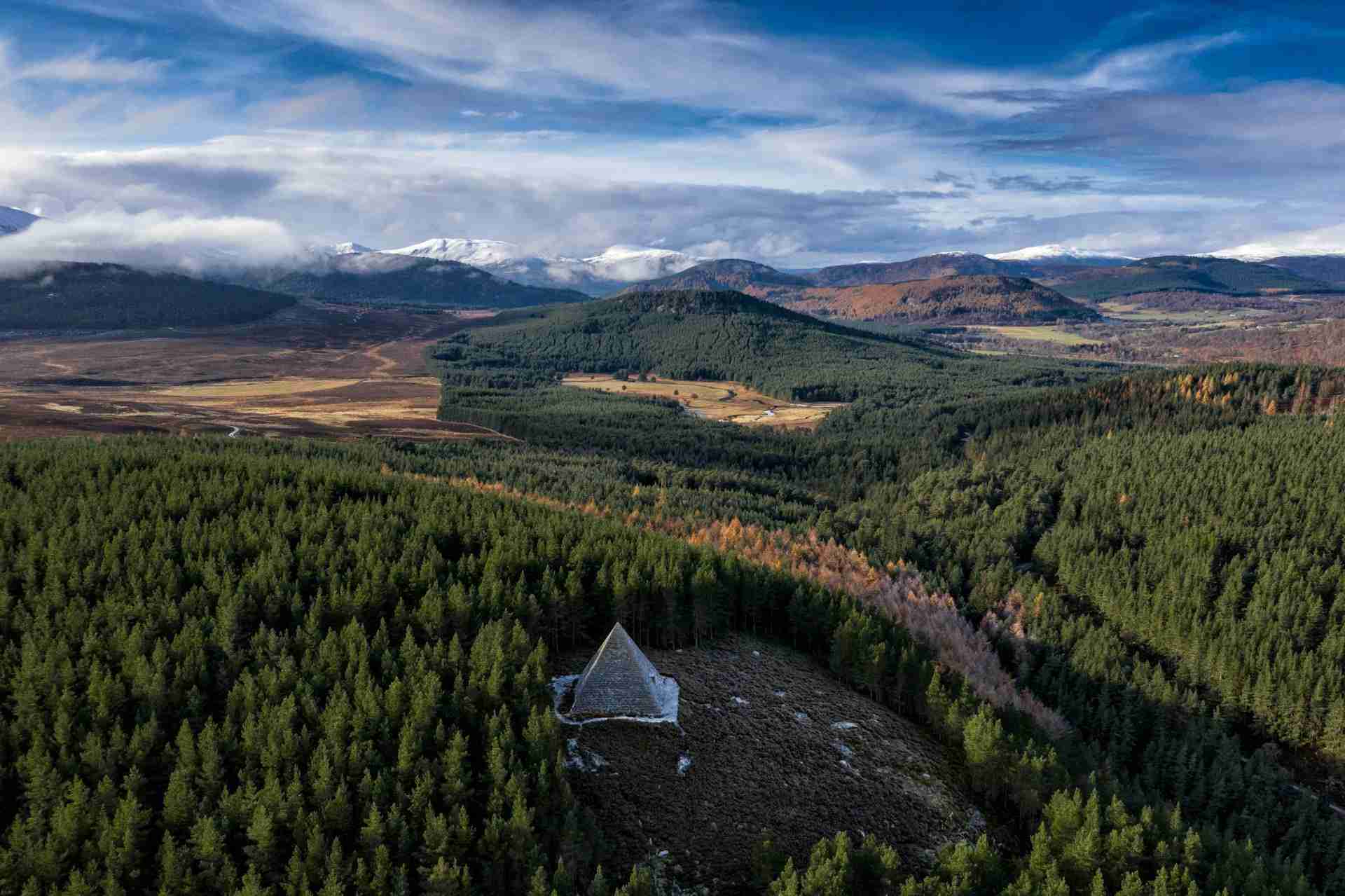
Standing high above the forests of Deeside, Prince Albert's Cairn—also known as the Balmoral Pyramid—is one of the most unexpected and photogenic monuments in the Scottish Highlands. Erected by Queen Victoria in 1862 after the death of her husband, the cairn crowns the summit of Craig Lowrie, offering sweeping views over Royal Deeside, the River Dee, and the Balmoral Estate. Built in the shape of a sharply pointed granite pyramid, it contrasts starkly with its natural surroundings—an angular tribute of grief and devotion set among windswept pines and open heather moorland. For photographers, this site combines dramatic landscape context with rich historical resonance and minimalist geometry, offering an evocative blend of portraiture, structure, and Highlands scenery.
Best Photography Opportunities
• The Cairn at Sunrise from the Southeast Approach
One of the most visually rewarding times to photograph the cairn is at sunrise, when first light breaks over the Cairngorms and spills across the Deeside valley. Approaching from the southeast trail places you slightly below the cairn as it rises against the warming sky. Using a wide-angle lens (16–35mm), you can incorporate foreground heather, frost-covered grass, or snow patches in winter to anchor the shot and enhance scale. In early autumn, the moorland takes on deep reds and golds, and low sun rakes across the stone, revealing subtle texture in the granite blocks. Positioning the cairn off-center, with a distant ridge or cloud formation balancing the frame, creates a layered and narrative-rich composition.
• Minimalist Symmetry from the Northern Flank
The pyramid's sharp geometry makes it ideal for minimalist and architectural compositions, especially from the northern side where the slope flattens slightly and the background sky often remains clear. This angle is strongest in mid to late afternoon when sidelight emphasizes the crisp shadow line of the structure. A standard or short telephoto prime (50–85mm) allows you to compress the subject against a soft sky, ideal for clean, centered compositions. A longer lens can also isolate detail at the cairn's apex or capture the silhouette of the monument against a mountain backdrop during overcast, moodier conditions.
• Contextual Wide Views Over Deeside
Standing beside the cairn and facing south delivers expansive views over the valley, including the snaking course of the River Dee, scattered Balmoral woodlands, and, on clear days, the distant hills of Lochnagar. This location is ideal for sweeping panoramic images stitched from multiple wide-angle frames or for compressed landscapes using a 70–200mm lens. Shooting just after rain, when the air is clearest, reveals deep depth and subtle layering in the landscape—ideal for black-and-white work or subdued tonal grading. Including the cairn in a wide frame from the path above it also offers strong leading lines and narrative potential.
• Moody Weather and Fog Play
The cairn's angular form lends itself to dramatic images under shifting clouds or mist. Autumn and winter storms often bring fast-moving fog that curls around the summit, partially obscuring and then revealing the monument. A fast prime or high ISO zoom is invaluable here to work handheld while chasing quick-changing light. Photographers can capture the cairn emerging from fog, or use long exposures (1–2 minutes) to create motion in the clouds while the stone remains sharp. These conditions favor mood over clarity and often result in some of the most evocative frames from the site.
• Detail Studies of Stonework and Inscription
Up close, the cairn's precisely set granite blocks and weather-worn plaque bearing Prince Albert's name make excellent subjects for macro or shallow depth-of-field photography. Side lighting—particularly early or late in the day—casts long shadows between stones, highlighting the craftsmanship and age of the structure. These frames work well as part of a broader visual story, providing texture and human connection to the monument's purpose. Even rain-soaked surfaces, with droplets clinging to rough stone, provide rich detail when shot at f/2.8 or wider.
Best Time to Visit
Prince Albert's Cairn can be photographed year-round, though access and conditions change significantly with season. Spring and early summer (April to June) offer fresh growth, blooming heather buds, and often the clearest light. Sunrise during these months aligns well with the southeastern approach, making early starts particularly rewarding. The landscape below is a patchwork of green pine, golden grass, and the silver ribbon of the Dee.
Autumn (late September through early November) provides the richest color palette. The birch woods below the summit turn gold and rust, while the cairn is frequently enveloped in low-hanging cloud or moody skies. This season is ideal for contrast-heavy compositions and emotionally resonant storytelling images, particularly under broken light.
Winter presents a stark, high-contrast landscape with snow-capped peaks and a bare, skeletal woodland. The path can be slippery, but fresh snowfall transforms the cairn into a monochrome study of shape and light. Low sun angles all day allow for flexible shooting windows, and the pyramid's sharp form stands out dramatically against a soft, wintry sky. Photographers should be prepared for rapid weather shifts and bring appropriate cold-weather protection for gear and self.
In summer, long daylight hours allow for extended golden hour sessions and varied lighting throughout the day. However, mid-day light can be harsh and flatten contrast, so early morning and late afternoon remain best for serious landscape work. Regardless of season, overcast skies often provide excellent diffused lighting for the stone's texture and forested surroundings.
How to Get There
Prince Albert's Cairn is located on the Balmoral Estate, near Crathie in Aberdeenshire, Scotland. It can be accessed via the Balmoral Pyramid Trail, a well-maintained loop walk that begins from a public car park near the estate gates along the A93. From the car park, cross the River Dee via the small footbridge and follow signage toward the cairns. The walk to Prince Albert's Cairn takes approximately 45 minutes to an hour one-way, with a steady incline through woodland and onto open moor.
The final ascent is moderately steep and can be slippery in wet or icy weather, especially in autumn and winter. Good hiking boots and weather-appropriate clothing are essential, and a trekking pole may aid stability when carrying gear. While the cairn lies on Crown Estate land, access is permitted via public paths, though visitors should respect private signage and stay on marked trails.
There are no amenities along the route or at the summit, so prepare accordingly. The nearest facilities, including toilets and cafés, are in Ballater (15 minutes east by car) or Braemar. Mobile signal varies but tends to be weak near the summit—GPS should be downloaded in advance if needed.
Recommended Photography Gear
Given the mix of architectural structure, atmospheric landscape, and light-changing conditions, a versatile but carefully chosen kit is essential. A full-frame camera body with solid dynamic range and good high-ISO performance allows you to capture both early morning fog and bright midday contrast without sacrificing detail. Weather-sealing is strongly recommended due to Scotland's unpredictable climate.
A wide-angle lens (16–35mm) is ideal for photographing the cairn within its landscape, especially when including foreground elements like heather, stone, or mist. A standard zoom (24–70mm or 24–105mm) provides flexibility for handheld work on the approach and for capturing both monument and distant ridges in a single frame. For landscape compression, a telephoto lens (70–200mm) is particularly valuable when isolating the River Dee valley or distant peaks in changing light.
A lightweight, travel-friendly tripod is essential for early morning and twilight work, particularly when capturing fog or long exposures. Use a remote release or 2-second timer to avoid shake. A polarizer enhances sky separation and foliage contrast, while graduated ND filters help balance sky and ground on clear mornings. In overcast conditions, filters can often be left behind in favor of bracketing exposures.
Bring a waterproof backpack, microfiber cloths, and lens wipes—Scotland's mist and drizzle can quickly obscure optics. A rain cover for your camera is advised, particularly in shoulder seasons. Gloves and a warm layer are essential even in late spring or early autumn, as wind at the summit can be biting. Finally, carry extra batteries, especially in cold weather, and a lens hood to shield against stray flare when shooting into low sun.
Nearby Photography Locations
• Lochnagar from the Gelder Shiel Path
Just south of the Balmoral Estate, the trail to Gelder Shiel bothy and Lochnagar offers expansive Highland vistas with dramatic rock faces and wide moorland. Lochnagar's north face reflects beautifully in its corrie loch, ideal for sunrise or golden hour work. The approach also passes through varied terrain—ideal for a narrative photographic walk.
• Ballater and the River Dee Shoreline
East of Balmoral, the River Dee near Ballater provides a tranquil setting with wide views of distant peaks, slow-moving water, and birch woodlands. Early morning light reflects gently in the river, and the bridge in Ballater adds a compositional anchor for symmetry and framing.
• Crathie Kirk and Surrounding Woodlands
Just below the estate, Crathie Kirk is a quiet, atmospheric stone church frequently visited by the royal family. Its detailed stonework, lichen-covered gravestones, and surrounding trees offer a completely different mood—ideal for close-up and detail-heavy storytelling.
• Corriemulzie Bridge and Burn
Tucked into the hills west of Braemar, this lesser-known location features a historic stone bridge over a tumbling burn. Long exposure waterfall photography meets rustic Highland charm, especially in spring when snowmelt feeds the stream. Excellent for isolating natural details and working without distraction.
Prince Albert's Cairn stands not just as a monument to mourning, but as a testament to love, permanence, and the power of memory set in stone. For the landscape photographer, it offers a rare blend of sculptural precision and Highland atmosphere. In stillness or storm, sunlight or fog, it endures—waiting to be rediscovered through the lens, again and again.
Comments
Loading comments…