
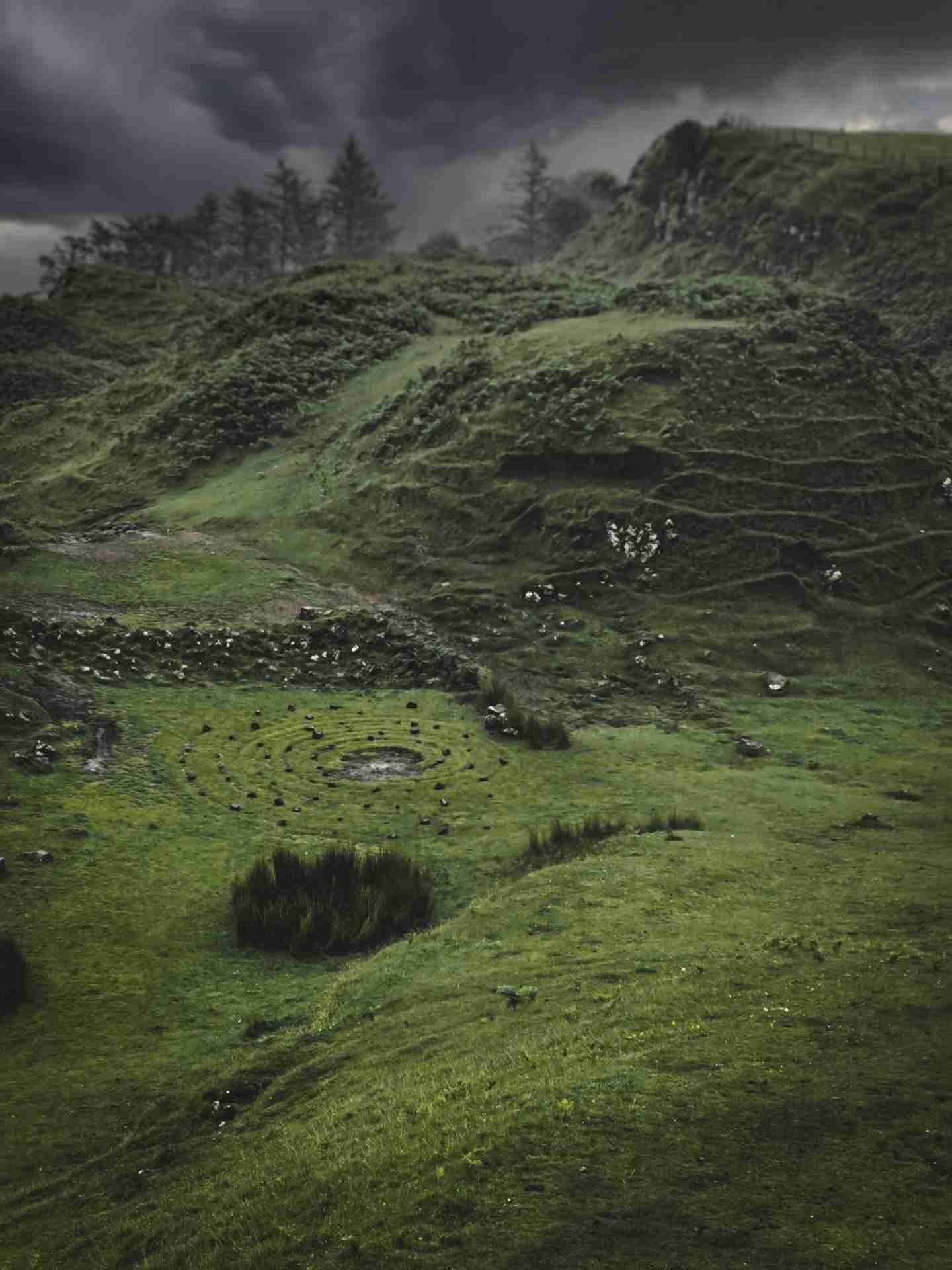
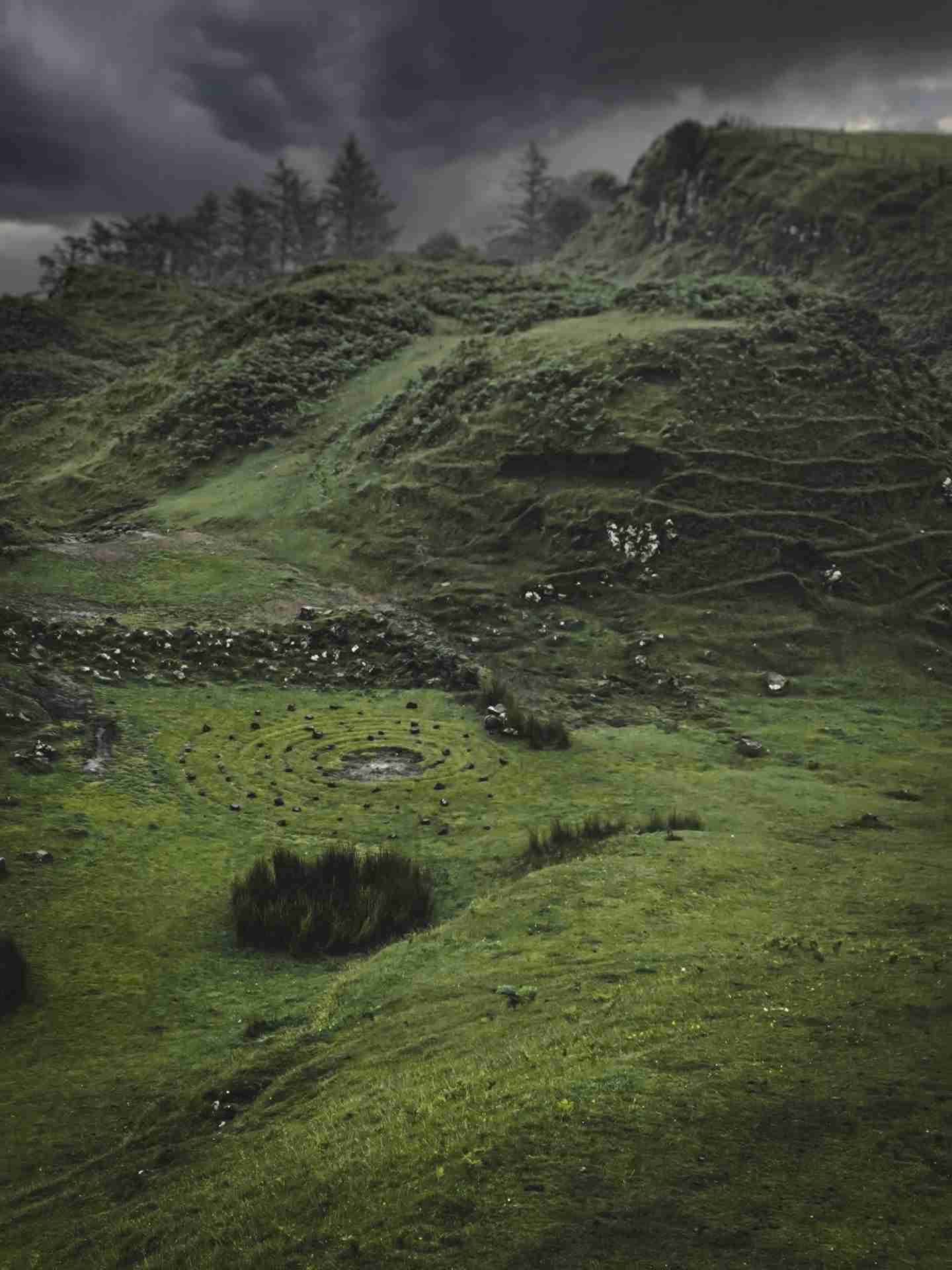
Tucked into the green folds above Uig on the Isle of Skye, The Fairy Glen feels like a place not entirely of this world. A tight network of grassy knolls, miniature lochans, basalt outcrops, and a distinct lack of signage or explanation give this landscape an almost accidental mystique. Formed by landslips and centuries of erosion, it resembles a scale model of the Quiraing or Storr — except smaller, stranger, and quieter.
The Fairy Glen's compact size and surreal topography make it an ideal setting for photographers interested in storytelling, symmetry, and soft northern light. While there are no official fairies to be found, it's easy to see why the site has drawn comparisons to folklore. Here, compositions are built from curves and contrast, subtle light shifts, and the interaction between land, sky, and shadow. The key is slowing down and allowing the landscape's understated drama to reveal itself.
Best Photography Opportunities
• Castle Ewan and Elevated Overviews
The rocky outcrop known as Castle Ewan crowns the glen and offers a natural viewpoint above the undulating landscape. From here, you can shoot down onto the spiraling hills and green basins below, using a wide-angle lens to exaggerate the terrain's soft peaks and shadows. Side lighting from early morning or late afternoon gives depth and brings out texture in the grass and stone. Framing Castle Ewan itself against the sky from lower down also works well, especially under dramatic clouds or shifting light.
• Fairy Circles and Spiral Formations
While some of the spirals and stone patterns are the result of human arrangement, they still photograph well when approached with care. Shoot from a slightly elevated angle to highlight their structure, particularly in soft light when the grass is dewy or the shadows are long. Incorporating these shapes into a wider composition — either with leading lines or by placing them in the foreground — adds a sense of scale and mystery. Avoid walking into the spirals to maintain their visual integrity for other visitors.
• Abstract Textures and Layered Landscapes
The Fairy Glen's rolling topography is a natural playground for creating compressed, abstracted compositions. Use a telephoto lens to isolate patterns in the hills, or focus on the interplay between rock, moss, and path. This works especially well in low-contrast conditions like fog or rain, where tonal subtleties take precedence over bold light. Look for moments when sheep or birds pass through frame, adding scale or a touch of movement to otherwise still landscapes.
• Reflections and Water Elements
A small lochan sits near the glen's entrance, and on calm days it offers the opportunity for mirror-like reflections of Castle Ewan or the surrounding slopes. Compose with the water's edge in the lower third of the frame to balance sky and land, and experiment with longer exposures if the light allows. In the wet months, small runoff channels also form natural curves and flow lines across the hillsides — subtle elements that add rhythm and motion to your compositions.
• Atmospheric and Weather-Driven Conditions
The glen transforms under different light and weather. On bright days, it feels open and sculptural. Under mist or drizzle, it becomes intimate and cinematic. Low fog filtering through the knolls adds depth, mystery, and a softness that plays well with muted colors. The basalt rocks catch highlights in side light, while the moss and grass take on rich saturation after rain. Wait for passing weather fronts and watch how the mood of the landscape shifts with each break in the cloud.
Best Time to Visit
The Fairy Glen is best visited in the early morning or late afternoon, when low sun angles create contrast across the knolls and ridges. Morning light tends to be softer and more diffused, especially when fog or dew is present, while golden hour in the evening warms the green tones and brings out shadows that sculpt the terrain. Because of the glen's position and topography, the lighting changes quickly, creating opportunities for varied exposures and dynamic compositions throughout a short visit.
Spring and autumn are particularly rewarding seasons here. Spring brings lush new growth and long dawns filled with bird activity, while autumn offers lower sun paths and softer skies that flatter the landscape's subdued palette. Summer can be beautiful, but the midday light is often harsh and the location sees heavier foot traffic, making early arrival essential. Winter visits offer solitude and stark contrasts, with frost or snow adding graphic definition to the hills, though trail access can be muddy and slippery.
The glen photographs well in overcast and moody conditions, which help emphasize the softness and layered shapes of the landscape. Wind is often calmer in the early hours, which benefits reflection shots and longer exposures. Because this location is intimate in scale, it rewards slower, more deliberate shooting under less-than-perfect skies.
How to Get There
The Fairy Glen is located just outside the village of Uig on the northern edge of the Isle of Skye. From Uig, take the narrow road signposted for Sheader and Balnaknock. After about 1.5 miles (2.5 km), you'll reach a small lay-by where limited roadside parking is available. Be respectful of local residents, as the glen sits on common grazing land and close to private properties.
From the parking area, a short walk through a gate and over a grassy field leads directly into the heart of the glen. The area is largely unmarked and open, so you're free to explore along worn footpaths that wind through the hills. The walk is gentle, though the ground can be muddy and uneven, particularly after rain. Footwear with good grip is recommended, as are waterproof layers due to sudden changes in weather.
There are no facilities on site, and drone use is discouraged to preserve the tranquility of the area. The best way to experience and photograph the Fairy Glen is slowly, thoughtfully, and with minimal intrusion.
Recommended Gear and Shooting Tips
A wide-angle lens (16–35mm) is ideal for showcasing the scale and structure of the glen, especially when you want to include foreground spirals, lochans, or the rolling knolls. A 24–70mm lens offers great flexibility for general landscape work and layering compositions, while a 70–200mm is excellent for isolating forms, compressing depth, or abstracting patterns in the hills.
A tripod is useful for low-light situations, longer exposures, or precise framing in calm conditions. A polarizing filter enhances the richness of the moss and helps control glare on wet surfaces. Bring a 6-stop ND filter if you plan on using longer shutter speeds to blur movement in grasses, clouds, or water.
The terrain invites slow exploration—spend time walking the perimeter before committing to one composition. Pay close attention to foreground textures like winding sheep trails, scattered rocks, or grassy tufts, all of which add depth and story when placed correctly. If the light is flat, shift to black-and-white to emphasize the structure of the land.
Weatherproof gear is a must, and always pack a lens cloth for wiping off moisture or rain. The soft, ever-changing Highland light is often more important than a dramatic sky — let it work with the landscape's quiet beauty rather than forcing contrast where it doesn't belong.
Nearby Photography Locations
• Quiraing Landslip
Located further north on the Trotternish Peninsula, the Quiraing offers dramatic cliffs, winding roads, and iconic rock formations. This larger-scale landscape rewards early morning visits and is perfect for pairing with the more intimate forms of the Fairy Glen.
• The Slipway at Uig Bay
Just minutes from the glen, this small harbor area features textured piers, tidal patterns, and reflections in calm water. It's excellent at sunrise, when the water picks up subtle light and the backdrop of cliffs frames the shoreline beautifully.
A lesser-traveled coastal walk leading to sea stacks and basalt cliffs that drop steeply into the Atlantic. Strong compositions are possible during golden hour or in dramatic weather, with grassy headlands offering leading lines and layered depth.
• Kilt Rock and Mealt Falls
A classic roadside stop where a waterfall drops straight into the sea beside vertical basalt columns. Ideal for long exposures or stormy compositions, especially when shot from slightly off-center to capture both the falls and distant headlands.
One of the Isle of Skye's most iconic landscapes, the Old Man of Storr rises from the ridge just east of Uig. Ideal for sunrise hikes and high-drama landscapes, it offers an entirely different scale and energy than the gentle forms of the Fairy Glen.
The Fairy Glen may be smaller and subtler than Skye's more famous landmarks, but its sculpted hills and hushed atmosphere offer photographers something equally powerful: a sense of quiet wonder. This is a landscape where the story lies in the curve of a path, the glint of light on wet moss, and the patient passage of shadow across ancient hills.
Comments
Loading comments…