

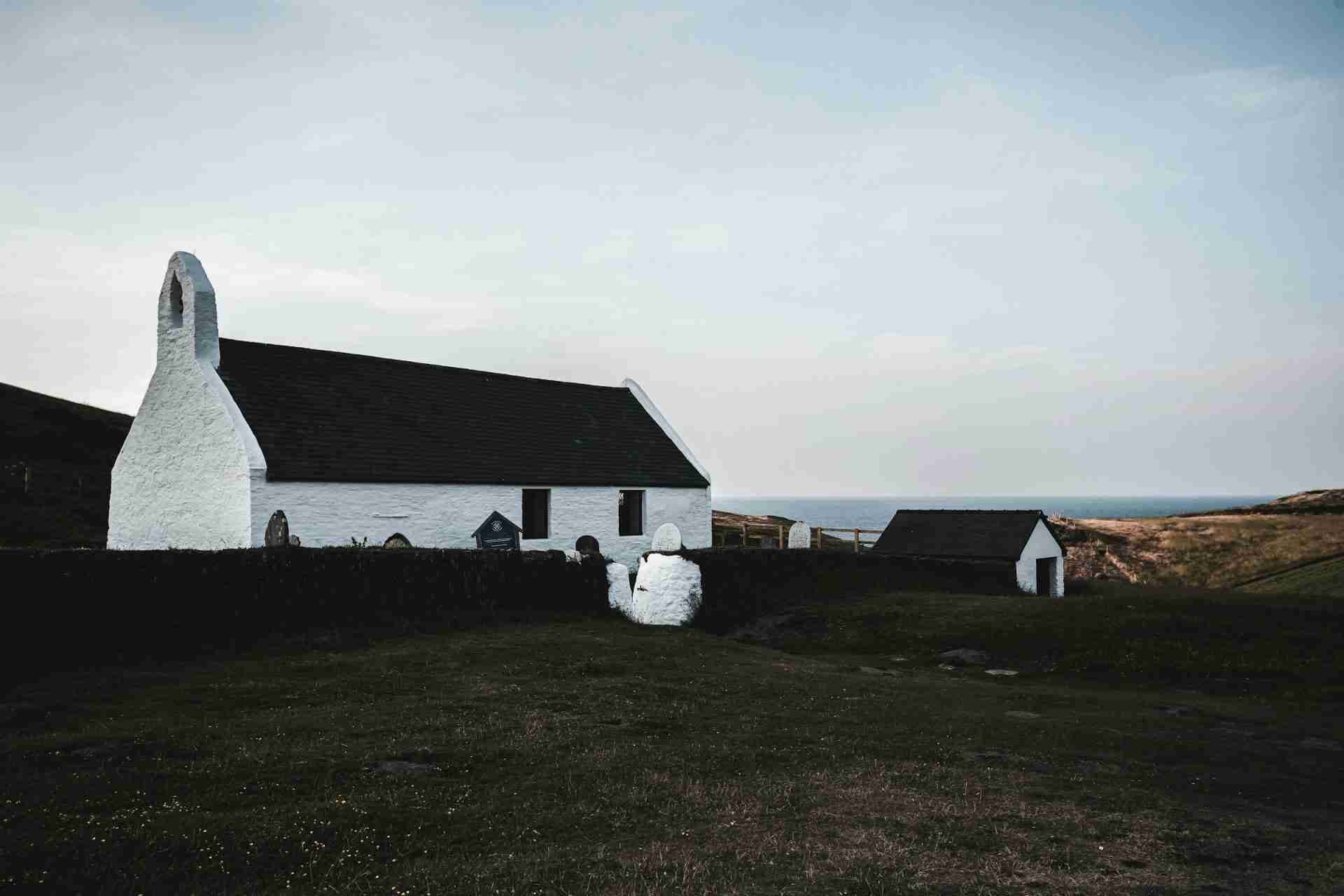
Holy Cross Church sits quietly on the slope just above Mwnt Beach, its simple stone walls and slate roof contrasting with the sweeping natural landscape around it. From this elevated position the church looks out across Cardigan Bay while the curved sandy beach and rugged cliffs unfold below. The setting feels both historic and timeless, with the chapel surrounded by open fields, coastal paths, and the constant sound of waves rolling into the sheltered bay. The church itself dates back several centuries and has long served as a place of worship for the small coastal communities of the region. Today it remains a peaceful landmark that draws visitors not only for its history but also for its extraordinary setting above the sea. The hillside around the chapel provides several natural viewpoints where photographers can capture the church in relation to the beach, cliffs, and open water. Because the building is small and isolated, it stands out clearly against both the green hillside and the wide sky above. This simplicity makes it an ideal subject for compositions that highlight scale, contrast, and the quiet character of the Welsh coastline.
Best Photography Opportunities
• Church with Mwnt Bay Below – One of the most compelling compositions places the church within the wider landscape of Mwnt Bay. From positions slightly downhill or to the side of the chapel, photographers can frame the white building with the sweeping curve of the beach and the blue water of Cardigan Bay behind it. This angle clearly shows how the church sits above the bay and helps create depth within the photograph. Including a section of the grassy hillside in the foreground can strengthen the composition and guide the viewer toward the church. When the tide is visible along the beach below, the scene gains an additional sense of scale and movement.
• Against the Open Sky – The simple architecture of Holy Cross Church makes it well suited for clean compositions against the sky. Photographing from a slightly lower point on the hillside allows the building to stand clearly above the horizon line. This angle emphasizes the white walls and dark roof while keeping the background uncluttered. Cloud movement across the Welsh coast often adds texture to the sky, giving these images additional atmosphere. Because the church is relatively small, careful framing helps maintain its visual impact within the scene.
• Churchyard Views – The area surrounding the churchyard provides several viewpoints that look directly out toward the sea. From these positions photographers can capture the chapel with the open water stretching across the background. The low stone walls and grassy paths around the church can act as subtle foreground elements that help guide the composition. This viewpoint also works well when waves are visible across the bay, adding movement to an otherwise quiet landscape. On clear days the horizon stretches widely across the frame, reinforcing the sense of openness around the chapel.
• Coastal Path Perspectives – The walking paths that cross the hillside above Mwnt Beach reveal additional angles of the church within the surrounding landscape. From slightly farther away the chapel appears smaller against the rolling green slopes and wide sky. These wider compositions show how the church sits within the coastal environment rather than dominating it. Including sections of the path can add leading lines that guide the viewer's eye toward the chapel and sea. These perspectives often feel more natural and immersive than the closer viewpoints.
• Mwnt Bay from the Church Hill – While the chapel is the main subject, the hill around it also provides excellent vantage points for photographing Mwnt Bay itself. From higher points near the church, photographers can capture the curved sandy beach, rocky headlands, and waves rolling into the bay. The church can sometimes be included at the edge of the frame as a subtle element within the broader landscape. These scenes work especially well during calm weather when the sea reflects the sky above. The contrast between the quiet hillside and the open bay helps create a balanced coastal composition.
Best Time to Visit
Sunset is often the most rewarding time to photograph Holy Cross Church and the surrounding coastline. As the sun lowers toward the horizon over Cardigan Bay, warm light spreads across the hillside and beach below. The white walls of the chapel catch this light and stand out strongly against the darker greens of the surrounding grass.
Spring and early autumn often provide especially good conditions along this part of the Welsh coast. During these seasons the air tends to be clear and the light sits lower in the sky, creating more texture across the landscape. Summer can also be appealing when the hillside is bright green and the sea appears calm and blue. Early morning visits offer quieter conditions with fewer visitors around the church and beach.
How to Get There
Holy Cross Church is located above Traeth Mwnt near the small coastal hamlet of Mwnt, just north of Cardigan in west Wales. The area lies within a protected coastal landscape managed by the National Trust. Visitors usually reach the site by following narrow rural roads from Cardigan toward Mwnt Beach. A designated parking area sits near the beach, from which a short walking path leads uphill toward the church. The walk to the chapel takes only a few minutes but climbs gently across the grassy hillside.
Access to the church and surrounding coastal paths is generally free. Because the area is part of a protected coastal landscape, visitors are encouraged to stay on marked paths and respect the natural environment while exploring the hillside viewpoints.
Recommended Photography Gear
A wide lens is particularly useful at Holy Cross Church because many compositions include both the chapel and the surrounding coastline. This allows photographers to capture the building within the broader landscape of Cardigan Bay. A moderate zoom lens can also be helpful for isolating the church against the sea or sky while compressing the surrounding scenery.
A tripod can be valuable during sunset when light levels drop and longer exposures may be needed. A circular polarizing filter helps reduce glare from the sea and deepen the blue tones of the sky on clear days. Because the location sits on an exposed hillside, photographers should also be prepared for wind coming off the coast.
Nearby Photography Locations
below the church forms a sheltered bay surrounded by grassy cliffs. From the shoreline photographers can capture waves rolling into the curved beach while the hillside rises above. The view back toward the church from the sand can also create an interesting composition with the chapel visible on the hill.
south of the beach provides elevated viewpoints looking across Cardigan Bay. From these cliffs photographers can capture wide coastal scenes where the sea stretches toward the horizon. Dolphins are occasionally seen offshore, adding wildlife opportunities to the landscape.
lies a short drive north of Mwnt and features some of the most dramatic cliffs along the Ceredigion coastline. The rugged rock formations and crashing waves create powerful seascape compositions. The high viewpoints along the cliffs provide sweeping views across the coast.
offers wide sandy beaches and views across the estuary. Photographers can capture shifting tides, distant headlands, and changing sky conditions across the open shoreline. Sunset light often reflects across the wet sand and water channels.
sits along the River Teifi within the town of Cardigan and provides a historic architectural subject. The restored buildings and surrounding gardens offer a very different photographic environment from the nearby coastline. From the castle grounds photographers can also capture views across the river and town.
Comments
Loading comments…