
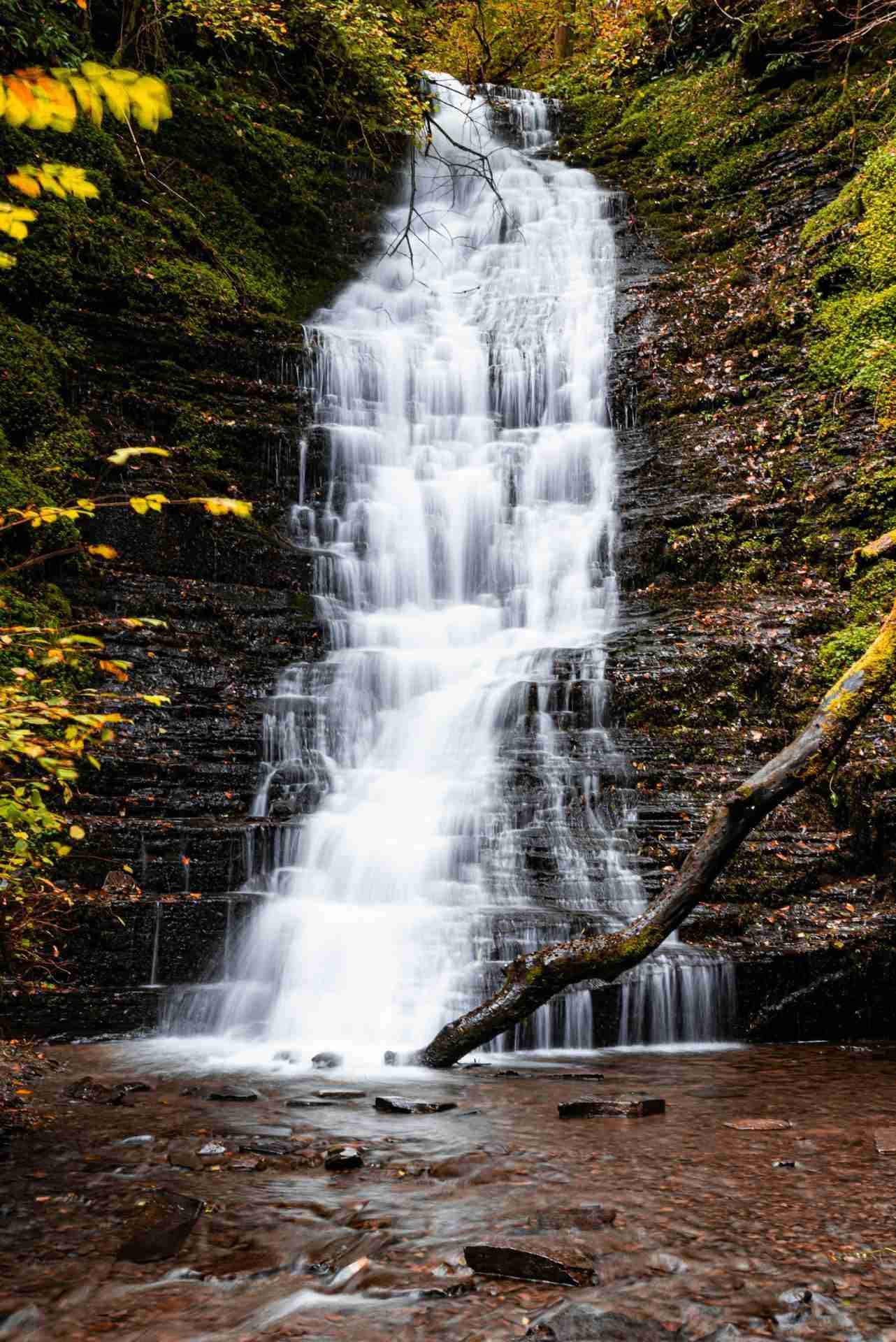
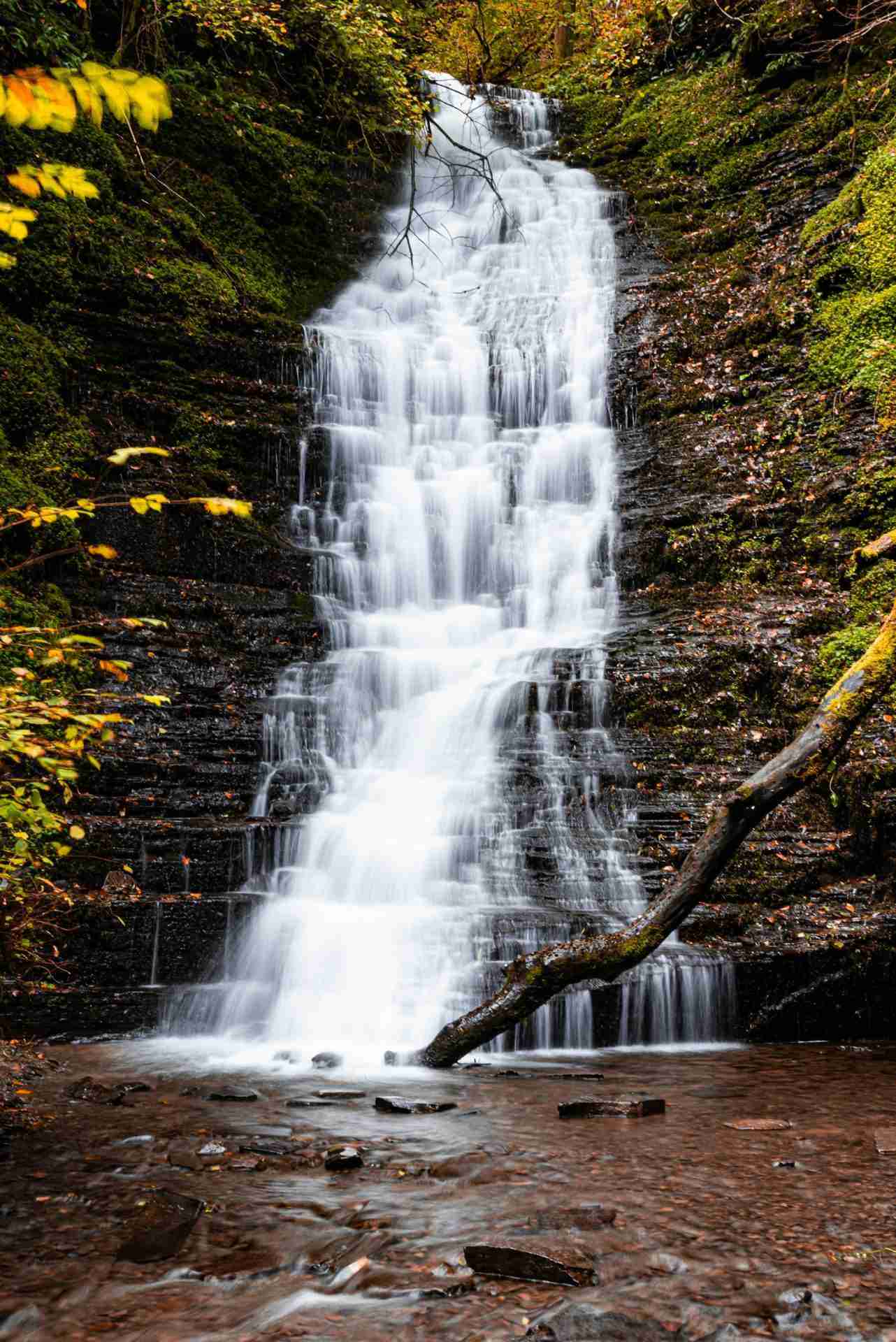
Tucked into the woodland hills of Radnorshire in mid Wales, Water Break Its Neck is a narrow gorge and waterfall located within Warren Wood, just outside the town of Presteigne. The site is named for the vertical drop of the stream as it falls from a ledge deep in the forest, but the atmosphere is far more peaceful than the name suggests. This is a location shaped by rain, shadow, moss, and time, where trees reach out over the trail and water slips quietly into a shaded pool. Photographers will find a blend of natural subjects here, from forest textures to water movement and upland views. It is a location that rewards early starts, patient observation, and a willingness to work with the subtle light of the woodland floor.
Best Photography Opportunities
• Water Break Its Neck Waterfall
The waterfall is the visual and acoustic center of this location. It drops vertically from a high ledge into a shallow basin surrounded by moss covered rock, twisted roots, and damp woodland. The stream is fed by rainfall, so the volume of water changes week to week, but the form of the fall remains clean and vertical. The best compositions often come from a position just downstream, where you can use the flow of the stream as a leading element and pull in the texture of the surrounding gorge. Light tends to remain soft due to the forest cover, which makes it easier to use long exposures without overexposing. A tripod is essential here, and the use of a circular polarizer can deepen contrast between the water and the surrounding stone.
• Stream and Forest Floor Below the Falls
As the stream flows away from the base of the waterfall, it travels over stones, roots, and moss toward the lower part of the gorge. This section offers opportunities for tighter, more intimate compositions that focus on detail and rhythm. You can shoot low to the ground to include the flow of the stream, scattered leaves, or reflections of the canopy above. After rainfall, the forest floor becomes rich with saturated greens and reds, and the light under the canopy becomes even more diffused. Look for quiet moments where branches arch across the water or leaves cluster at the edge of a rock. These compositions often benefit from slower shutter speeds and careful framing to avoid visual clutter.
• Woodland Trail and Canopy Texture
The approach to the waterfall follows a short but steep path through Warren Wood, and along this trail are multiple chances to frame tree trunks, canopy patterns, and dappled light. Early in the morning, light slants in from the east and creates soft backlight through the upper branches. The trail itself can be used as a visual line, especially when it curves between tree trunks or dips into hollows. The structure of the forest shifts from tight undergrowth to more open spaces, which gives you opportunities to vary your focal length and approach. These scenes are especially well suited to soft light or mist, and they reward deliberate observation rather than wide framing.
• Upper Gorge and Stone Formations
Above the waterfall, the gorge narrows and the terrain becomes more rugged, with moss covered rock walls and root systems wrapping around exposed stone. This area is less visited and harder to access but offers a more wild and layered setting for photography. The textures here are strong, with a mix of saturated greens, slick stone surfaces, and fallen wood. You can compose with vertical frames that emphasize height or use a short telephoto lens to isolate intersecting lines in the rocks and branches. Fog or recent rain adds to the richness of the textures and softens the visual density of the scene.
• Open Hills and Upland Light
Beyond the woods, the landscape opens into higher ground with long views across the Radnorshire countryside. From the upper trail, you can frame isolated trees against the sky, rolling pastureland, and layered ridges in the distance. Light in these areas is most effective in the late afternoon, when the sun begins to break low across the terrain. During autumn and winter, these open spaces often hold mist or soft gradients in the sky, especially just after rain. These upland views provide a useful contrast to the enclosed space of the gorge and allow for wider, more expansive compositions that work well with longer focal lengths.
Best Time to Visit
The best time to visit Water Break Its Neck for photography is during spring and autumn, when the forest holds the most visual variation and the waterfall is consistently active. In April and May, fresh green growth fills the understorey and new leaves catch soft morning light through the canopy. These conditions are ideal for woodland compositions, and the water flow is typically strong after late spring rains. Autumn brings a complete shift in tone. From mid October to early November, the forest floor becomes covered in fallen leaves, and the branches shift to copper and gold. Light during this time tends to be lower and more diffused, perfect for long exposures and detail work near the water.
In summer, the forest becomes denser and the light more broken by the leaves. Midday conditions are often too contrasty, but early morning still offers soft light and quiet trails. Winter can be stark, with bare branches and fast moving clouds, but the waterfall continues to run and occasional frost can bring new texture to the moss and rocks. Rain is common in all seasons, but it is also what gives this location its texture and mood. Overcast skies are preferred, as they allow for balanced exposures and reveal the full color range of the greens and browns in the forest.
Fog is most common in the early morning after rain, especially in autumn and late spring. These are the best conditions for atmosphere, as they allow for simplified shapes, faded backgrounds, and a quiet feel that matches the setting. Early visits are recommended year round, as the location is compact and best photographed without foot traffic or direct midday light.
How to Get There
Water Break Its Neck is located in Warren Wood near the village of New Radnor in Powys, Wales. The nearest town is Presteigne, which sits just to the east near the English border. From New Radnor, follow signs to Warren Wood where there is a designated picnic site with a small parking area. The trail to the waterfall begins directly from the car park and is clearly marked. It takes around 10 to 15 minutes to reach the base of the falls, depending on pace and conditions. The trail is uneven in parts and can become muddy or slick after rain, so sturdy footwear is recommended.
There are no entrance fees or permits required to access the site. The trail is open year round and generally quiet outside of school holidays and weekends. While the trail is short, it climbs steadily and includes roots and loose ground. Facilities at the parking area are limited to a few benches and informal picnic areas. Mobile signal in the area is weak, especially in the forested sections, so plan ahead if relying on mapping apps. The site is suitable for a short visit or as part of a longer day exploring the Radnor Hills.
Recommended Photography Gear
A simple but flexible kit works best at Water Break Its Neck, with an emphasis on detail, soft light, and water motion. A wide angle lens in the 16 to 24 millimeter range is useful for capturing the full height of the waterfall from tight shooting spots and for framing compositions inside the gorge. A mid-range lens around 24 to 70 millimeters gives you enough reach to work with forest paths, stream textures, and tighter scenes without changing lenses frequently. A telephoto in the 70 to 200 millimeter range can help compress the landscape in the upland sections above the woods or isolate patterns in the canopy and hillside.
A tripod is essential for long exposures of the waterfall and for working in the forest where light can be low even during the day. A circular polarizer is helpful for cutting surface glare from the stream and bringing out natural color in wet leaves and moss. Neutral density filters in 6 and 10 stop strengths are ideal if you want to blur water movement during brighter periods of the day. Bring a lens cloth or towel, as spray and moisture are constant in the gorge and can affect image clarity quickly.
Waterproof footwear and a weather resistant backpack are recommended, especially after rain. A rain cover for your gear can help if showers pass through while you are on the trail. If you plan to shoot in early morning or late afternoon, a small headlamp will help navigate the forest path safely. You do not need a large setup for this location, but your gear should be reliable in damp, shaded conditions and capable of working with subtle shifts in natural light.
Nearby Photography Locations
Above Warren Wood, the higher ridge lines open to sweeping views across the central Welsh hills. The terrain is shaped by pasture, wild grasses, and scattered trees, offering a wide canvas for long lens work. Early or late light brings out shape in the folds of the hills and casts long shadows across the land.
• Whimble Hill
This distinctive hill north of the falls offers a clear silhouette and 360 degree views from its rounded summit. The trail to the top is short but steep, and the open land around it is excellent for minimalist landscape compositions with sky, land, and form in balance.
To the southeast, this high ridge walk near Kington follows the border with England and includes views across patchwork fields, distant moors, and winding lanes. Light moves fast across this open terrain, and the changing skies make it a strong location for moody, wide angle work.
Roughly an hour west, the Elan Valley features a chain of reservoirs, stone dams, and forested hills. Water levels and weather create constant variation, and the area is best explored on foot with plenty of pullouts for roadside compositions and waterfall shots.
• Presteigne Riverside Paths
Closer to town, the River Lugg winds through quiet farmland, low bridges, and gentle bends. This is a calm location for working with reflection, soft light, and lead-in lines created by fences, footpaths, and tree lines in low morning or evening light.
Water Break Its Neck is a small site, but it offers strong subjects for photographers who enjoy woodland work, soft light, and the quiet rhythm of water in motion. With the right timing and a patient approach, the textures, tones, and seasonal shifts here provide enough material for multiple return visits and a wide range of photographic studies.
Comments
Loading comments…