
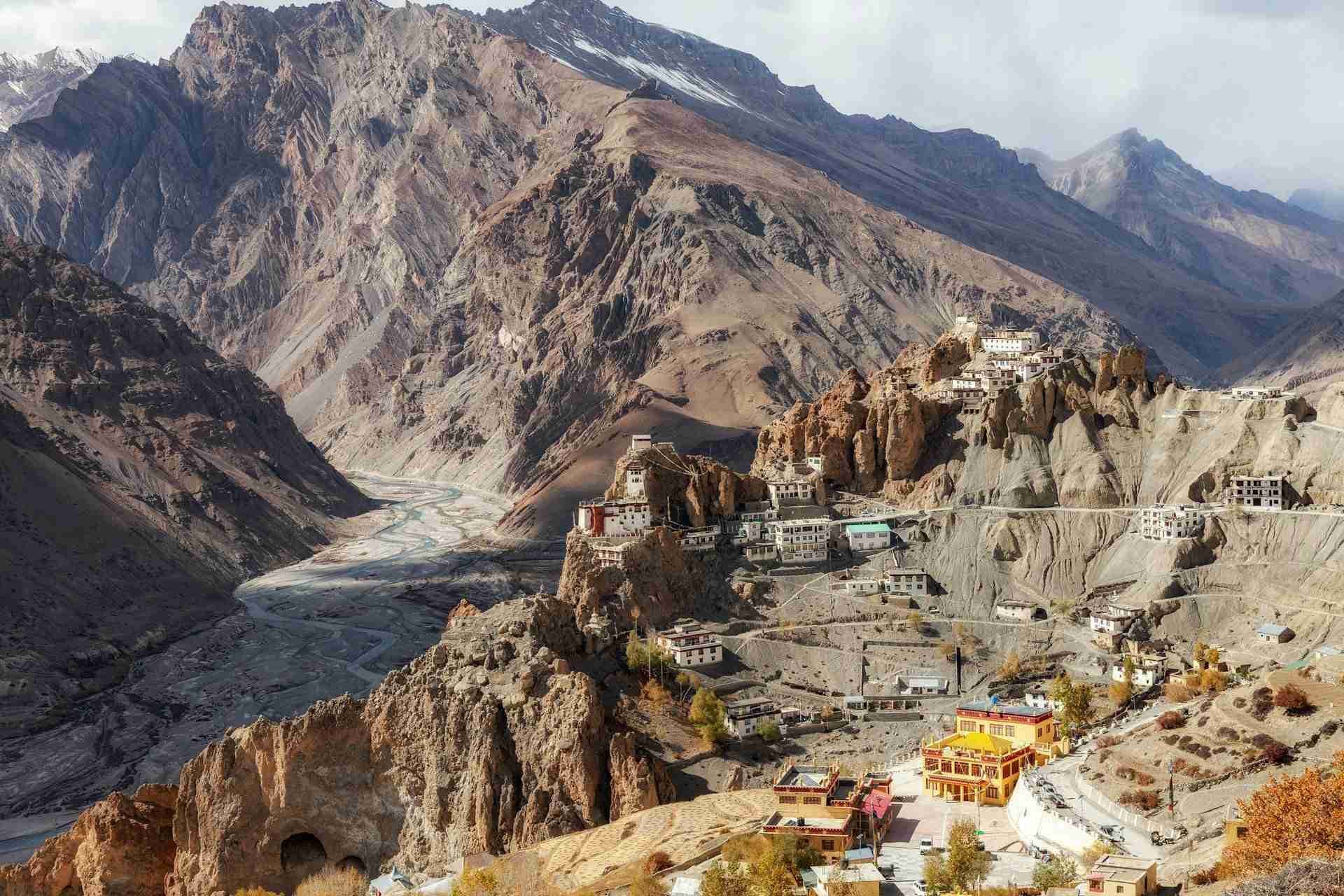
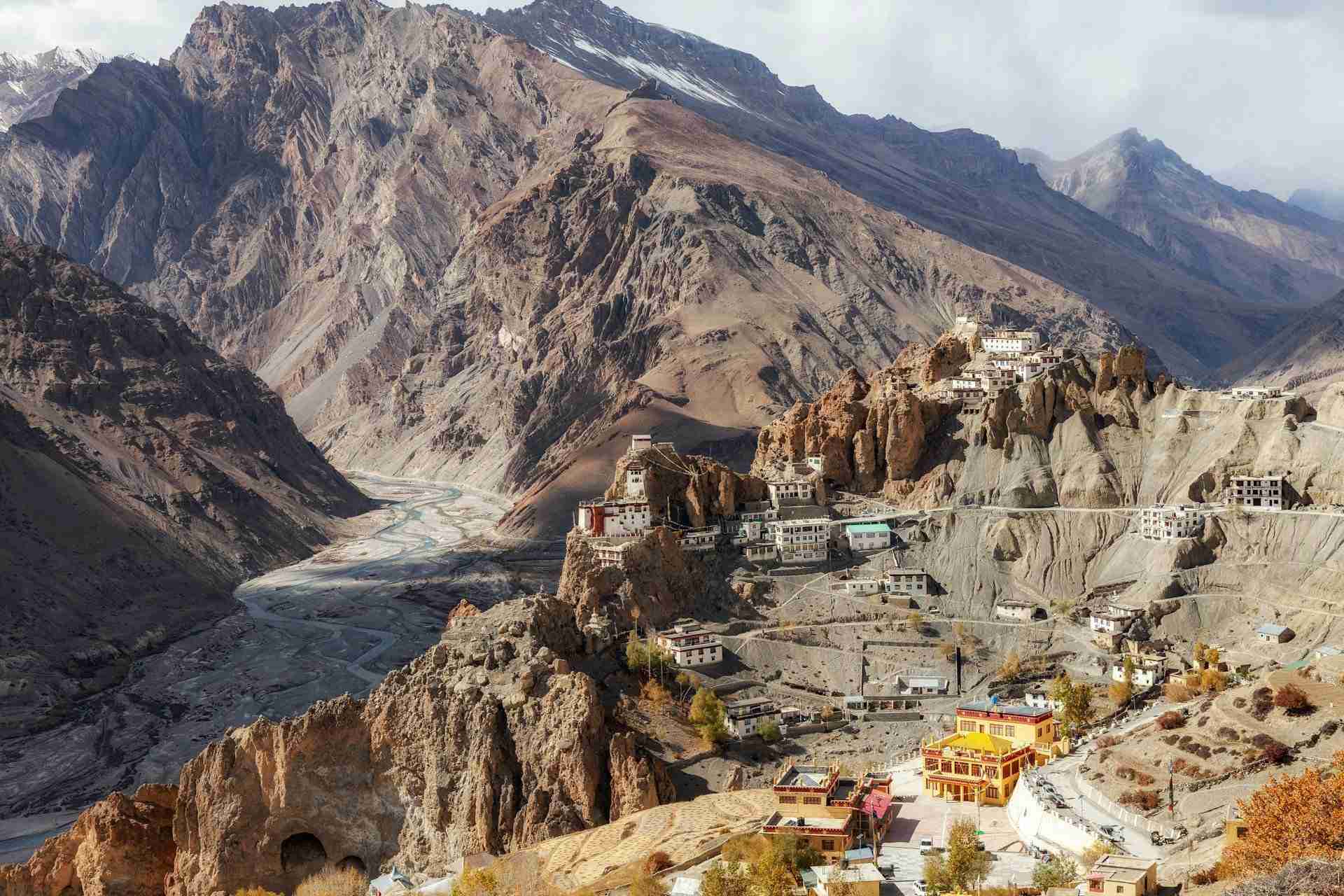
Perched precariously on a rocky spur above the confluence of the Spiti and Pin Rivers in Himachal Pradesh, Dhankar Monastery is one of India's most visually spectacular religious sites. At over 3,800 meters above sea level, this 1,000-year-old gompa clings to a rugged mountainside with commanding views of the high-altitude desert and glacial rivers far below. The stark contrast between the whitewashed monastery walls and the ochre cliffs makes Dhankar a dream location for landscape, travel, and architectural photography. Steeped in Tibetan Buddhist heritage and surrounded by vast, elemental landscapes, Dhankar offers photographers not just a destination, but an experience of light, silence, and spiritual gravity in the Indian Himalayas.
Best Photography Opportunities
• Cliffside Wide Shots of the Monastery
– The most iconic view of Dhankar comes from a trail just east of the monastery, where you can frame the entire complex perched dramatically against jagged cliffs with the Spiti River winding far below. Sunrise casts a warm glow on the monastery and highlights the surrounding peaks, while late afternoon adds dramatic shadows and texture.
• Monastery Interiors and Prayer Rooms
– Inside the ancient prayer halls, dim ambient light filters through narrow windows, illuminating statues, wall paintings, and rows of butter lamps. A fast lens and careful exposure reveal rich reds, golds, and earth tones, offering a mood of timeless spirituality. Focus on details like prayer wheels, thangka scrolls, or flickering candles to tell a more intimate story.
• Aerial or Drone Shots (Where Permitted)
– If permitted, an aerial perspective reveals how Dhankar is fused into the rock itself. From above, the geometry of flat rooftops, tight walkways, and the cliff edge creates a dramatic abstract of human architecture in a forbidding environment. Be mindful of airspace rules and monastic privacy—drone usage should be extremely respectful.
• Portraits of Monks and Daily Life
– The monks at Dhankar often go about their routines quietly and are approachable with respect. Capturing portraits or candid images of life in the monastery brings a human element to the dramatic landscape. Soft morning or diffused afternoon light works best, and always ask for permission before photographing people.
• Landscape Shots Toward the Spiti Valley
– From the monastery, you can turn your lens outward toward the layered ridges, glacial rivers, and braided plains of the Spiti Valley. Long lenses compress the landscape for painterly images, while wide-angle compositions highlight the immense scale and remoteness of the setting.
Best Time to Visit
The best time to photograph Dhankar Monastery is from May to October, when the Spiti Valley is accessible and the weather is stable. During this window, skies are often deep blue, and the light is crisp and clear—a dream for high-altitude photography.
Mornings offer soft, angled light and fewer visitors, making them ideal for landscape and architectural compositions. Golden hour in the evening can bathe the mountains and monastery in warm, glowing light, while the shadows grow long across the valley floor.
The monsoon season (July to August) brings occasional clouds, which can enhance mood and create beautiful light breaks. Autumn (late September to October) is especially photogenic, with clearer air, crisp light, and early snow dusting the distant peaks. Winter is stunning but extremely harsh—access becomes difficult and most guesthouses close.
How to Get There
Dhankar Monastery is located in Spiti Valley, Himachal Pradesh, India, about 32 km from Kaza and 24 km from Tabo. The road is narrow, unpaved in sections, and climbs steeply to the cliffside village of Dhankar. From Kaza, take a shared taxi or private vehicle via the NH505, turning toward Dhankar near Shichiling.
The drive from Kaza takes roughly 1.5 hours depending on road conditions. There is a small parking area near the village, with a short uphill walk to the monastery entrance. For photographers carrying gear, altitude and terrain should be considered—move slowly and stay hydrated.
There is a small fee to enter the monastery, which helps with its maintenance. Photography is allowed in most areas, though some inner sanctums may request no photos. Always ask permission before entering restricted rooms or photographing residents.
Exploring Dhankar and the Surrounding Area
The monastery is only part of what makes Dhankar a unique destination. Above the village lies Dhankar Lake, a peaceful alpine tarn surrounded by barren peaks, reachable by a steep 45-minute hike. This lake is ideal for reflection shots, minimalist compositions, and a dramatic change in scale from the monastery below.
Around the village, adobe homes and mani walls create authentic backdrops for documentary and travel photography. The narrow alleys, open courtyards, and mountain-facing balconies offer intimate scenes of Himalayan village life.
Hiking trails stretch along the ridge above the monastery, leading to viewpoints and cliff edges that provide fresh angles on the monastery and valley. During evening blue hour, the monastery lights come on, offering rare opportunities for low-light and night photography in this isolated setting.
Nearby Photography Locations
– Known as the "Ajanta of the Himalayas," this ancient monastery complex features richly painted murals, mud-brick temples, and prayer halls dating back to the 10th century. Its courtyard and whitewashed stupas photograph beautifully in warm evening light.
– Just across the river from Dhankar, this protected area is home to stark desert cliffs, wildflowers, and snow leopards. The road to Mudh Village offers incredible compositions of braided rivers and shifting light across the valley.
– North of Kaza, this iconic fortress-like monastery is perched on a hill with panoramic views and interior prayer rooms filled with centuries-old artifacts. It's one of Spiti's most famous and photogenic sites.
– A high-altitude village with a giant seated Buddha overlooking the valley. The surrounding hills, fossil-rich soil, and dramatic skies make Langza ideal for wide landscape and cultural imagery.
– This tiny village provides a perfect travel photography subject, with its remote outpost, friendly residents, and vast Himalayan backdrop. Excellent for environmental portraiture and storytelling.
Dhankar Monastery is where silence, scale, and history converge in a powerful photographic experience. With its cliffside position, ancient textures, and sweeping views, it offers an unforgettable window into both the spiritual heart of Spiti and the raw grandeur of the Himalayas.
Comments
Loading comments…