

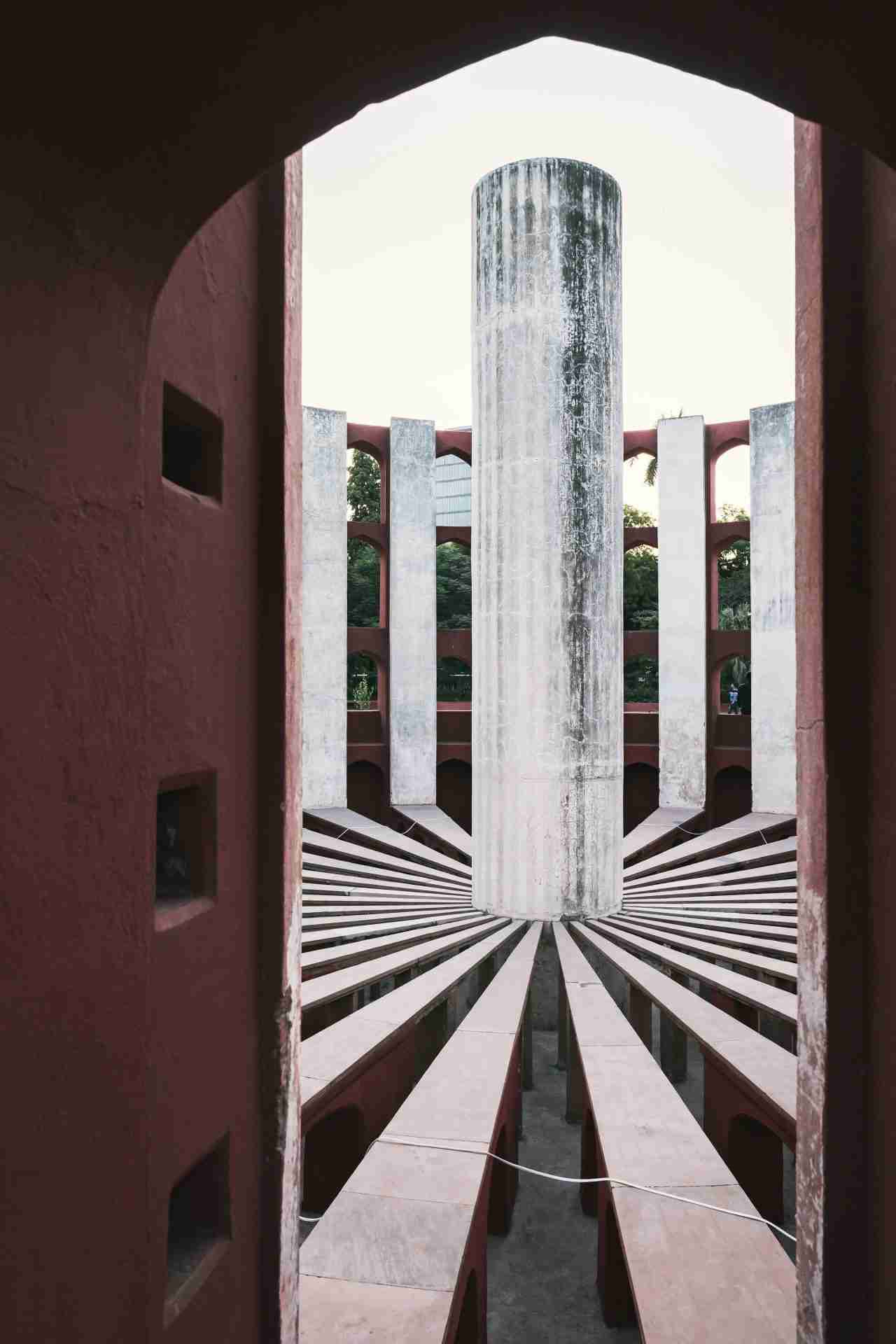
Jantar Mantar is an unique collection of large scale astronomical instruments built in the 18th century. At first glance, it feels more like a sculptural park than a scientific site, with curved walls, steep staircases, and bold forms rising out of the ground. The structures are painted in warm red and white tones, which immediately stand out against the surrounding city. Each instrument was designed for a specific purpose, measuring time or tracking celestial movement, but you do not need to understand the science to appreciate the layout. The site is compact enough to explore in one visit, yet varied enough that you can keep finding new angles as you move through it. Elevated walkways and changing heights give you different perspectives, while the strong geometry keeps compositions clean and intentional. It is a location that feels structured but still open to interpretation, making it easy to approach in different ways.
Best Photography Opportunities
• Bold Geometric Forms And Clean Lines
The most immediate strength of Jantar Mantar is its strong, clear shapes. Curved walls, sharp angles, and large planes of colour create compositions that feel structured without being complicated. By positioning yourself carefully, you can isolate individual forms and remove distractions from the frame. Shooting from slightly lower angles can emphasize scale and make the structures feel more dominant. The contrast between red and white surfaces helps define edges and adds visual clarity. This is a location where simple compositions often work best.
• Elevated Perspectives
Many of the instruments include staircases and raised platforms that allow you to change your viewpoint easily. Climbing these structures gives you access to angles that are not visible from ground level. From above, you can look down and create more abstract compositions using overlapping shapes. From below, the same structures feel more imposing and dramatic. This variation in height allows you to experiment without needing to move far. It is one of the most effective ways to add variety to your images within a compact space.
• Light Vs Shadow
Light plays a major role in how the site looks and feels. The strong shapes create defined shadows that shift throughout the day, adding depth and contrast to the scene. Midday light produces sharper shadows and higher contrast, which can work well for graphic compositions. Softer light in the morning or late afternoon reduces contrast and gives the surfaces a more even tone. Positioning yourself to include shadow lines can help guide the viewer's eye through the frame. This is a location where paying attention to light direction makes a noticeable difference.
• Abstract Compositions
By focusing on smaller sections of the structures, you can create more abstract images that remove context and emphasize form. Cropping tightly allows you to work with curves, intersections, and blocks of colour without showing the entire instrument. Slight changes in angle can completely change how these shapes interact. This approach works particularly well when the light is even, as it keeps the focus on form rather than contrast. It is a good way to explore a more creative side of the location. The simplicity of the design makes it easy to experiment.
• Human Scale And Movement Within The Space
Including people in your frame can help give a sense of scale to the structures. A single figure on a staircase or walkway can show how large the instruments really are. Positioning them carefully within the geometry helps maintain balance in the composition. Movement can also add a dynamic element, especially if you capture someone walking through the frame. Timing becomes important, as the site can be busy at times. This approach helps bring life into an otherwise static environment.
Best Time to Visit
Early morning and late afternoon are the most comfortable times to photograph Jantar Mantar, both in terms of light and crowd levels. The softer light during these times helps reduce harsh contrast and makes it easier to manage exposure across the bright surfaces. Midday light is stronger and can create very defined shadows, which can be useful if you are aiming for more graphic, high contrast images.
Seasonally, Delhi's weather plays a role in how enjoyable your visit will be. Winter months tend to offer clearer skies and more comfortable temperatures, while summer can be extremely hot and harsh. Overcast days are less common but can be useful for more even lighting. Visiting on weekdays can also help avoid larger crowds, giving you more flexibility with your compositions.
How to Get There
Jantar Mantar is located in central Delhi, near Connaught Place, making it easy to reach from most parts of the city. It is accessible by metro, with nearby stations within walking distance, as well as by taxi or auto rickshaw. Its central location makes it convenient to include as part of a wider photo walk.
There is an entry fee to access the site, as it is a protected historical location. Once inside, you can move freely between the different structures, though certain areas may have restrictions for preservation reasons. Tripods may not be permitted, so it is best to plan for handheld shooting. The layout is straightforward, and you can cover the entire site without difficulty.
Recommended Photography Gear
A standard zoom lens in the range of 24 to 70mm works well for capturing both wider architectural shots and more focused compositions. A wider lens can help emphasize the scale and curvature of the structures, especially when shooting from close range. A longer lens can be useful for isolating details and compressing shapes into more abstract frames.
Because tripods may not be allowed, it is helpful to have a camera that performs well at higher ISO levels. A polarizing filter can help manage glare on bright surfaces and deepen colour slightly. Keeping your setup compact will make it easier to move through the site and adjust quickly to different angles.
Nearby Photography Locations
Connaught Place is a large commercial and cultural hub with circular colonnades and consistent architectural patterns. It offers strong opportunities for street and architectural photography. The layout makes it easy to build symmetrical compositions.
India Gate is a large war memorial set within open grounds, offering clear sightlines and strong central compositions. It works well for both wide shots and more focused details. The surrounding area provides additional space to explore.
Agrasen ki Baoli is a historic stepwell with repeating arches and descending steps that create strong leading lines. It is ideal for symmetry and depth based compositions. The structure offers a different type of geometry compared to Jantar Mantar.
• Rajiv Chowk Metro Station
Rajiv Chowk Metro Station is one of the busiest transit points in Delhi, offering opportunities for capturing movement and urban life. The interior spaces can be used for more dynamic compositions. It provides a contrast to the stillness of Jantar Mantar.
Janpath Market is a busy street market with colour, texture, and constant activity. It is a good place for candid photography and capturing everyday scenes. The energy here is very different from the structured environment of Jantar Mantar.
Comments
Loading comments…