
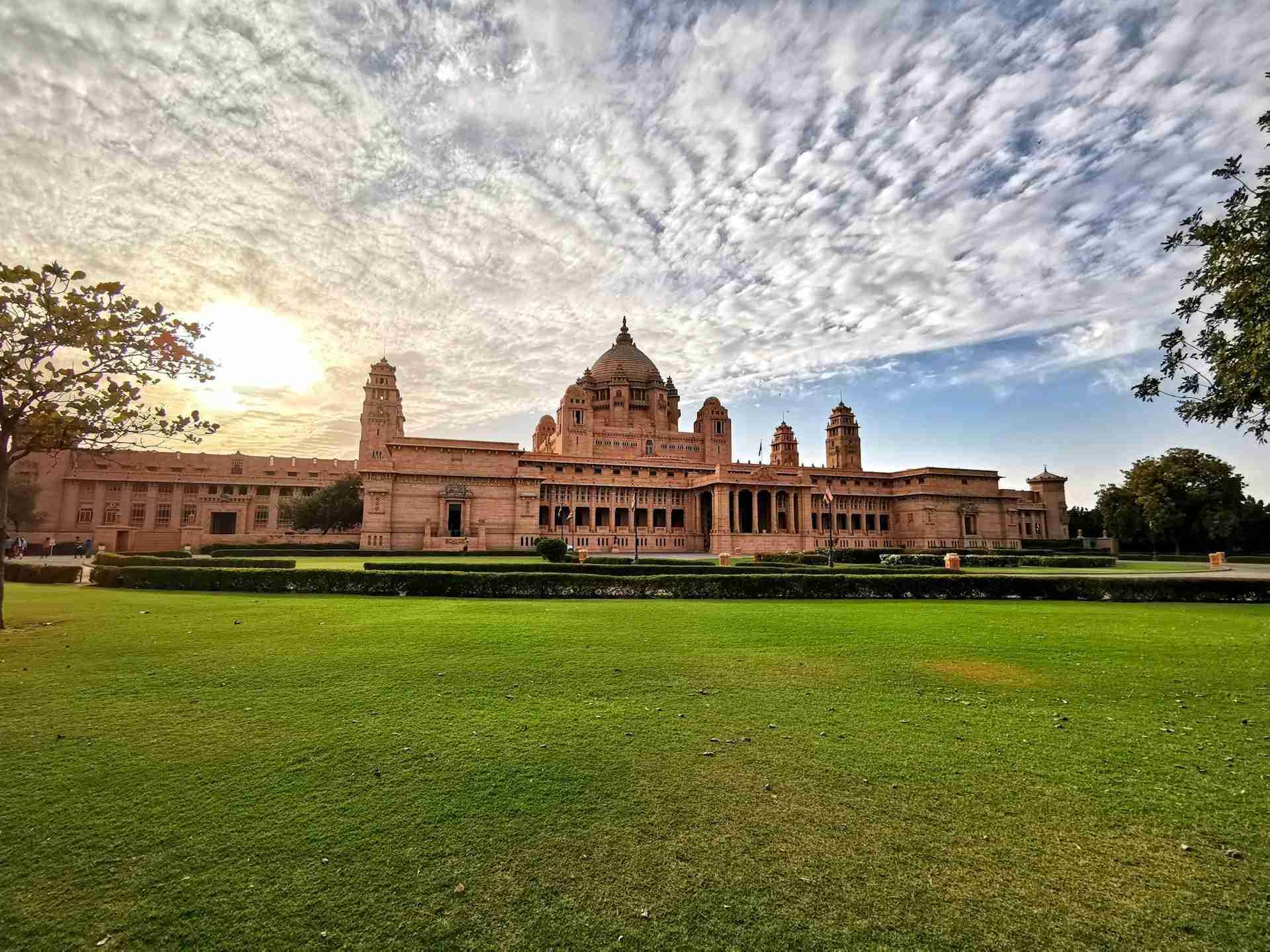
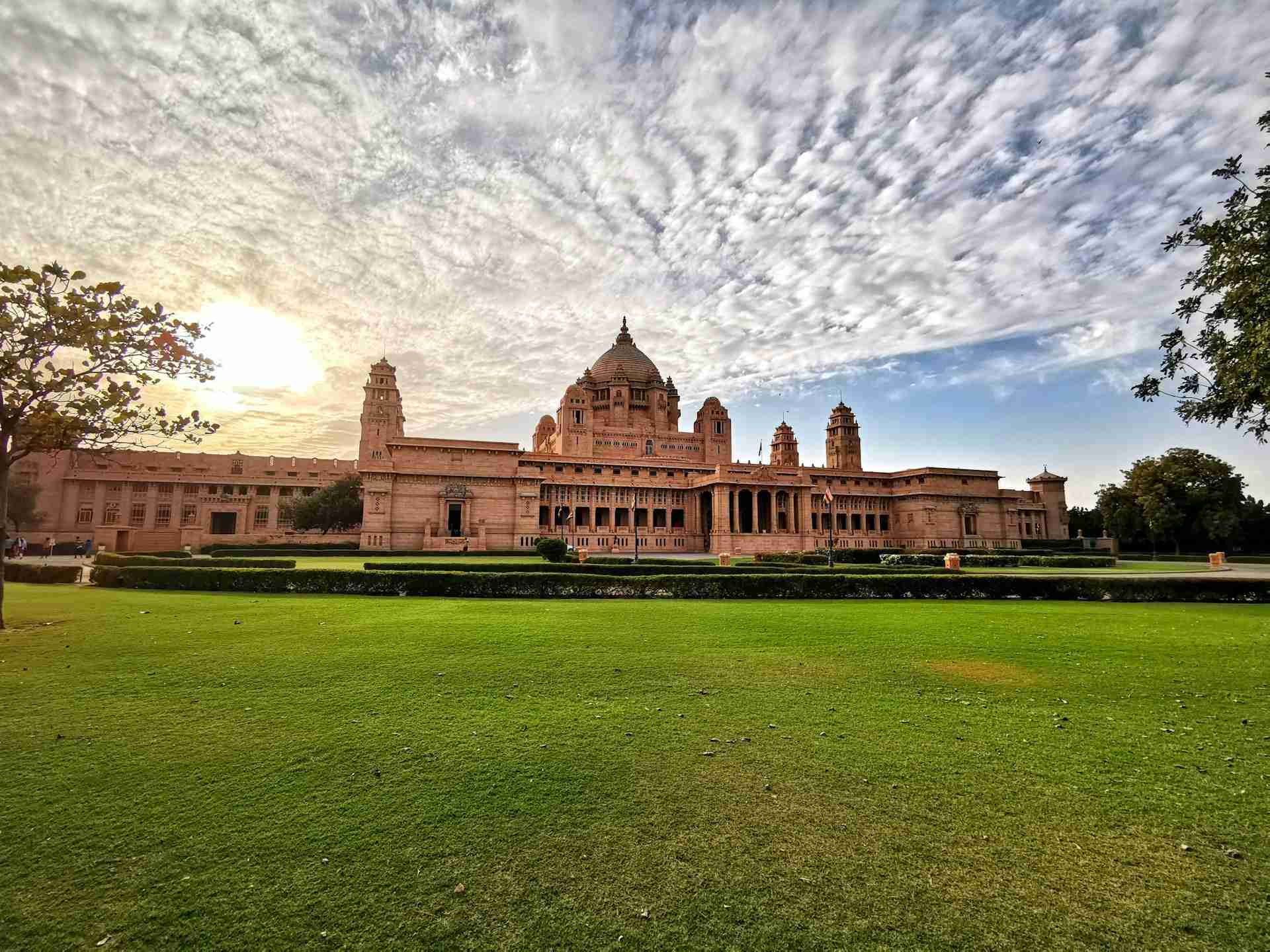
Umaid Bhawan Palace sits high above Jodhpur on Chittar Hill, built from golden sandstone that catches the morning light and stands out clearly against deep blue skies. Constructed in the early 20th century, the palace is massive, symmetrical, and built in a mix of Indo-Saracenic and Art Deco styles. It remains part luxury hotel, part museum, and part royal residence. For photographers, it offers a chance to shoot a building that blends imperial scale with fine detail. While access to the full grounds is limited without hotel booking or tour permission, even public areas provide opportunities for framing large structural forms, repeating lines, and fine stonework with clean backdrops. The palace is best photographed in the early morning when the light hits the front facade and crowds are low.
Best Photography Opportunities
• Frontl Views from the Entry Path
One of the best shooting angles is from the main approach, where the palace's central dome, flanking towers, and broad front lawn align perfectly. This view is strongest early in the day, when the rising sun lights the facade without casting harsh overhead shadows. A standard or wide angle lens helps to frame the full structure with space for foreground elements like walkways or lawn borders. Including leading lines from the pavement or garden edges helps draw attention toward the dome and reinforces the building's symmetry. On clear days, the yellow stone pops sharply against the sky, and shooting from a slightly lower angle adds presence.
• Side Views and Dome Details
Moving around the outside paths provides more angular views that bring out depth and form in the building. These side views also allow for compressed compositions of the dome, side towers, and layered walls. A short telephoto lens helps isolate architectural details while still showing the palace's size and structure. Light is more directional here later in the morning or closer to sunset, which helps separate stone textures and bring out the curvature in the dome. These frames work well even in flat light, where tone and form become more important than color.
• Close-Up Architectural Elements in the Museum Wing
Visitors of the museum area can photograph carved stone columns, staircases, ceiling patterns, and doorways that showcase a mix of local and European influence. These areas are best shot handheld with a fast lens, as tripods are not allowed. Framing tight details in soft light works better than trying to capture wide interior scenes, which can be too dim or cluttered. These subjects suit high ISO black and white work or clean, minimal edits that retain the color of the sandstone and inlaid elements. The museum also includes vintage artifacts and rooms that can be included in documentary style compositions.
• Shooting with the City in the Background
From the upper parts of the palace gardens or nearby areas on the hill, you can turn and frame Jodhpur's sprawl below. These city views are best shot in the late afternoon or early evening, when the haze is softer and the light drops across the buildings. The palace itself can be framed in profile or with garden elements in the foreground, depending on your position. These wider compositions are strongest with a standard zoom lens and work well under changing light conditions, especially when the sky begins to shift color.
• Twilight Shooting
At dusk, portions of the palace are lit with soft warm lighting that lines the base and emphasizes the dome. Blue hour shots from the main drive or outer wall can show this glow clearly, especially if the sky holds some gradient. These shots require a tripod and careful exposure to balance ambient light with the artificial highlights. Including silhouettes of nearby trees or lamp posts can add extra depth without distracting from the structure. These images benefit from a low shooting angle and clean framing to emphasize the building's shape in full darkness.
Best Time to Visit
Umaid Bhawan Palace is best photographed in the cooler months between October and March, when skies are clearer and the light is softer in the mornings and evenings. Sunrise is ideal for front facing shots, as the palace is oriented to catch early sun. Midday is harsh, especially in summer, when shadows are short and contrast is difficult to manage. Late afternoon and twilight are good for side light and glow from artificial illumination. Early morning also offers the quietest conditions, with fewer visitors and fewer vehicles near the entry drive. During major festivals or wedding events, access may be restricted or sections of the palace may be closed off. Always check in advance if you're planning a visit specifically to photograph.
How to Get There
Umaid Bhawan Palace is located at the top of Chittar Hill in Jodhpur It is easily reached by auto rickshaw, taxi, or private car. Visitors can enter the museum portion of the palace without a hotel reservation, and tickets are available at the entrance. Entry to the hotel and certain grounds areas is restricted to guests or those with prior permission. Public areas such as the front drive, surrounding walls, and selected gardens are accessible during museum hours, though photography inside the hotel itself is limited unless you're a guest. There are no photography fees for exterior shooting, but tripods may be questioned by security and are not allowed indoors.
Recommended Photography Gear
A wide angle lens is helpful for shooting the full facade and keeping the foreground in frame without distortion. A standard zoom gives flexibility when moving around the exterior and shooting side angles or garden details. A short telephoto lens is useful for isolating the dome, carving work, or compressing layers from a distance. A lightweight tripod helps with blue hour and twilight shots but may not be usable in museum or hotel areas. A circular polarizer can improve color contrast and reduce glare on stone surfaces, but it should be used carefully in clear skies to avoid uneven exposure. A fast prime lens is helpful for low light detail work indoors. Bring extra batteries and a cleaning cloth, especially during dusty or windy days.
Nearby Photography Locations
This massive fort overlooks the city and offers some of the best panoramic views. The stone walls, courtyards, and ornate interiors are highly photogenic, with strong light and shadow contrasts throughout the day.
• Sardar Market and Ghanta Ghar
A busy commercial area that gives strong opportunities for handheld, fast paced street photography. The market has color, texture, and tight lanes that contrast well with the clean symmetry of the palace.
A marble cenotaph located near the fort, Jaswant Thada offers clean architectural forms, reflected water surfaces, and excellent morning light. It's quieter than the fort and provides space for more thoughtful compositions.
Located on the edge of the city, these gardens contain a collection of cenotaphs and temples that are partially overgrown and worn by weather. Good for structural detail and quiet compositions in soft or hazy light.
A restored stepwell in the heart of Jodhpur's old city, this site features strong geometric patterns and deep shadows that work well for both abstract shots and documentary work. Early or late light is best to avoid harsh contrast.
Comments
Loading comments…