
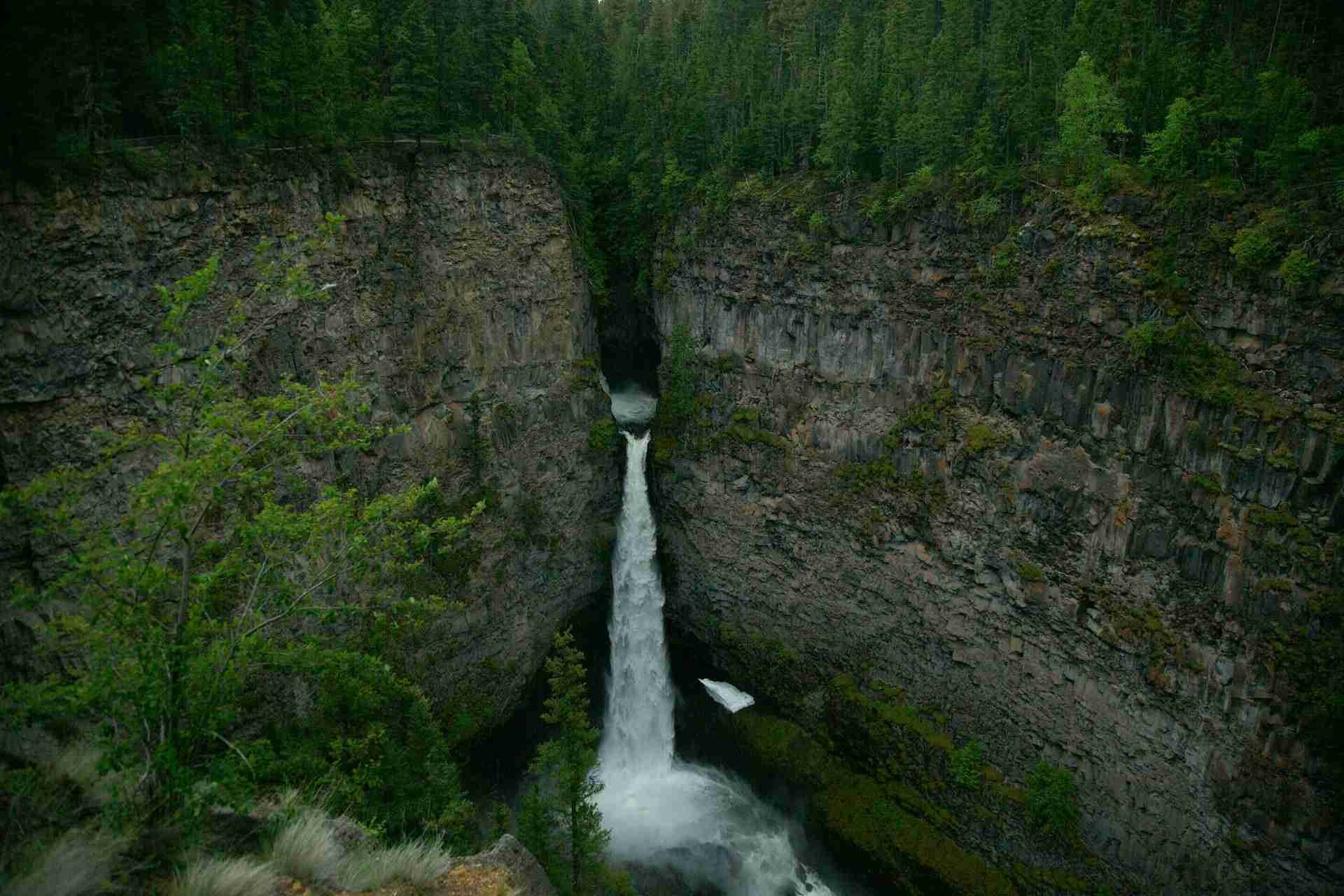
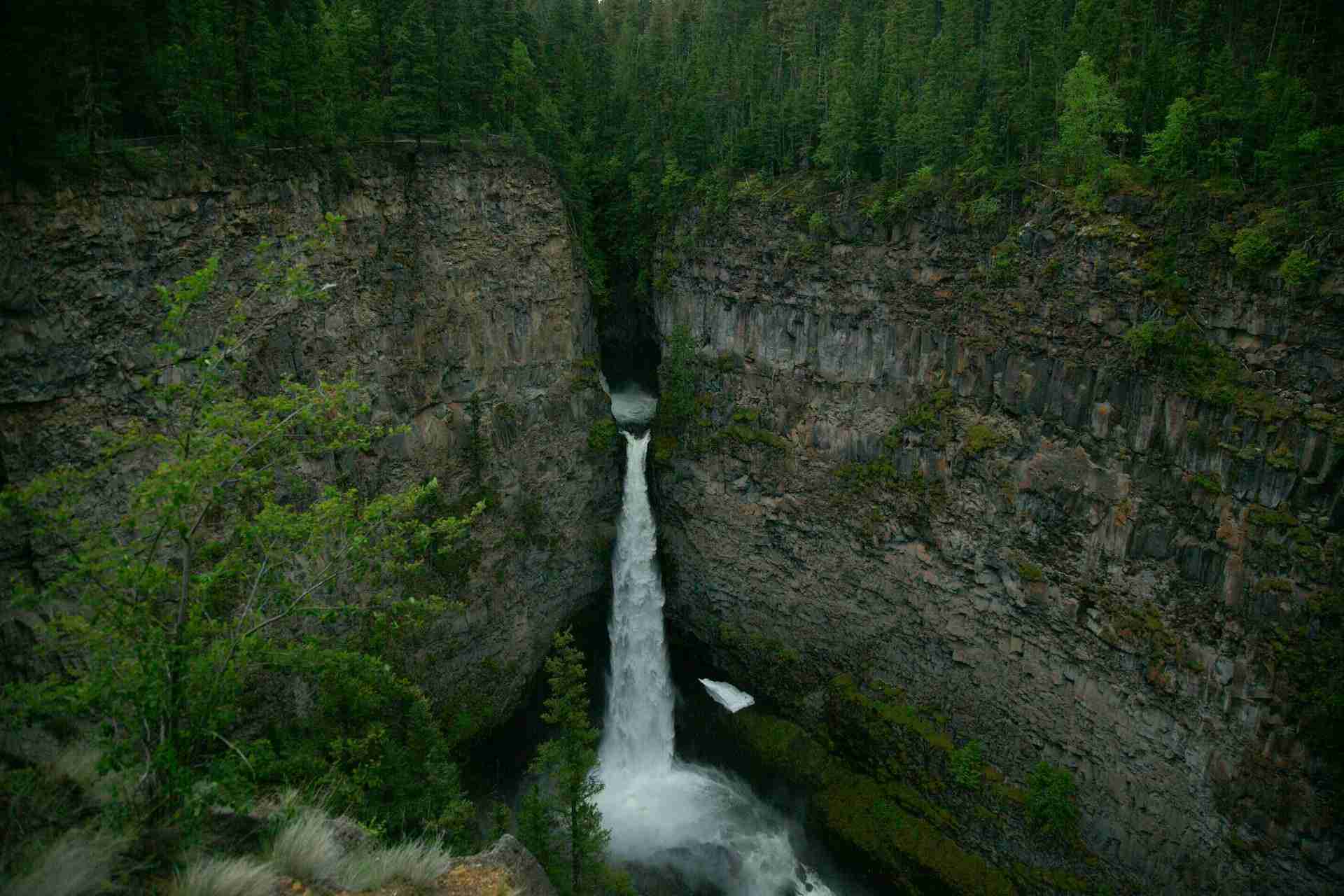
On the western edge of Wells Gray Provincial Park in British Columbia, Spahats Creek Falls plunges nearly 80 meters from a narrow canyon mouth into the valley below. Unlike many waterfalls that spread across wide rock faces, Spahats shoots out in a single, powerful column, framed by towering basalt cliffs carved by volcanic activity millions of years ago. The canyon itself, with its sheer vertical walls and forested rim, gives the falls a dramatic stage, while the viewpoints along the rim trail provide photographers with both grand perspectives and opportunities to study textures and layers. Spahats Creek Falls is one of the most accessible waterfalls in the park, yet its scale and geological setting make it feel wild and untamed, offering endless ways to compose images that balance raw power with natural geometry.
Best Photography Opportunities
• Main viewpoint across the canyon
: The most popular and rewarding perspective is from the main viewing platform opposite the falls. From here, you can frame the entire scene, with the waterfall dropping into the depths of the canyon and basalt columns lining the walls. A wide-angle lens captures both the waterfall and its dramatic geological surroundings, while a medium zoom helps balance composition by excluding crowds or distracting edges. Morning light strikes the falls more directly, highlighting the white water against darker rock, while overcast days soften shadows and emphasize detail in the canyon walls. Including foreground elements such as trees along the rim adds depth to the frame.
• Basalt column detail
: The cliffs surrounding Spahats Creek Falls are made of volcanic basalt, stacked in columns that create striking vertical patterns. These formations make excellent subjects for detail shots, either as abstract close-ups or as textural backdrops to the waterfall. A telephoto lens isolates sections of the wall, showing how light plays across the geometric lines. Late afternoon, when the sun rakes across the canyon walls, emphasizes relief and shadow, creating more dramatic tonal separation. Black and white processing can enhance these graphic qualities, turning geological forms into bold compositions.
• Long exposure studies of the water
: The waterfall's single narrow stream makes it ideal for long exposure photography. By using a tripod and neutral density filters, you can turn the vertical flow into a silky white ribbon that contrasts beautifully against the dark canyon walls. Exposures of several seconds smooth the fall into a continuous thread, while shorter exposures retain texture and turbulence. The effect is particularly striking in low light conditions such as dawn, dusk, or cloudy weather. Including sections of the canyon wall in the frame adds contrast between stillness and motion.
• Seasonal perspectives
: Each season changes the visual story at Spahats Creek Falls. In spring, snowmelt increases water flow, making the falls more powerful and dramatic. In summer, the surrounding forest is lush and green, providing contrast to the stark canyon walls. Autumn adds warm tones to the trees lining the canyon rim, creating a colorful frame around the falls. Winter transforms the scene entirely, with snow and ice formations clinging to the basalt columns and the waterfall itself partly frozen into sculptural shapes. A telephoto lens helps capture these details from across the canyon while maintaining safety on icy trails.
• Aerial and elevated viewpoints
: While drones are subject to regulations in provincial parks, permitted aerial perspectives can show the waterfall in its broader canyon context. From above, the contrast between the narrow creek mouth and the wide plunge below becomes even more striking. Elevated views from the trail approaching the viewpoint also allow for slightly different angles, especially when framed through gaps in the trees. Early morning mist rising from the canyon adds atmosphere, softening lines and giving a sense of scale.
Best Time to Visit
Spahats Creek Falls is photogenic throughout the year, though each season offers a distinct mood. Spring, from April to June, brings the most powerful water flow, with snowmelt surging through the creek and creating an intense vertical drop. Summer offers long daylight hours and clear views, with vibrant greens in the surrounding forest contrasting against the basalt cliffs. Autumn, particularly in late September, is one of the most rewarding times to visit, as golden and red leaves along the canyon rim frame the falls in warm color. Winter is both challenging and rewarding, with icy conditions on the trails but the possibility of frozen cascades and snow-covered cliffs creating an entirely different visual palette.
Daily timing is equally important. Morning light illuminates the waterfall directly and minimizes glare from the canyon walls. Midday sun can create harsh contrasts, but it works well for highlighting the textures of the basalt columns. Evening light shifts onto the rim trees, creating backlit silhouettes and warm tones in the forest canopy. Overcast days are especially effective for photography, providing even lighting that brings out detail in both water and rock while avoiding blown highlights in the whitewater.
How to Get There
Spahats Creek Falls is one of the most accessible sites in Wells Gray Provincial Park. From the town of Clearwater, follow the Clearwater Valley Road north for about 10 kilometers to the well-marked turnoff for Spahats Falls. A short paved road leads to a parking area with facilities. From the parking lot, it is only a few minutes' walk along a level, well-maintained path to the main viewing platform. The trail is easy for all visitors, though caution is advised near canyon edges, where safety barriers should not be bypassed. Access to the falls is free, as it is part of the provincial park system. In winter, the road and trail may be snow-covered but are still open, with snowshoes or boots recommended. Tripods are permitted and easy to use given the accessible platform, making it an excellent site for both casual and dedicated photography.
Recommended Photography Gear
A wide-angle zoom, such as a 16 to 35 millimeter lens, is essential for capturing the entire waterfall and canyon from the viewing platform. A mid-range zoom in the 24 to 70 millimeter range provides versatility for framing compositions that balance the waterfall with surrounding cliffs and forest. A telephoto lens up to 200 millimeters is useful for isolating details in the basalt columns, ice formations, or the waterfall itself. A sturdy tripod is highly recommended for long exposures, especially during dawn, dusk, or cloudy conditions.
Filters are particularly effective at Spahats Creek Falls. A polarizing filter cuts glare from wet rock surfaces and enhances the depth of color in both foliage and sky. Neutral density filters allow for long exposures that transform the waterfall into a smooth vertical ribbon. Graduated ND filters can help balance exposure between bright sky and shadowed canyon walls. Weather protection for your gear is advisable, as mist and spray from the falls can reach the platform, particularly during high flow in spring. Comfortable shoes with good grip are useful for navigating wet or icy paths in winter.
Nearby Photography Locations
: Just 35 kilometers farther into Wells Gray Provincial Park, Helmcken Falls is one of Canada's most spectacular waterfalls, plunging 141 meters into a vast amphitheater-shaped canyon. Its scale and mist are best captured at sunset, when golden light cuts across the spray.
: This broad, multi-tiered cascade sits along the Murtle River. Its width and layered rock shelves are ideal for wide-angle shots and long exposures that emphasize motion across the full span.
: A slightly more challenging hike leads to Moul Falls, where you can actually walk behind the curtain of water. This unique perspective is excellent for dramatic compositions, particularly in summer when the trail is easily accessible.
• Clearwater River Valley
: Driving deeper into the park reveals countless pullouts and trails with views of the Clearwater River winding through forested valleys. These broader landscapes provide strong context for the park's waterfall photography.
: This series of rapids and chutes on the Clearwater River is particularly compelling during late summer, when salmon leap upriver. Telephoto work captures the energy of both water and wildlife in motion.
Spahats Creek Falls is a reminder of how dramatic compositions can be found in accessible locations. Its narrow plunge, volcanic canyon walls, and shifting seasonal character make it one of the most photogenic sites in Wells Gray Provincial Park. For photographers who take the time to explore light, texture, and perspective, the falls offer images that balance natural power with geological precision.
Comments
Loading comments…