
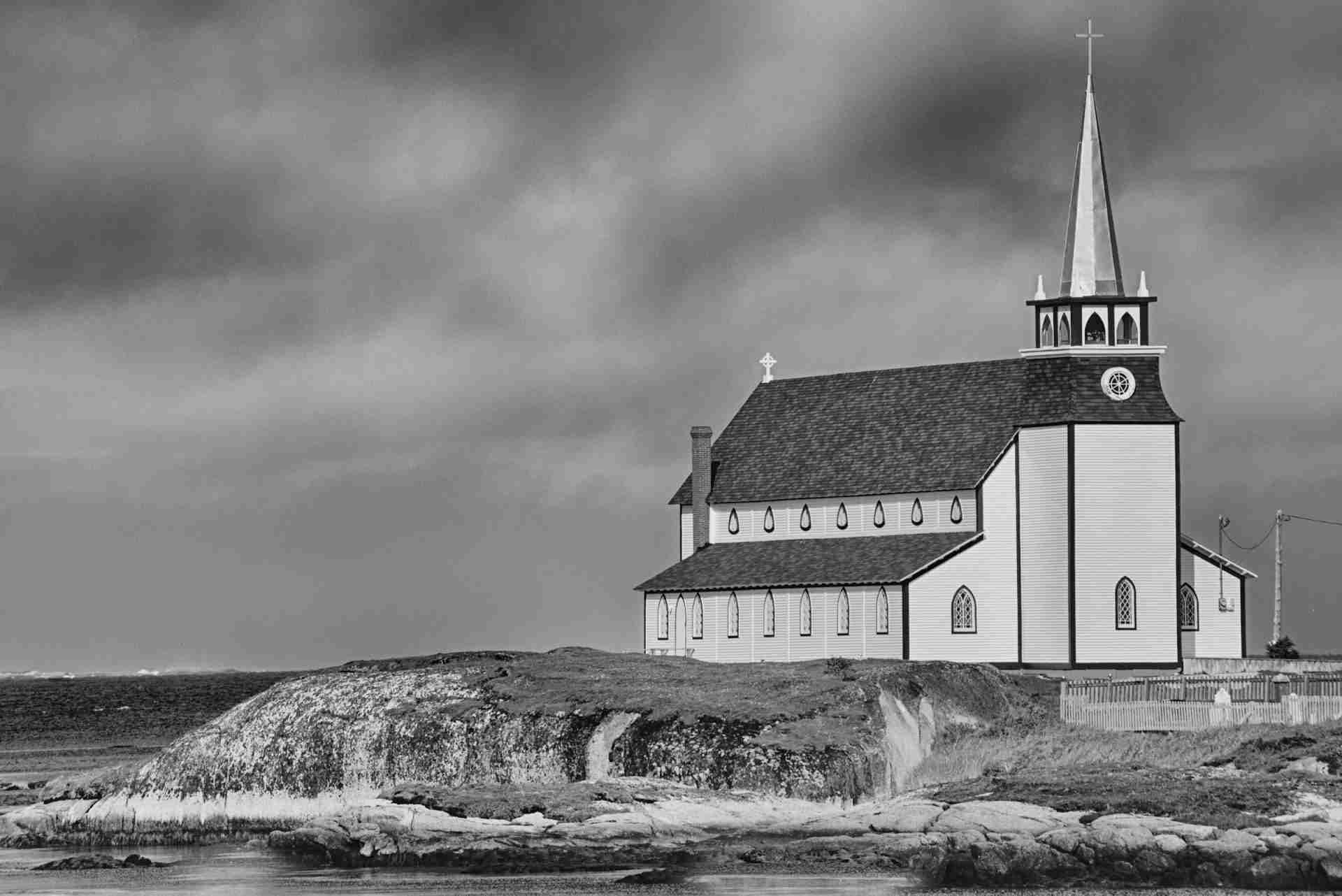
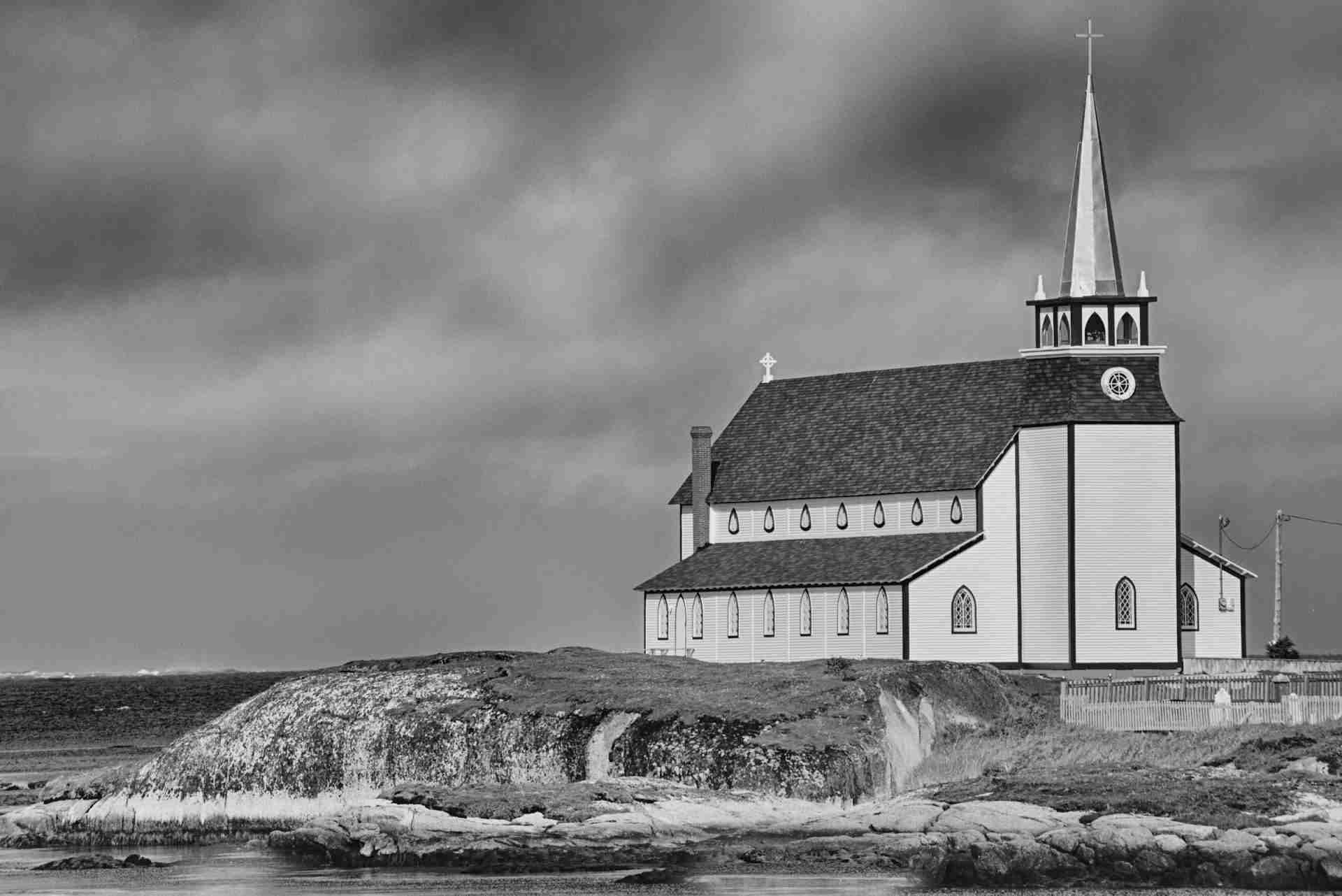
St. Luke's Anglican Church stands just above the shoreline in Newtown, a small coastal town on the northeastern edge of Newfoundland. Built in 1892, the church is made of wood, painted crisp white with deep red trim, and topped with a modest steeple that rises just enough to mark its place against the open sky. The setting is straightforward and clean, with low grasses and quiet roads surrounding the structure and the Atlantic always in view nearby. This kind of location suits photographers who like simple forms, soft colors, and the contrast between human structures and wide natural space. There's no need to overthink the compositions here, the subject speaks clearly on its own.
Best Photography Opportunities
• Front Composition from Church Lane
The road running directly in front of the church gives an easy and balanced frame with the structure centered and leading lines formed by the gravel and grass edges. This view is best in the early morning or evening when light falls gently on the front facade, avoiding harsh contrast on the white paint. A standard lens works well here, and including a portion of the road helps ground the scene. Overcast days are also strong, as they soften the shadows and bring out the texture in the wood siding.
• Side View with Steeple Emphasis
From the grassy area to the side, the church takes on a more vertical form with the steeple standing against the sky. This is a clean angle for midrange or vertical compositions that isolate the architecture and use negative space above. It's a good setup for minimal editing and can hold up well in black and white or soft color palettes. Try shooting with a small aperture to keep the steeple and body of the church sharp from front to back.
• Detail Shots of Trim and Texture
The dark framed windows and doors give contrast to the white exterior and invite close up shots that focus on form, weathering, and craftsmanship. These details are useful for photographers interested in texture and design, especially when shooting in diffused light. A short telephoto lens can help isolate individual elements without distortion, and angled compositions can bring a little rhythm to repetitive features like windows or rooflines.
• Distant Shot with Open Surrounding Landscape
By stepping back across the open field or road, you can frame the church as a small shape within a larger, empty space. This approach plays on scale and is especially effective in low light or moody weather. Look for sky movement or low lying clouds to add texture behind the structure. These wide compositions benefit from a tripod and careful framing to keep the horizon level and the building balanced in the frame.
• Golden Hour or Blue Hour
While the location lacks artificial lighting, the surrounding landscape opens up opportunities for soft directional light, especially when the sun is low. In the morning, light comes from behind the church if you're shooting toward the water. In the evening, light wraps the building's front and side, pulling warm tones from the painted surfaces. Blue hour is especially calm here, and long exposures can smooth out any wind movement or catch the last sky color over the roofline.
Best Time to Visit
Late spring through early fall provides the best conditions for both light and accessibility. The grass is green, the skies stay relatively clear, and morning fog often adds mood to the scene. Sunrise is typically quiet, with long shadows across the ground and soft angles on the structure. Evenings can be windy, but the low sun often paints the building warmly. In summer, the longer days give more flexibility to wait for calm light. Winter access may be limited due to weather, and snow buildup can obscure the road and surroundings, though the church remains photogenic if conditions are safe. Overcast conditions are ideal for detail and texture work on the white-painted surface.
How to Get There
St. Luke's Anglican Church is located on Church Lane in Newtown, a small town along Route 330 in Newfoundland's Bonavista Bay region. The church is easy to reach by car, with the road running directly in front of it with easy parking nearby. There are no fees to access the area, and the grounds around the church are open, though respect for the site and any local activity is important. The area is quiet and rarely crowded.
Recommended Photography Gear
A wide angle lens is helpful for capturing the full church and its surroundings, especially from closer distances or lower angles. A midrange zoom lens is ideal for framing details like trim, windows, and the steeple without distortion. A tripod is useful for early morning, late evening, or long exposure work during low light conditions. A circular polarizer may help cut glare off the white surfaces in strong sun but isn't essential. Comfortable footwear is recommended if you plan to move through the grassy areas for alternate perspectives, and a weather-sealed camera or lens cover is smart in case the wind shifts or light rain moves in.
Nearby Photography Locations
A rugged, open stretch of headland just north of New-Wes-Valley with rocky outcrops and crashing surf. Best for big sky frames, long exposures of waves, and minimalist coastal compositions in all weather.
A cluster of historic homes and outbuildings preserved along the waterfront, this site offers wooden textures, docks, and colorful trim in a traditional Newfoundland setting. Best shot in soft light or on overcast days.
• Fair Island from the Water or Shoreline
Accessible by boat or viewed from nearby points, Fair Island holds old house frames, simple piers, and quiet views. It's ideal for documentary or environmental compositions when the light is low and the air is still.
A sandy beach and calm water area with grassy dunes and soft inland light. Ideal for texture work and wide environmental frames. Works well at both sunrise and sunset, especially on still days.
A bit farther northwest, these natural dunes give contrast to the mostly rocky coast. Rolling sand patterns and shifting light create strong black and white opportunities or soft, neutral-toned color work.
Comments
Loading comments…