
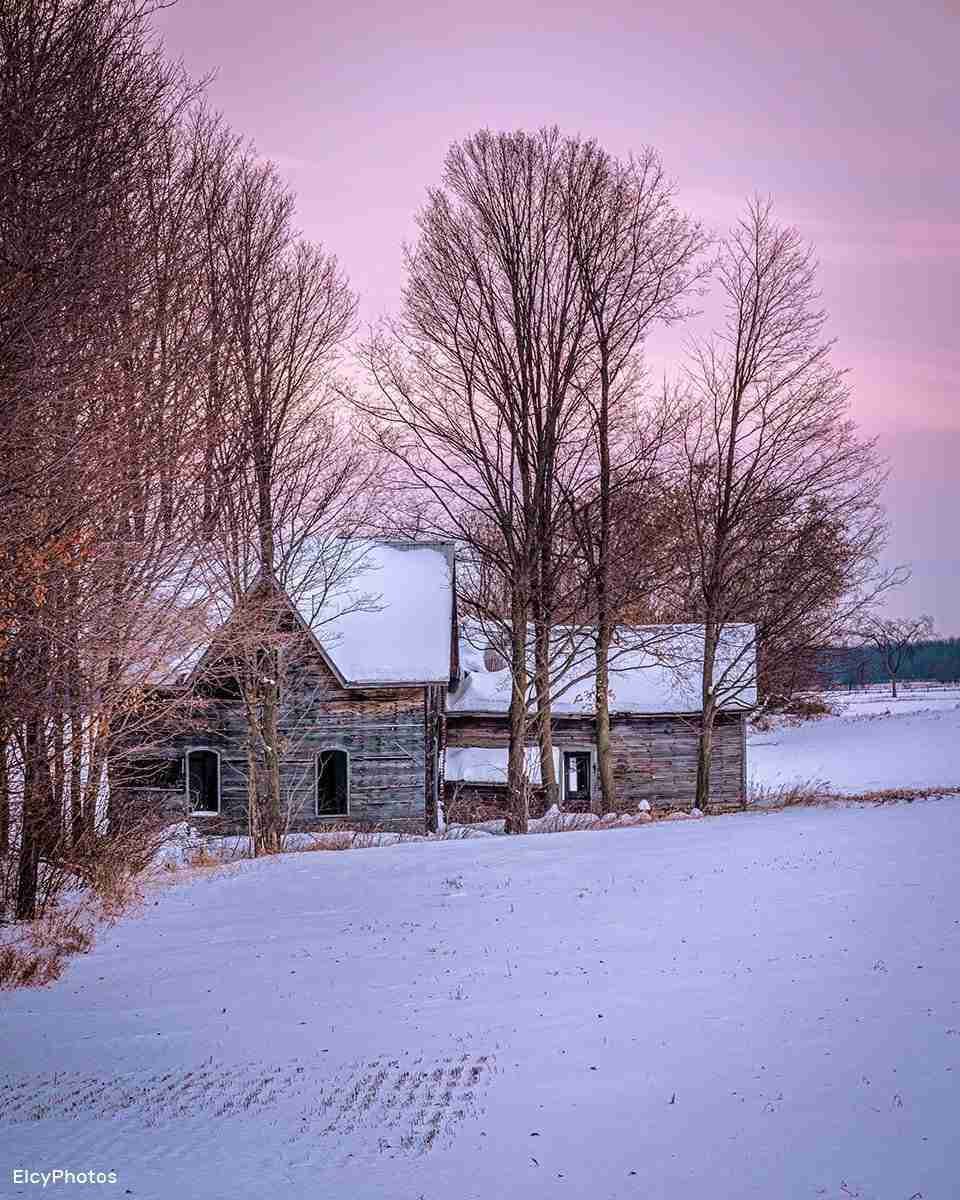
Hidden just inside a line of mature trees in the heart of the Ottawa Valley, this abandoned farmhouse along La Passe Road near Beachburg, Ontario, is a timeless portrait of rural decay. Weathered wood, collapsing gables, and faded siding blend into the surrounding forest, especially during the green months of spring and summer. The house appears suddenly, tucked within the treeline and just far enough from the road to feel forgotten—but not entirely lost.
This location speaks to the slow process of nature reclaiming what was once built. It offers photographers an evocative subject for architectural decay, rural documentation, and seasonal contrast. Whether you're visiting in winter when the house is most visible, or hoping to capture the filtered light of autumn through thinning branches, this site rewards patience, subtle framing, and sensitivity to place.
Best Photography Opportunities
• Frontal Elevation and Leading Lines
From the roadside, the best angle is often a slightly offset frontal shot, where the treeline parts just enough to reveal the house in its entirety. Tire tracks, ditches, or even the edge of La Passe Road itself can be used as subtle leading lines to guide the viewer into the composition. Position yourself slightly uphill or down the shoulder to change the elevation and emphasize the building's vertical lines. Shooting in early morning or late afternoon will help catch warm light on the façade, adding contrast between sunlit wood and shadowed windows.
• Seasonal Textures and Overgrowth
In late autumn and winter, the bare trees and snow reveal the house more clearly, adding contrast between the structure and its background. Spring and summer offer different textures—tangles of vines, leaves overtaking siding, and dappled light filtering through the canopy. These changing layers of overgrowth tell a story of reclamation and lend themselves to visual storytelling through sequence or repetition. Try returning at different times of year to capture how nature reshapes your composition, from full exposure in February to near-obscurity in July.
• Detail Shots of Decay
If visible from the road, zoom in on the collapsing porch, shuttered windows, or rusted metal elements. Look for small signs of the home's past life: mailboxes, sagging trim, or the outline of former paint colors. These subtle cues are perfect for close compositions that highlight texture and the passing of time without requiring interior access. Overcast days work best for this kind of detail photography, softening shadows and making subtle surface textures—like peeling paint or warped wood—easier to read on camera.
• Winter Minimalism and Monochrome
Snow transforms the site into a more minimalist scene, with clean contrast between the white ground, dark timbers, and sky. Overcast days work well for monochrome or desaturated edits, while golden-hour winter light warms up the scene dramatically. A minimalist approach with strong negative space can isolate the structure and emphasize its silhouette. Use the empty white field of snow as a visual pause to heighten the emotional tone, and consider converting to black and white to focus attention on form and shadow.
• Drone Photography and Site Context
A legal and respectful drone flight offers a more complete view of the house in relation to the surrounding forest and fields. From above, the shape of the home and the depth of encroaching vegetation become more evident. This overhead perspective is especially powerful in the early morning when long shadows create dimensionality and a sense of isolation. Use low-altitude or oblique angles to add context with the road and treeline, or fly higher to create minimalist compositions with the structure centered within the forest grid.
Best Time to Visit
Visibility is a key factor here, making late autumn through early spring the most productive time for photography. From November to April, the leafless trees and occasional snowfall make the house more accessible visually and easier to photograph from the roadside. Winter snow adds mood and texture, while early spring exposes structural detail under a soft, overcast sky.
Summer brings dense foliage that may nearly obscure the house entirely from public vantage points. If you're visiting during the green season, go early or late in the day when light cuts through the treetops and casts a warm glow across the clearing. Midday light tends to flatten the scene and exaggerate contrast between shade and sun.
Morning visits may offer mist rising through the trees, especially after rain or on cooler days. Evenings can yield side light that grazes across the weathered siding. Overcast conditions help balance the scene if you're focused on detail or moody tonal work.
How to Get There
This house is located along La Passe Road, north of Beachburg in the Whitewater Region of Renfrew County, Ontario. It sits just inside a treeline on the east side of the road, and is most easily viewed when driving north from the village. Because the house is on private land, photography should be done respectfully from the roadside—there is no public access.
Roadside shoulders are narrow but manageable; be cautious when parking and always ensure you're not obstructing traffic. There are no amenities nearby, so come prepared, especially if visiting in colder months. In the summer, the dense brush and roadside vegetation may require creative angles or elevated shooting positions.
Recommended Gear and Shooting Tips
A mid-range zoom lens (24–70mm) offers the best flexibility for shooting from the roadside, allowing for wide views of the full structure and tighter detail work without physically approaching the house. A telephoto lens (70–200mm) is helpful when foliage is thick, letting you compress the scene and reach past brush without compromising your composition.
Tripods are useful in low-light or overcast conditions, though they may be impractical in snow or from uneven roadside footing. A polarizer can help reduce glare from snow or glass and deepen color, particularly in the autumn when leaves and wood tones are strongest. In winter, expose carefully to retain detail in both the snow and the shadows of the building's interior.
Wear weather-appropriate footwear and bring gloves in colder seasons—camera operation can be finicky in freezing temperatures, especially with metal gear. Be cautious of icy ditches or embankments when stepping off the road for a better angle.
Nearby Photography Locations
• Westmeath Lookout and Bluff
Located to the west, this elevated ridge above the Ottawa River offers panoramic views of forest, farmland, and water—especially stunning in fall. The light here is particularly soft in early morning, and the lookout makes an excellent counterpoint to the more intimate, ground-level scene of the house.
• Beachburg Fairgrounds and Arena Area
The historic community fairgrounds just south of the village contain aging barns, fences, and open fields that offer good compositional variety, particularly in winter or golden hour. Look for long shadows cast by aging bleachers or fence posts across snow or mud.
• Ross Township Roads and Rolling Farmland
The roads between Beachburg and Foresters Falls are dotted with rural textures: old barns, decommissioned machinery, and sweeping open fields. This is prime territory for a rural series or to extend your abandoned architecture portfolio with varied scale and backdrop.
• Chenaux Dam and Ottawa River Shoreline
Northeast of La Passe Road, the Chenaux hydroelectric dam sits at the edge of the Ottawa River and provides both industrial texture and waterside landscape. Shoot from nearby walking trails or the dam's approach for wide compositions that combine water, infrastructure, and sky.
• Foran's Hill and Pine Stands
This lesser-known hill near Westmeath offers dense, symmetrical pine groves that photograph beautifully in winter or fog. Look for snow-covered branches, natural symmetry, or backlit scenes as light filters through the trunks.
This abandoned house on La Passe Road is a quiet witness to time passing in the Ottawa Valley—a structure slowly folding into the trees. For photographers attuned to subtlety, mood, and rural atmosphere, it offers a richly evocative canvas.
Comments
Loading comments…