
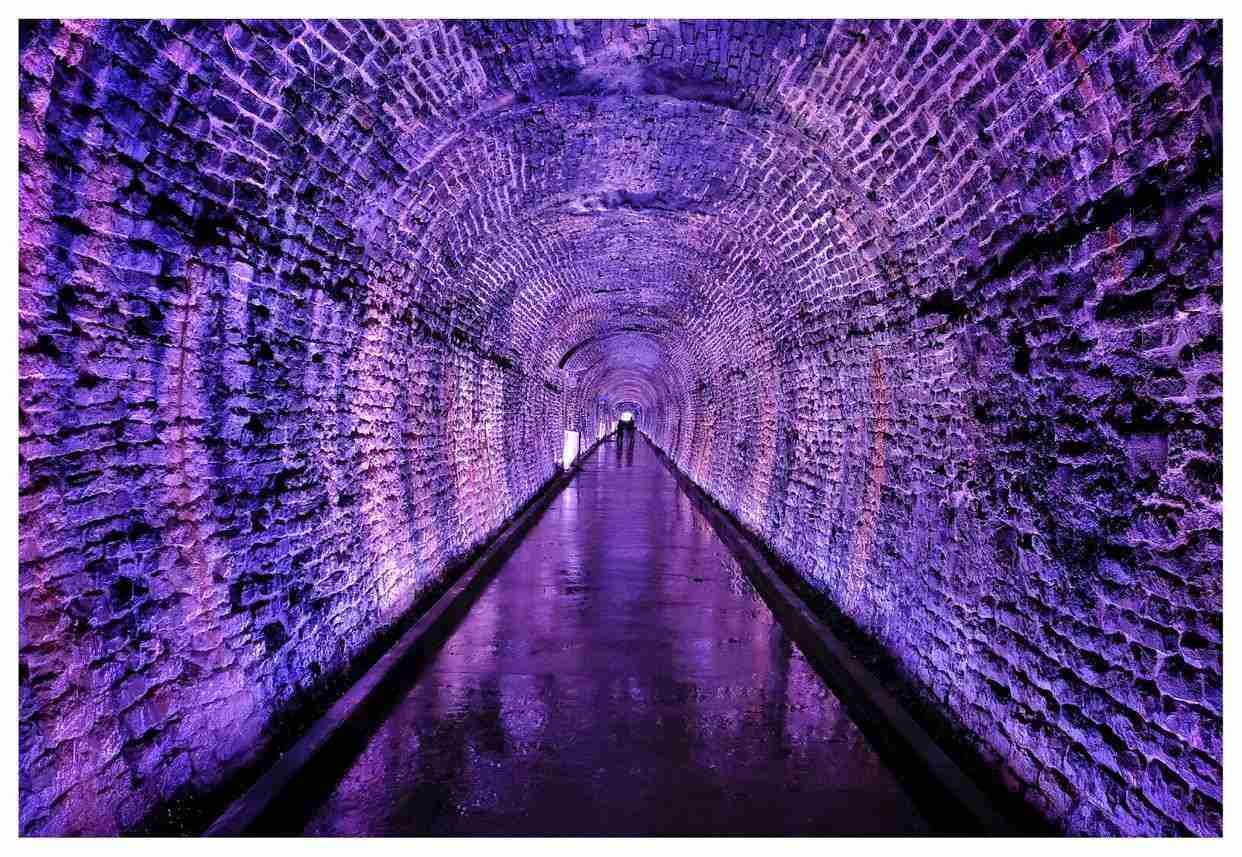
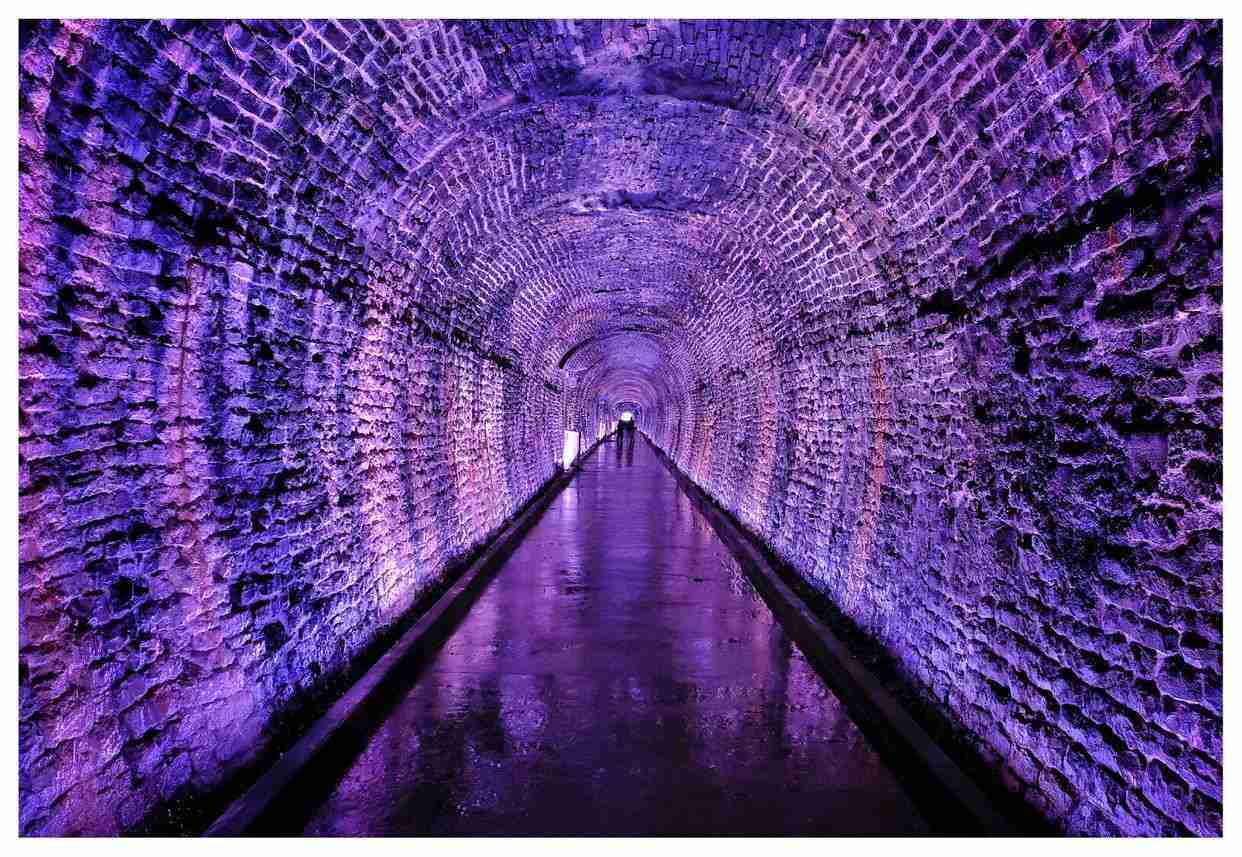
Running beneath the heart of downtown Brockville, the Brockville Railway Tunnel is Canada's oldest railway tunnel and one of its most visually immersive heritage sites. Originally constructed beginning in 1854 to connect the timber trade of the Ottawa Valley with the port facilities on the St. Lawrence River, the tunnel now serves a very different purpose—welcoming photographers, families, and visitors into a long, echoing corridor of light and stone. No longer part of an active rail line, the tunnel has been reimagined as a pedestrian experience, complete with a programmable LED lighting system and ambient music track that fills the space with rhythm and shifting colour.
Extending from the south portal near Water Street to the north-end gorge, the tunnel offers a continuous 525-metre (1,722-foot) walk through a beautifully preserved 19th-century engineering marvel. The stone walls glisten with moisture and mineral deposits, while the modern light system transforms the space into a surreal photographic environment that changes moment by moment.
Best Photography Opportunities
• Full Tunnel Interior and Leading Lines
From just inside either portal, you can capture the tunnel's long, symmetrical passage receding into darkness or colour. Use a wide-angle lens to emphasize the vanishing point and create visual tension with the converging lines of the floor tracks and arched ceiling. The curvature of the tunnel paired with the vivid LED lights makes for dynamic, futuristic compositions, especially when framed from a low perspective with the floor tracks leading directly into the center of the frame.
• Light and Color Transitions
The LED lighting system is not static—it shifts through programmed colour patterns, casting bold hues onto the wet stone walls. Use a tripod and long exposure to blur transitions or layer multiple colour states into a single shot. Depending on the programming schedule, you'll encounter flowing rainbows, pulsating waves, or soft colour gradients. These sequences offer an ever-changing palette and make the tunnel feel like a kinetic light sculpture as much as an architectural relic.
• Stone Texture and Industrial Detail
Despite the light show, the historic character of the tunnel remains central. The hand-hewn stone, rusting bolts, and original rail lines make for excellent detail photography. Get in close to show the contrast between old and new—cracks in the masonry illuminated by cool LED tones, or ancient water stains picked up in neon pink or green light. A fast lens with a shallow depth of field works beautifully here to isolate texture in the glowing environment.
• Silhouettes and Subject Placement
The tunnel provides a perfect setting for dramatic silhouettes and moody environmental portraits. Place a subject walking or standing in the center of the tunnel, backlit by the glowing walls or distant light at the opposite portal. Use a small aperture to capture starbursts from brighter LED clusters, or go handheld to blur figures into ghost-like forms. This is an excellent place to explore scale, contrast, and cinematic mood.
• Reflections and Wet Surfaces
The floor of the tunnel often has wet patches or subtle puddles, especially in shoulder seasons. These surfaces create unexpected reflections that double the light display and add symmetry to your compositions. Use a low tripod position or tilt-screen to frame from just above the ground and maximize the visual impact of these reflections.
Best Time to Visit
The Brockville Railway Tunnel is open seasonally, typically from late spring through late autumn, with daily hours posted by the City of Brockville. Visiting during dusk or evening hours gives you the most dramatic experience, as the LED lighting becomes far more pronounced without daylight competing at the tunnel portals.
For photography, early evening after sunset is ideal for full control over exposure and colour intensity. Cloudy or rainy days can enhance the tunnel's wet, glistening textures, and reflections are more likely when water gathers on the tunnel floor. Midweek visits often mean fewer people in the tunnel, allowing for clean, undisturbed compositions.
Check the tunnel's lighting schedule in advance if you're hoping to catch a specific sequence, especially during holidays or special events when themed lighting may be in place.
How to Get There
The tunnel's south entrance is located in downtown Brockville just off Water Street, near Armagh Sifton-Price Park and the waterfront marina. From Highway 401, exit at Stewart Boulevard and drive south toward the river. There is ample public parking nearby, with lots located along Water Street and King Street.
Visitors can enter at the south portal and walk the full length of the tunnel to the north-end gorge, where a ramp brings you back up to street level. The entire path is flat and accessible, making it easy to carry gear or work from a tripod. Entrance is free, and the tunnel remains open to pedestrians during posted hours unless closed for maintenance or seasonal shutdown.
Recommended Gear and Shooting Tips
A wide-angle lens (16–35mm) is crucial for capturing the full tunnel arc and leading lines. A 24–70mm zoom is useful for more flexible compositions and tighter framing of wall textures and light interactions. A tripod is essential for long exposures, especially if you're aiming to capture the full colour transitions or achieve maximum sharpness in low light.
Use a lens cloth frequently—humidity and mist within the tunnel can cause condensation, particularly near the middle where ventilation is minimal. A remote shutter or timer is helpful for long exposures when you're trying to avoid camera shake. Be patient and wait for foot traffic to clear for clean interior shots, or embrace the movement with slower shutter speeds that blur passersby into abstract streaks.
Shoot in RAW to preserve colour fidelity and detail in both highlights and shadows, as the contrast between LEDs and the dark tunnel surfaces can be intense. Consider underexposing slightly to protect the highlights, especially during brighter lighting patterns.
Nearby Photography Locations
Just outside the south portal, the marina and riverfront park provide excellent views of the St. Lawrence River, passing ships, and Brockville's charming skyline. Best shot during sunrise or early golden hour.
A historic Edwardian estate with formal gardens, intricate architectural features, and a strong heritage presence. Great for detail work, symmetry, and classic portrait backdrops.
• Blockhouse Island and Tall Ships Landing
This peninsula extending into the river features lookout points, docks, and public art. A perfect complement to the tunnel's industrial style with open sky and water-based compositions.
Located just north of town, this conservation area includes wetlands, boardwalks, and seasonal migratory bird activity. Ideal for nature photography and peaceful landscapes.
• Downtown Brockville Architecture and Streetscapes
The historic core features Victorian brickwork, vintage signage, and old shopfronts that make excellent street photography subjects. Combine urban textures with natural light for editorial-style compositions.
The Brockville Railway Tunnel transforms a relic of Canada's industrial past into a surreal and immersive lightscape. For photographers, it offers a rare combination of historical narrative, geometric form, and dynamic lighting—all within a space that changes by the minute. Whether you're after fine detail or bold, cinematic compositions, this tunnel turns a walk into a journey through colour, shadow, and story.
Comments
Loading comments…