
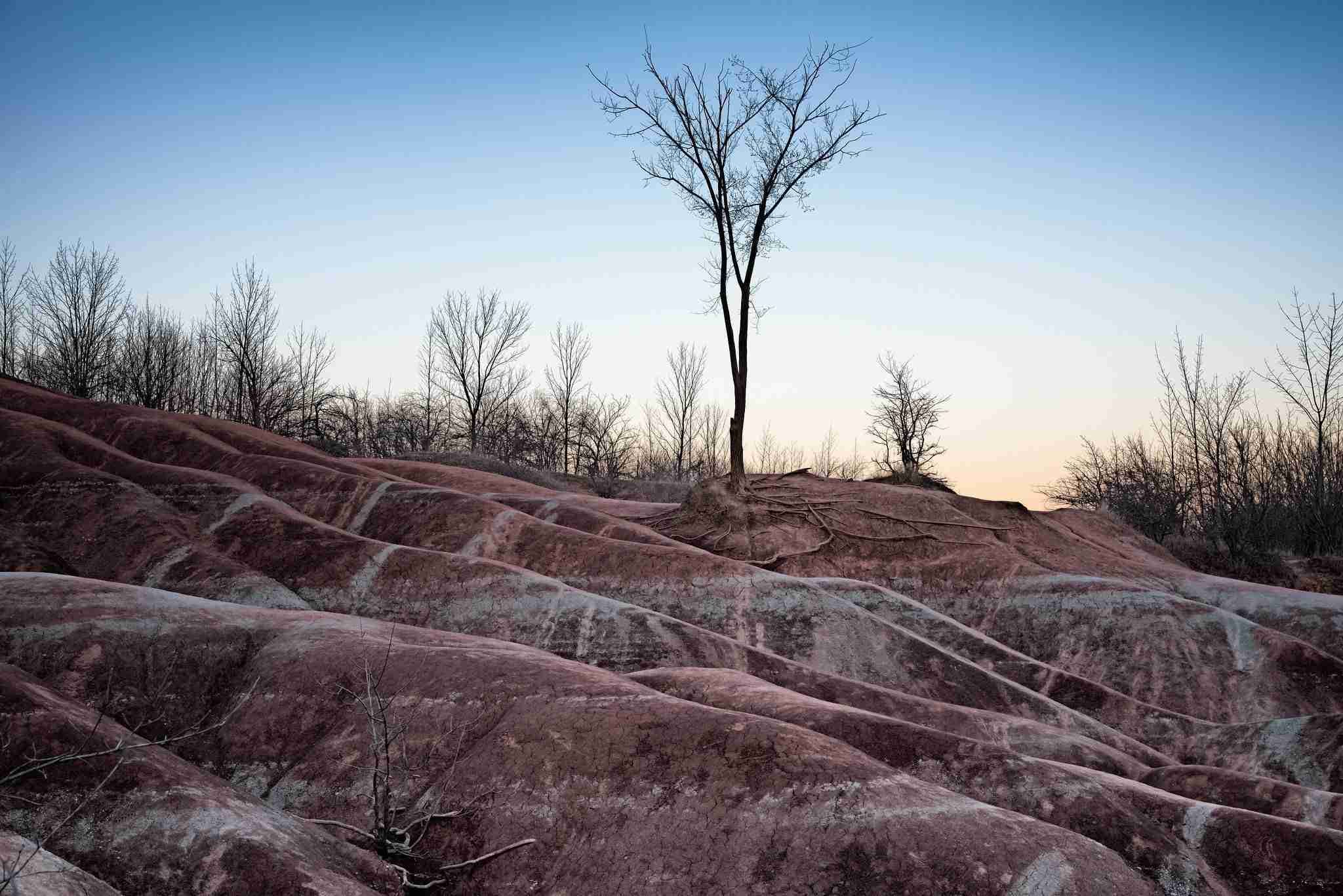
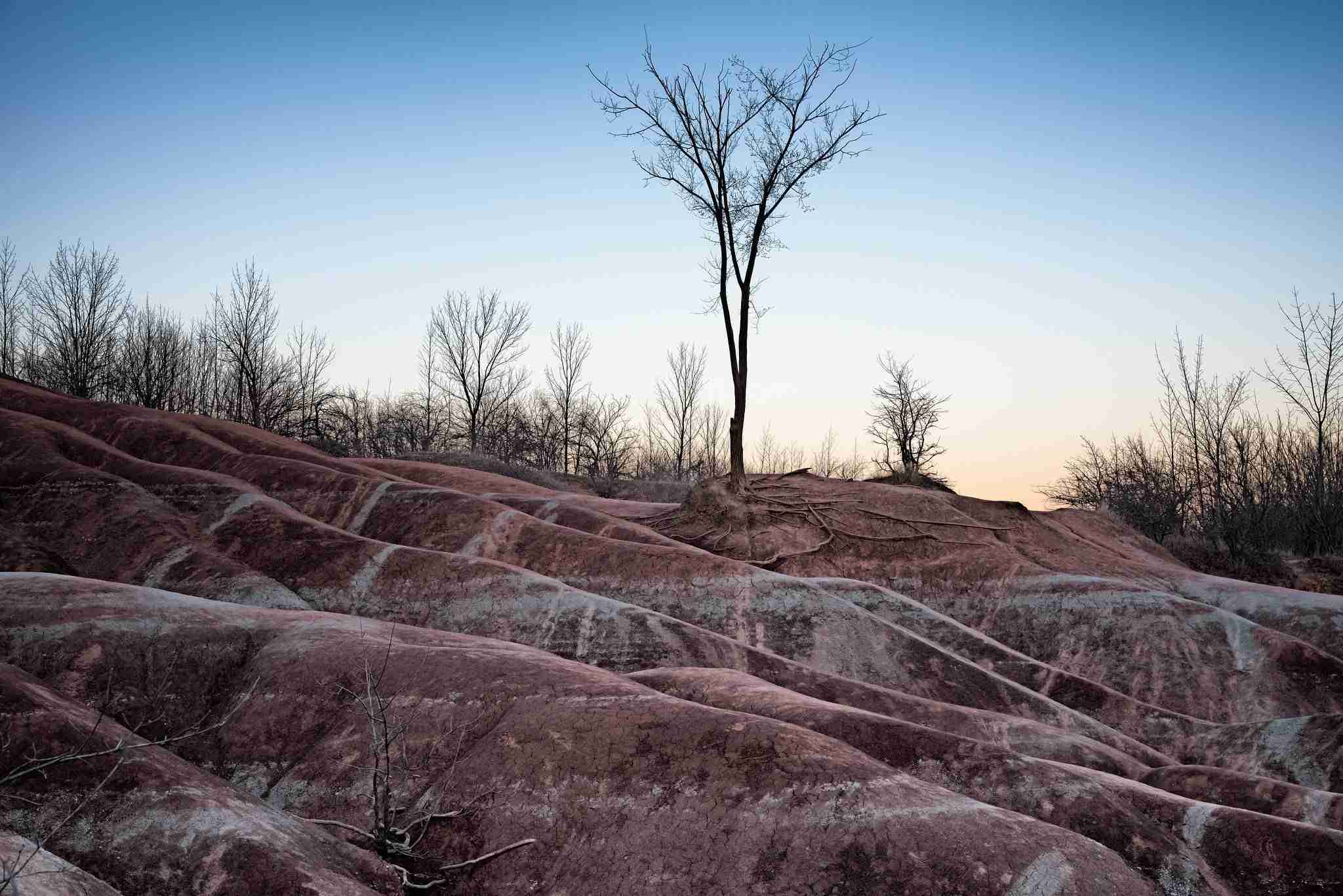
The Cheltenham Badlands, located in Caledon along the Niagara Escarpment, offer one of Ontario's most visually distinct landscapes. Characterized by dramatic undulating ridges of exposed red Queenston shale, this small but striking geological formation presents a surreal, almost Martian terrain tucked into the rolling countryside. For photographers, it's a place where color, form, and natural erosion converge to create minimalist compositions, patterns in texture, and strong contrast between the land and sky.
While access to the fragile landscape is limited to designated trails and boardwalks, the site remains an outstanding location for thoughtful compositions and layered storytelling. It's not just the terrain that captivates—it's the challenge of working with light, shadow, and the rhythm of the hills. Whether you're interested in geological detail, abstract landscapes, or wide-environment scenes with human scale, the Cheltenham Badlands provide a visually rich and environmentally sensitive subject.
Best Photography Opportunities
• Wide Landscapes and Rhythmic Ridges
The Badlands are best known for their rolling, exposed red shale hills, which form visually arresting wave-like ridges across the landscape. From the elevated viewing platforms and along the main boardwalk, wide-angle compositions can capture the curvature of the land under changing light. Early or late in the day, long shadows help define the undulations, adding drama and depth to the scene. Framing with sky overhead and slope in the foreground offers natural leading lines into the image, and shifting just a few feet left or right can completely alter the visual rhythm of the terrain.
• Abstract Patterns and Textures
Zoom in to explore smaller sections of the Badlands and you'll find mesmerizing surface details—cracked clay, fine erosion channels, and soft lichen growths that break up the monochromatic red. Telephoto or mid-range lenses work well to isolate these patterns. Overcast light softens the contrast and enhances the earthy hues, while golden-hour light intensifies the rust-red tones and casts warm directional highlights into the valleys. Try framing shallow furrows or intersecting erosion lines to build graphic, almost topographic compositions that feel both organic and geometric.
• Sky and Weather Contrast
Because the site is relatively open and treeless, the sky plays a significant role in shaping the overall composition. Look for opportunities to balance the harsh texture of the terrain with soft cloud movement or dynamic weather. In particular, stormy skies or layered clouds add weight and tension to the scene. Wide-angle lenses can exaggerate sky forms, while including the horizon low in the frame pushes attention toward color and atmosphere. A good sky at Cheltenham can elevate even a basic composition into something cinematic and elemental.
• Seasonal Variation and Edge-of-Frame Elements
While the core landscape is consistent throughout the year, seasonal shifts in the surrounding vegetation offer subtle compositional changes. In spring, fresh greens along the edge of the boardwalk contrast strongly with the red clay. In autumn, golds and oranges from nearby trees add warmth to the upper edges of wide-angle compositions. Even in winter, the site can be visually compelling when dusted with snow—though access may be limited—creating stark contrast and emphasizing shape over color. Look for ways to frame the ridges with encroaching branches, grasses, or trail elements to add softness and context.
• Minimalist and Environmental Portraiture
With the right permissions and respect for site guidelines, environmental portraits can be effective here—especially when composed from a distance with subjects along the boardwalk or walking paths. The land's curvature offers natural leading lines that frame solitary figures, and the color palette lends itself well to stylized, cinematic edits. Try placing a subject where the ridges converge or layering their silhouette against the sky to create emotionally charged, scale-rich compositions. Earth-tone clothing blends seamlessly, while monochrome or bold outfits provide contrast and graphic simplicity.
Best Time to Visit
Photographically, the Cheltenham Badlands are best visited in the shoulder hours of early morning and late afternoon when shadows fall long across the ridges, highlighting texture and form. Midday light can be harsh and flatten the terrain, so if you must shoot during high sun, consider tight frames or monochrome edits to minimize visual distraction.
Autumn is especially photogenic due to the color contrast between the red shale and the golden foliage of the surrounding escarpment forest. Spring brings fresh greenery that balances the composition, while summer's high sun and dry conditions make for sharp, contrast-heavy images. Winter, though less popular, can be particularly striking when snow outlines the ridges and a cold sky hangs overhead, though the site may close during icy conditions.
Weather plays a significant role here. Overcast skies help reduce glare off the shale and reveal subtle tonal shifts, while passing clouds can create dramatic spot lighting across the ridges. Because the Badlands are so open, windy days can also add atmosphere—especially for time-lapse or motion-based work involving surrounding grasses and vegetation.
How to Get There
Cheltenham Badlands are located on Olde Base Line Road, just east of Creditview Road in Caledon, Ontario. From Toronto, it's about a 45-minute drive northwest via Highway 410 and Regional Road 10. The site is managed by Credit Valley Conservation and includes a designated parking lot with paid, time-slotted access during the main visiting season.
Visitors must remain on the boardwalk and trail system to protect the sensitive landscape. Off-trail photography is prohibited, but the viewing platforms and elevated trail angles offer excellent vantage points for wide and tight compositions alike. Be sure to check seasonal hours and parking requirements before visiting, especially during weekends or peak fall foliage periods when the area can get busy.
Recommended Gear and Shooting Tips
A wide-angle lens (16–35mm) is essential for capturing the full sweep of the terrain, especially from the boardwalk where you can place the landscape in full context. A mid-range zoom (24–70mm) is great for isolating sections of the ridges or composing layered frames that incorporate both land and sky. A telephoto lens (70–200mm) is ideal for detail work and compressing foreground and background patterns for abstract or graphic compositions.
A sturdy tripod is helpful for working in low light or when you're composing carefully along the boardwalk's rails. Use a polarizer to manage glare off the shale and bring out richer earth tones. In bright light, a 3- or 6-stop ND filter can help slow down shutter speeds for cloud motion or light drag effects in time-lapse sequences.
Watch your edges—since the scene is very linear and open, even small distractions like trail signs, people, or fences can break the mood. Move slowly, reframe often, and try different elevations to either isolate or include the environmental context. For best results, pre-scout the boardwalk to find your ideal spots before the light peaks.
Nearby Photography Locations
Just a short drive away, this park offers scenic trails, a waterfall, and a trestle bridge—perfect for landscape and long exposure work. The Credit River valley has great forest color in autumn and misty light in spring.
A quieter alternative for nature photography, with wooded trails, boardwalks, and marshland reflections. A good place to work on texture, symmetry, or environmental abstract shots.
This charming site features a small waterfall, stone bridge, and natural gorge scenery. It's ideal for short exposure studies or moody woodland shots during overcast weather.
Located slightly further north, this park has limestone cliffs, forest boardwalks, and elevated views over the escarpment. Great for wide-angle work and moody hiking shots.
Just down the road, this rustic cider mill offers farmland views, vineyard textures, and a lovely red-brick building. It's a great complement to the earthy tones of the Badlands for a rustic documentary-style shoot.
The Cheltenham Badlands may be small in area, but their sculptural form and saturated color make them one of Ontario's most unique and challenging photo subjects. For photographers who enjoy rhythm, repetition, and the artistry of geological time, this landscape delivers in every season.
Comments
Loading comments…