
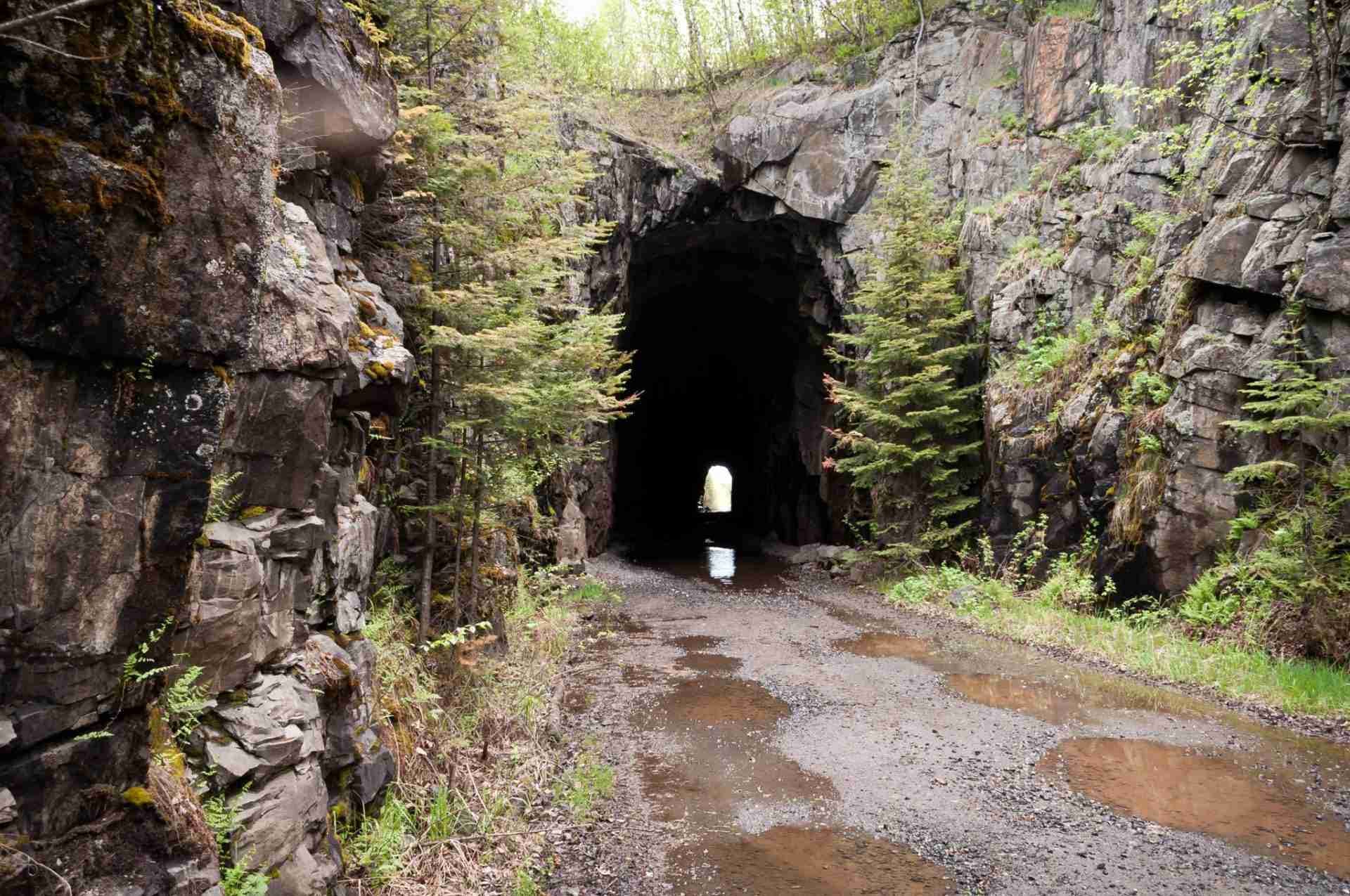
Hidden deep within the boreal forest northwest of Thunder Bay, the Flett Tunnel stands as a haunting relic of Ontario's industrial past, now surrendered to time and wilderness. Once part of a long-abandoned railway line, this narrow, hand-hewn passage cuts through a rugged outcrop of Canadian Shield, its chisel-marked walls now softened by moss and shadow. Over the decades, nature has crept inward—ferns, vines, and water stains slowly reclaiming its damp interior—turning the space into a visual intersection of geology, history, and decay. For photographers with a taste for the atmospheric and the offbeat, the Flett Tunnel offers a surreal, almost cinematic experience far from the well-trodden paths of Ontario's parks.
Best Photography Opportunities
• Tunnel Mouth Framing with Forest Context
: From the approach trail, the tunnel reveals itself slowly through the dense undergrowth, its black maw framed by birch trunks and green overgrowth. Shooting from a short distance with a mid-range zoom (24–70mm) allows you to balance the geometric symmetry of the tunnel entrance against the chaotic energy of the surrounding forest. In early morning or late afternoon, light filtering through the canopy creates dappled textures across the moss-covered rocks—perfect for compositions that contrast the precision of the tunnel's man-made form with the softness of nature.
• Interior Light Play and Depth Studies
: Inside the tunnel, conditions shift from dim to near-dark depending on the season and time of day. Bring a tripod and long-exposure settings to capture the subtle light that filters through one end, creating gradients that fall across rough-hewn walls and wet stone floors. Using a wide-angle lens (16–35mm), position your camera low to the ground to exaggerate depth and lead the viewer's eye into the tunnel's vanishing point. Fog or morning mist adds further atmosphere, especially when backlit by soft ambient light from the tunnel's exit.
• Moss and Macro Textures
: On the damp stone walls, photographers can isolate a world of textures—dripping condensation, green moss veins, lichen spots, and rusted hardware remnants. A macro lens or close-focusing prime (like a 50mm or 100mm) allows you to turn these organic details into abstract studies of decay and renewal. On overcast days, the diffuse lighting inside the tunnel minimizes glare and brings out micro contrast in stone and growth. These shots work particularly well as part of a series exploring the tunnel's transition from industrial relic to living ruin.
• Drone Perspectives and Terrain Context
: While the tunnel itself is mostly enclosed and best photographed from the ground, a drone flight just above the tree line offers a valuable perspective on its remote setting. The surrounding terrain—rolling ridges, pine forest, and broken rock—places the tunnel in its broader context. A vertical composition taken directly above the approach trail and tunnel entrance can create a powerful abstract image, especially during autumn when the foliage adds a splash of color to the green and gray palette. Ensure safe flying practices and good satellite coverage before launching.
• Human Scale and Narrative Portraits
: Adding a figure—whether silhouetted in the tunnel's mouth or walking away into its darkness—adds a strong narrative element to your images. Use a 35mm or 50mm lens for environmental portraits, and time your shot so that ambient light outlines the subject without overpowering the background. These compositions are especially effective in backlight or fog conditions, where shadows and atmosphere amplify the sense of mystery. A figure also helps convey scale in what is otherwise a hard-to-measure space.
Best Time to Visit
The Flett Tunnel is best photographed from late spring through early autumn, when the approach trail is dry and foliage frames the structure in vibrant contrast. May through June provides lush undergrowth and a soft light canopy, while September to early October introduces red and gold hues to the scene—perfect for warm-toned, moody compositions.
Early morning brings fog and ambient humidity, which can dramatically enhance interior shots and macro details, while late afternoon offers warmer directional light that spills into the tunnel's eastern entrance. Overcast days reduce contrast and bring out the tonal subtleties of moss, stone, and bark, especially valuable for macro and texture-focused work.
Winter is possible but challenging—snow and ice obscure footing and reduce accessibility, and interior photography becomes more hazardous due to slippery stone and limited natural light. If visiting in colder months, proceed only with proper gear and full daylight hours.
How to Get There
The Flett Tunnel is located approximately 40 minutes northwest of Thunder Bay, Ontario. From the city, take Highway 102 west to Dawson Road, then turn onto Flett Road, which becomes a gravel track as you approach the trailhead. Continue to the end of Flett Road, where a small clearing offers informal parking for a few vehicles.
The trail to the tunnel is unmarked but well-used by hikers and explorers. It runs roughly 800 meters through forest and over uneven terrain, including occasional wet spots and low rock scrambles. Wear waterproof hiking boots and bring a flashlight or headlamp for interior exploration. Cell service may be intermittent—inform someone of your route and expected return time before setting out.
There are no facilities or signage at the site. This is a wilderness location, and all visitors must pack out what they pack in. Be mindful of local wildlife, especially in early morning or evening hours. Avoid climbing on or entering unstable areas of the tunnel, particularly after heavy rain.
Recommended Gear and Shooting Tips
Photographing the Flett Tunnel requires preparation and versatility. A wide-angle lens (16–35mm) is essential for interior shots and forest-to-tunnel compositions, while a mid-range zoom (24–70mm) provides flexibility for approach trail scenes and framing with background context. A macro lens is useful for textural detail and moss patterns, and a fast prime (35mm or 50mm) is ideal for environmental portraits in low light.
A tripod is essential for interior long exposures, and a remote shutter or self-timer will reduce shake. Bring a headlamp with red light mode to preserve night vision while setting up in dark conditions. A flashlight can also be used creatively as a light-painting tool for adding subtle highlights to the tunnel's internal textures during longer exposures.
Weather-sealed gear or rain covers are recommended due to humidity inside the tunnel. A microfiber cloth is essential for wiping down lenses, especially in mist or rain. Footwear should be rugged, with good ankle support and waterproof soles.
Work methodically: scout compositions on the approach, pause often to observe how the light shifts inside, and give yourself time to adapt to the visual mood of the place. The tunnel rewards patience and sensitivity to detail—don't rush the atmosphere.
Nearby Photography Locations
• Kakabeka Falls
: Just a short drive southwest, this powerful waterfall plunges over a 40-meter cliff into the Kaministiquia River gorge. Long exposure work here is spectacular, especially at sunrise when mist rises from the falls and light filters through the trees.
• Sleeping Giant Provincial Park
: Located east of Thunder Bay, this park offers dramatic cliffside views, boreal forest, and sweeping vistas over Lake Superior. The Top of the Giant Trail is a full-day hike, but the view is one of Ontario's most iconic.
: A quiet, less-traveled destination with multiple cascades and rapids, Silver Falls offers excellent forest trail compositions, river scenes, and rock textures with fewer visitors than Kakabeka or Sleeping Giant.
• Cedar Creek Railway Trestle (Abandoned)
: For photographers interested in rail infrastructure decay, this old wooden trestle near Kaministiquia offers another atmospheric subject, especially when framed from below with fall color or winter fog.
• Mount McKay Lookout
: Just outside Thunder Bay, this scenic overlook provides panoramic views of the city, Lake Superior, and the surrounding boreal plateau. It's especially photogenic at dusk when the sky lights up and the city begins to glow.
The Flett Tunnel isn't just an abandoned structure—it's a living intersection of wilderness and memory. Whether you're capturing the last light slipping across mossy stone, or standing in shadow with the sound of water dripping through dark stillness, this location invites you to slow down, listen, and frame a piece of Ontario most travelers never see.
Comments
Loading comments…