
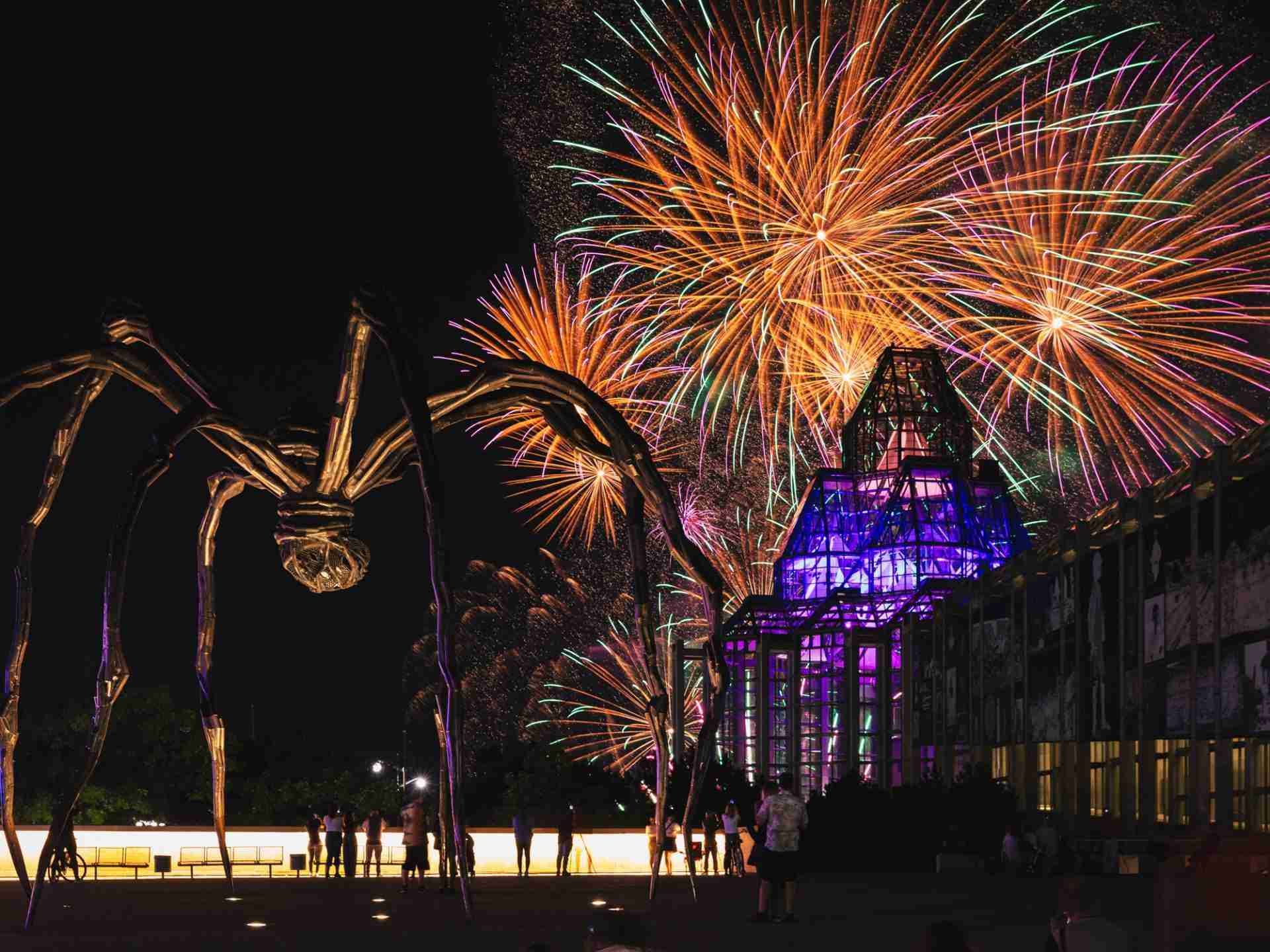
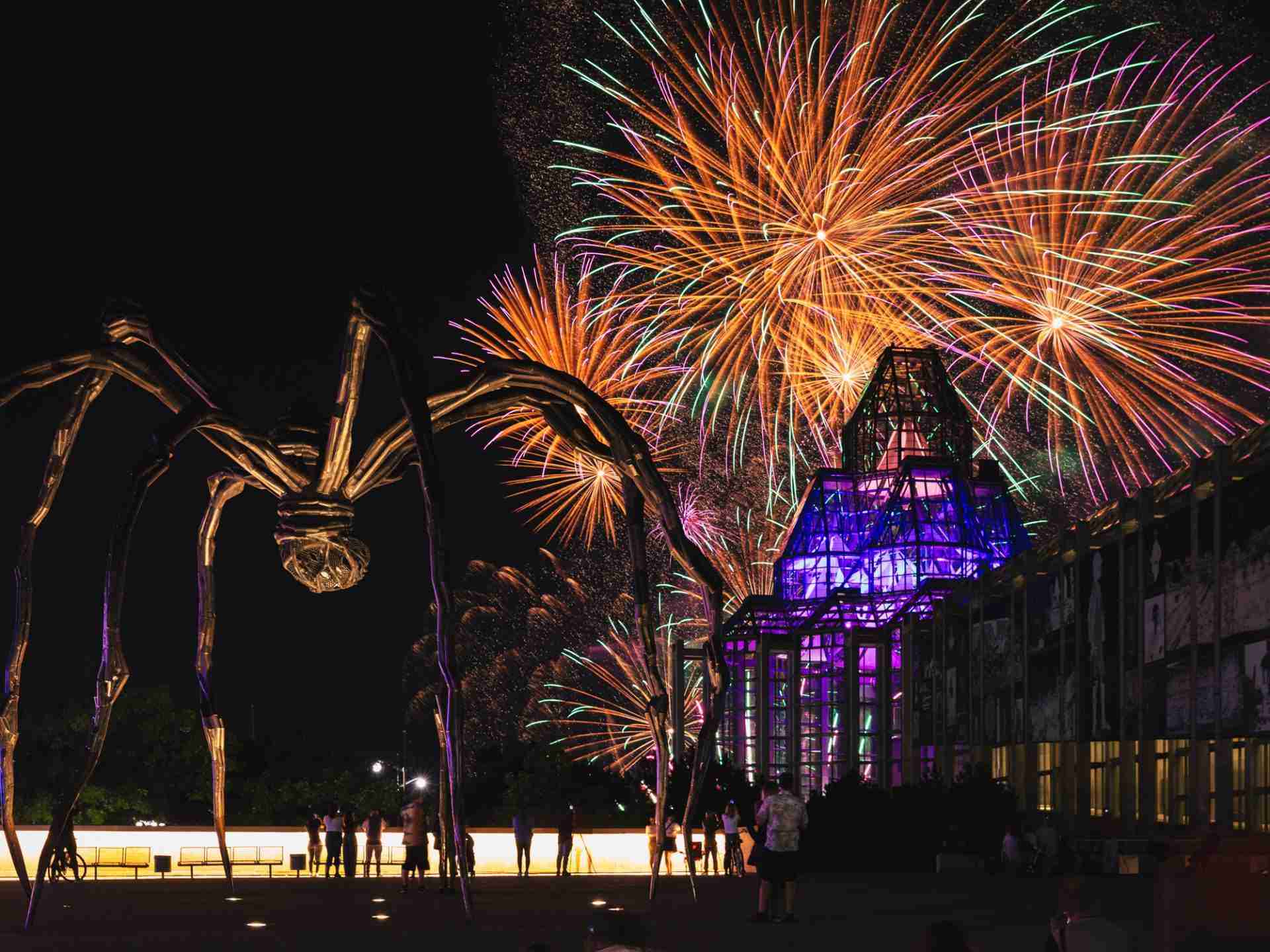
Set at the northern edge of Ottawa's historic ByWard Market, overlooking the Ottawa River and Parliament Hill, the National Gallery of Canada is more than a cultural institution—it's one of the city's most dynamic photographic locations. With its soaring glass and granite facade, angular geometry, and ever-shifting reflections, the building offers architectural photographers a masterclass in modern form and light. Yet it's the presence of Maman, Louise Bourgeois' towering bronze spider, that gives the site its surreal energy—a strange and beautiful fusion of permanence, fragility, and shadow. Whether bathed in golden-hour light, silhouetted against fireworks, or dusted with snow in the dead of winter, this location challenges and rewards photographers with its rich interplay of line, shape, and story.
Best Photography Opportunities
• Wide-Angle Compositions of Maman and the Gallery
: From the plaza along Sussex Drive, you can frame Maman in the foreground with the National Gallery's glass tower rising behind. Use a wide-angle lens (16–35mm) and a low vantage point to exaggerate the scale of the spider, creating a dynamic tension between sculpture and structure. Early morning offers clean, shadowless light that enhances the reflective surfaces of the gallery, while late afternoon casts long shadows from Maman's limbs that dance across the plaza—excellent for black and white conversions.
• Close-Up Studies of Maman's Anatomy
: The sculpture's eight spindly legs and sac-like body are laden with texture—bronze striations, weathered patina, and complex curves. A mid-telephoto lens (70–200mm) lets you isolate these elements for abstract studies. Consider shooting upward from beneath the sculpture to frame it against sky or architecture. Overcast days reduce glare and emphasize texture, while a clear dusk sky adds contrast and tonal drama. These close-ups can stand alone or be integrated into wider environmental frames to create visual narrative.
• Glass and Geometry of the Gallery Facade
: The gallery's sharply defined rooflines and glass curtain walls are best explored with architectural precision. Use a tilt-shift lens or tripod-mounted wide-angle setup to control distortion when shooting the building head-on. Reflections from Parliament Hill, the Peace Tower, or dramatic skies often appear in the gallery's facade, creating layered compositions. Try shooting in soft evening light when the internal glow begins to seep through the atrium windows, revealing silhouettes of the interior structure.
• Fireworks Photography from the Gallery Grounds
: On Canada Day (July 1) and during the Grands Feux du Casino Lac-Leamy festival in August, the area outside the National Gallery becomes one of the most photogenic vantage points for capturing Ottawa's fireworks. From the plaza or the north-facing lookout over the Ottawa River, use a tripod and long exposure to frame Maman beneath exploding bursts of color. Shoot wide enough (24–50mm) to include the sculpture in the foreground, using its legs as visual framing devices. Arrive early to secure your spot and scout angles before crowds arrive.
• Winter Minimalism and Night Light
: In winter, snow transforms the entire plaza into a minimalist scene—white ground, dark bronze sculpture, and crystalline reflections on the gallery's glass. The site is well-lit at night, offering soft illumination for long exposure work. A tripod and remote shutter are essential, and a fast prime lens (35mm or 50mm) works well for capturing hand-held low-light frames without excessive ISO noise. Consider composing Maman against the warm interior light of the gallery's glass atrium to juxtapose warmth and cold, life and sculpture.
Best Time to Visit
The National Gallery exterior and Maman sculpture can be photographed year-round, with the character of the location changing dramatically by season and time of day. Spring and autumn provide the best balance of light and temperature, with soft skies and fewer tourists. Morning light is clean and highlights the eastern face of the building and sculpture, while late afternoon brings warmth and elongated shadows that enhance the form of both subjects.
Summer draws larger crowds but also brings vivid sunset skies and the possibility of dramatic weather fronts—ideal for capturing contrast, motion, or storm-lit skies above the glass canopy. Blue hour in summer is excellent for light trails, reflections, and firework compositions, especially during national celebrations.
Winter strips the landscape bare and turns the plaza into a snow-covered canvas, perfect for minimalist compositions or high-contrast black and white work. Reflections in ice patches or the sheen on the bronze sculpture add subtle texture. The site is well-plowed and accessible, though be cautious of ice and bring weather-sealed gear.
How to Get There
The National Gallery of Canada is centrally located at 380 Sussex Drive in Ottawa, adjacent to Major's Hill Park and just steps from Parliament Hill and the ByWard Market. By car, access is straightforward via Sussex Drive, with metered street parking available nearby and underground paid parking beneath the gallery itself.
For public transit users, OC Transpo buses stop within a short walk of the entrance—major routes run along Rideau Street and Mackenzie Avenue, with pedestrian paths leading directly to the gallery grounds. Cyclists can use the Ottawa River Pathway or Rideau Canal routes, both of which connect directly to Sussex Drive via scenic spurs.
There is an admission fee to enter the gallery building, but the exterior grounds, sculpture plaza, and surrounding walkways are fully open to the public and free to access year-round. Tripods may be used freely outdoors; drone photography should be approached with caution due to the proximity of federal landmarks and airspace regulations.
Recommended Gear and Shooting Tips
This location rewards a mix of architectural, detail, and environmental shooting. A wide-angle zoom (16–35mm) is essential for capturing Maman in relation to the gallery's soaring facade. A standard zoom (24–70mm) handles most general compositions, including fireworks, reflections, and public life around the plaza. A telephoto lens (70–200mm) is useful for isolating sculpture details, architectural junctions, or compressed views across the Ottawa skyline.
A tripod is necessary for long exposure work, especially at night or during fireworks events. Bring a remote release or use a 2-second timer to eliminate vibration. ND filters are helpful for smoothing pedestrian motion or softening skies during longer daytime exposures. A polarizer enhances reflections on the glass walls but should be used carefully to avoid uneven polarization across wide compositions.
Pack a lens cloth and weather protection for winter or rainy conditions—bronze and glass surfaces both hold condensation, and mist can drift from the river or nearby fountain. Scout the location at multiple times of day if possible, noting how light shifts across the structure and how crowds flow through the plaza. For firework shoots, arrive at least 1–2 hours early and frame your shot to include key foreground elements for depth and storytelling.
Nearby Photography Locations
• Parliament Hill and the Peace Tower
: Just a short walk southwest, Parliament Hill offers Gothic Revival architecture, manicured lawns, and expansive views over the Ottawa River. Golden hour lights the stonework beautifully, and the tower silhouettes well against late-day skies.
: Adjacent to the gallery, this elevated park provides panoramic views of Parliament, the Rideau Canal locks, and the Château Laurier. Spring blossoms and autumn foliage make it an ideal spot for landscape framing and wide cityscapes.
• Notre-Dame Cathedral Basilica
: Located directly across Sussex Drive, this historic twin-spired cathedral offers strong symmetry and ornate Gothic detailing. Interior photography is allowed during quiet hours with discretion and low light sensitivity.
• Alexandra Bridge and the Ottawa-Gatineau Viewpoint
: From the bridge or its pedestrian walkway, you can frame the gallery, Maman, and Parliament Hill in one sweeping composition—particularly striking at twilight when reflections appear on the river below.
• Rideau Canal Locks and the Château Laurier
: A few blocks away, this classic Ottawa scene features historic engineering, formal architecture, and seasonally changing water levels—ideal for story-rich compositions in all weather.
The National Gallery of Canada isn't just a hub for artwork—it's a canvas in its own right, sculpted in glass, stone, and bronze. With Maman standing sentinel over plaza and skyline, this site offers photographers a layered, evolving subject where stillness, symbolism, and spectacle intersect. Whether chasing reflections, light trails, or a spider beneath fireworks, this is a place where creativity and cityscape merge in striking form.
Comments
Loading comments…