
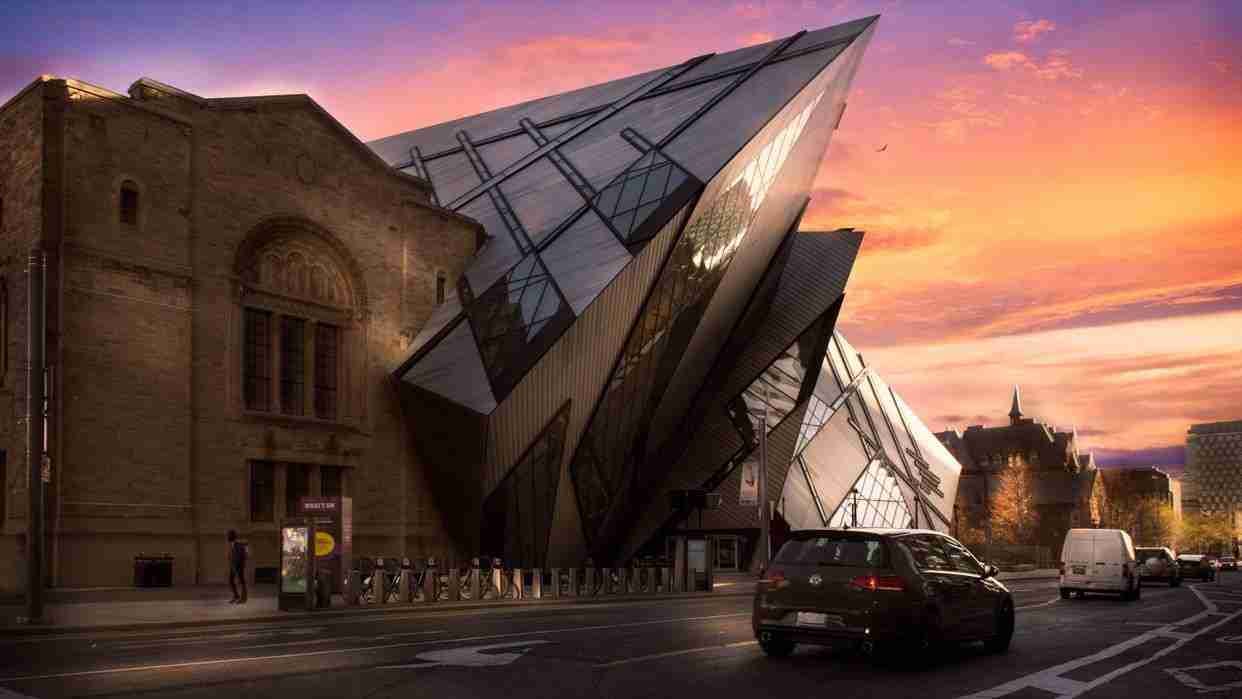
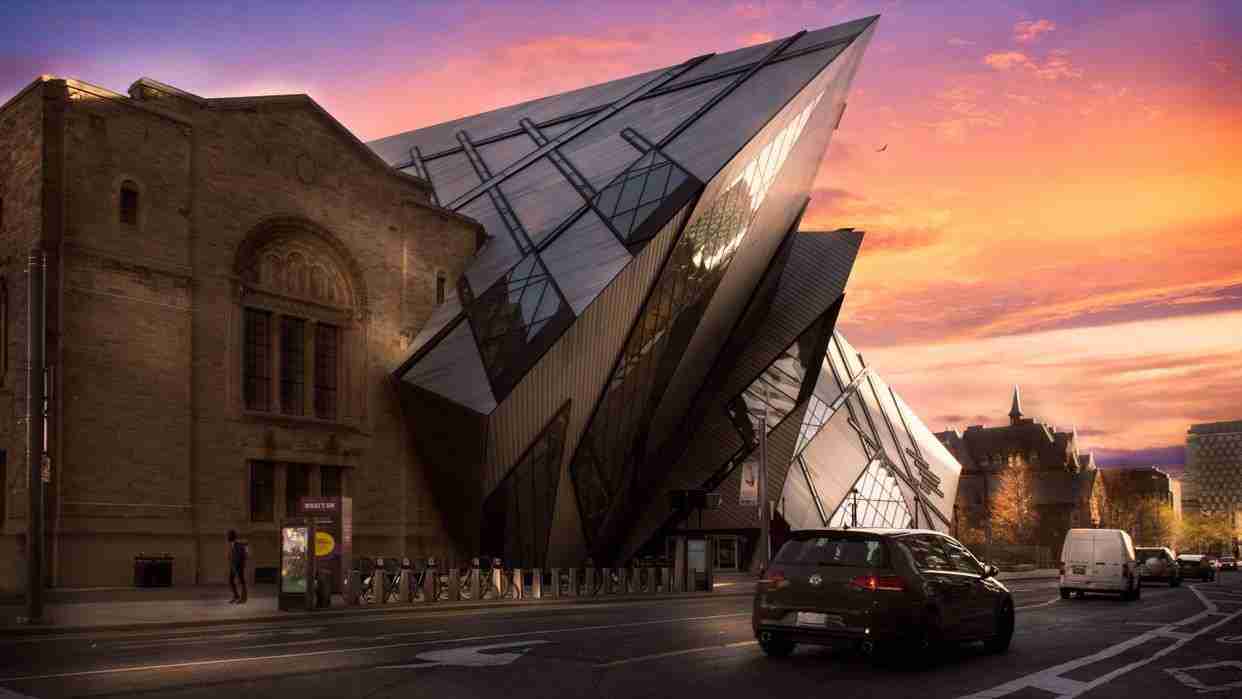
Located at the intersection of Bloor Street and Queen's Park, Toronto's Royal Ontario Museum (ROM) is a masterclass in architectural duality. Blending its original 1914 heritage stone structure with the bold, angular modernity of the Michael Lee-Chin Crystal—an aluminum-and-glass addition completed in 2007—the ROM offers photographers a rare opportunity to capture the collision of old and new in one striking frame. As Canada's largest museum, it's not only a cultural landmark but a visual magnet for anyone interested in design, geometry, and urban storytelling. Whether framed in natural light or glowing at night, the ROM's dramatic lines and textures provide endless creative possibilities.
Best Photography Opportunities
• Juxtaposition of Old and New Architecture
– One of the most compelling aspects of the ROM is its merging of two architectural eras. The original stonework is stately and textured, while the angular crystal juts out like a shard of glass breaking through the past. This visual contrast is heightened when captured during golden hour or twilight, emphasizing both material and era in a single frame.
• Reflections and Shadows on the Crystal Facade
– The glass and metal surfaces of the crystal addition are highly reactive to light. Shooting at different times of day—especially during golden hour—can result in fascinating reflections of sky, clouds, and nearby buildings. On rainy days, the reflective surface adds layered depth, capturing subtle hues from the environment.
• Close-Up Abstracts of Lines and Angles
– Get in tight with a wide or medium lens to isolate sections of the crystal's fractured geometry. These close-ups highlight the construction detail, repeating triangles, and intersecting metal beams, making for powerful abstract compositions. These angular shapes are ideal for black-and-white interpretations that emphasize contrast and line.
• Night Photography of Illuminated Structures
– After dark, the museum is often lit from within and below, giving the crystal a luminous quality. Long exposures smooth out passing traffic and emphasize the architectural glow against the night sky. The surrounding streetlights and vehicle trails create added drama and urban ambiance.
• Street Photography with Architectural Backdrop
– The museum's central location ensures a constant flow of pedestrians, cyclists, and streetcars. Framing human subjects against the massive angles of the crystal or the arched entrances of the historic facade creates visual stories about time, scale, and movement through space. Waiting for a single person to walk through the frame can provide a strong focal point of contrast and scale.
Best Time to Visit
The Royal Ontario Museum is photogenic year-round, but lighting conditions and street activity vary throughout the seasons. Spring and autumn offer the best overall conditions, with angled sunlight, cooler air, and vibrant street life. Winter scenes are minimalist, with snow contrasting starkly against the dark metal of the crystal, while summer's longer days and busier sidewalks provide more energy and crowd interaction.
Golden hour—particularly in the evening—offers the best light for architectural photography. The setting sun reflects warmly on the museum's surfaces, while twilight and blue hour allow for elegant night compositions. Overcast days are excellent for minimizing harsh shadows and isolating form, especially for detail or abstract work.
How to Get There
The ROM is located at 100 Queen's Park, at the corner of Bloor Street West in downtown Toronto. It is directly accessible via the Museum Station on the TTC's Line 1 (Yonge–University), which exits within steps of the museum's east side. Alternatively, St. George Station (Lines 1 and 2) is just a short walk away.
Streetcar and bus routes also run along Bloor Street and Avenue Road, and the area is highly walkable from other nearby attractions. Paid parking is available in underground garages in the surrounding blocks, but public transit is the easiest and most efficient method.
Photography of the exterior is allowed at any time from public sidewalks. Interior photography is permitted in many areas of the museum, though flash and tripods are typically restricted. It's always best to check with museum staff or signage before shooting indoors.
Exploring the ROM and the Surrounding Area
The ROM's exterior is only the beginning of what's photographically possible in the area. Directly outside, the flow of foot traffic, cyclists, and transit adds layers of motion to your architectural shots. Diagonal sightlines along Bloor and Avenue Roads reveal new angles of the building that shift dramatically depending on your distance and height.
To the west, the campus of the University of Toronto offers ivy-covered academic buildings, quiet courtyards, and tree-lined paths, ideal for environmental and documentary-style photography. Just steps south, Queen's Park adds a classical government building, statues, and a circular road—perfect for symmetrical compositions and storytelling.
The museum's base-level reflecting surfaces and sculpture elements offer micro-landscapes of texture and abstraction, while the intersection itself becomes a dynamic zone for urban photography. Whether focusing on design or daily life, this corner of Toronto is a constantly evolving frame.
Nearby Photography Locations
• The Sharp Centre for Design
– Located a short walk southwest at OCAD University, this iconic "tabletop" structure appears to hover over the street and offers bold contrast to traditional downtown architecture. The vibrant column supports and elevated design provide futuristic lines perfect for visual experimentation.
– Just behind the ROM, these elegantly designed performance spaces offer sweeping wooden curves, glass facades, and a quiet courtyard perfect for architectural studies. Reflections in the glass during sunset or rain make for highly stylized compositions.
– A tree-lined path running between the ROM and the Royal Conservatory, ideal for capturing transitions from natural to built environments. In spring and fall, the foliage adds a rich seasonal dimension that softens architectural edges.
• Museum Subway Station
– Directly beneath the ROM, this sculptural TTC station features columns modeled after museum artifacts. Its moody subterranean light and symmetrical forms are perfect for long exposure and fine-art urban photography.
– Just east of the museum, this upscale neighborhood features a mix of modern glass towers, historic row houses, public art, and luxury storefronts—excellent for architectural detail and street photography alike. The mix of materials and fashion-forward pedestrians creates dynamic visual contrasts.
Comments
Loading comments…