
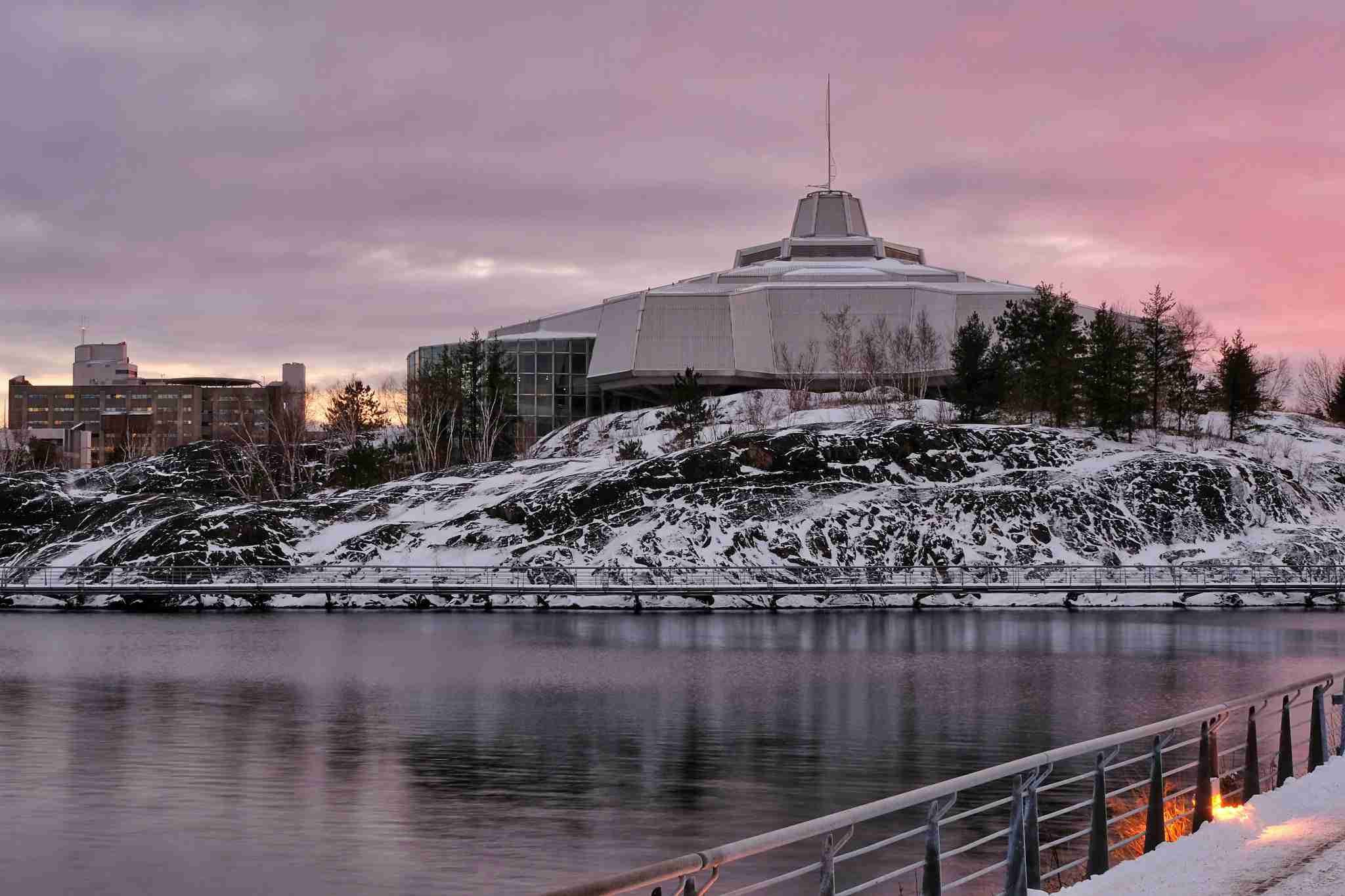
Poised on the edge of Ramsey Lake, Science North is both a landmark and an architectural statement—one that reflects Sudbury's evolution from mining town to science-forward community. Its two snowflake-shaped buildings, linked by an underground rock tunnel, make it one of the most distinctive structures in Northern Ontario. Set against the water and surrounded by natural shoreline, the complex offers compelling angles for architectural, documentary, and environmental photography. Inside, light pours into the central atrium, illuminating interactive exhibits, a suspended whale skeleton, and glass-walled galleries filled with natural life.
Science North is more than just a science museum—it's a place where bold design meets thoughtful exhibition. Photographers will find opportunities both outside and in, from the elegant geometry of the lakeside façade to the intricate visual stories unfolding within. Whether you're after bold lines, layered exhibits, or a playful visual narrative, this location offers an ideal mix of structure, scale, and subject matter.
Best Photography Opportunities
• Lakeside Architecture from Bell Park Boardwalk
One of the best vantage points for capturing Science North's exterior is from the Bell Park Boardwalk, which follows the shoreline of Ramsey Lake to the north. From here, you can frame both snowflake-shaped buildings jutting into the water with beautiful symmetry, especially at golden hour when warm light reflects off the lake. The buildings' radial geometry and clean edges create strong focal points that pop against the lake and sky. In the fall, colorful shoreline trees add a layer of contrast, while winter snow softens the lines and makes the structure appear to hover above the frozen lake.
• Suspended Whale Skeleton and Atrium Views
Inside the central atrium, a 20-metre fin whale skeleton hangs dramatically overhead. It's one of the museum's most photogenic interior elements, perfectly suited to vertical compositions or layered environmental frames. Shoot from multiple levels—there are walkways that allow you to frame the skeleton from above, below, and side angles. The changing natural light throughout the day creates varying shadows across the vertebrae and ribs, offering opportunities for dramatic black-and-white edits or high-contrast color work that highlights the skeleton's scale and elegance.
• Tunnel of Rock and Structural Texture
Connecting the two buildings is a long, underground tunnel carved directly through the Canadian Shield bedrock. Lit with dramatic, low-key lighting, the tunnel offers an unusual opportunity for textural and moody photography. Its natural stone walls, illuminated from floor-level fixtures, have a cinematic quality that's rare in institutional architecture. Use a wide aperture to isolate details in the stone, or frame the entire length of the tunnel for a leading-line composition that draws the eye toward light and shadow. It's an excellent space for minimalist detail studies or adding an atmospheric break between exterior shots.
• Butterfly Gallery and Glass-House Enclosure
The tropical butterfly gallery provides a lush, light-filled space ideal for macro and shallow depth-of-field work. Butterflies move freely among exotic plants, flowers, and hanging feeders, creating an immersive environment that's both serene and vibrant. Reflections off the surrounding glass walls and misted air add soft diffusion, making the space excellent for dreamy, ethereal compositions. Patience is key—waiting for a butterfly to land on a brightly colored bloom or to catch backlight through its wings can result in delicate, jewel-toned imagery.
• Night Photography and Reflections on Ramsey Lake
After dark, Science North glows softly along the shoreline, with the lake reflecting its angular form and low architectural lighting. Blue-hour compositions from Bell Park or even the public docks nearby provide symmetrical, reflective images of the complex set against the night sky. The snowflake geometry becomes even more striking when paired with long exposure techniques that smooth out the lake surface and saturate the blue twilight. Interior lights give the building a warm glow that contrasts beautifully with the surrounding cool tones—ideal for color-balanced or split-tone editing.
Best Time to Visit
For exterior architectural photography, early morning and late afternoon provide the most dynamic light, especially in spring and fall when the sun's lower angle casts longer shadows across the snowflake structures and Ramsey Lake. Golden hour yields soft reflections and warm tones that contrast beautifully with the cool palette of the building's concrete and steel finishes.
Winter photography is also particularly strong here. Fresh snow on the boardwalk and ice on the lake help emphasize the structure's bold form, while fog and soft skies offer mood and atmosphere. Interior photography is possible year-round, with midday light best for the atrium and butterfly gallery thanks to their window-heavy designs. Weekdays generally offer fewer crowds, allowing for cleaner compositions indoors.
How to Get There
Science North is located at 100 Ramsey Lake Road in Sudbury, Ontario, with clear signage and dedicated parking on-site. From downtown Sudbury, it's a five-minute drive east along Paris Street, or a pleasant 15-minute walk through Bell Park along the Ramsey Lake boardwalk. The building is directly accessible by car, foot, or public transit, and is a central landmark in the city's lakefront park system.
For those looking to photograph the building from a distance, the Bell Park Boardwalk offers excellent elevated and waterside views. There are benches and viewing platforms along the trail, and wide walkways suitable for tripods. Public washrooms and picnic areas make this a good place to spend time waiting for ideal light.
Recommended Gear and Shooting Tips
A wide-angle lens (16–35mm) is key for capturing the full exterior of the snowflake-shaped buildings from the lake or boardwalk. A mid-range zoom (24–70mm) will allow you to move fluidly between full-building frames and tighter architectural detail, particularly around the tunnel entrance and interior displays. For indoor low-light environments like the tunnel or the whale skeleton atrium, a fast prime lens (35mm or 50mm f/1.8) is ideal.
A tripod is helpful for both long exposures at night and precise interior compositions during low-light conditions. A polarizer can help manage glare on the lake's surface and reduce reflection off indoor display glass. ND filters can be used for long-exposure lake shots at sunset or smoothing out ripple textures when photographing reflections.
Indoors, avoid flash—many exhibits are in light-sensitive environments. Instead, work with ambient light and wide apertures. Be mindful of visitors in the frame, or use them intentionally for scale and atmosphere. Focus stacking can be useful in macro scenes like the butterfly gallery if you're after maximum sharpness.
Nearby Photography Locations
A beautifully landscaped park with winding paths, lakeside overlooks, and tree-lined benches. Great for environmental portraiture, golden-hour landscape shots, and water reflections. The view back toward Science North is exceptional.
Just across town, the 9-metre-tall Big Nickel sculpture offers iconic industrial imagery set above a geologically themed science centre. Excellent for bold graphic compositions and storytelling contrast between science and mining heritage.
Minutes away, this trail system features wooded paths, rock outcroppings, and smaller lakes—ideal for nature photography, especially in fall or after fresh snowfall.
A short drive southeast, this protected area offers quiet hiking trails, marshland scenes, and birding opportunities in a more natural setting. Sunrise over the lakes here can be especially photogenic.
• Downtown Sudbury Murals and Urban Textures
For a change of pace, Sudbury's growing mural scene and historic brick buildings provide strong opportunities for street photography and urban abstract work. Look for weathered signage and alley murals tucked between shops.
Science North is one of Ontario's most visually compelling educational spaces—where bold design, natural beauty, and scientific storytelling intersect. Whether you're photographing its structural geometry, suspended wildlife, or soft reflections on Ramsey Lake, this is a location that offers architectural precision and natural poetry in equal measure.
Comments
Loading comments…