
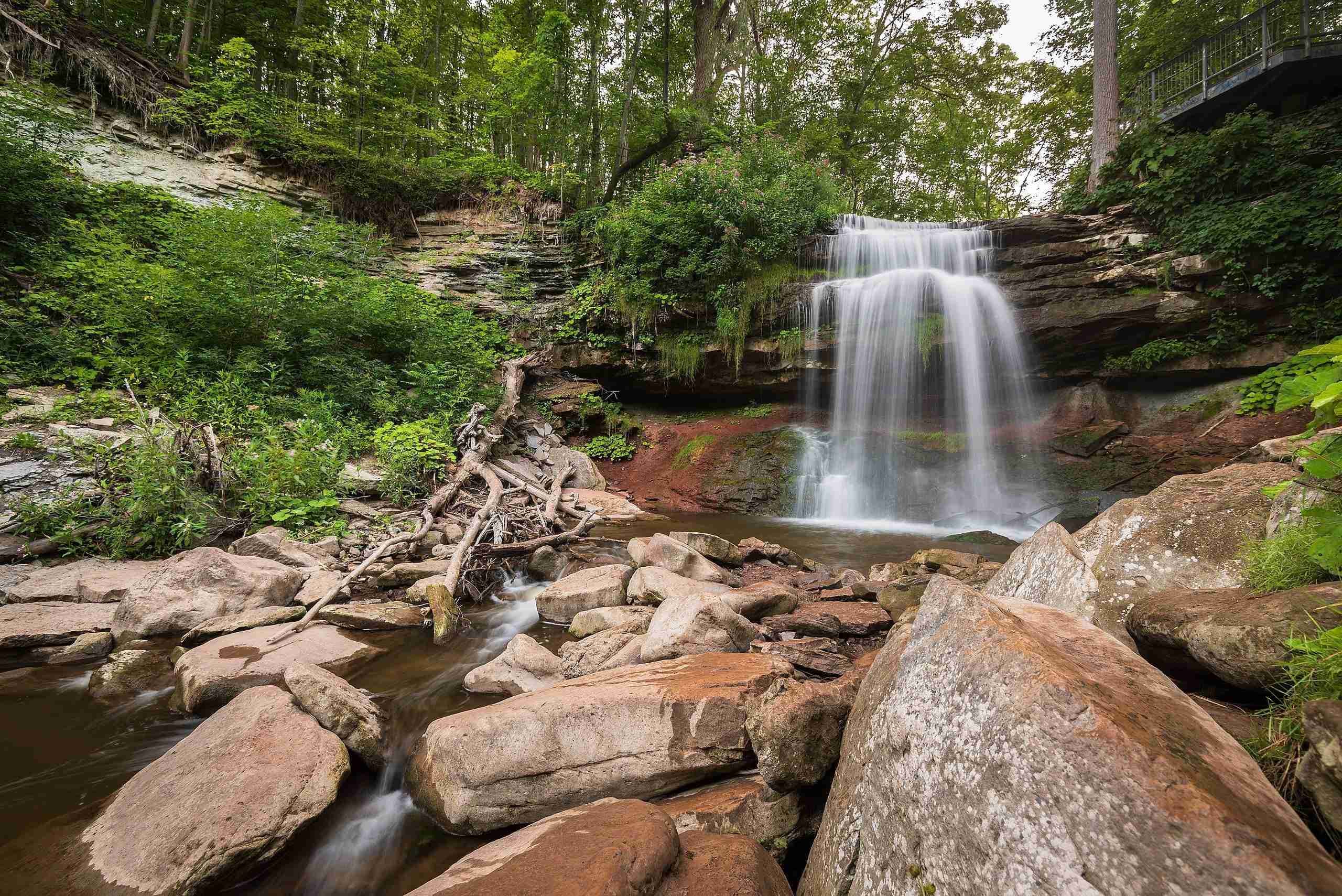
Tucked into the wooded slopes of the Niagara Escarpment in Waterdown, Smokey Hollow Falls—also known as Grindstone, Great, or Waterdown Falls—is a compact but visually rewarding two-tier waterfall set in a tranquil forested ravine. Dropping roughly 10 metres into a shallow pool, the falls mark a scenic point along Grindstone Creek as it cuts through layers of sedimentary rock and cedar-lined banks. Though modest in scale, this site offers strong compositional elements for photographers who appreciate natural framing, textured cascades, and easily accessible viewpoints with room to explore different angles.
Well-marked trails and a wooden viewing platform make the area beginner-friendly, but the best photographic results come from descending closer to the creek bed. The shaded environment keeps lighting conditions manageable even during mid-day, and the combination of exposed roots, layered rocks, and seasonal color make this a strong location for detail-focused waterfall photography and environmental compositions.
Best Photography Opportunities
• Lower Creek Bed Perspective
The most dynamic and photogenic view of the falls is from the base, where you can frame the two-tiered cascade head-on with layered rocks and flowing water in the foreground. A wide-angle lens lets you capture the full drop and the surrounding trees, while also pulling in textural details from the creek bed. Long exposures smooth the water and emphasize the elegant structure of the falls. Visit in early morning or late afternoon when the light filters softly through the trees for added warmth and contrast.
• Midstream Compositions and Rock Formations
Downstream from the falls, the creek winds through clusters of mossy boulders and angular rock formations that provide rich foreground texture. These natural elements offer excellent leading lines back toward the waterfall and help establish depth in your frame. Use a mid-range zoom to compress the scene slightly and accentuate the sense of flow, or get low and close to the stream surface for a more immersive angle.
• Detail and Texture Studies
Smokey Hollow's vertical rock face and split cascade create opportunities for isolating smaller elements—like rivulets of water tracing stone ledges, lichen-covered outcrops, or weathered logs resting in the stream. These shots work well in diffused light or during overcast conditions, which bring out the subtle tones in the rock and foliage. A macro or telephoto lens helps capture surface patterns, leaf contrast, and the interaction between water and natural texture.
• Autumn Color and Canopy Framing
In fall, the ravine surrounding the falls fills with brilliant orange, yellow, and red foliage that adds vibrant contrast to the grey and brown stone. Use the changing canopy as a natural frame or include fallen leaves in the foreground to introduce color and seasonal mood. This is one of the best times of year to shoot from elevated angles on the surrounding trail for wider landscape-style compositions.
• Upstream and Trailside Vignettes
Beyond the main cascade, the creek flows gently over ledges and shallow pools framed by cedar and beech trees. These areas are quieter, less photographed, and ideal for capturing soft, meditative images of water movement, forest floor detail, or trailside documentary shots. Use these scenes to build a narrative around the falls, especially if you're planning a photo series or working with a slower-paced, contemplative style.
Best Time to Visit
Smokey Hollow Falls is photogenic year-round, but the best times to visit are during spring and autumn. Spring brings strong water flow from snowmelt and rainfall, adding power and volume to the falls. Overcast spring days also reduce harsh shadows, which helps when capturing long exposure shots among the rocks.
Autumn is particularly vibrant, as the ravine fills with color and the surrounding forest takes on rich, warm tones. Fallen leaves gather along the stream and on the rocks, offering excellent textural and tonal contrast for composition. Summer brings more foliage and higher contrast light, but early morning or evening visits still offer rewarding conditions. In winter, the falls often freeze partially, creating intricate ice formations that transform the space into a more abstract and high-contrast scene.
The best lighting is typically found in early morning or late afternoon, when the sun is low enough to skim through the trees and highlight water and stone without blowing out highlights. After recent rain, the water flow intensifies and adds drama to both the sound and motion of the scene.
How to Get There
Smokey Hollow Falls is located in Waterdown, Ontario, just off Mill Street South. From Hamilton, take Highway 5 (Dundas Street) west, turn left onto Mill Street South, and follow the signage for Smokey Hollow Resource Management Area. The parking lot is located on the east side of the road and is free to use, though it can fill up quickly on weekends and during peak fall color.
From the parking area, a short path leads directly to a wooden viewing platform overlooking the falls. For better angles, follow the marked trail down toward the creek bed. The descent is steep in sections but manageable for most visitors. Wear proper hiking footwear, especially if you're planning to climb around on wet rocks near the stream. The Bruce Trail also passes through this area, allowing for extended hiking and additional photo opportunities further up or downstream.
Recommended Gear and Shooting Tips
A wide-angle lens (16–35mm) is ideal for capturing the full cascade and surrounding forest in tight quarters. A mid-range zoom allows you to shoot from trail level or isolate smaller features within the falls or creek bed. For fine detail or abstract shots, a macro lens or longer prime helps bring out texture in water movement, foliage, or rock formations.
A tripod is essential for long exposure work and for composing precisely in uneven terrain. A neutral density filter allows you to slow shutter speeds even in brighter light, smoothing the waterfall's flow into clean, ribbon-like motion. A circular polarizer helps reduce glare on wet rocks and enhances foliage contrast, especially after rainfall.
Bring a microfiber cloth for your lens—spray from the falls can accumulate quickly when working at close range. Use a lens hood or shield your lens by positioning yourself slightly off-axis from the main cascade. Scout multiple angles, and don't be afraid to revisit compositions as light changes throughout your session.
Nearby Photography Locations
• Webster's Falls and Spencer Gorge
Located just a short drive east in Dundas, this dramatic plunge waterfall is much taller and set within a broader gorge. It's ideal for grand compositions, especially during spring melt or in early autumn.
• Borer's Falls
Accessible via the Bruce Trail near Smokey Hollow, Borer's Falls is a smaller curtain-style waterfall with excellent rock formations and trail-access viewpoints. Less visited and ideal for moody or close-up work.
• Great Falls Trail System
Continuing along Grindstone Creek, this trail network leads to quiet forested paths, smaller cascades, and excellent opportunities for nature and macro photography away from the main falls.
A short drive away, this area features rail trails, ravines, and hardwood forest, perfect for wildlife photography or atmospheric woodland scenes, particularly in the fog or during early spring.
• Tew's Falls and Dundas Peak
For expansive escarpment views, Tew's Falls and the nearby overlook at Dundas Peak offer a more dramatic, wide-angle counterpoint to the intimate setting of Smokey Hollow.
Though small in stature, Smokey Hollow Falls delivers far more than first impressions suggest. Framed by forest, layered with stone and root, and changing with every season, it's a location where subtlety and structure combine—perfect for photographers who know how to shape light, texture, and motion into quiet but powerful frames.
Comments
Loading comments…