
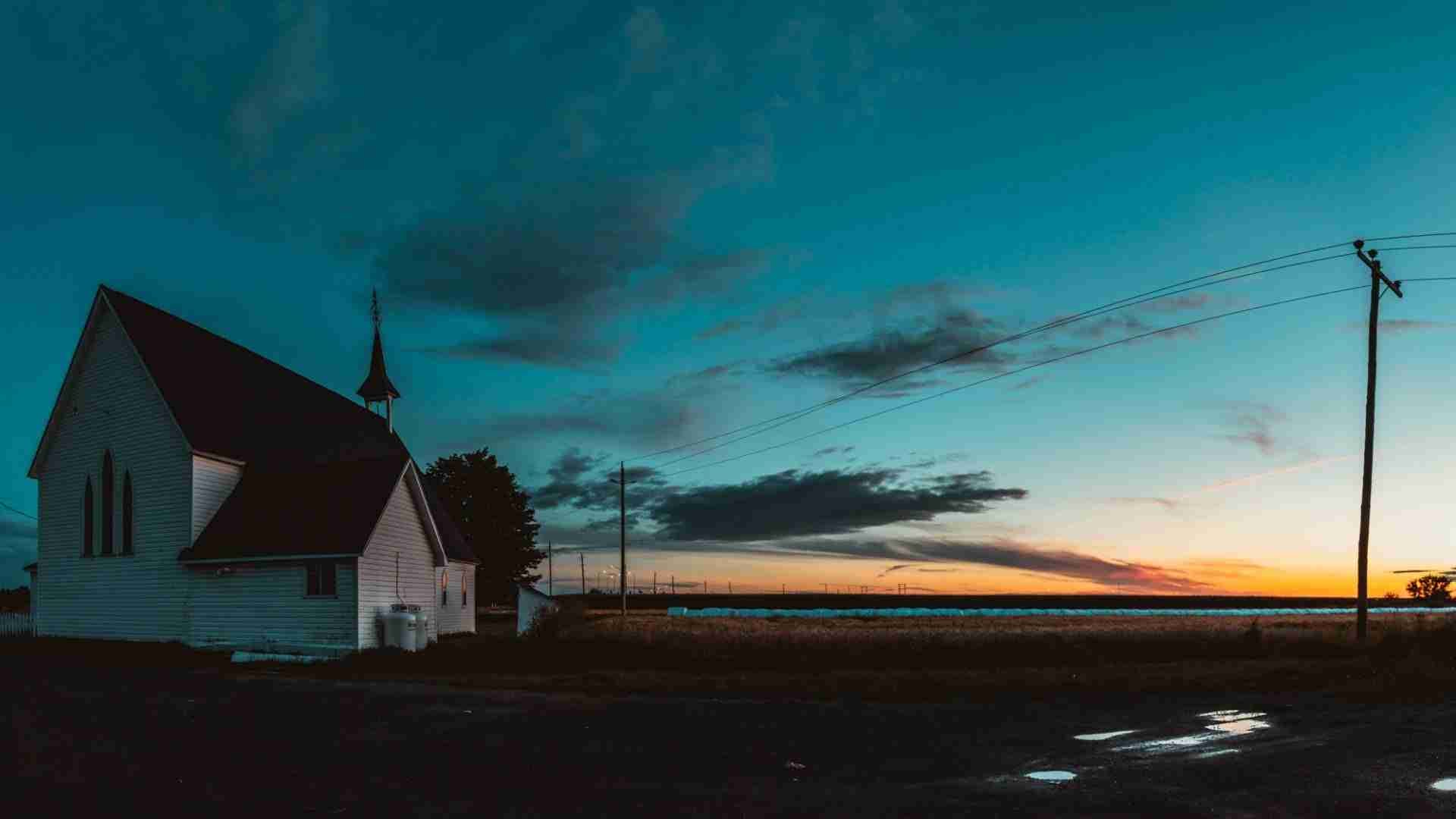
Standing humbly on a small rise beside a quiet rural intersection just off Ontario's 417 TransCanada Highway, St. John's Anglican Church in Kinburn is a study in contrast and compositional opportunity. Its steep white gables, modest red brick façade, and pointed arch windows speak of tradition, solitude, and 19th-century craftsmanship—while the surrounding expanse of fields and the subtle proximity of modern infrastructure add layers of narrative tension. This is not a church fenced in by town or trees, but one that opens directly into farmland, sky, and the long rural lines of the Ottawa Valley. For photographers, it offers architectural purity set against a big-sky backdrop, and the chance to compose rural reverence with a sense of timeless quiet.
Best Photography Opportunities
• Frontal Elevation with Field Perspective
: Approaching from the small road that runs parallel to the 417, you can frame the church straight-on with the open farmland stretching behind it. This angle highlights the building's strong symmetrical profile and crisp lines, especially when shot with a standard lens (35mm or 50mm) from a low vantage point. Early morning sidelight adds soft dimensionality to the brickwork and creates gentle shadows across the arched doorway and buttresses. Use the field's natural texture—whether planted or fallow—as a foreground layer to guide the eye toward the church.
• Wide-Angle Compositions with Highway in the Distance
: Step back along the roadside shoulder to include more of the landscape and subtly incorporate the TransCanada Highway's elevated line in the background. This juxtaposition of rural devotion and modern travel can be composed poetically, especially at sunrise or dusk when headlights or taillights form thin streaks of motion beneath the stillness of the church. A 24–70mm zoom allows you to balance scale and proximity, and long exposures help blur any passing vehicles into visual suggestion rather than distraction.
• Architectural Detail and Weathered Texture
: Up close, the church reveals its age and character—worn steps, wood-framed stained glass windows, and a patina of soft moss and brick dust that reads beautifully in directional light. Use a short telephoto (85mm or 135mm) to isolate window arches or roofline details with shallow depth of field. Cloudy days work well for this kind of photography, reducing harsh contrast and allowing the red brick and white trim to hold their natural tones. Look for small signs of history: lichen on the foundation stones, the hand-cut look of the original sills, or the simplicity of the wooden steeple.
• Sunset Silhouette from the Field Edge
: From the western edge of the adjacent field, you can frame the church as a silhouette against the sky, especially in late summer or fall when the setting sun dips behind the building. A wide-angle or mid-range lens composed at ground level allows you to place rows of planted crops or natural grasses in the foreground. Golden hour light bathes the scene in warmth, often catching the edges of the steeple and trees, while the open sky transitions through layered color gradients—making for one of the location's most emotive shots.
• Drone Perspective of Church and Surrounding Grid
: With permission and mindful flying, a drone flight at low to mid altitude can reveal the unique setting of the church in full context: bordered by country roads, open fields, and the gentle curve of the highway beyond. Overhead, the church's clean rectangular footprint contrasts starkly with the natural patchwork of agriculture around it. Shoot early or late for long shadows and soft contrast, and consider top-down compositions that turn roadways and field lines into minimalist geometry around the ecclesiastical anchor point.
Best Time to Visit
St. John's Anglican Church can be photographed throughout the year, but its visual power shifts subtly with season and light. Spring brings new greens to the surrounding fields and fresh contrast against the red-brick walls. Soft light and patchy clouds work well here, adding atmosphere without flattening the landscape.
Summer offers rich rural context, especially when the surrounding fields are in full growth—sunflowers, wheat, or hay bales often frame the structure in golden or green tones. Early morning and late afternoon are best to avoid harsh midday light and to take advantage of the building's long shadows.
Autumn is arguably the most expressive time to visit. The surrounding trees change color, and low sun angles bring out warm reflections in the brick. Slight mist in the mornings, combined with empty or harvested fields, adds a layer of narrative depth to both wide and detail shots.
Winter simplifies everything. The snow-covered ground becomes a natural reflector, highlighting the shape of the church and casting deep blue shadows across the unbroken drifts. With clear skies and long golden hours, the church becomes a sculptural element in a clean, almost monochrome environment—perfect for high-contrast work or minimalist compositions.
How to Get There
St. John's Anglican Church is located near Kinburn, Ontario, just west of Ottawa. From the 417 TransCanada Highway, take Exit 169 for Kinburn Side Road. Drive north until you reach the intersection with Woodkilton Road, where the church sits just off the corner, visible from a distance.
There is no formal parking lot, but ample space exists to park safely along the shoulder near the intersection or on a nearby laneway (without blocking driveways or traffic). The area is quiet and rural, with minimal vehicle movement during off-peak hours. There are no gates or posted restrictions, but as always in rural Ontario, be respectful of adjacent private land and structures.
The church is not always open to the public, but exterior photography is fully accessible from the roadside and grassed areas. There is enough space to use a tripod, set up for long exposures, or even fly a drone within safe distances of the structure and surrounding roads. Lighting poles and overhead wires are minimal, allowing clean skyward compositions.
Recommended Gear and Shooting Tips
To capture the church in both its architectural and environmental contexts, bring a kit that balances structure and distance. A wide-angle zoom (16–35mm) helps emphasize scale against sky, especially when working from low angles with cloud-heavy backdrops. A standard zoom (24–70mm) is excellent for general use, particularly for capturing the relationship between building, road, and landscape.
A mid-telephoto lens (70–200mm) excels for compressing space and isolating the church against horizon or field lines. For detail work, especially the textures of brick and wood trim, a fast prime in the 85mm or 135mm range allows for shallow focus and natural light rendering in changing conditions.
Bring a tripod for sunset, silhouette, and long-exposure work. ND filters are rarely essential here but can be useful if you're blending long exposures of passing clouds or vehicles from the nearby road. A polarizer can deepen the sky and cut glare on bright days, but use it sparingly to avoid unnatural contrast on brick and glass surfaces.
Footwear should be durable and suited for uneven or grassy roadside terrain. Pack a cloth for lens cleaning—gravel dust from the nearby road can lift in breezes, especially in summer. Because the site is so open, watch for sudden weather changes and adjust compositions quickly if dramatic clouds roll in.
Nearby Photography Locations
: Just 15 minutes south, this riverfront park offers forest trails, wooden bridges, and marshy inlets—perfect for golden hour landscape work or moody forest scenes in fog or snow. Boardwalks and river channels provide strong natural lines and reflections.
• Galetta's Stone Church and Mississippi River View
: A short drive west, the hamlet of Galetta features a beautiful stone church and views over a bend in the Mississippi River. Strong textures and soft light make it a solid companion location for detail-focused work.
• Carp Ridge and Thomas Dolan Parkway
: Southeast of Kinburn, this elevated ridge road offers panoramic views over the Ottawa Valley and makes an excellent route for capturing rolling fields, tree lines, and distant church steeples silhouetted on the horizon.
• Pakenham's Five Span Bridge
: Further west, this iconic stone bridge offers powerful symmetry, open river views, and historical context that blends well with the ecclesiastical tone of the Kinburn area. Strong compositions can be made in both color and black and white.
• St. Mary's Church in Dunrobin
: Tucked further north, this classic white country church is framed by forest and field, and often overlooked. Ideal for overcast or snow-draped compositions, it echoes the visual voice of St. John's while offering a different backdrop and architectural form.
St. John's Anglican Church may not draw crowds, but it rewards those who seek quiet stories in strong shapes. Its presence is humble, but its compositional voice is bold—framed by field, sky, and a sense of rooted stillness that asks only for your attention and respect.
Comments
Loading comments…