
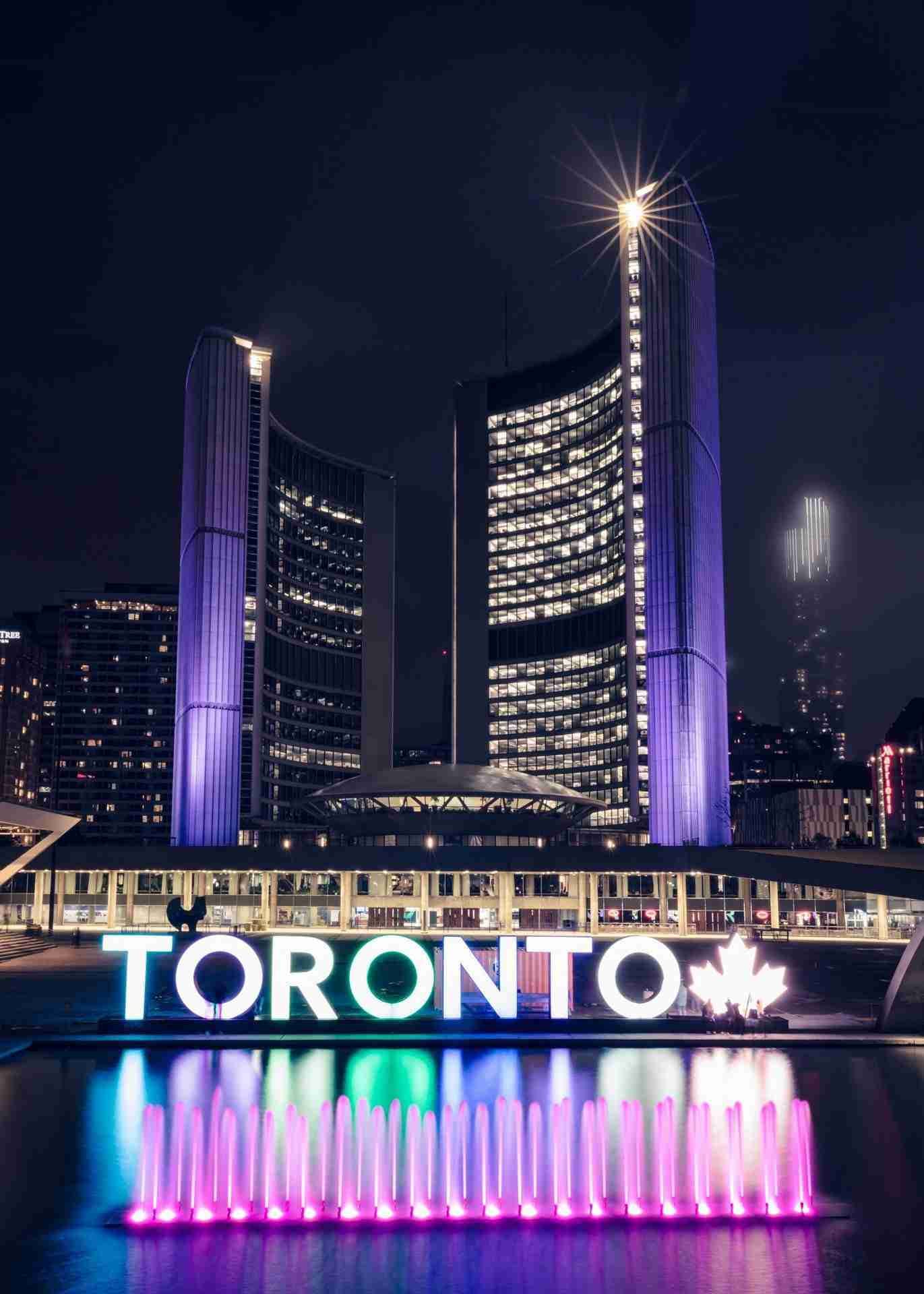
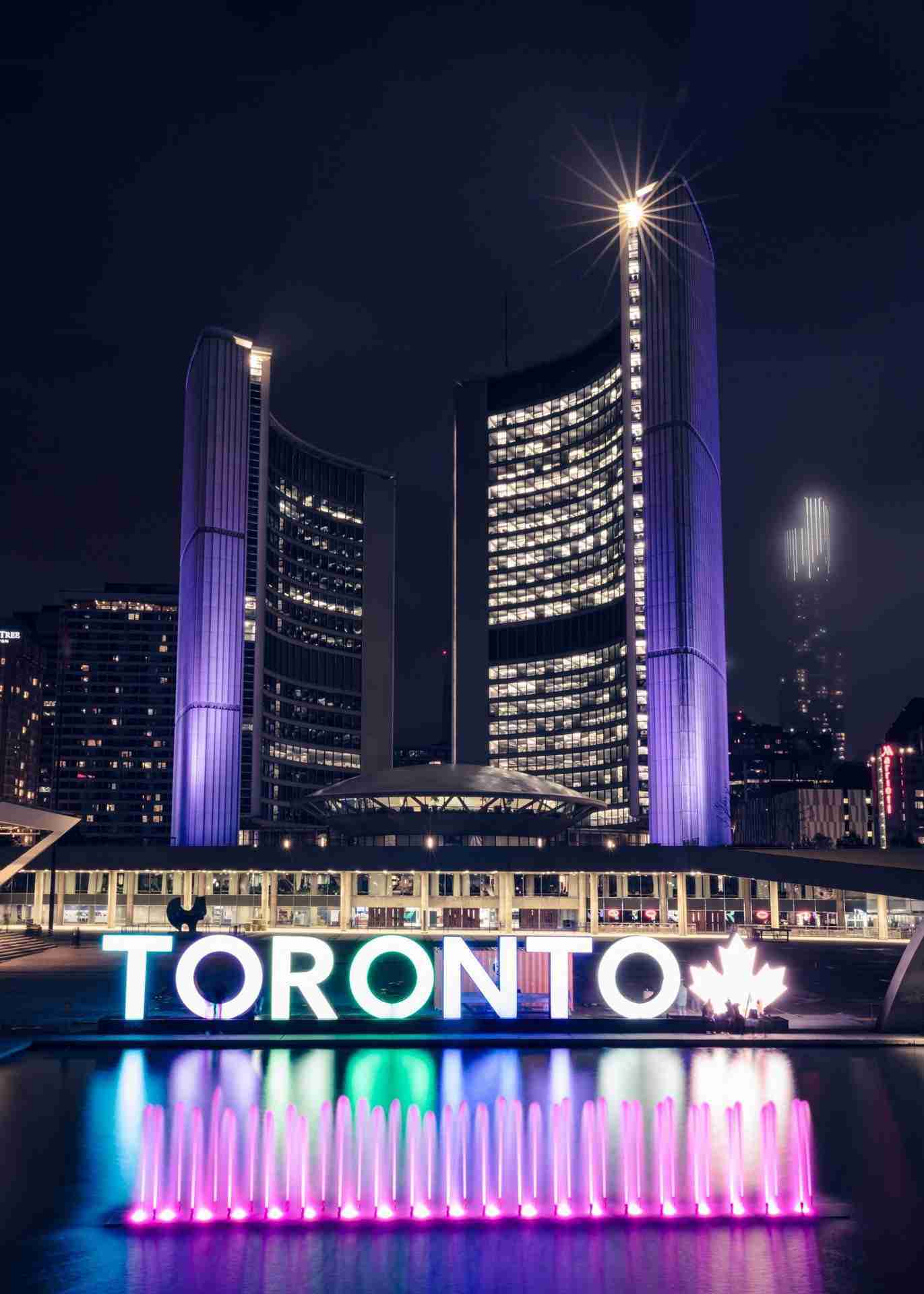
Toronto City Hall is one of the most visually distinct and symbolically important buildings in the city—a sweeping, modernist structure that anchors Nathan Phillips Square and redefines traditional civic architecture. Designed by Finnish architect Viljo Revell and completed in 1965, the complex features twin curved towers that rise around a central saucer-like council chamber, forming a sculptural ensemble that's instantly recognizable. From dramatic architectural lines to bustling public activity, Toronto City Hall offers photographers a wide range of subjects in one cohesive location. Whether you're shooting minimalist geometry, urban life, or cityscape contrasts, it's a place where design and storytelling intersect.
Best Photography Opportunities
• Symmetrical Composition from Nathan Phillips Square
The most iconic view of City Hall is taken from directly across the reflecting pool, with the Toronto sign in the foreground and the twin towers curving inward around the council chamber. This central angle works beautifully for wide-angle lenses, especially during blue hour when the sign is lit and the building glows with interior light. In winter, the reflecting pool becomes a skating rink, adding movement and festive ambiance to your composition.
• Elevated Perspectives from the Sheraton Hotel Terrace
For a unique vantage point, the terrace at the Sheraton Centre across Queen Street offers a raised, frontal view of the entire square. This elevation helps isolate the sweeping lines of the architecture and provides a clean background for capturing large-scale events, light shows, or the quiet geometry of the building on a clear morning. It's a perfect location for capturing time-lapses or long exposures with urban motion.
• Abstract and Minimalist Angles of the Towers
Up close, the curved towers lend themselves to abstract compositions—particularly when shot with a telephoto or tilt-shift lens to isolate lines, curves, and the contrast between concrete and glass. Late afternoon light adds definition to the fluted façades, and cloud reflections enhance the glass strip running along each tower's edge. These tight shots work well in both color and black-and-white, offering clean studies in form and texture.
• Council Chamber Dome with Foreground Elements
The central council chamber, shaped like a flying saucer, becomes an effective focal point when framed with nearby trees, flags, or architectural elements. Shooting at ground level with a low angle exaggerates its futuristic profile. During the holiday season or special civic events, decorations and lighting add layers of visual interest that contrast with the dome's sleek, modernist simplicity.
• Night Photography and Light Trails from Queen Street
Facing west from the corner of Queen and Bay Streets, photographers can capture the illuminated towers with light trails from passing traffic in the foreground. This long exposure setup is especially dynamic when the Toronto sign and fountains are lit, adding color and texture to the image. A tripod and remote shutter release are essential here due to the volume of pedestrian and vehicle movement.
Best Time to Visit
Toronto City Hall is photographable in every season, though the visual environment changes significantly throughout the year. Spring and summer offer the most vibrant foregrounds, with flower beds, public art, and consistent foot traffic in Nathan Phillips Square creating dynamic human elements. Early mornings are best for uncluttered compositions, while golden hour softens the stark concrete surfaces and casts long, elegant shadows across the plaza.
Autumn brings cooler temperatures and changing leaves, which add a warm contrast to the building's cool-toned materials. Fall also brings a clearer skyline, often free of haze, which helps define the towers against the sky—ideal for clean architectural work. The low-angled autumn light enhances surface texture, particularly on the towers' concrete fins.
Winter presents an entirely different scene. The reflecting pool is transformed into an ice rink, ringed with festive lights and a towering holiday tree in December. Snowfall softens the geometry, while crisp skies and long twilight hours offer excellent conditions for night photography. Overcast days flatten contrast but provide even lighting—ideal for minimalist shots or street photography that includes the plaza's activity.
The area becomes particularly photogenic during civic celebrations, public art installations, or events like Nuit Blanche and New Year's Eve, when lights, projections, and crowds transform the space. Blue hour and nighttime visits are some of the most rewarding, especially for photographers interested in architectural lighting, reflections, and motion blur from crowds or traffic.
How to Get There
Toronto City Hall is located in the heart of downtown, making it one of the most accessible photo spots in the city. The closest subway station is Osgoode (Line 1), located just a block west, while Queen Station is also a short walk away to the east. Numerous TTC streetcar and bus routes pass directly in front of Nathan Phillips Square, offering easy access from all directions.
Paid underground parking is available beneath Nathan Phillips Square, with additional lots nearby along Bay and Queen Streets. Street parking is limited and often restricted during business hours, so public transit is typically the most efficient option for daytime visits.
There is no cost to access the square or photograph the exterior of City Hall. However, if you're planning to shoot inside the building or set up professional equipment, such as tripods or lighting rigs during major events, permits may be required depending on your setup. The plaza itself is open to the public daily, and photographers are welcome to explore its various corners and angles without restriction.
Exploring the Surrounding Area
The area around Toronto City Hall offers a dynamic mix of civic, commercial, and historical spaces that add further visual context to your shoot. To the immediate south, Old City Hall stands as a sandstone counterpoint to the sleek modernism of its successor. Its Romanesque Revival architecture, complete with arched windows and a central clock tower, provides a rich backdrop for contrast-driven compositions, especially when framed together with the new City Hall from within the square.
To the west, Osgoode Hall adds a touch of Victorian grandeur, set back behind ornate iron fences and surrounded by manicured grounds. Photographers can capture tight architectural details, wide compositions featuring the building's symmetry, or quiet portraits among the tree-lined paths. This historic courthouse brings a distinctly different architectural flavor to the area and is especially striking in spring and fall.
Moving just east along Queen Street, the Eaton Centre introduces glass canopy curves, escalator lines, and heavy pedestrian movement—perfect for those looking to shift into urban abstraction or street photography. Between these landmarks, the city's rhythm plays out in cafes, alleyways, and small public art installations that can be used for more spontaneous, layered compositions. Every block in the vicinity offers a new frame, whether you're working with grand architecture or fleeting human moments.
Nearby Photography Locations
Directly across the street, this Romanesque landmark adds historic weight and architectural contrast to City Hall's modernist style. Its arched windows, clock tower, and intricate stonework offer strong compositions in both detail and wide shots, particularly during golden hour or in soft overcast light.
While technically part of the City Hall complex, the square itself is a subject all its own. From its large reflecting pool and pedestrian bridges to temporary art installations, events, and seasonal transformations, the space offers ever-changing foregrounds and activity for dynamic storytelling.
A few minutes' walk west, this heritage building features iron fencing, classic columns, and ornate window details set within a tree-lined park. It's an ideal location for architectural close-ups, portraits with a historic backdrop, or quiet atmospheric frames.
A short walk east, this urban shopping hub offers modern lines, dramatic skylights, and elevated walkways that lend themselves to high-contrast, urban geometry photography. The constant motion inside contrasts sharply with the stillness of the square, making it perfect for visual variety within a single outing.
Just a few blocks northeast, this busy public square is Toronto's answer to Times Square. Neon signage, crowds, fountains, and constant motion make it ideal for night photography, street portraiture, and energetic wide-angle compositions that embrace the city's electric pace.
Whether you're chasing precise symmetry, abstract architectural forms, or the layered interaction of people and place, Toronto City Hall offers one of the city's most versatile and inspiring photo environments. With its sweeping modern design, rich historical context, and central location, it invites photographers to explore the built environment as both subject and setting—a canvas where geometry meets civic life in full motion.
Comments
Loading comments…