
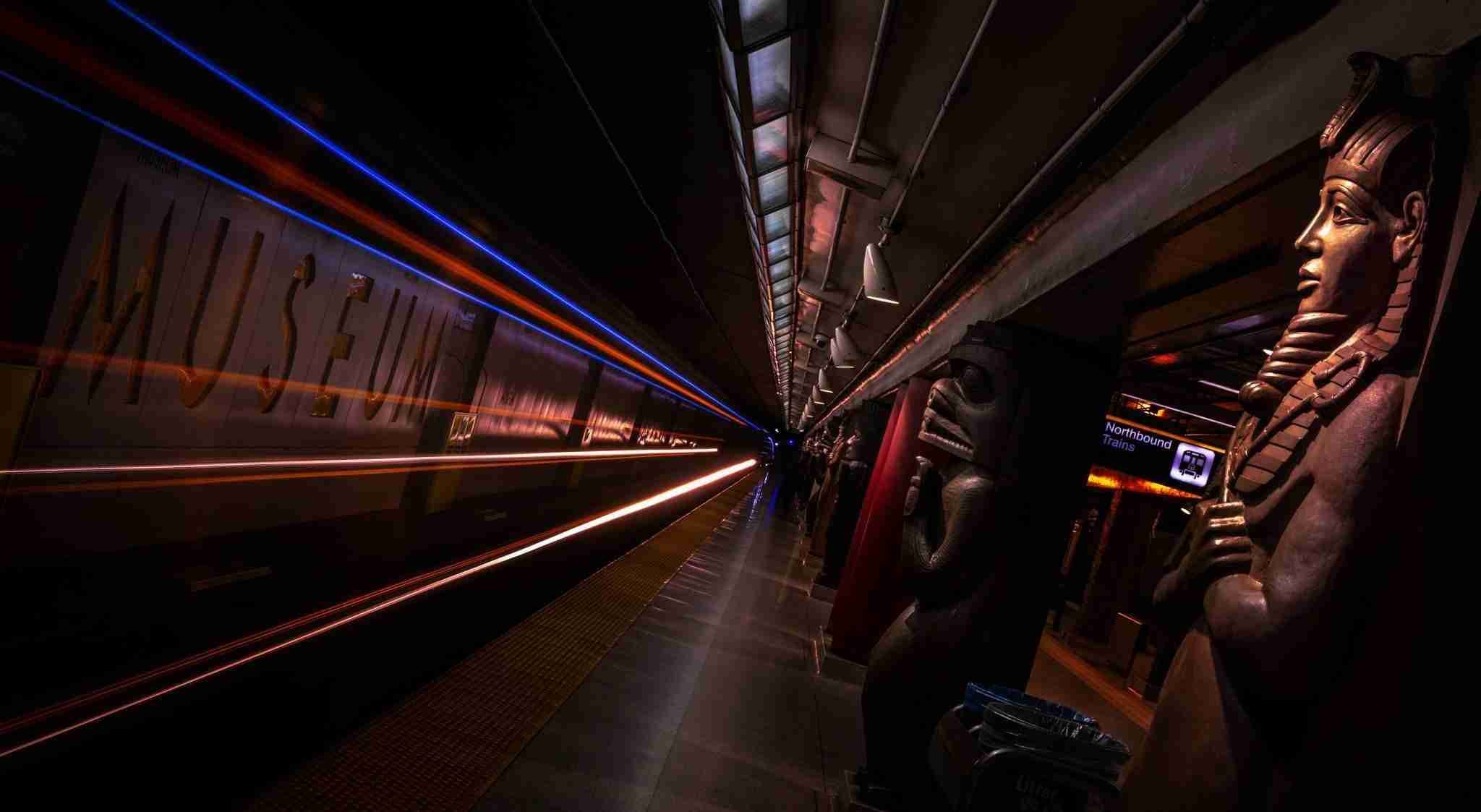
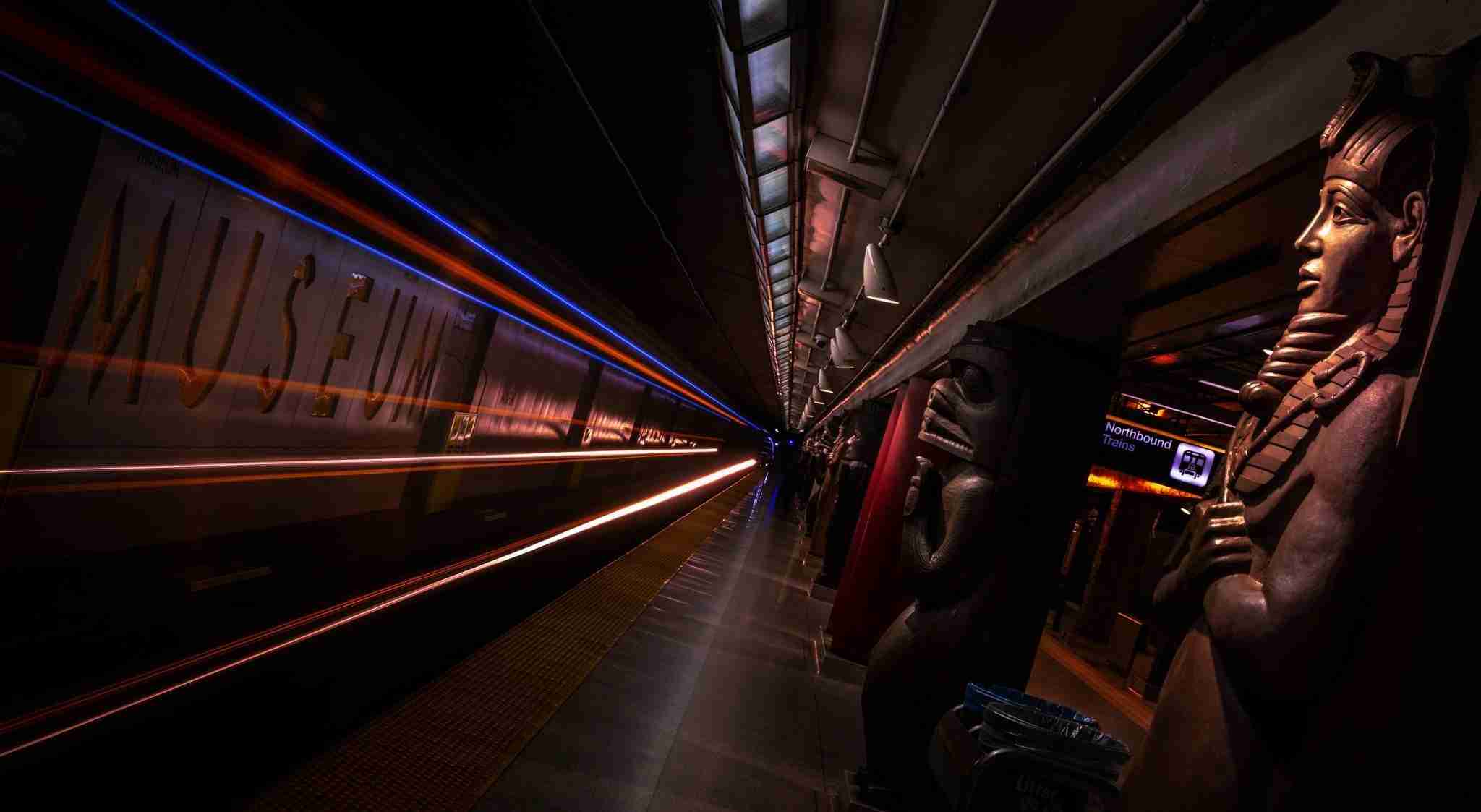
Tucked beneath Queen's Park in downtown Toronto, Museum Subway Station is widely regarded as one of the most photogenic subway terminals in the world. Located on the TTC's University Line, this architecturally unique stop is named after the nearby Royal Ontario Museum—and its design fully embraces the connection. Opened in 1963 and dramatically redesigned in 2008, the station now features sculptural columns modeled after artifacts from various world cultures, creating an immersive museum-like environment deep below the city streets. For urban and architectural photographers, it's a rare subterranean location where creative geometry, historical motifs, and ambient lighting come together in a space unlike any other in Toronto.
Best Photography Opportunities
• Sculptural Columns and Symmetry
– The platform columns are wrapped in replicas of ancient cultural forms, including Egyptian, Toltec, and Doric styles. These sculptural shapes create strong vertical focal points and symmetrical frames that are ideal for centered, low-angle shots. Their arrangement across the platform invites repeating patterns and clean architectural symmetry in wide or medium focal lengths.
• Wide-Angle Shots for Architectural Impact
– Using a wide-angle lens exaggerates the repeating forms and curvature of the ceiling panels, allowing you to emphasize the grand design of the station in a single frame. The full platform length can be captured from end-to-end, revealing the clean lines and rhythmic spatial divisions.
• Reflections and Ambient Light Play
– The station's muted lighting and polished tile surfaces offer subtle opportunities for reflections. Shooting across the platform or at oblique angles can reveal mirror-like details on the floor and accentuate the interplay of light and shadow on textured walls. Reflections also help highlight the station's layered design and contribute to more immersive, abstract compositions.
• Minimalist Compositions with Cultural Detail
– Isolating a single sculptural element—such as the Egyptian column or the carved First Nations-inspired post—allows for clean, minimalist shots that highlight texture, form, and cultural detail. These tighter compositions benefit from consistent artificial lighting, making handheld shooting straightforward and reliable.
• Motion Blur of Passing Trains
– Long exposure techniques can be used to create dynamic contrast between the stillness of the platform and the motion of arriving trains. This adds energy and movement to your composition and works particularly well when centered between columns for symmetry. The colorful streaks created by the trains add a bold visual accent against the station's neutral palette.
Best Time to Visit
The best time to photograph Museum Subway Station is during off-peak hours—early morning before the rush begins, or late evening after the crowds have cleared. These quiet windows allow you to compose your shots without waiting for foot traffic to clear and make long exposures more feasible without distractions.
Visiting on weekends or during statutory holidays often results in lower traffic flow as well, providing more time to experiment with angles and compositions. Since the lighting is artificial and consistent throughout the day, time of day has little impact on exposure but greatly affects access and the number of subjects in the frame.
Museum Station is open year-round and weatherproof—making it an ideal location for shooting during harsh Toronto winters or rainy days when outdoor photography becomes more challenging.
How to Get There
Museum Subway Station is located directly beneath Queen's Park at Charles Street West, in Toronto's downtown core. It's easily accessible by taking Line 1 (Yonge-University) on the Toronto Transit Commission (TTC) network.
From Union Station, head northbound toward Vaughan and disembark at Museum Station, just five stops away. The station is fully accessible and located near several of the city's major cultural landmarks, including the Royal Ontario Museum, the Gardiner Museum, and the University of Toronto campus.
There are multiple street-level entrances, and no additional fee is required beyond the standard TTC fare. Photography is allowed within TTC stations, but the use of tripods or professional lighting may draw attention from transit staff and should be used discreetly during quieter hours.
Exploring Museum Station and the Surrounding Area
Once you've captured the interior of the station, the area above ground offers just as much creative opportunity. The Royal Ontario Museum, with its dramatic Michael Lee-Chin Crystal addition, is directly above, presenting bold, angular architecture that contrasts with the historic building it adjoins. Across the street, Queen's Park and the Ontario Legislative Building offer formal gardens, statues, and classic government architecture.
Walking west leads to the University of Toronto's St. George campus, with its mix of neo-Gothic buildings, quiet courtyards, and ivy-covered facades that photograph beautifully in all seasons. The Gardiner Museum just a block away also offers a sleek, modernist exterior ideal for architectural shots.
In every direction from Museum Station, photographers will find a blend of old and new, historical references and contemporary design—making the area a compact but rich destination for urban exploration and visual storytelling.
Nearby Photography Locations
• Royal Ontario Museum (ROM)
– Just above the station, the ROM's iconic architectural mix of heritage stonework and crystalline glass provides a dramatic subject in both daylight and night photography. Bold lines, reflections, and cultural context make this a must-shoot location.
– A short walk away, this sprawling campus is filled with ornate architecture, historic courtyards, and tree-lined walkways. The contrast between old-world stone buildings and modern additions offers a wide range of visual styles.
– Surrounded by gardens and monuments, this formal government site offers symmetrical compositions, sculptures, and strong leading lines in the landscape. Perfect for documentary and architectural photography.
– A scenic pedestrian path running behind the ROM and the Royal Conservatory of Music. It's ideal for moody, shaded compositions and portraits in a quiet, leafy setting that feels far removed from the busy streets nearby.
– Just west of the station, this uniquely shaped limestone structure resembles a partially unwrapped shoebox. Its clean lines, curves, and textured façade make it a fascinating study for architectural minimalism.
Comments
Loading comments…