
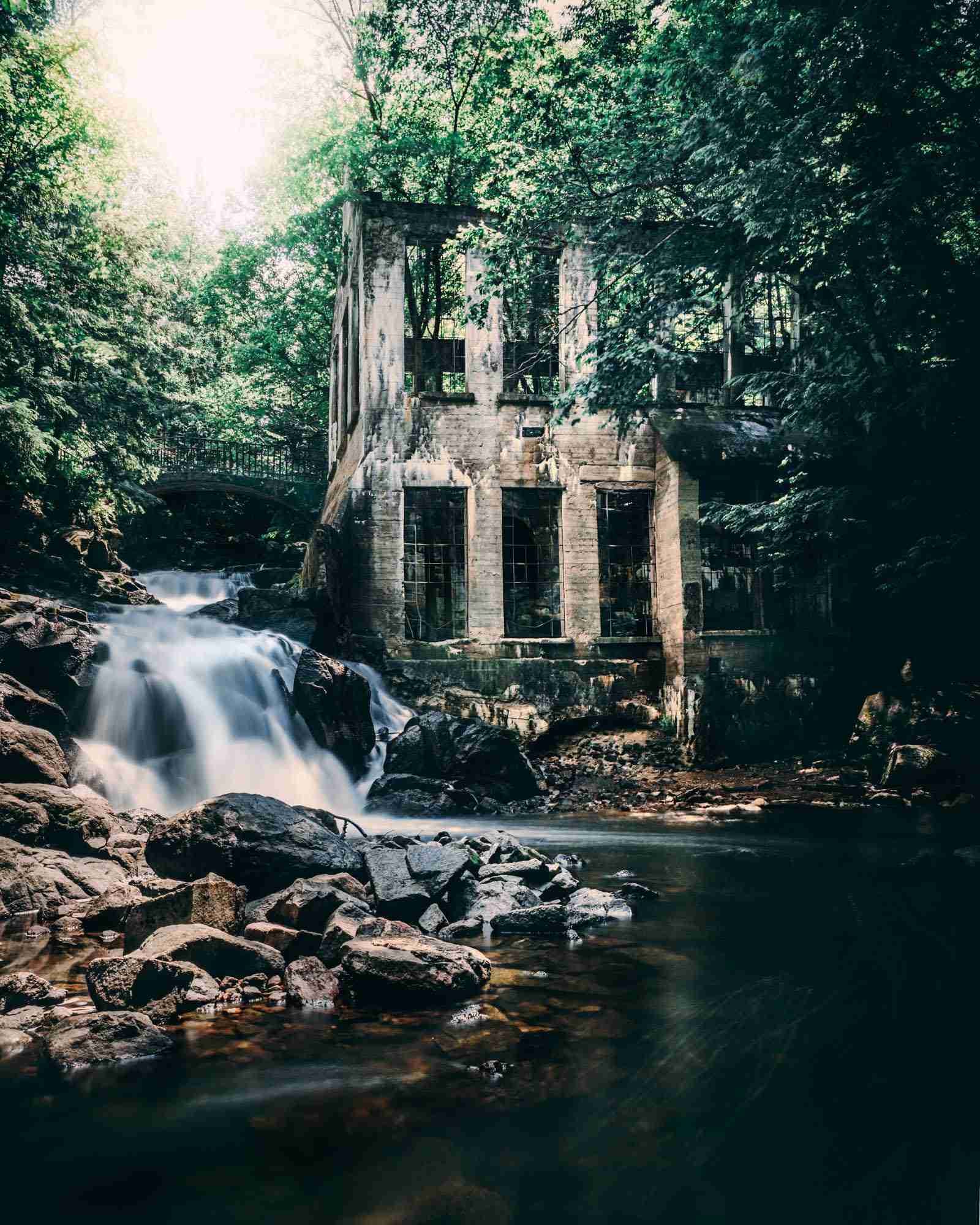
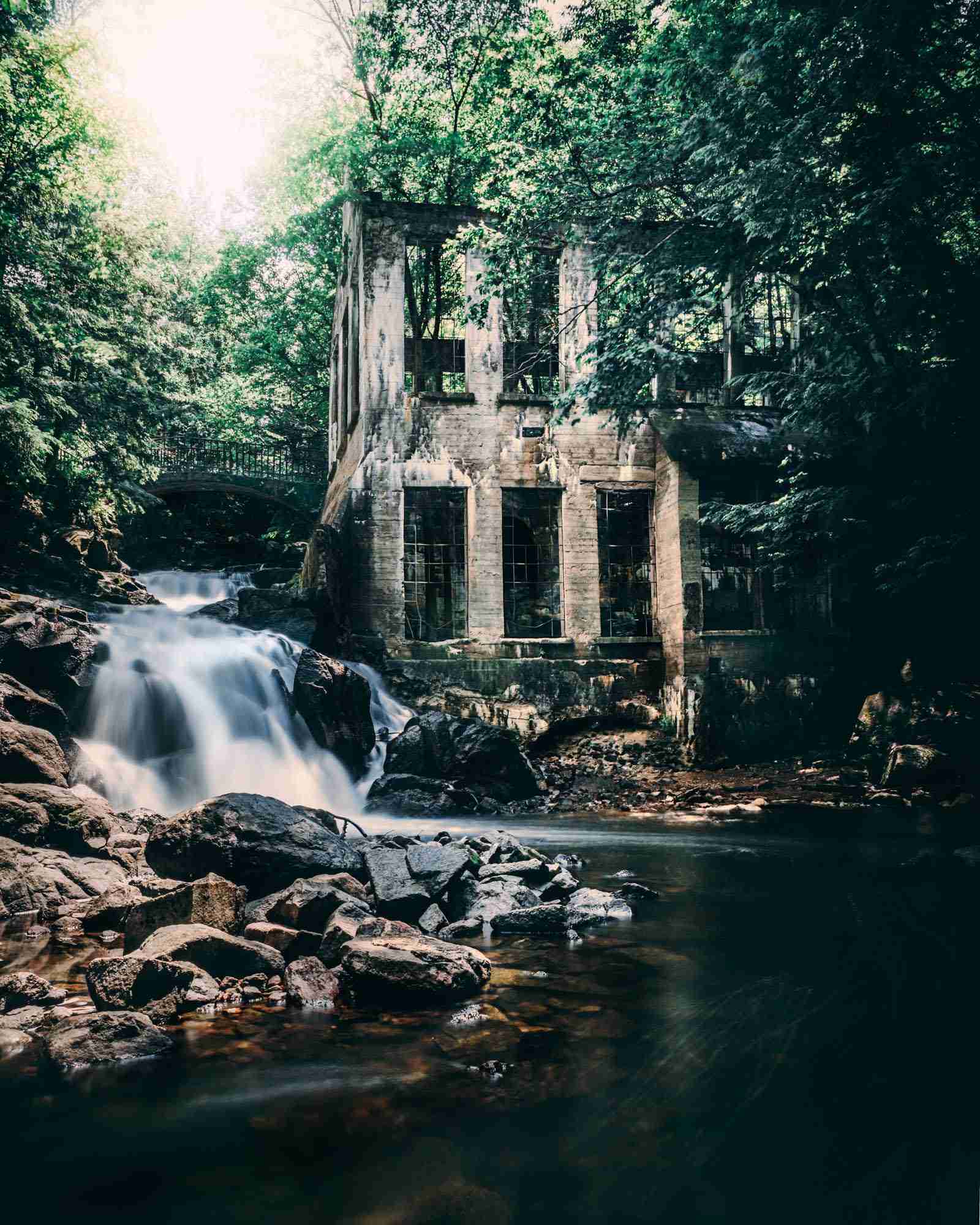
Tucked deep within the wooded interior of Gatineau Park, the Carbide Wilson Ruins are among the region's most compelling photographic locations. Far from the park's busier trails and lookouts, these secluded stone remains lie along a quiet riverbend, framed by dense forest and the sound of rushing water. Built in 1911 by inventor and industrialist Thomas "Carbide" Wilson as part of an ill-fated fertilizer experiment, the ruins are all that remain of a hydroelectric research facility—now overtaken by time, moss, and mist. Accessible only by foot or bike, this location rewards photographers willing to seek out atmosphere, texture, and the intersection of human ambition and natural reclamation.
Best Photography Opportunities
• Main ruin and waterfall compositions from the approach trail
The heart of the site is the large stone building situated directly beside a cascading stream. As you round the final corner of the trail, the structure emerges through the trees, with water flowing down the rocky hillside into a pool that reflects the fragmented walls. This is the iconic wide shot—where the built and natural world are in equal balance. Using a wide-angle lens, you can compose the building, the waterfall, and the stream into a single frame that leads the eye through movement and structure. Shoot during early morning or under overcast skies to avoid high-contrast glare and to allow longer exposures that turn the falls into soft, ribbon-like motion. The angle also allows for use of the streambed as a compositional anchor, with rocks, leaves, or branches adding natural texture to the foreground.
• Interior and wall detail photography from within the ruins
Entering the ruins reveals a series of partial walls, broken windows, and open structural voids that are rich with texture and visual rhythm. These elements are excellent for detail-focused photography, where you can highlight the roughness of the stone, the way vines and moss creep across the surfaces, or how shafts of light fall through the empty window frames. A mid-range zoom or fast prime lens allows you to isolate these moments. In spring and summer, the greenery beyond the stone provides striking contrast; in autumn, fallen leaves build up along the edges, creating color patterns against the neutral walls. Shooting wide open offers a painterly softness, while stopped-down apertures bring the hard edges and architectural geometry into sharp relief.
• Reflections and mirrored compositions from downstream
Just below the main site, the stream levels out into a calm, shallow pool that often reflects the ruins above. On still days or in the early morning before foot traffic begins, this mirror-like water offers symmetrical compositions with the ruins doubled in the surface. Position your camera close to the water, using flat stones or mossy outcrops as foreground anchors. A polarizer allows you to fine-tune the reflection intensity and reduce surface glare. These scenes benefit from low, horizontal compositions that emphasize the divide between reflection and structure, and from framing that includes the surrounding forest to ground the image in its natural context.
• Forest trail leading to the site as part of the narrative
The experience of photographing the ruins starts long before you arrive. The approach trail, approximately 3.2 kilometers from the Meech Lake parking area, winds through a dense hardwood forest, across wooden bridges, and beside gently flowing streams. This trail is excellent for layered woodland compositions, particularly in the early morning when light filters through the canopy or fog hangs low among the trees. Look for switchbacks, curved paths, or bridge crossings where you can use natural lines to lead the viewer into the frame. In autumn, the trail becomes carpeted in color; in winter, the same paths transform into minimalist lines of snow and shadow. These images help situate the ruins within their broader landscape and offer strong lead-up shots in a photographic series.
• Seasonal compositions featuring snow, ice, and changing vegetation
Each season dramatically alters the mood and structure of the Carbide Wilson Ruins. In winter, the flowing stream partially freezes, forming icicles along the building's edges and creating stark contrasts between stone and snow. These scenes lend themselves to monochrome or desaturated color palettes that emphasize form and texture. In spring, moss returns and meltwater increases the power of the falls, while summer wraps the entire structure in dense green. Autumn is perhaps the most photogenic period, as the ruins are encased in gold and crimson from surrounding maples. Each season demands its own approach: winter calls for contrast and minimalism, spring for movement and renewal, summer for overgrowth and light play, and fall for saturated color and nostalgic atmosphere.
Best Time to Visit
The Carbide Wilson Ruins can be photographed year-round, but lighting, water flow, foliage, and trail conditions vary dramatically by season, changing both access and aesthetic.
Spring offers high water volume from snowmelt, which strengthens the visual impact of the waterfall and surrounding stream. The ruins emerge from the forest's thaw with moss-covered walls and a vibrant, damp forest floor. Morning fog is common, particularly in April and early May, making for richly atmospheric scenes.
Summer brings dense foliage, long days, and strong dappled light throughout the forest and across the ruins. Early morning or late afternoon is essential to avoid harsh midday shadows. The stream levels moderate, allowing for easier access to downstream compositions, and the vegetation offers dramatic contrast between stone and leaf.
Autumn is the most visually dynamic time to visit. Peak color typically arrives between late September and mid-October, when golden and red leaves blanket the forest floor and collect around the ruins. Soft early light enhances color separation, and misty conditions are common following overnight rain or cold fronts. This is also the busiest time of year, so early weekday mornings are ideal for uninterrupted shooting.
Winter transforms the site into a minimal, snow-bound location. Access can be challenging, requiring snowshoes or crampons, but the reward is a sculptural composition of stone and ice. The waterfall often freezes into jagged formations, and the quietness of the snow-dampened trail offers deep visual and emotional stillness. Blue hour and twilight compositions are especially effective in winter, particularly when using longer exposures and wide dynamic range.
How to Get There
The Carbide Wilson Ruins are located in Gatineau Park, near Meech Lake in Quebec. From Ottawa, take Highway 5 north and exit at Chelsea. Follow Meech Lake Road until you reach the P11 parking lot at the north end of the lake. This is the primary access point for the trail to the ruins.
The trail to the site is 3.2 kilometers (one way) and follows a well-marked, moderately easy path along the stream. It's accessible to hikers, cyclists, and snowshoers depending on the season. Plan for a 20–40 minute walk each way depending on pace and gear.
There are no restrooms or water stations along the route or at the ruins, so come prepared. The trail and site are unsupervised, and there are no safety barriers at the ruins themselves. Use caution near the stream or on slick rocks, particularly after rain or in snow. Because of the site's popularity with hikers, early morning visits provide the best opportunity for quiet shooting conditions.
Recommended Photography Gear
A wide-angle zoom lens (16–35mm) is essential for capturing the full structure of the ruins, as well as working in tight interior spaces and foreground-heavy compositions at the stream's edge. A mid-range zoom (24–70mm) provides flexibility for isolating elements, capturing vertical trail compositions, or working from bridge-level perspectives.
A tripod is highly recommended for long exposures, low-light forest work, and precision composition at the waterfall or within the ruins. ND filters (6- or 10-stop) allow for shutter speed control over water movement in daylight, and a circular polarizer helps manage glare on wet surfaces and enrich foliage tones.
A fast prime lens (35mm or 50mm) is ideal for handheld work within the ruins, where light levels may be low and where tight depth of field adds mood. For detail shots—like moss, stone carvings, or leaf-strewn surfaces—a macro or close-focusing prime lens enhances texture and intimacy.
Wear sturdy, waterproof footwear and pack light. The trail requires mobility, and most compositions benefit from the ability to shift position quickly or crouch low to the ground. In colder months, bring spare batteries and microfiber cloths for lens cleaning, especially when shooting near water or in freezing conditions.
Nearby Photography Locations
Just steps from the P11 parking area, the lake offers glassy morning reflections, wooded shorelines, and strong sunrise compositions. It's a quiet complement to the vertical drama of the ruins.
A vivid, green-tinted meromictic lake with trail access and elevated views. Great for mirrored compositions and soft forest reflections. Early mornings in summer often bring fog over the water's surface.
• MacKenzie King Estate
A heritage site featuring forest trails, formal gardens, and a curated collection of classical ruins. Offers architectural subjects and soft garden compositions that pair well with the rawness of the Carbide Wilson site.
• Luskville Falls Trail
A more rugged alternative, this trail leads to a dramatic seasonal waterfall and panoramic lookouts over the Ottawa Valley. Ideal for hikers seeking elevation-based landscapes.
A nearby ridgeline with sweeping views of the escarpment and valley below. Golden hour produces dramatic side-lighting, especially during peak autumn color.
Photographing the Carbide Wilson Ruins is not just about capturing architecture—it's about documenting a space where time, nature, and human ambition intersect. Every angle, every season, and every weather condition reveals something different. For photographers who value texture, mood, and narrative, this hidden industrial relic is a location that rewards the journey.
Comments
Loading comments…